

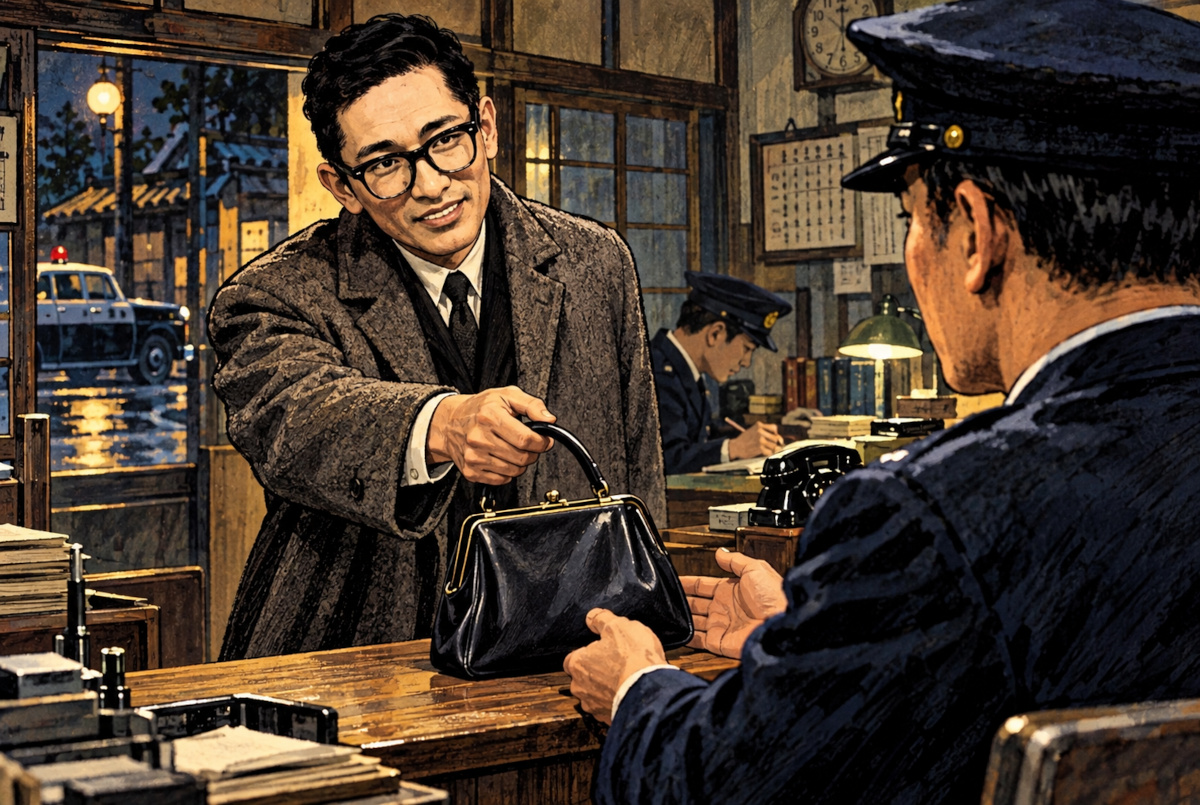
A con artist usually wants people to hand over their money. Akira Nishiguchi was doing something considerably more disturbing.
Over 78 days between October 1963 and January 1964, he killed five people. At the same time, he traveled across Japan, impersonated a university professor and a lawyer, and committed a string of fraud and theft offenses.
Then there is the strangest detail of all: while on the run, Nishiguchi voluntarily walked into a neighborhood police box to hand in a lost handbag containing money.
A fugitive linked to multiple murders had willingly put himself in front of a police officer.
Why would a man so determined to gain people’s trust repeatedly resort to murder? How much money did he actually obtain during those 78 days?
Japan’s official police records and parliamentary testimony reveal a criminal history far more contradictory than the familiar story of a master of disguise.
Three Robbery-Murder Cases, Ten Frauds and Two Thefts in 78 Days
First, the numbers.
According to the Japanese National Police Agency’s Police White Paper 2000, Nishiguchi committed three separate robbery-murder incidents in Fukuoka, Shizuoka and Tokyo, killing five people.
In October 1963, he attacked a cash-collection vehicle operated for Japan’s government tobacco monopoly in Fukuoka Prefecture, killing an employee and the driver.
In November, at a lodging establishment in Shizuoka Prefecture, he killed the female proprietor and her mother. In December, he killed a lawyer in Tokyo’s Toshima Ward.
The police white paper also records two thefts and ten fraud offenses apart from those three robbery-murder incidents.
Count them separately and the documented incidents total fifteen:
3 robbery-murder incidents + 2 thefts + 10 fraud offenses = 15 incidents.
This is our tally of the offenses listed in the police white paper, not a claim to have reconstructed every action Nishiguchi took while fleeing.
The 78-day period can also be checked directly. Counting both October 18, 1963, and his arrest date of January 3, 1964, gives 14 days in October, 30 in November, 31 in December and three in January.
That is exactly 78 days.
Dividing 78 by 15 produces a crude average of one recorded incident every 5.2 days. Of course, it does not mean he committed crimes at regular five-day intervals.
Was It ¥800,000? The Police Records Add Up Differently
Some popular accounts of the Nishiguchi case mention approximately ¥800,000, sometimes describing it as money obtained through fraud.
But which offenses does that figure include? We could not establish a reliable breakdown behind it.
Rather than accept the number at face value, we returned to the amounts recorded in the National Police Agency’s official account and separated them by incident.
| Incident or Offense Category | Proceeds Recorded by Police |
|---|---|
| October 1963: Fukuoka robbery-murder | ¥270,000 in cash |
| November: Shizuoka robbery-murder | ¥150,000 in cash |
| December: Tokyo robbery-murder | Wristwatch and lawyer’s badge; monetary value not specified |
| Two other thefts and ten fraud offenses | More than ¥500,000 |
Start with the two robbery-murder cases for which the white paper provides cash amounts:
¥270,000 + ¥150,000 = ¥420,000.
Add the more than ¥500,000 obtained through the other twelve theft and fraud offenses.
That gives a documented total of more than ¥920,000.
This is our own calculation using the amounts given in the police white paper. It is not a figure explicitly presented there as the combined total.
It excludes the monetary value of the wristwatch and lawyer’s badge taken in Tokyo. It is also not a calculation of the complete financial damage, nor does it represent the money Nishiguchi still possessed when arrested.
And it would be misleading to compare this figure directly with a claim of approximately ¥800,000 unless we first knew which crimes that smaller figure included.
The distinction matters: the two robbery-murder incidents in Fukuoka and Shizuoka alone involved ¥420,000 in cash.
Money was taken in both cases. But those amounts cannot, by themselves, explain everything that led Nishiguchi to kill.

The police records distinguish cash proceeds from other items taken during the crimes. AI-generated conceptual illustration comparing those categories. The people, evidence, banknotes and records room are not reproductions of actual investigators, seized property or an authentic crime-scene photograph.
From University Professor to Lawyer: The Power of a Borrowed Title
There was another peculiar feature of Nishiguchi’s time on the run.
He repeatedly claimed to hold prestigious professional positions.
According to later accounts of the case, he stayed at an establishment in Hamamatsu, Shizuoka Prefecture, while pretending to be a professor from Kyoto University. His appearance and behavior reportedly helped him gain the proprietor’s confidence.
Those details come from retrospective accounts rather than the particular police white paper examined here, and should be understood accordingly.
The Tokyo murder provides a more directly documented connection to another profession.
There, Nishiguchi killed a real lawyer and took his wristwatch and lawyer’s badge. The National Police Agency explicitly records both items.
He later presented himself as a lawyer when visiting the home of Tairyu Furukawa, a religious activist in Tamana, Kumamoto Prefecture.
At a parliamentary hearing on February 4, 1964, the National Police Agency commissioner described how Nishiguchi had used a business card bearing the name of one real lawyer and a letter of introduction associated with another.
Whether he displayed the badge taken from the murdered lawyer during his visit to the Furukawa family could not be established from the records examined for this article.
Still, a pattern emerges.
What mattered was not simply changing his appearance. Nishiguchi repeatedly borrowed the social authority associated with respected professions.
A university professor could be welcomed as an educated guest. A lawyer might be trusted in discussions involving legal proceedings or wrongful convictions.
Nishiguchi exploited those expectations. Exactly which detail convinced each individual victim, however, cannot be established from the official summary alone.
The Fugitive Who Walked Into a Police Box
And now for the detail that bothered me most.
On the afternoon of November 21, 1963, Nishiguchi entered a neighborhood police box, known in Japan as a koban, and handed in a handbag containing cash and other belongings as lost property.
It sounds almost too absurd to be true.
Yet it is documented in testimony before Japan’s House of Councillors Committee on Judicial Affairs on February 4, 1964.
Masao Hihara, director of the National Police Agency’s Criminal Affairs Bureau, acknowledged that the incident had occurred.
But the testimony also corrects an important part of a frequently repeated version of the story.
According to that version, Nishiguchi walked into a police box where his own wanted photograph was already displayed, and the officer failed to recognize him.
The parliamentary account gives a different chronology.
Nishiguchi handed in the bag during the afternoon of November 21. The National Police Agency issued its special nationwide wanted alert that night, with the corresponding measures implemented by prefectural police from November 22 onward.
At the time of the handbag report, the special wanted photograph had not yet been posted at that police box.
So the fugitive really did appear before a police officer. But the claim that the officer overlooked a special wanted photograph already displayed at the station is not supported by the official testimony.
That is a substantial difference.
Why did Nishiguchi choose to report the handbag in the first place?
Was it overconfidence? An attempt to appear respectable? Some other calculation?
The parliamentary testimony does not establish his motive. Any confident answer would be speculation.
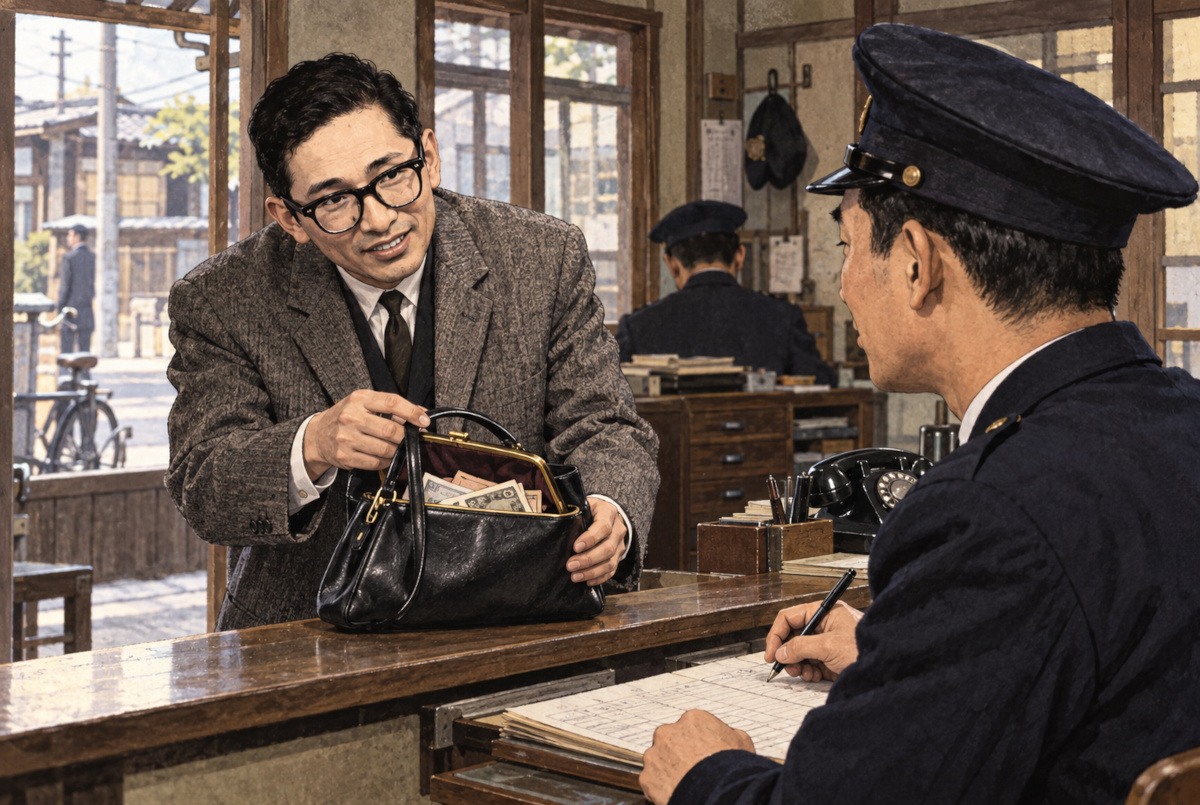
On the afternoon of November 21, 1963, Nishiguchi reported a handbag containing money as lost property. Parliamentary testimony confirms that his special wanted photograph had not yet been displayed at that police box. AI-generated illustration; the people, handbag, interior and location are not authentic reproductions.
Why Would a Con Man Keep Committing Murders?
Fraud and robbery-murder operate in fundamentally different ways.
A fraudster obtains property by inducing someone to believe a false story. A robbery-murder involves violence and the taking of property, with a victim losing their life.
Nishiguchi committed both types of crime during the same 78-day period.
But the figures in the police white paper cannot tell us precisely what he was thinking before each killing.
It would be irresponsible to claim that every murder had been planned from the beginning, or that every killing followed a failed attempt at fraud. The evidence examined here does not establish either explanation.
What we can say is that fraud and theft provided one route to obtaining money, while his robbery-murder incidents involved taking property through deadly violence.
And therein lies the disturbing contradiction.
Building a false identity requires others to trust you. Repeated murders, meanwhile, increase the likelihood of attracting an intensive police investigation.
Yet Nishiguchi carried on with both.
In the end, it was not a professional title that brought his deception undone. A fifth-grade girl remembered the face on a wanted poster and questioned the supposed lawyer visiting her family.
In Part 3, we will examine the police investigation itself, including what happened during the night of his arrest and what Japanese parliamentary records reveal about the officers’ decisions.
Editor’s Note
My first reaction was simple: if you’re already a con man, why on earth would you start killing people? Fraud is a crime too, obviously, but murder takes it somewhere else entirely.
Then I went through the police records.
There were the false identities, the thefts, the scams and the five murders. And somewhere in the middle of that extraordinary sequence, the man apparently found time to visit a police box and hand in somebody else’s handbag.
What sort of person does that?
The money figures also gave me a reason to stop and look again. Some accounts mention ¥800,000. Yet the amounts in the police white paper, when grouped and added, exceed ¥920,000. It turns out that even a simple-sounding figure means very little until you know what has been counted.
Greed is hardly a modern invention, and scams are not going extinct. But treating Nishiguchi as some colorful outlaw who simply talked his way through Japan would miss what makes this case so grim.
Five people were killed.
He was capable of winning people’s confidence while repeatedly committing crimes that cost others their lives. That contrast is what I find most disturbing.
No matter how impressive the borrowed title, it could not erase what he had done.
The Girl Who Ended a 78-Day Manhunt: The Akira Nishiguchi Case $2014 Four-Part Series
A fifth-grader recognized a wanted killer posing as a lawyer. Across four articles, we trace her discovery, Nishiguchi's deceptions and crimes, the police response to his arrest, and the human story that followed.
- Part 1: The Adults Trusted a Fake Lawyer. Why Did a Fifth-Grader Suspect Him? — The Akira Nishiguchi Case
- Part 2: Professor, Lawyer, Five Murders: Akira Nishiguchi’s Bizarre 78-Day Crime Spree
- Part 3: 21 Police Officers Outside, None Inside: What Went Wrong in Akira Nishiguchi’s Arrest? Coming soon
- Final Part: Why Did Tairyu Furukawa Keep Writing to Akira Nishiguchi, the Killer His Family Exposed? Coming soon
References
- National Police Agency of Japan, Police White Paper 2000, Chapter 1 (in Japanese) — Official record of the three robbery-murder incidents, five victims, two thefts, ten fraud offenses and the amounts obtained. Figures used in our independent calculation.
- National Diet Library, House of Councillors Committee on Judicial Affairs, Meeting No. 2, February 4, 1964 (in Japanese) — Official testimony concerning the lost handbag, the timing of the special wanted alert, the absence of the special wanted photograph at the police box, and Nishiguchi’s use of lawyers’ identities.
- Bunshun Online, April 28, 2026: Akira Nishiguchi’s Background and Serial Murders (in Japanese) — Retrospective account of his background and actions while on the run, adapted from a published collection of historical crime stories.
- Bunshun Online, May 3, 2026: The Girl Who Recognized Fugitive Killer Akira Nishiguchi (in Japanese) — Secondary account of his false professional identities, his approach to the Furukawa family, and the circumstances leading to his arrest.