

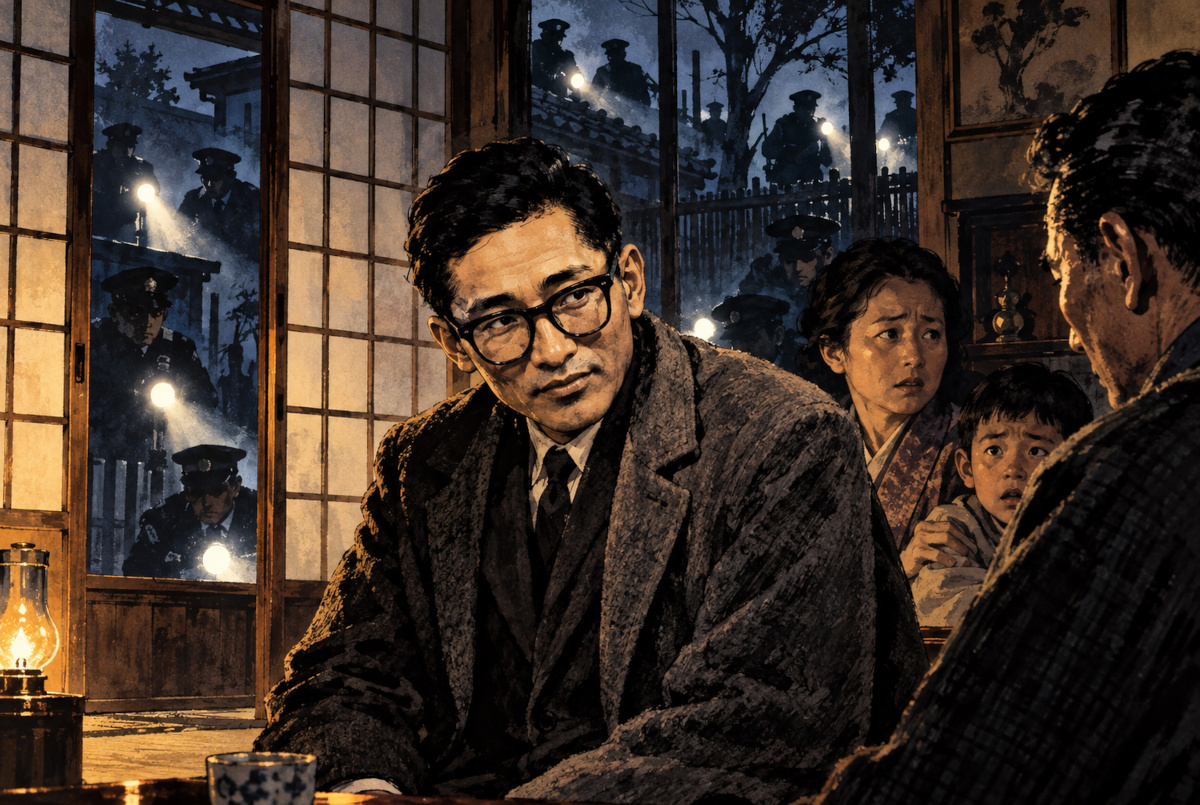
On January 3, 1964, Japanese police arrested Akira Nishiguchi, a fugitive responsible for five murders, at the home of religious activist Tairyu Furukawa in Tamana, Kumamoto Prefecture.
The breakthrough had come from Furukawa’s fifth-grade daughter, who suspected that their visitor, supposedly a lawyer, was actually the wanted man.
After the family alerted the police, officers were called out. Eventually, 21 officers were deployed around the property.
But something in the official record does not add up.
There were 21 police officers outside the house. Inside, where a suspected serial killer was staying with members of the family, not a single officer had been stationed.
Even stranger, the prefectural police headquarters had instructed officers to take up positions inside.
What if Nishiguchi had attacked the family? Why had the officers stayed outside, and what exactly had the police been doing through the night?
The answers are buried in a remarkable parliamentary hearing held on February 4, 1964. Looking closely at that testimony reveals not just a difficult operational decision, but three conflicting versions of the same police operation.
From the 11:30 p.m. Alert to the 4:00 a.m. Signal
First, let us reconstruct the night from the testimony given to Japan’s House of Councillors Committee on Judicial Affairs, part of the National Diet.
National Police Agency Commissioner General Toshio Eguchi and other senior officials described when the family contacted police, how officers were deployed, and when those inside the house learned that help was nearby.
| Date and Time | Police Action Described in the Hearing |
|---|---|
| Jan. 2, around 11:30 p.m. | Furukawa’s wife and daughter went to a former police box, where contact was made with the police station. |
| Jan. 3, around midnight | Two officers reportedly met Furukawa’s wife at an inn called Ariakeso to discuss the situation. |
| Around 1:30 a.m. | The first five officers took up positions outside the house. |
| Around 1:50 a.m. | Four additional officers arrived. |
| Later that night | Another twelve officers joined the operation, bringing the outside deployment to 21. |
| Around 4:00 a.m. | An officer tapped on the house’s glass door to signal to Furukawa that police were watching from outside. |
This timeline has been independently assembled by our editorial team from statements made during the parliamentary hearing. The times are approximate, not minute-by-minute entries from an operational log.
The arithmetic is straightforward.
From the family’s initial contact at approximately 11:30 p.m. to the arrival of the first officers outside at 1:30 a.m.: about two hours.
From that first deployment to the signal to Furukawa at around 4:00 a.m.: another two and a half hours.
In total, approximately four hours and thirty minutes passed between the report and the signal to the man inside the house.
But it would be misleading to say that the police had no contact whatsoever with the family during those four and a half hours.
According to Eguchi’s testimony, two officers had already met Furukawa’s wife at the inn around midnight and discussed precautions.
The real distinction is between police already taking action and Furukawa himself, still inside with the suspect, being informed that officers were outside.
Those are not the same thing. And for a family living through that night, the difference mattered enormously.
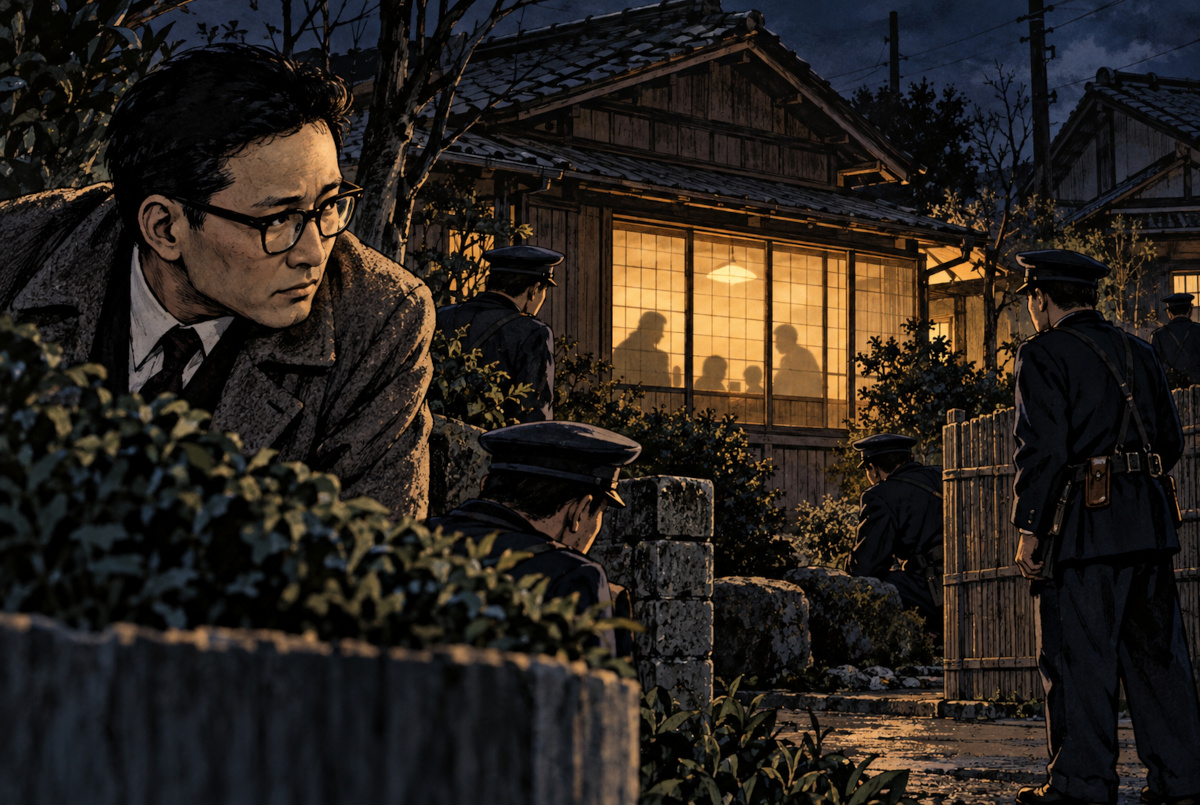
In the early hours of January 3, 1964, police watched the Furukawa property from outside but did not establish an inside surveillance post. AI-generated conceptual illustration, not a reconstruction of the actual house, people or officer positions. The bespectacled man in the foreground is a fictional figure, not Akira Nishiguchi.
Headquarters Said Go Inside. The Officers Stayed Outside.
Why did the police not enter the building?
During the parliamentary questioning, Commissioner General Eguchi confirmed that the head of the prefectural police headquarters’ First Investigation Division had instructed officers to establish surveillance inside the house.
The reasoning was understandable. Officers stationed close to the suspect could help protect the family, prevent an escape and make an arrest as soon as Nishiguchi’s identity was confirmed.
Yet the officers on the scene did not carry out that instruction.
Masao Hihara, director of the National Police Agency’s Criminal Affairs Bureau, offered an explanation.
It was the middle of the night. Even small noises could be heard clearly. Officers entering the building risked alerting Nishiguchi to the police presence.
And if he realized he was surrounded, police feared that he might harm himself, attack members of the family or attempt to escape.
The house was relatively small, Hihara explained. Officers believed they could monitor activity inside by watching closely from the exterior without taking the additional risk of entering.
There is a legitimate dilemma here. Moving officers indoors would not necessarily have made the family safer if the sound of their arrival had provoked the suspect.
But it creates a troubling contradiction.
Headquarters wanted officers inside to protect the family. Officers at the scene believed staying outside was the safer way to protect them.
Both decisions were presented as measures intended to reduce danger.
Which approach would actually have worked better is impossible to establish without knowing far more about the precise layout and conditions of the property.
What is not disputed is that the inside deployment never took place.
Eguchi acknowledged that fact in Parliament.
The Stranger Detail: The First Report Said Four Officers Were Inside
Here is where the story becomes even more uncomfortable.
During the same hearing, legislator Seiichi Inaba pressed the police leadership about what had happened after Nishiguchi’s arrest.
Eguchi revealed that the first report received by the National Police Agency had stated that four officers had been stationed inside the house.
Except they had not.
The real operation had relied on officers outside, and the original report was corrected later that same day.
Put the three versions together and the problem is hard to miss.
Headquarters’ instruction: station officers inside. Actual deployment: zero inside. Initial report to the National Police Agency: four inside.
There was a discrepancy between what headquarters ordered and what the officers did. Then another discrepancy appeared between what the officers did and what their superiors were initially told.
That alone would warrant scrutiny.
But Parliament also examined an allegation concerning what an officer said to Furukawa’s wife after the arrest.
Eguchi disclosed that a subsequent investigation had received a report suggesting that an officer had made remarks to the effect that it would be helpful if the family described the police as having been stationed inside.
His account was cautious. He did not establish that Furukawa himself had been directly asked to lie, and the testimony does not prove that senior police leaders had ordered an organized cover-up.
Eguchi explained that headquarters had initially assumed the inside-surveillance instruction had been carried out. After discovering otherwise, he ordered further inquiries into the reporting discrepancies.
Nevertheless, the suggestion that a member of the family may have been encouraged to give an inaccurate account was a separate problem from the tactical decision itself.
A difficult judgment in the field is one thing. An inaccurate account of what happened afterward is another.
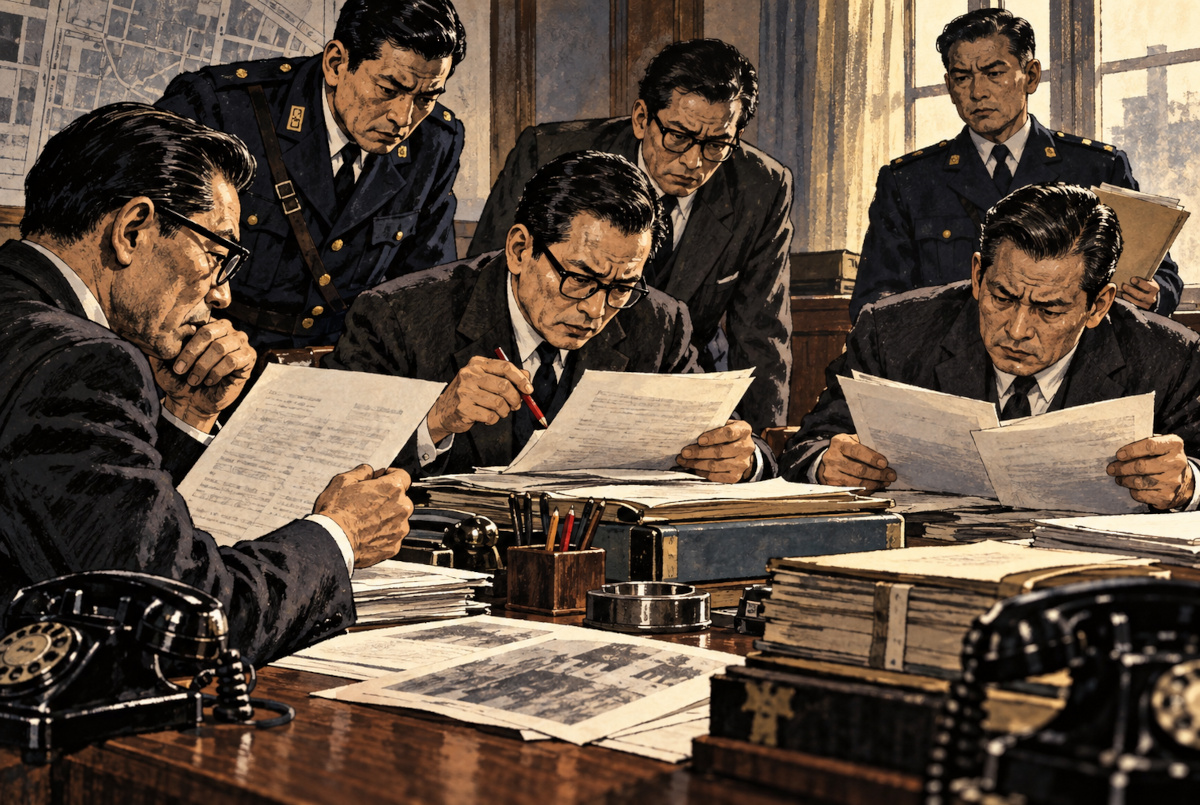
The initial report to the National Police Agency stated that four officers had been stationed inside, although no inside deployment had occurred. AI-generated conceptual illustration of reviewing conflicting reports. It does not depict an actual meeting, police official, office or historical document.
They Caught Him. Does That Make the Operation a Success?
The parliamentary hearing was not a simple exercise in blaming the police for failing to enter the house.
Takashi Hayakawa, chairman of Japan’s National Public Safety Commission, explained that officers had needed time to determine whether their suspect really was Nishiguchi.
He also acknowledged the difficult balance between respecting a suspect’s legal rights and acting quickly enough to prevent further harm.
At the same time, Hayakawa recognized the fear of a family who had knowingly sheltered a man suspected of multiple murders.
He did not claim the police response had been perfect. He acknowledged that there were aspects of the operation from which lessons should be learned.
Furukawa’s dissatisfaction was not merely something reported secondhand.
After the arrest, he traveled to Tokyo in connection with receiving a letter of appreciation and directly expressed his complaints to Hayakawa. That exchange was also discussed during the hearing.
So the question is not simply which side deserves credit for catching Nishiguchi.
It is about who bears responsibility for the safety of civilians who cooperate with an investigation, how officers communicate with those civilians, and whether police reports accurately describe what happened.
An arrest can succeed while serious questions remain about the operation behind it.
How the Nishiguchi Case Changed Japan’s Nationwide Investigations
The case also exposed a broader problem within Japan’s policing system.
Nishiguchi had committed crimes across multiple prefectures, including Fukuoka, Shizuoka and Tokyo, before being arrested in Kumamoto.
As Japan’s National Police Agency later explained in its Police White Paper 2000, the case prompted the introduction, in April 1964, of the Special Investigation Guidelines for Major Crimes Spanning Multiple Prefectures.
Under this framework, the National Police Agency could designate major crimes involving multiple jurisdictions and coordinate investigations by the prefectural police forces concerned.
The Police White Paper 2004 also identifies the Nishiguchi case as a catalyst for improving investigations that crossed prefectural boundaries.
But there is an important distinction.
These guidelines addressed cooperation and coordination across jurisdictions. They were not a direct rulebook for deciding whether officers should enter the Furukawa residence during an arrest operation.
Protecting civilians during a dangerous arrest and coordinating a nationwide investigation are related concerns, but they are not the same operational problem.
Nishiguchi’s arrest brought his flight to an end. It did not settle every question about how the police had handled the case.
And as the parliamentary record shows, the lessons went beyond catching one fugitive.
Editor’s Note
Twenty-one officers outside. None inside.
That was the detail that stopped me when I first read about this case.
Then again, I can understand the police explanation. If a team of officers started moving through a quiet house in the middle of the night, a suspected killer might realize what was happening. Nobody could guarantee how he would react.
Fine. That is a genuine operational problem.
But what about the family? Being told that plenty of officers are somewhere outside is not quite the same as feeling protected when the man they are watching is in the building with you.
What bothered me even more was the paperwork afterward.
No officers had been stationed inside, yet the first report said there were four. Then came the suggestion that someone in the family might have been encouraged to describe the situation differently.
I can accept that people make difficult decisions under pressure. Some decisions will turn out to be wrong. That is part of reality.
But if a questionable decision is polished into a success story afterward, how is anyone supposed to learn what needs fixing before the next case?
Nishiguchi used respectable titles to make people trust him. The police, by contrast, should earn trust through an accurate account of what they actually did.
That distinction matters.
In the end, Nishiguchi was arrested and the family survived. I would be relieved about that before anything else.
But relief should not prevent us from asking whether the outcome depended, at least in part, on everyone being fortunate that night.
Terms That May Need a Quick Explanation
- Special Investigation Guidelines for Major Crimes Spanning Multiple Prefectures
- An English rendering of the Japanese term Koiki Juyo Jiken Tokubetsu Sosa Yoko (広域重要事件特別捜査要綱). Introduced by Japan’s National Police Agency in April 1964, these guidelines established a framework for coordinating major investigations involving multiple prefectures. Official police histories identify the Nishiguchi case as a catalyst for their introduction.
The Girl Who Ended a 78-Day Manhunt: The Akira Nishiguchi Case $2014 Four-Part Series
A fifth-grader recognized a wanted killer posing as a lawyer. Across four articles, we trace her discovery, Nishiguchi's deceptions and crimes, the police response to his arrest, and the human story that followed.
- Part 1: The Adults Trusted a Fake Lawyer. Why Did a Fifth-Grader Suspect Him? — The Akira Nishiguchi Case
- Part 2: Professor, Lawyer, Five Murders: Akira Nishiguchi’s Bizarre 78-Day Crime Spree
- Part 3: 21 Police Officers Outside, None Inside: What Went Wrong in Akira Nishiguchi’s Arrest?
- Final Part: Why Did Tairyu Furukawa Keep Writing to Akira Nishiguchi, the Killer His Family Exposed? Coming soon
References
- National Diet Library, House of Councillors Committee on Judicial Affairs, Meeting No. 2, February 4, 1964 (in Japanese) — Primary source for the deployment of 21 officers, the timeline from the family’s report, the unfulfilled instruction to station officers inside, the correction of the initial report, and testimony from senior police officials, including Toshio Eguchi, Masao Hihara and Takashi Hayakawa.
- National Diet Library, February 4, 1964, Statement No. 35 by National Police Agency Commissioner General Toshio Eguchi (in Japanese) — Direct testimony concerning the initial report of four officers inside the house, its subsequent correction, and the inquiry into remarks allegedly made to Furukawa’s wife.
- National Police Agency of Japan, Police White Paper 2000, Chapter 1 (in Japanese) — Official historical account of the Nishiguchi case and the April 1964 introduction of special guidelines for major crimes spanning multiple prefectures.
- National Police Agency of Japan, Police White Paper 2004, Section on Reforms Addressing Crime Across Prefectural Boundaries (in Japanese) — Additional official confirmation that the Nishiguchi case prompted changes to coordination between prefectural police forces.