
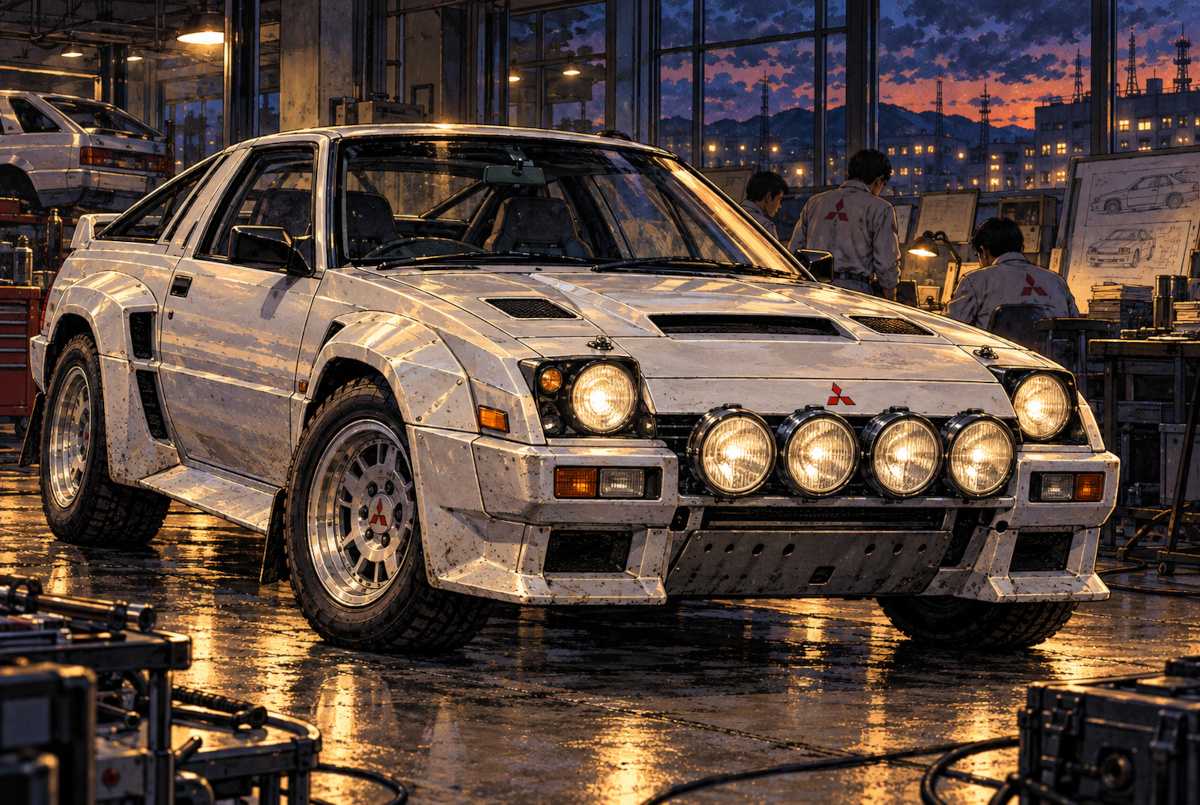
In the autumn of 1983, Mitsubishi unveiled an extraordinary machine at the Tokyo Motor Show: the Starion 4WD Rally. It had a turbocharged engine rated at 350 PS, full-time four-wheel drive, and a clear ambition—to compete in the World Rally Championship (WRC) under the notorious Group B regulations.
But Mitsubishi never obtained Group B homologation for the car. The project was eventually abandoned, leaving the Starion 4WD with a reputation as one of Japan’s great phantom rally machines.
There is one problem with that description.
Mitsubishi’s own motorsport history records a class victory in France in 1984. Two years later, the Starion 4WD finished second overall in the Hong Kong–Beijing Rally.
A rally car that never received Group B approval nevertheless competed—and achieved some remarkable results. So what exactly was “phantom” about the Starion 4WD?
The Four-Minute Gap That Convinced Mitsubishi It Needed 4WD
The Starion 4WD project did not begin with a desire to build a spectacular show car. It emerged from Mitsubishi’s experience with the Lancer EX 2000 Turbo, its previous works rally machine.
At the August 1982 1000 Lakes Rally in Finland, Pentti Airikkala drove the rear-wheel-drive Lancer EX to third place overall.
That was a strong result. But the two Audi Quattros that finished ahead of it were both four-wheel-drive turbocharged cars, and the gap was more than four minutes.
According to Mitsubishi’s official motorsport history, the result convinced its development team that there was a practical limit to how competitive a two-wheel-drive rally car could become. A new four-wheel-drive machine was needed.
Development of the Starion 4WD Rally proceeded at Mitsubishi’s passenger-car engineering center in Okazaki, Aichi Prefecture, Japan.
The prototype was unveiled at the 25th Tokyo Motor Show, held from October 28 to November 8, 1983.
Although the car retained a recognizable connection to the production Starion coupe, its appearance was radically different. The production car’s pop-up headlights gave way to fixed round lamps. The front section was shortened, and the body was widened for competition.
Period show documentation reproduced by Miki Press also describes extensive use of lightweight materials. Carbon-fiber-reinforced plastic (CFRP) was used for components including the propeller shaft, suspension lower arms, and underguard, while fiberglass-reinforced plastic (FRP) was used for several body panels.
350 PS—But Why Do the Engine Specifications Disagree?
While researching the prototype, I came across a curious discrepancy.
Mitsubishi’s official motorsport history lists the Starion 4WD Rally with a 2,140cc turbocharged SOHC four-cylinder engine from the 4G63 family, producing 350 PS.
But the 1983 Tokyo Motor Show material reproduced by Miki Press gives a different displacement: 1,997cc. It also quotes 350 PS and a vehicle weight of 960 kg.
Comparing the same sources reveals another discrepancy. The 1983 show material lists an overall length of 4,280 mm, whereas Mitsubishi’s official motorsport history gives 4,170 mm.
| Source | Displacement | Overall Length | Maximum Power |
|---|---|---|---|
| 1983 Motor Show documentation | 1,997cc | 4,280 mm | 350 PS |
| Mitsubishi’s official motorsport history | 2,140cc | 4,170 mm | 350 PS |
Note: Both sources describe the Starion 4WD Rally. However, they may refer to different stages of development or different prototype specifications. They should not automatically be treated as measurements of an identical vehicle at the same point in time.
It is possible that Mitsubishi revised the engine displacement and body dimensions during development. That would be entirely plausible for an experimental rally car.
But the sources examined here do not establish precisely when such changes occurred or which particular prototype configuration each set of dimensions represents.
Rather than quietly choosing one set of figures and discarding the other, it is worth asking a different question.
Could the apparently odd 2,140cc displacement have had something to do with the rally regulations?
Multiply 2,140cc by 1.4. The Result Is Just 4cc Below 3,000cc.
To investigate, I went back to the FIA’s original 1983 Appendix J regulations.
Under those rules, turbocharged and other supercharged engines were assigned a notional displacement for competition classification. Their actual engine capacity was multiplied by a factor of 1.4.
Applying that rule to the 2,140cc figure in Mitsubishi’s official history produces a rather striking result.
2,140cc × 1.4 = 2,996cc
That leaves just 4cc before reaching the 3,000cc class limit under the 1983 rules.
Article 256 of the same Appendix J regulations specified a minimum weight of 960 kg for Group B cars in the class up to 3,000cc.
And the original 1983 Starion 4WD Rally show material also quoted a vehicle weight of 960 kg.
The alternative 1,997cc engine figure would have produced a corrected displacement of 2,795.8cc, still within the same 3,000cc class.
| Engine Displacement | 1983 FIA Multiplier | Corrected Displacement | Class Limit |
|---|---|---|---|
| 1,997cc | × 1.4 | 2,795.8cc | 3,000cc |
| 2,140cc | × 1.4 | 2,996cc | 3,000cc |
These calculations use the displacement figures published in the two historical sources and the supercharging coefficient specified by the FIA in 1983. They do not establish which engine configuration was used at every subsequent rally.
The 2,140cc specification put the Starion remarkably close to the upper displacement limit of its 1983 competition class.
That raises an obvious possibility: perhaps the engine capacity was deliberately selected with the rules in mind.
But possibility is not proof. I have not found a direct statement from Mitsubishi’s engineers confirming that they chose 2,140cc specifically to approach the 3,000cc corrected-displacement limit.
Matching a regulation so closely is intriguing. It is not, by itself, evidence of the engineers’ intentions.
There is another important qualification. The 960 kg weight recorded for the 1983 show prototype cannot be assumed to apply to every car that subsequently competed.
Class Victory in France, Second Overall in the Hong Kong–Beijing Rally
So what did the Starion 4WD Rally actually accomplish?
Rather than relying on the familiar description of an abandoned Group B project, I compared Mitsubishi’s official competition history and arranged the documented events chronologically.
| Year | Event | Recorded Result |
|---|---|---|
| 1983 | Tokyo Motor Show | Prototype unveiled |
| August 1984 | Mille Pistes Rally, France | Prototype-class victory |
| 1984 | RAC Rally, United Kingdom | Experimental entry in a special class |
| 1985 | Malaysian Rally, S Class | Retired due to engine overheating |
| 1986 | Hong Kong–Beijing Rally | Second overall |
| 1987 | Hong Kong–Beijing Rally | Entered the event |
Note: Chronology compiled primarily from Mitsubishi’s official motorsport history. Experimental entries in classes that permitted prototype vehicles must be distinguished from competing as an FIA-homologated Group B car. The RAC entry did not mean the Starion had obtained Group B approval.
The Starion’s first competition appearance came at the Mille Pistes Rally in France in August 1984.
Despite suspension trouble, the prototype managed to win its class. Mitsubishi subsequently entered the RAC Rally as part of its testing and development program.
In 1985, Mitsubishi introduced a revised center-differential arrangement intended to improve cornering performance. The car entered the S Class of the Malaysian Rally but retired when its engine overheated.
That was hardly the end of the project.
The Starion continued to compete, and in the 1986 Hong Kong–Beijing Rally it finished second overall. Mitsubishi identifies that result as the Starion 4WD Rally’s highest placing.
The car also entered the Hong Kong–Beijing Rally in 1987, after the Group B era had ended.
The Starion 4WD was not a rally car that never raced. What never materialized was its intended full-scale WRC campaign as a homologated Group B machine.
That distinction matters. It changes the Starion from an interesting but unused engineering experiment into a prototype with an actual competition history—including a class victory and an overall runner-up finish.
Why Did Mitsubishi Never Obtain Group B Homologation?
There was a fundamental obstacle to Mitsubishi’s plan: Group B was not a category in which a manufacturer could simply build one extreme prototype and enter it in the WRC.
Article 256 of the 1983 FIA Appendix J regulations required at least 200 identical cars, each with a minimum of two seats, to be manufactured within 12 consecutive months for basic Group B homologation.
In other words, Mitsubishi needed more than a promising rally prototype. It needed to establish a qualifying production model.
The company continued development of a road-going version intended to satisfy the requirements, but the Starion 4WD Rally never obtained Group B homologation.
Then the regulations themselves became a moving target.
In May 1986, a fatal accident involving a Lancia during the Tour de Corse brought the escalating dangers of Group B into sharp focus. The category was subsequently brought to an end after the 1986 season.
Mitsubishi abandoned its planned full-scale WRC campaign with the Starion 4WD.
However, it would be misleading to blame the entire failure of the project on the 1986 accident. Mitsubishi had already spent years developing the prototype and working toward a production-based homologation program.
The project’s failure to reach Group B approval cannot be reduced to a single incident.
There is also another Starion result that occasionally complicates discussions of Mitsubishi’s rally history.
In 1987, Kenjiro Shinozuka won the Himalayan Rally in a car described in Mitsubishi’s official history as a “Starion Turbo.”
Mitsubishi lists that car separately from the 350 PS Starion 4WD Rally prototype. Its Himalayan Rally victory should therefore not be added to the 4WD prototype’s competition record without evidence that the vehicles were the same.
What Did the 350 PS Prototype Leave Behind?
Mitsubishi describes the experience gained from the Starion 4WD Rally as a foundation for its subsequent development of turbocharged four-wheel-drive cars.
In 1987, the company introduced the Galant VR-4, a high-performance sedan combining a turbocharged engine with full-time four-wheel drive.
The Galant VR-4 entered the WRC in 1988, and Mitsubishi went on to achieve WRC overall victories with the model in 1989.
That sequence is significant, but it also needs to be interpreted carefully.
The available sources establish that Mitsubishi regarded the Starion 4WD project as an important part of its motorsport development experience. They do not establish that specific experimental components from the Starion were transferred unchanged into the Galant VR-4.
The distinction between accumulated engineering knowledge and direct component inheritance is worth keeping.
Ultimately, the Starion 4WD never had the opportunity to fight Peugeot, Lancia, and the other leading Group B manufacturers in a full championship campaign under the homologation it had been designed to obtain.
But it did leave something tangible: experience with a powerful four-wheel-drive rally car, failures that led to revisions, actual competition entries, and results in international events.
The 350 PS Starion was not a legendary machine that never existed. It was a real competition prototype that never reached the particular stage on which Mitsubishi intended it to race.
Editor’s Note
Whenever the Starion 4WD comes up, the story usually ends with the same phrase: Mitsubishi’s forgotten 350-horsepower Group B monster that never made it.
Except that it did make it onto rally roads. It won a class in France and finished second overall in the Hong Kong–Beijing Rally. That’s rather more than I’d expected from a supposedly phantom machine.
But the number that really caught my attention wasn’t 350 PS. It was 2,140cc.
Multiply that by the FIA’s 1983 turbo factor of 1.4, and you get 2,996cc. Just 4cc below the 3,000cc class limit.
Maybe the engineers had a very specific regulation in mind. Maybe there was another reason. Without a statement from the people who made the decision, I can’t call it anything more than a fascinating possibility.
Still, this is exactly why I enjoy digging through old automotive brochures. Sometimes the most interesting number is not the one printed in the biggest type.
It is a shame the Starion never received Group B approval. Would it have been capable of challenging Peugeot and Lancia at the highest level? Or would it have been comprehensively outclassed? No amount of historical research can produce a race result from a championship campaign that never happened.
What I do know is that calling it a machine that never raced sells its story short. The competition records are there.
There is one more Starion oddity worth pursuing in a special feature: the gullwing-door Starion associated with Ishihara Productions. That machine took Mitsubishi’s angular coupe in an entirely different, and wonderfully eccentric, direction.
Mitsubishi Starion $2014 5-Article Series
From its 1982 origins and DASH engine to the rare GSR-VR, the ambitious 4WD rally project, and a gullwing special: four main articles and one special feature.
- Part 1: The 1982 Mitsubishi Starion Was Meant to Be Smaller—Until Chrysler Stepped In
- Part 2: Why Did Mitsubishi’s 200 PS Starion Shut Off an Intake Valve?
- Part 3: Why Did Mitsubishi Give the Starion GSR-VR a 2.6L Engine for Just 5 More PS?
- Final Part: The “Phantom” Mitsubishi Starion 4WD: 350 PS, No Group B Approval—and a Second-Place Rally Finish
- Special: English edition Coming soon
Terms That May Need a Quick Explanation
- Homologation
- Formal approval confirming that a vehicle meets the requirements of a particular competition category. Under the basic 1983 FIA Group B rules, manufacturers had to produce at least 200 identical qualifying cars with a minimum of two seats within 12 consecutive months. An experimental rally appearance did not automatically constitute Group B homologation.
References
- Mitsubishi Motors — World Rally Championship History, 1981–1987 (Official manufacturer motorsport history, in Japanese. Covers the Starion 4WD Rally’s 2,140cc and 350 PS specifications, development, Mille Pistes and RAC entries, Malaysian Rally retirement, and Hong Kong–Beijing Rally results).
- Miki Press M-BASE — Mitsubishi Starion, Part 1 (June 27, 2024. Japanese-language historical feature reproducing original 1983 Tokyo Motor Show documents, including the 1,997cc, 350 PS, 960 kg, and 4,280 mm specifications, along with construction details).
- FIA/FISA — Appendix J to the International Sporting Code, 1983 (Original period competition regulations, including the 1.4 supercharging multiplier and Article 256 on Group B homologation requirements and minimum weights).
- Tokyo Motor Show — History of the 25th Tokyo Motor Show, 1983 (Official Japanese-language event archive documenting the October 28–November 8, 1983 exhibition).
- Web Motor Magazine — Mitsubishi’s Motorsport Activities Before the Lancer Evolution, Part 2 (Japanese automotive history feature discussing Starion 4WD development, the Mille Pistes prototype-class victory, experimental RAC participation, and delays in securing homologation).
- Mitsubishi Motors — World Rally Championship History, 1988–1992 (Official manufacturer history, in Japanese. Covers the Galant VR-4’s WRC program and subsequent competition results).