

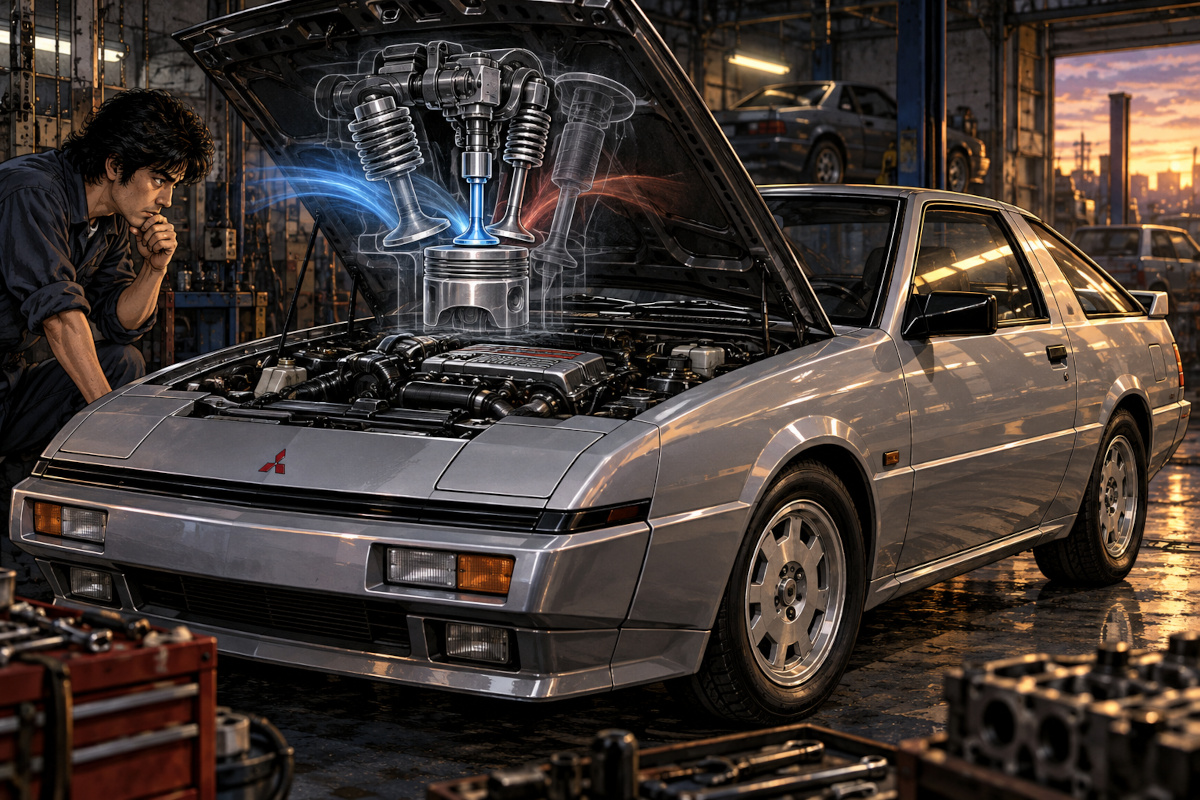
In June 1984, Mitsubishi added a 200 PS model to its Starion sports coupe lineup: the 2000 Turbo GSR-V. Under the hood was the Sirius DASH 3×2, a turbocharged 2.0-liter SOHC inline-four producing 200 PS and 28.5 kg-m of torque. Those were serious figures for a Japanese 2.0-liter car in the mid-1980s.
But the strangest thing about this engine wasn’t its output. Each cylinder had three valves: two intake valves and one exhaust valve. Yet at low engine speeds, Mitsubishi deliberately kept one of those intake valves closed.
If the goal was to make more power, why not use every available valve all the time? It sounds almost backward. But that seemingly unnecessary complication was central to the DASH engine’s design.
From 145 to 200 PS: The Power Increase Came in Two Stages
Before examining the valve mechanism, it helps to look at how the Starion’s engine developed. Mitsubishi’s official vehicle history and contemporary brochures reveal a clear progression.
| Introduction | Engine Specification | Maximum Power |
|---|---|---|
| May 1982 | 2.0L turbo | 145 PS |
| June 1983 | Intercooled turbo | 175 PS |
| June 1984 | DASH 3×2 turbo | 200 PS |
Note: Japanese-market manufacturer figures, all using the gross engine-output rating system of the period. PS means metric horsepower.
Between 1982 and 1984, output climbed by 55 PS, an increase of approximately 37.9%. But it would be misleading to credit the entire improvement to the DASH cylinder head.
By June 1983, Mitsubishi had already introduced an intercooler along with other changes, raising output from 145 to 175 PS.
The DASH version arrived the following year with another 25 PS, equivalent to a 14.3% increase over the intercooled model. Maximum torque also rose from 25.0 to 28.5 kg-m, a gain of 14.0%.
In other words, DASH was not simply the result of adding an intercooler. Mitsubishi had already done that. The next challenge was extracting more power while retaining useful low-speed behavior.
What Does 3×2 Mean? Three Valves, Two Operating Modes
DASH stands for “Dual Action Super Head.” The 3×2 designation refers to three valves per cylinder operating in two different stages. It does not mean six valves per cylinder.
The G63B DASH engine had two intake valves of different sizes: a smaller 29 mm primary valve and a larger 37 mm secondary valve. A third valve handled exhaust gases.
Unlike a conventional three-valve engine, however, the DASH system did not operate both intake valves throughout the engine’s entire speed range.
| Operating Range | Intake Valves | Purpose |
|---|---|---|
| Low engine speed | Small primary valve only | Increase intake flow velocity and promote stable combustion |
| Medium to high engine speed | Both primary and secondary valves | Increase airflow capacity and support higher output |
The switching point was approximately 2,500 rpm. Below that threshold, an oil-pressure-operated valve control mechanism kept the larger secondary intake valve closed. Only the smaller primary intake valve opened and closed.
Using the smaller passage helped maintain the velocity of the incoming mixture and encouraged a swirling motion inside the cylinder, known as swirl. This was intended to improve combustion and low-speed torque.
Once engine speed rose, the larger secondary intake valve began operating as well. Its timing and lift were designed for higher-speed breathing, allowing the cylinder to take in substantially more air.
At low rpm, Mitsubishi deliberately restricted the intake path. At higher rpm, it opened the second path. The two intake valves had different jobs from the start.
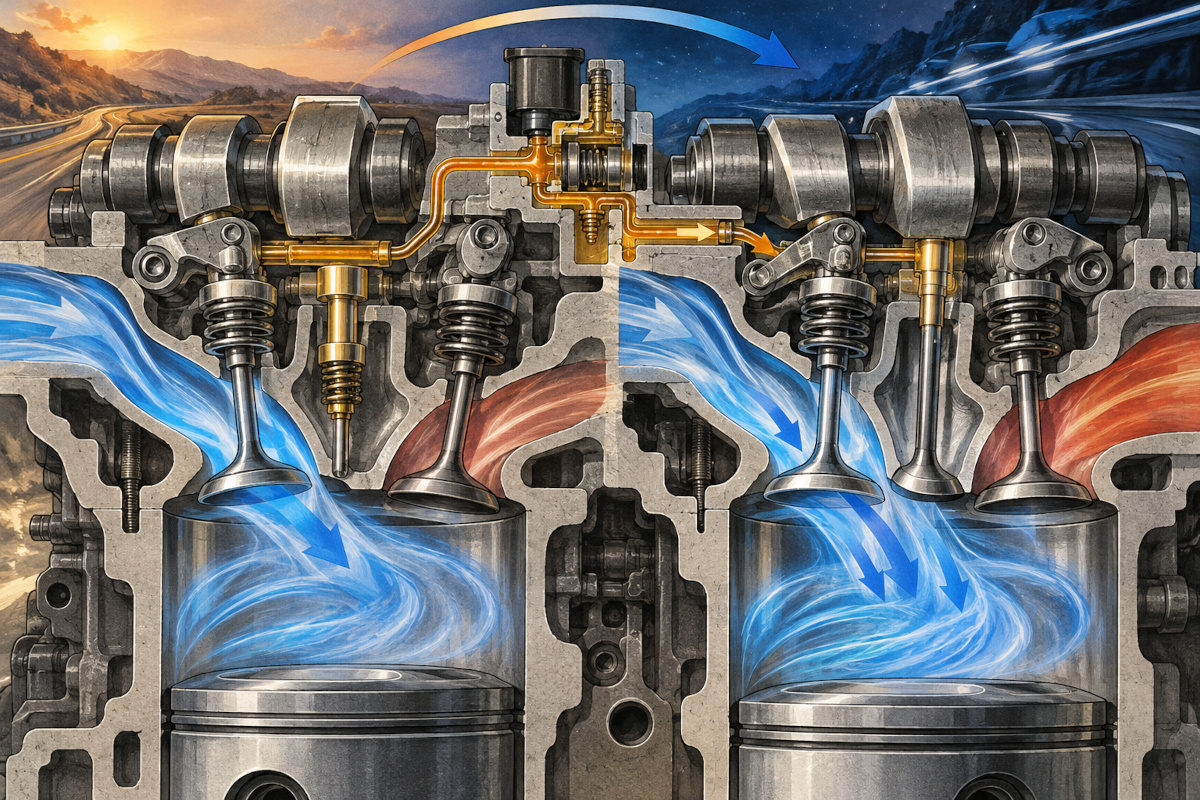
Conceptual illustration of the DASH 3×2 intake control system. Valve sizes, component positions, and hydraulic mechanisms are not reproduced precisely. In the actual engine, only the smaller intake valve operates at low rpm; both intake valves operate at medium and high rpm.
The Clever Part: Its Roots Were in a Fuel-Economy Engine
This is where the story takes an unexpected turn.
Looking back through Mitsubishi’s corporate history leads to the MD engine introduced for the Mirage in February 1982. MD was a variable-displacement system designed primarily to reduce fuel consumption.
Under light engine loads, it deactivated two of the four cylinders by preventing their intake and exhaust valves from operating. When more power was needed, the engine returned to four-cylinder operation.
Technical accounts of the DASH engine explain that Mitsubishi adapted the valve-deactivation technology already developed for the MD system.
The applications were different. MD effectively took entire cylinders out of operation to save fuel. DASH continued firing all four cylinders but selectively deactivated one intake valve per cylinder to change the engine’s breathing characteristics.
A mechanism developed to help an economical engine use less fuel became part of a 200 PS turbocharged performance engine.
That is the sort of engineering connection that tends to disappear when an engine’s history is reduced to its peak horsepower figure.
The 200 PS Figure Wasn’t Achieved by Valve Switching Alone
The DASH engine displaced 1,997 cc. Dividing its 200 PS output by 1.997 liters gives a specific output of approximately 100.2 PS per liter.
For comparison, the 1983 intercooled version produced 175 PS from the same displacement, or approximately 87.6 PS per liter.
That represents a 14.3% improvement in specific output.
But how much of that increase came directly from the 3×2 valve mechanism?
The available technical information does not provide a controlled comparison in which only the valve system was changed while every other factor remained identical.
The 1984 engine also used a two-stage turbo boost-control system, switching between standard and higher boost under appropriate operating conditions. Its electronic fuel-injection system was adapted to the changing airflow requirements, while the air-to-air intercooler introduced earlier remained part of the package.
These systems worked together. The intake valves determined how the cylinders breathed, the turbocharger supplied pressurized air, and the fuel system had to deliver the appropriate amount of fuel.
It would therefore be incorrect to claim that the variable-valve mechanism alone was responsible for the additional 25 PS.
The more accurate explanation is that Mitsubishi coordinated valve operation, boost control, and fuel delivery to achieve the 200 PS rating.
The Skyline Made 205 PS. The Starion Had More Peak Torque.
There was a particularly interesting rival in 1984: Nissan’s Skyline 2000 Turbo Intercooler RS.
Its FJ20ET engine was a 2.0-liter turbocharged inline-four with a DOHC four-valve cylinder head. Nissan claimed 205 PS, giving it a narrow advantage over the Mitsubishi on peak horsepower.
But comparing the manufacturer’s published specifications reveals a rather different picture.
| Specification | Starion GSR-V | Skyline Turbo RS |
|---|---|---|
| Displacement | 1,997 cc | 1,990 cc |
| Valve System | SOHC, DASH 3×2 | DOHC, four valves per cylinder |
| Maximum Power | 200 PS at 6,000 rpm | 205 PS at 6,400 rpm |
| Maximum Torque | 28.5 kg-m at 3,500 rpm | 25.0 kg-m at 4,400 rpm |
Note: Japanese-market manufacturer figures for the 1984 models. The peak torque values and the engine speeds at which they occur do not describe the complete torque curves or establish which car accelerates faster.
The Skyline led by 5 PS in maximum output. But the Starion’s published maximum torque was 3.5 kg-m higher, a difference of 14.0% relative to the Skyline.
And there was another distinction: the Starion reached its torque peak at 3,500 rpm, while the Skyline reached its own at 4,400 rpm. That is a 900 rpm difference.
A 205 PS DOHC four-valve Skyline versus a 200 PS SOHC three-valve Starion. The Skyline won the peak-horsepower contest, but the Starion had the higher published peak torque.
Does that prove the Mitsubishi was faster? Not at all. Vehicle weight, gear ratios, traction, and the full torque characteristics would all matter in an actual acceleration test.
What the figures do reveal is that the DASH engine deserves to be examined for more than its headline power output. Its unusual valve system was intended to serve both low-speed and high-speed operation, rather than maximizing airflow at every engine speed.
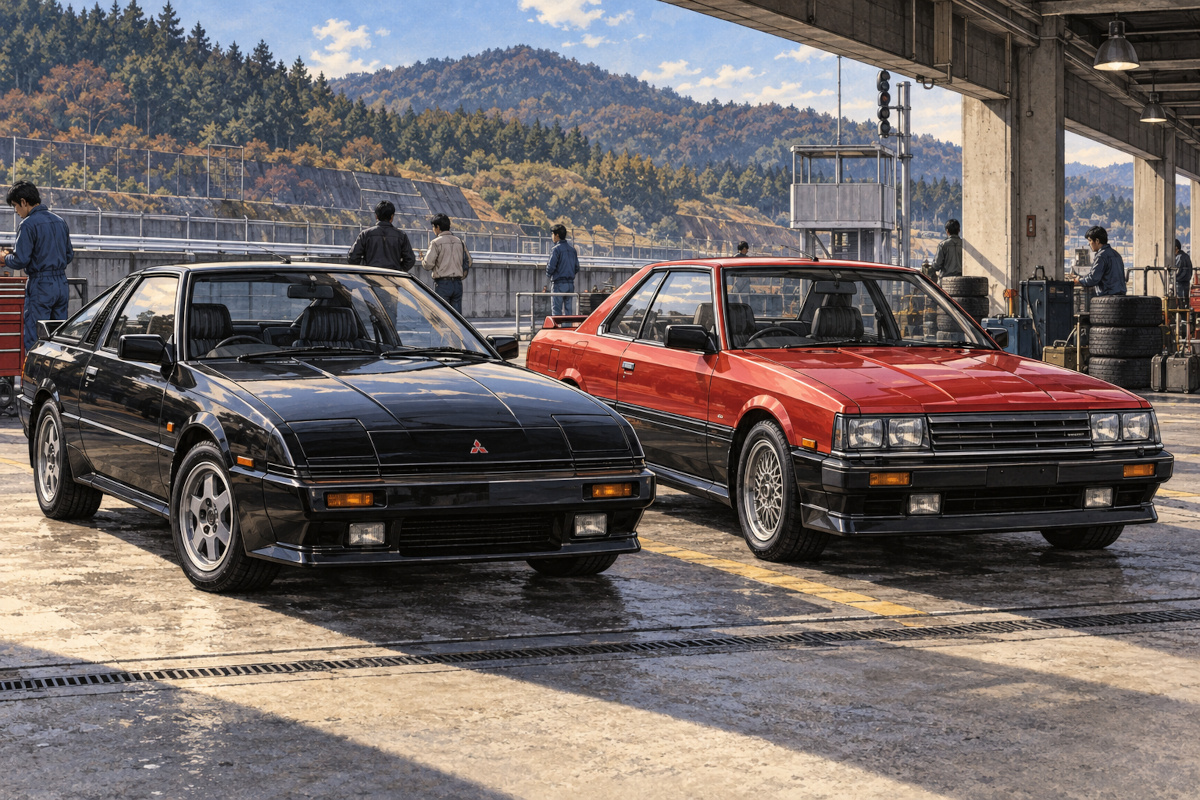
Artistic interpretation of Japan’s 1984 2.0-liter turbo performance rivalry. Both cars differ in some exterior details from their original production versions. In particular, the Skyline on the right does not accurately reproduce the grilleless “Iron Mask” front end of the 1984 model. This is not a depiction of an actual comparison test.
Why the Later 170 PS Rating Wasn’t Necessarily a Power Cut
There is one more trap for anyone comparing Starion brochures from different years.
Later versions of the DASH engine were listed at 170 PS. At first glance, that appears to represent a substantial fall from the original 200 PS.
But the figures were measured under different rating systems. The 1984 figure was a gross power rating, whereas the 1987 figure was a net rating.
Subtracting one from the other and declaring a 30 PS loss would ignore that fundamental difference in measurement conditions.
The original 200 PS GSR-V was equipped with a five-speed manual transmission and standard 215/60R15 Pirelli P6 tires. Mitsubishi clearly considered the tires and chassis equipment part of the high-performance package, rather than treating the engine as the whole story.
The DASH concept was not confined to the Starion, either. Mitsubishi also fitted DASH engines to models in the Galant Sigma family, indicating that the technology was intended for broader use rather than being merely a one-off gimmick for a special-edition sports car.
Editor’s Note
Back in the 1980s, terms like DOHC, four valves per cylinder, and turbocharging could make an engine sound fast before you even looked at the specifications.
Then Mitsubishi came along with a SOHC three-valve engine that deliberately stopped using one of its intake valves at low rpm. My first reaction was simple: why install the extra valve if you’re going to leave it shut?
And I find the Skyline comparison almost as entertaining. The Nissan made 5 PS more, yet the Mitsubishi produced 14% more peak torque. If you only read the horsepower figures, you would miss that distinction entirely.
What appeals to me most, though, is the connection to the earlier fuel-economy engine. Mitsubishi did not invent every part of this system from scratch. It took a valve-deactivation idea developed for one purpose and applied it to an entirely different problem.
That strikes me as very characteristic of old-school Mitsubishi engineering. Sometimes the interesting part isn’t how much power an engine makes. It’s the slightly unconventional way somebody decided to make it.
Next in the series: the limited-production Starion GSR-VR and the final 2.6-liter model. After developing a 200 PS two-liter turbo, why did Mitsubishi eventually move toward greater displacement instead?
Mitsubishi Starion $2014 5-Article Series
From its 1982 origins and DASH engine to the rare GSR-VR, the ambitious 4WD rally project, and a gullwing special: four main articles and one special feature.
- Part 1: The 1982 Mitsubishi Starion Was Meant to Be Smaller—Until Chrysler Stepped In
- Part 2: Why Did Mitsubishi’s 200 PS Starion Shut Off an Intake Valve?
- Part 3: English edition Coming soon
- Final Part: English edition Coming soon
- Special: English edition Coming soon
Terms That May Need a Quick Explanation
- Intercooler
- A heat exchanger that cools the air compressed by a turbocharger. Lowering intake-air temperature increases its density, helping the engine take in more air.
- Swirl
- A rotating motion of the incoming air or air-fuel mixture inside an engine cylinder. It can help mix the charge and promote more stable combustion.
- Gross and Net Power Ratings
- Different methods of measuring engine output. Gross ratings are measured under conditions with fewer accessory loads, while net ratings more closely reflect an installed engine with its operating equipment. Figures obtained under the two systems should not be compared directly.
References
- Mitsubishi Motors — Corporate History (Official manufacturer history, in Japanese; development of the MD engine and Sirius DASH technology).
- Mitsubishi Motors — Vehicle History: Starion (Official Japanese-language vehicle history, including the 1983 intercooled 175 PS model and the 1984 DASH 200 PS model).
- Miki Press M-BASE — Mitsubishi Starion, Part 2 (July 27, 2024; Japanese automotive history feature reproducing period brochures and documenting DASH 3×2 specifications and later revisions).
- Nissan Motor Corporation — Heritage Collection: Skyline 2000 Turbo Intercooler RS-X (Official Japanese-language vehicle specifications for the 1984 DR30 and its FJ20ET engine).
- Web Motor Magazine — Mitsubishi G63BT: The 200 PS SOHC Turbo Engine Behind the Starion (August 17, 2019; Japanese technical feature covering the 3×2 valve system, hydraulic control, turbo boost, and fuel injection).