

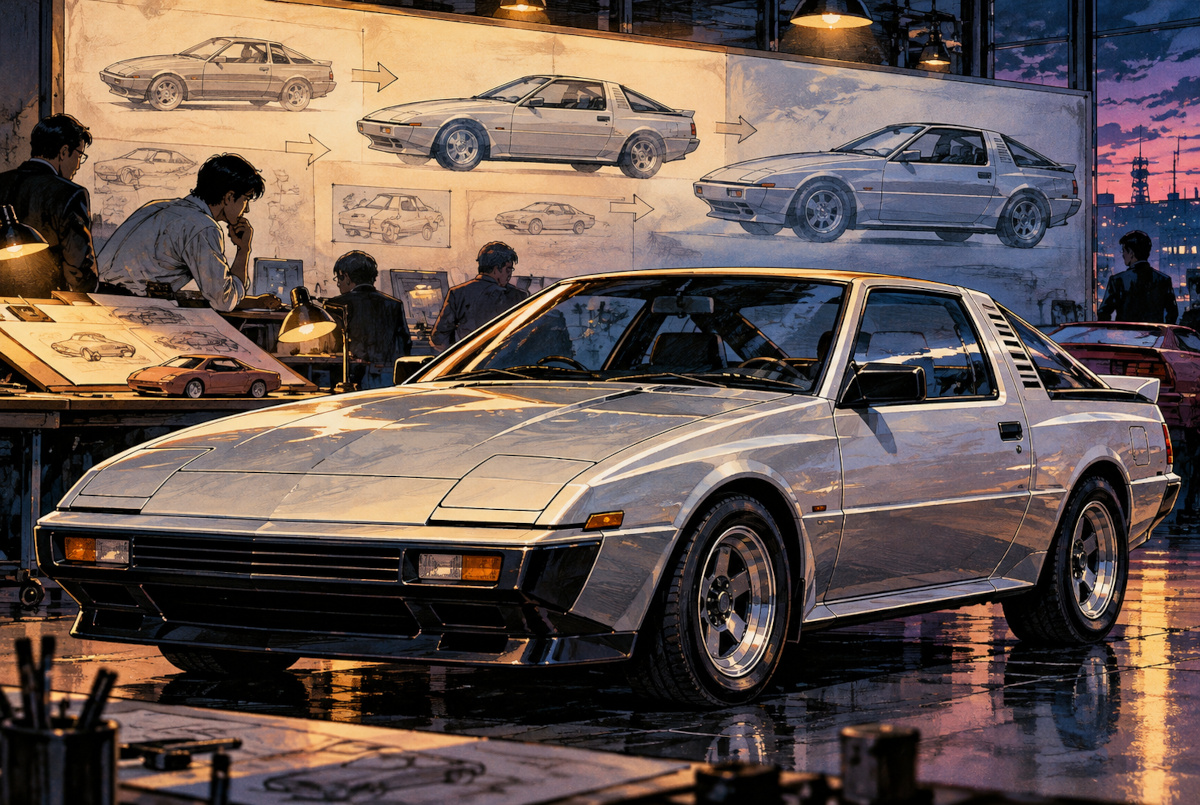
On May 14, 1982, Mitsubishi launched the Starion, a front-engine, rear-wheel-drive sports coupe with a distinctly futuristic profile. It measured 4,400 mm long and 1,685 mm wide, with pop-up headlights, a sharply sloping nose, and an available 2.0-liter turbocharged engine. It looked like the sort of machine that could only have emerged from the early 1980s.
But digging into its development history reveals something unexpected. The Mitsubishi Starion was not originally intended to be a sports coupe of this size.
It began as a proposed successor to the smaller Lancer Celeste. Then Chrysler, Mitsubishi’s American partner, became involved, and the project moved upmarket. How did a relatively modest coupe evolve into a car aimed at international sports-GT buyers?
Before the Starion, There Was the Celeste II
In a March 2022 interview with Motor-Fan, Hidetoshi Aoki, one of the designers responsible for the Starion’s exterior, described how the project changed direction.
The original plan was to develop a replacement for the Lancer Celeste using engines and components from the Lancer EX. In other words, Mitsubishi was initially working toward a smaller, relatively conventional rear-wheel-drive coupe.
Chrysler had other ideas. With North American sales in mind, the American partner wanted something larger and sportier. Mitsubishi consequently shifted toward using components from the larger Galant family. Aoki recalled that this change of direction occurred around June 1978, although he presented the timing as a recollection rather than a precise corporate record.
GAZOO’s historical description independently identifies the production Starion as a sporting three-door coupe using components from the Galant Lambda, Mitsubishi’s earlier two-door grand tourer.
The Starion therefore began with a Celeste-replacement concept, but emerged as a more substantial sports coupe intended for a much broader market. That distinction matters when examining its size, equipment, and surprisingly wide price range.
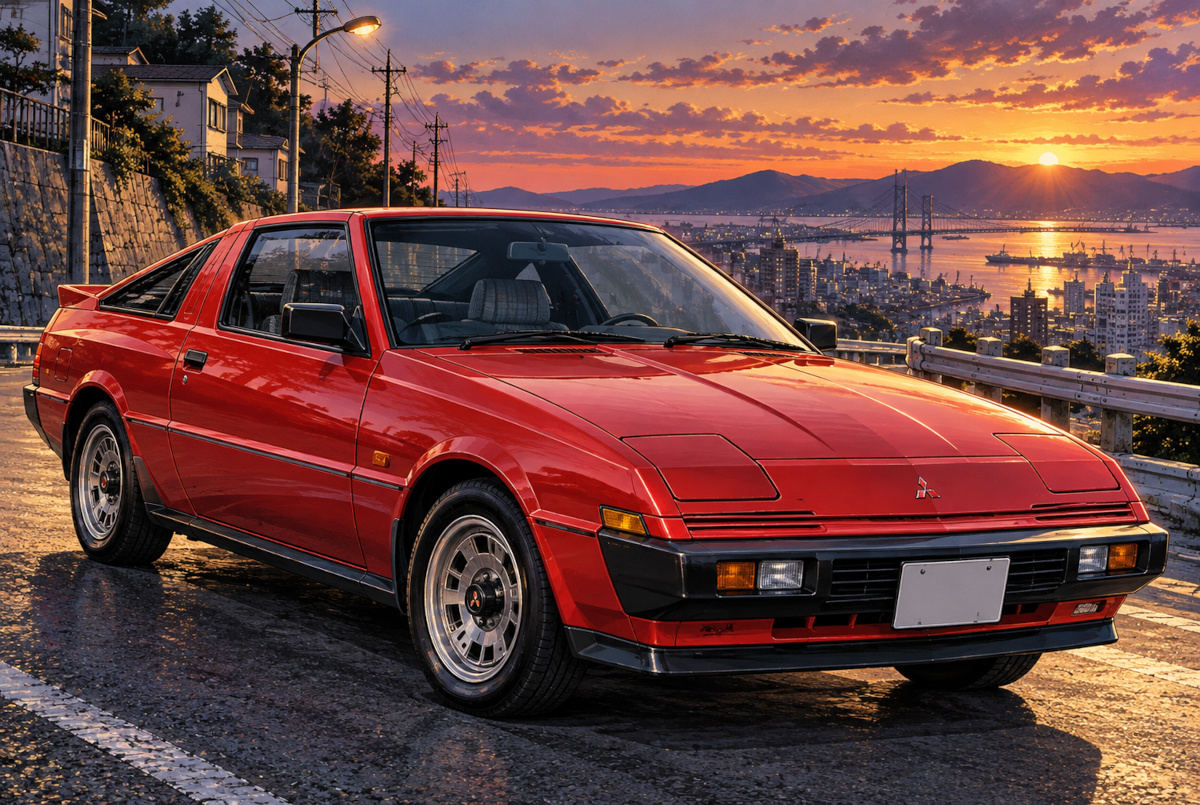
Artistic interpretation of the 1982 Mitsubishi Starion. Some details, including the mirrors and bumpers, differ from the original Japanese-market production car.
European Performance Ambitions, American Muscle-Car Styling
A history published by Miki Press, drawing on original Mitsubishi brochures, places the beginning of the full-scale Starion development program in the autumn of 1978. Among its objectives were sustained high-speed performance above 200 km/h and the ability to compete with sports cars of a similar class from West Germany.
The Porsche 924 Turbo is sometimes mentioned as a possible benchmark. However, the sources examined here do not establish that Mitsubishi officially selected that specific model as its development target.
What makes this more interesting is Aoki’s own account. Rather than describing a determination to beat one particular European car, he spoke of wanting a powerful appearance influenced by the American muscle cars he admired.
Even the angular rear end has a story behind it. Aoki said the original design tapered more dramatically toward the rear, but Mitsubishi president Tomio Kubo objected, prompting a change to a broader-looking shape.
So the Starion’s styling was not simply the result of drawing the sharpest possible wedge. Personal preferences, executive decisions, and the requirements of an international market all helped shape the finished car.
The timing of its release also tells us something about the period. The Starion had originally been expected in 1981, but did not reach Japan until 1982. Historical accounts refer to difficulties surrounding approval for turbocharged new models, while Aoki also recalled the effect of the second oil shock. The available evidence does not justify reducing the delay to a single cause.
Just ¥85,000 More Bought an Entirely Different Rear Suspension
The original Japanese Starion range included the naturally aspirated GX and several turbocharged GSR variants. To see what Mitsubishi was actually selling in 1982, we compared three five-speed manual models using contemporary brochure figures.
| Model | Power | 1982 Japanese Price |
|---|---|---|
| GX | 110 PS | ¥1,730,000 |
| GSR-I | 145 PS | ¥1,815,000 |
| GSR-X | 145 PS | ¥2,735,000 |
Note: Japanese-market launch prices and published engine outputs for five-speed manual versions. PS denotes metric horsepower. These are historical yen prices, not inflation-adjusted figures.
The difference between the GX and GSR-I was only ¥85,000. That meant spending approximately 4.9% more for an increase of 35 PS, or about 31.8% over the GX’s published maximum output.
But the extra money did not merely buy a turbocharger.
The GX used a four-link live rear axle, while the turbocharged GSR models received independent suspension at all four wheels. The rear brakes differed too: the GX used conventional solid discs at the rear, whereas the GSR models received ventilated rear discs to improve heat dissipation.
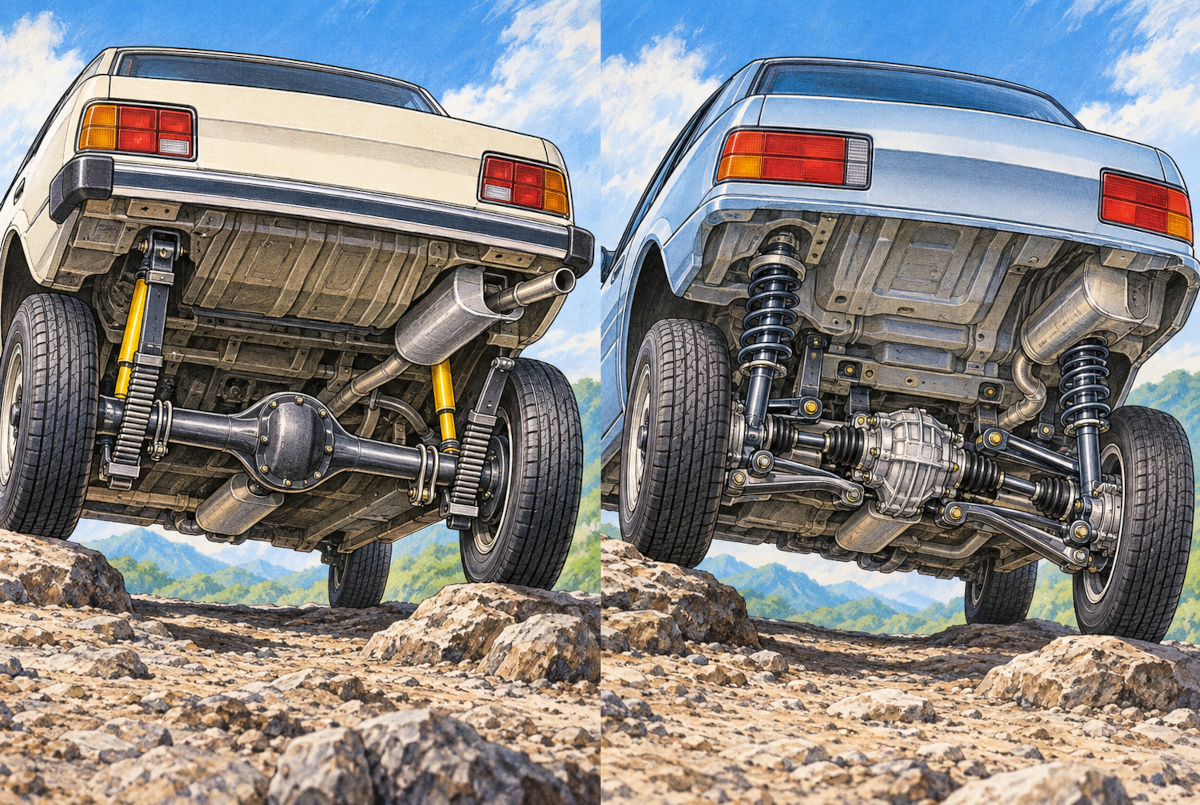
General comparison of a live axle (left) and independent rear suspension (right). The actual Starion GX used a four-link live axle, not the leaf-spring design illustrated on the left. The right-hand illustration is also schematic and does not reproduce the GSR suspension in exact detail.
Now consider the opposite end of the range. Moving from the GSR-I to the flagship GSR-X raised the price by ¥920,000, or approximately 50.7%, without increasing the published 145 PS output.
Instead, the GSR-X emphasized premium features, including electronic instrumentation.
Mitsubishi offered much of the Starion’s fundamental performance in the relatively affordable GSR-I, while charging substantially more for the luxury and technology of its flagship.
That pricing structure suggests something more complicated than a straightforward sports car. The Starion was also intended to serve as a sophisticated personal grand tourer.
145 PS in Japan, but 170 PS in the Export Brochure
There is another useful clue in the original documents: the Starion described in Mitsubishi’s Japanese brochure was not identical to the 2.0-liter model presented in an English-language export brochure issued in 1982.
| Specification | Japanese 2.0L Turbo | Export 2.0L Turbo |
|---|---|---|
| Maximum power | 145 PS | 170 PS |
| Overall width | 1,685 mm | 1,705 mm |
| Seating capacity | 5 | 4 |
| Top speed | 180 km/h (limited) | 220 km/h (claimed) |
Note: Comparison of Mitsubishi’s 1982 Japanese brochure with a contemporary English-language export brochure for the 2.0-liter model. The export figures do not represent every overseas market, particularly the separately specified North American models. Because the power-rating conditions have not been established as fully identical, the entire 25 PS difference cannot automatically be attributed to mechanical changes.
The Japanese car’s width of 1,685 mm placed it within Japan’s then-familiar compact passenger-car dimensional category, commonly called the “5-number” class. The export example was 20 mm wider, at 1,705 mm.
The export brochure also claimed a top speed of 220 km/h, consistent with the development program’s ambition to build a car capable of exceeding 200 km/h. That figure, however, is a manufacturer’s published claim, not a verified independent road-test result.
For perspective, Toyota introduced the Japanese-market Celica XX 2000G Turbo in February 1982 with a 2.0-liter turbocharged inline-six producing 145 PS. The domestic Starion used a turbocharged inline-four to achieve the same published maximum output.
Judging the original Starion’s 145 PS by modern standards alone misses the point: in its own launch year, that figure was directly comparable to a notable Japanese turbocharged rival.
The differing body dimensions, seating arrangements, and engine specifications also underline how seriously Mitsubishi took overseas markets. The Starion was never simply a domestic Japanese coupe with an export badge added afterward.
What Was the 1982 Starion Really Trying to Be?
The original Starion was not a clean-sheet competition car developed solely for motorsport. It drew on existing Galant-family engineering and combined a turbocharged engine, independent suspension on the performance versions, high-speed development priorities, and luxury equipment in a distinctive rear-wheel-drive coupe.
Chrysler’s requirements helped move the project beyond the original Celeste-successor concept. The finished product had to appeal to buyers looking for performance, styling, and grand-touring comfort, rather than merely replacing a small sporty hatchback.
Power rose to 175 PS in selected intercooled models in 1983, and the celebrated 200 PS DASH engine followed in 1984. Those later figures are important to the Starion story, but they should not be confused with what customers could buy at launch.
To understand the Starion of 1982, the more revealing questions concern its change in size, its unusual model hierarchy, and the different specifications Mitsubishi prepared for different markets.
Editor’s Note
When I think of the Starion, the first image that comes to mind is usually the later GSR-VR, with those outrageously wide fenders. But once you start examining the original car, you find a very different story underneath.
The part that caught my attention was Chrysler’s role. Mitsubishi started with a Celeste replacement, and somehow ended up building a much bigger international sports coupe. Then there is that peculiar Japanese price list: ¥1.73 million for a GX, all the way up to ¥2.735 million for a GSR-X.
Was Mitsubishi trying to sell a sports car or a luxury coupe? Apparently, it wanted to sell both.
And I still can’t get over that ¥85,000 step from the GX to the GSR-I. Thirty-five extra PS, a different rear suspension, and upgraded rear brakes for less than 5% more money. That tells me more about Mitsubishi’s ambitions in 1982 than a glossy slogan ever could.
Next in the series: the 200 PS DASH 3×2 engine introduced in 1984, and the unusual valve system Mitsubishi used to achieve that figure.
Mitsubishi Starion $2014 5-Article Series
From its 1982 origins and DASH engine to the rare GSR-VR, the ambitious 4WD rally project, and a gullwing special: four main articles and one special feature.
- Part 1: The 1982 Mitsubishi Starion Was Meant to Be Smaller—Until Chrysler Stepped In
- Part 2: Why Did Mitsubishi’s 200 PS Starion Shut Off an Intake Valve?
- Part 3: English edition Coming soon
- Final Part: English edition Coming soon
- Special: English edition Coming soon
Terms That May Need a Quick Explanation
- Live Axle
- A suspension arrangement in which the left and right rear wheels are connected by a rigid axle assembly that also transmits drive to the wheels. It is relatively simple and durable. Independent rear suspension allows each wheel to move separately, which can improve road-wheel control and ride comfort. The design alone, however, does not determine a car’s overall handling quality.
References
- Mitsubishi Motors — Vehicle History: Starion (Official manufacturer history, in Japanese).
- Miki Press M-BASE — Mitsubishi Starion, Part 1 (June 27, 2024; Japanese historical feature reproducing original 1982 Japanese and export brochures, including specifications, prices, and development background).
- Motor-Fan — Interview with Mitsubishi Starion Designer Hidetoshi Aoki (March 29, 2022; Japanese-language interview covering the Celeste project, Chrysler’s influence, and the Starion’s exterior design).
- GAZOO — Mitsubishi Starion Model History (Japanese model overview describing the car’s Galant Lambda-derived components and positioning).
- Toyota Motor Corporation — “Toyota Introduces Celica Turbo” (Official English-language news release dated February 22, 1982, confirming the Celica XX turbo’s 145 PS output).