
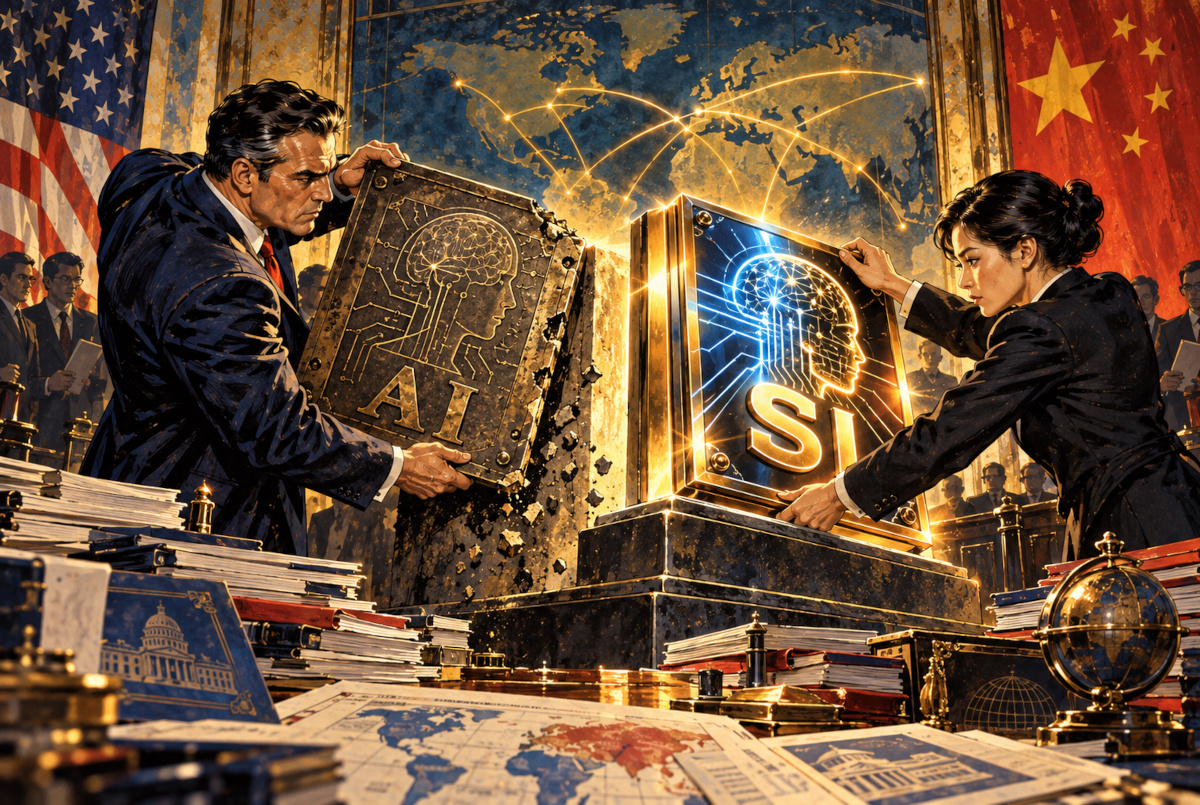
Artificial Intelligence is apparently getting a new name. President Donald Trump wants the US government to call it “Super Intelligence,” or SI.
On September 29, 2026, Trump signed Executive Order 14434, directing federal executive agencies to replace “Artificial Intelligence” and “AI” with the new terminology wherever legally permitted.
But here’s the question that bothers me: AI has been an established term for 70 years. Is this really about America’s technological rivalry with China? And when a government decides to rename an entire field, who pays for all the changes?
I went back to the executive order, compared official statements from Washington and Beijing, and examined a surprisingly useful government cost estimate. The answers weren’t quite what I expected.
America Invented the Term AI. Now It Wants to Rename It.
Trump’s objection begins with a single word: “Artificial.” He argues that it makes intelligence sound fake or somehow less genuine.
The field of artificial intelligence took shape at the Dartmouth research workshop in 1956. Its capabilities have advanced enormously since then. But “artificial” does not necessarily mean “fake.” An artificial heart, for example, is not a fraudulent heart.
What caught my attention was Section 3 of the executive order. For the time being, the new term “Super Intelligence” retains the same legal definition as the existing term “artificial intelligence.”
In other words, renaming a technology does not magically improve its capabilities. Everything from image recognition to generative AI can fall under the new government label without becoming genuinely superintelligent.
Is This About China? Beijing Didn’t Exactly Say No.
America’s competition with China is an obvious place to look for an explanation.
The Trump administration’s AI Action Plan, released in July 2025, explicitly promoted exporting American AI technology, including hardware, models, software, applications, and standards. Establishing global technological leadership is part of the administration’s economic and national security strategy.
So is the SI rebranding another move to distinguish American technology from China’s?
To investigate, I compared the official statements issued by the two governments following the September 2026 US-China summit.
| US Government’s Statement | Chinese Government’s Statement |
|---|---|
| Both presidents agreed to use the term “Super Intelligence.” | China respects the US choice of terminology. |
| A “US-China Super Intelligence (SI) Dialogue” was announced. | The corresponding Chinese announcement called it a “US-China Artificial Intelligence Dialogue.” |
That’s an intriguing difference.
Beijing did not openly reject Washington’s preferred terminology. But neither did it clearly commit to replacing “artificial intelligence” throughout China’s own institutions. Its official summary of the summit continued to use the Chinese term for artificial intelligence.
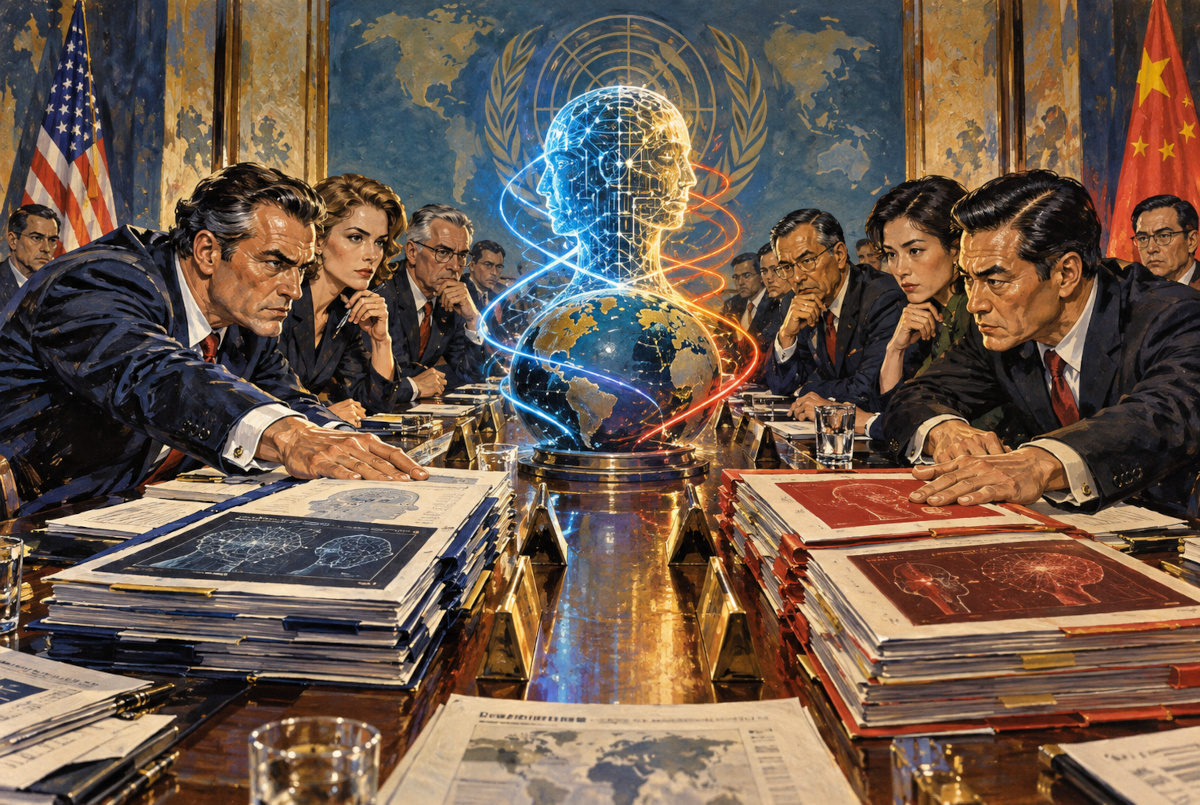
AI-generated conceptual illustration of the two countries’ positions. It does not recreate an actual diplomatic meeting or depict the officials involved.
The US government’s broader ambition to lead global AI development is well documented. But I could not find evidence establishing that differentiation from China was the direct purpose of this particular renaming order.
There is another possibility. If Washington wants to set the world’s technological vocabulary, persuading China to use that vocabulary could be more valuable than creating a name that separates the two countries.
That is my interpretation of the policy documents, not a confirmed explanation of Trump’s motives.
How Much Does It Cost to Change a Name?
Here’s where the story gets more interesting to me. Changing a name sounds simple until someone has to update the websites, policy papers, training materials, manuals, and administrative documents.
Fortunately, there is a revealing comparison from the same administration.
In 2025, Trump authorized “Department of War” as a secondary title for the Department of Defense. In January 2026, the Congressional Budget Office (CBO) examined the potential cost of implementing that change.
The CBO estimated roughly $10 million for a modest implementation, while a broad, rapid rollout could cost as much as $125 million.
That’s a 12.5-fold difference between those two implementation scenarios, simply depending on how extensively and quickly the new name is introduced.
To be clear, those figures concern the Department of Defense’s alternative name, not the AI-to-SI change. They cannot be treated as an estimate of what Trump’s SI policy will cost.
But they demonstrate why the scope of a renaming exercise matters.
I also ran a simple calculation focused solely on the labor required to review documents.
Assume each document requires five minutes of review and the labor cost is ¥5,000 per hour. Reviewing 10,000 documents would cost approximately ¥4.17 million. For 100,000 documents, the figure rises to approximately ¥41.67 million.
The calculation is straightforward: number of documents × five minutes ÷ 60 × ¥5,000.
These are hypothetical figures, not estimates based on actual US government document counts, wage rates, or expenditure. The original assumptions are expressed in Japanese yen because the calculation was developed from a Japanese editor’s perspective.
There is also a critical limitation: Trump’s executive order does not require agencies to rewrite previously issued regulations, contracts, presidential actions, or other historical documents.
So a massive, immediate revision of every existing document is not mandated, and the hypothetical costs above should not be mistaken for money the US government is actually spending.
Nevertheless, new documentation, the coexistence of old and new terminology, possible future legislative changes, and software maintenance could still create administrative work.
I could not verify an official government-wide estimate of the total cost or broader economic losses associated with the AI-to-SI renaming.
Section 4 of the order assigns the publication costs of the executive order itself to the White House Office of Science and Technology Policy. But that is not a budget for changing terminology across federal agencies.
It would be unfair to claim that Trump gave no thought to implementation costs. The exemption for historical documents clearly limits the required work. What I could not find, however, was a quantitative public comparison showing that the expected economic benefits of the rename outweigh its costs.
Does Japan Have to Follow Washington’s Lead?
Japan offers an instructive contrast.
In 2025, Japan enacted the Act on Promotion of Research and Development, and Utilization of Artificial Intelligence-related Technology, commonly referred to as its AI Act. The term “artificial intelligence” appears in both the law’s official title and its definition of the technology.
On October 8, 2026, Yuichiro Tamaki, leader of Japan’s Democratic Party for the People, raised the renaming issue in the House of Representatives, the lower house of Japan’s parliament.
Prime Minister Sanae Takaichi responded cautiously. AI is already widely used in government documents and academic research, she explained, making an immediate wholesale switch to SI difficult.
The issue extends beyond Japanese legislation. International standard ISO/IEC 22989:2022 also uses “Artificial Intelligence” in its title and terminology.
Japan is under no legal obligation to adopt Washington’s new label merely because the US president ordered its use within the executive branch.
Whether the terminology eventually changes internationally will depend on much more than an American presidential directive.

Editor’s Note
What bothered me wasn’t so much Trump’s dislike of the term “AI.” It was a much less glamorous question: how much work, and how much money, will changing the name actually involve?
I used to work in engineering design. When someone proposed changing a name or a specification, you didn’t just cross out a word on one drawing and call it a day. You had to check the parts lists, manufacturing instructions, manuals, and every other document connected to it. A minor revision could spread further than anyone expected.
I understand the desire to beat China in the technology race. But how exactly does replacing two letters improve the performance or price competitiveness of American AI products? I’d like to see the calculation behind that claim, if there is one.
Meanwhile, Beijing has neither openly rejected the American term nor abandoned its existing terminology. Perhaps it’s simply keeping its options open and waiting to see what proves useful. That’s speculation, of course, but it’s a reasonable question to ask.
In the end, a president can change what his government calls a technology. He can’t change what that technology is capable of by renaming it.
Surely the people using these systems, testing their limits, and dealing with their mistakes have something to say about whether the intelligence is really “super.”
References
- The White House: Executive Order 14434, “Inaugurating the Era of Super Intelligence” (September 29, 2026) — Scope of the terminology change, existing documents, legal definitions, and publication costs.
- The White House: Fact Sheet on the US-China State Visit (September 25, 2026) — The US account of the agreement on Super Intelligence terminology and the bilateral dialogue.
- Ministry of Foreign Affairs of China: Spokesperson’s Remarks on Artificial Intelligence (September 26, 2026) — China’s official English-language explanation of its position on the US terminology.
- Ministry of Foreign Affairs of China: Eight Outcomes of the US-China Summit (September 26, 2026; in Chinese) — The Chinese summary uses the term “artificial intelligence dialogue.”
- The White House: “America’s AI Action Plan” (July 23, 2025) — The administration’s strategy for exporting American AI technology and standards.
- Congressional Budget Office: “The Costs of Using the Name ‘Department of War’” (January 14, 2026) — Official estimates for a separate government renaming exercise.
- e-Gov Japan: Act on Promotion of Research and Development, and Utilization of Artificial Intelligence-related Technology (2025; Japanese legal text) — Japan’s AI legislation.
- Japanese Law Translation Database: English Translation of Japan’s AI Act — Official government translation provided for English-language readers.
- TV Asahi: Prime Minister Takaichi’s Response to the AI Naming Proposal (October 8, 2026; in Japanese) — Reporting on the Japanese parliamentary exchange.
- ISO: ISO/IEC 22989:2022 — Artificial Intelligence Concepts and Terminology — The established international terminology standard.
- John McCarthy et al.: “A Proposal for the Dartmouth Summer Research Project on Artificial Intelligence” (1955) — Historical source for the term Artificial Intelligence.