

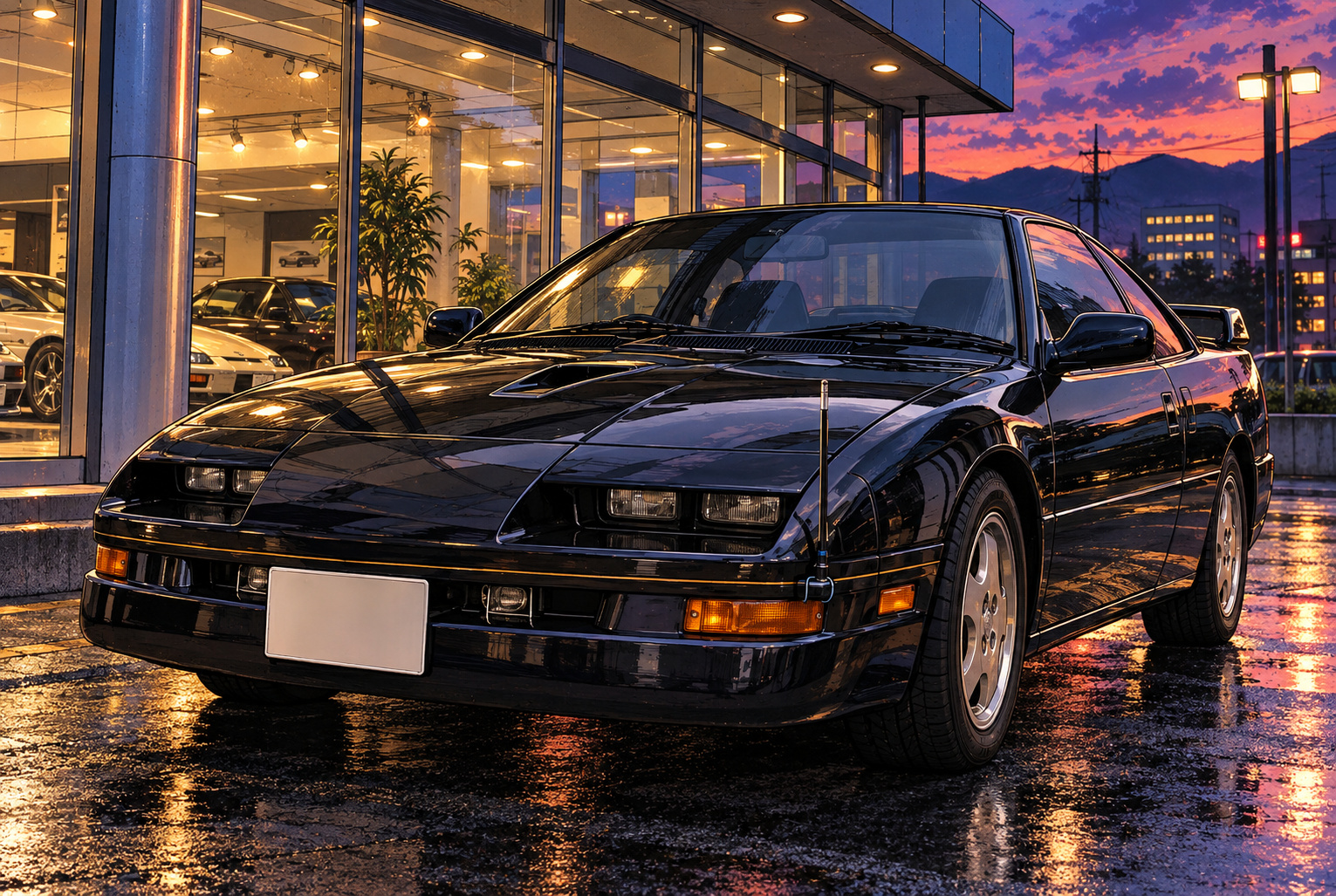
When I first heard the name “PA Nero,” I assumed it was some kind of successor to the Piazza Nero—the Yanase-sold version of Isuzu’s first-generation Piazza.
That assumption turned out to be wrong. The PA Nero belonged to the third-generation Gemini family and was closely related to the Geo Storm sold in North America. Then, in 1991, Isuzu and Yanase went even further and added the Irmscher 160R: a compact coupe with a 1.6-liter turbo engine, 180 PS, full-time AWD and a 5-speed manual.
The strange part is not simply that it made 180 PS. The real question is why Yanase was selling essentially this kind of Isuzu performance coupe under a different name at all.
The Piazza Nero and PA Nero were not the same car
First, the names need untangling. The Piazza Nero appeared in 1981 as a Yanase-market version of Giorgetto Giugiaro’s Isuzu Piazza. The PA Nero arrived roughly nine years later and belonged to a completely different generation of Isuzu compact coupes.
According to Yanase’s corporate history, sales of the PA-NERO began on June 1, 1990. The higher-performance PA-NERO Irmscher 160R followed on March 2, 1991.
Here is where the timeline gets odd. Isuzu’s own Gemini Coupe joined the domestic lineup in August 1990. In other words, the PA Nero reached the market before the car that is often casually described as its Isuzu-dealer counterpart.
That makes “a Yanase-badged Gemini Coupe” a little too simple as an explanation. The two cars were better understood as members of the same wider Isuzu coupe program, sold through different channels and given different identities.
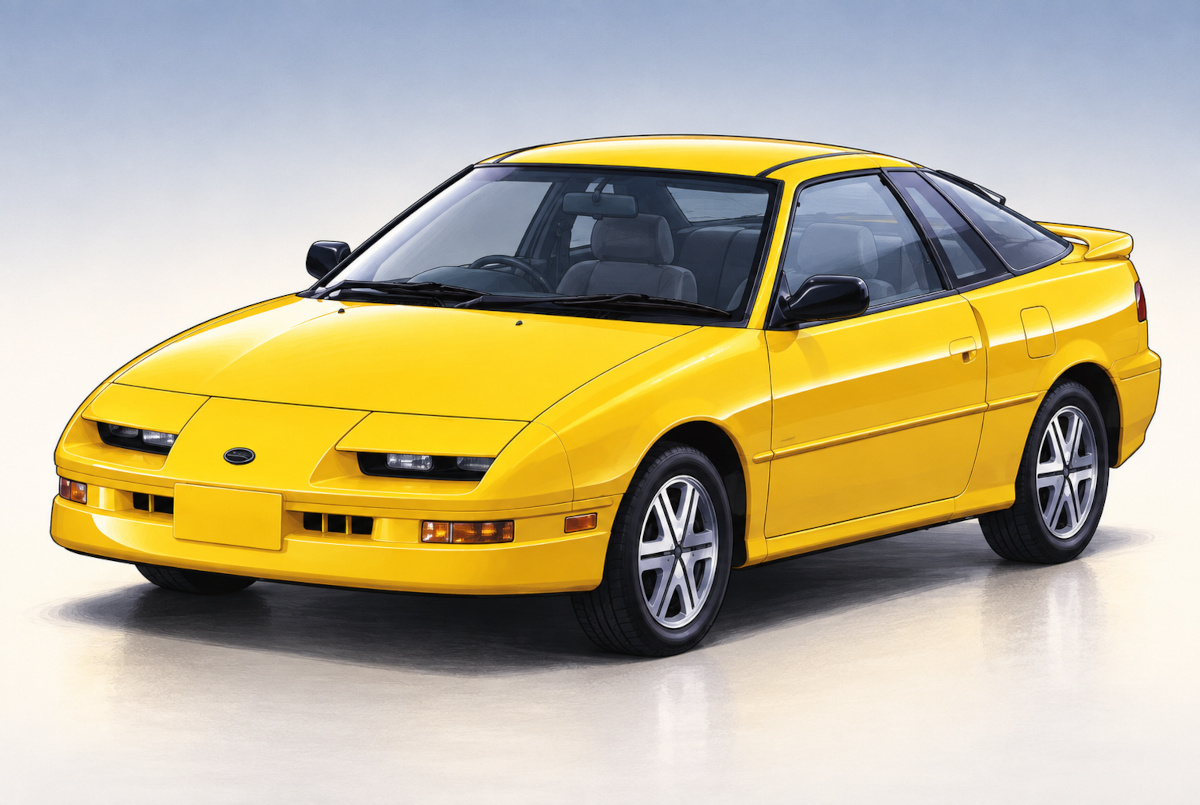
AI-generated illustration based on period images of the PA Nero. It does not depict the 160R specifically, and some exterior details differ from the production car.
The 160R was more than a cosmetic performance trim
The top PA Nero was the Irmscher 160R, chassis code E-JT191S. Its 1,588cc 4XE1 engine was a turbocharged DOHC four-cylinder rated at 180 PS at 6,600 rpm and 21.2 kgm of torque at 4,800 rpm. Power went through a 5-speed manual transmission to a full-time AWD system.
The car weighed 1,190 kg, and its original Japanese list price was ¥2.079 million.
| PA Nero Irmscher 160R | Specification |
|---|---|
| Engine displacement | 1,588cc |
| Maximum output | 180 PS / 6,600 rpm |
| Maximum torque | 21.2 kgm / 4,800 rpm |
| Drivetrain | Full-time AWD |
| Transmission | 5-speed manual |
| Vehicle weight | 1,190 kg |
| Original price | ¥2.079 million |
If we calculate the power-to-weight ratio in the Japanese convention used at the time:
1,190 kg ÷ 180 PS = about 6.61 kg/PS.
Today, 180 PS by itself does not sound shocking. But this was a 1.6-liter Japanese coupe in 1991, measuring only around 4.15 meters long, with a turbocharger, AWD and a manual gearbox. This was not simply a stylish “specialty coupe” with a sporty badge attached.
Then you discover the Gemini had almost the same 160R hardware
This is where the PA Nero story becomes much stranger.
The Gemini Coupe also received an Irmscher R version. Its key specifications were almost identical: E-JT191S chassis code, 1.6-liter 4XE1 turbo engine, 180 PS, 21.2 kgm, AWD, a 5-speed manual and a vehicle weight of 1,190 kg.
| PA Nero 160R | Gemini Coupe Irmscher R | |
|---|---|---|
| Chassis code | E-JT191S | E-JT191S |
| Maximum output | 180 PS | 180 PS |
| Vehicle weight | 1,190 kg | 1,190 kg |
| Drivetrain | AWD / 5MT | AWD / 5MT |
| Original price | ¥2.079 million | ¥1.999 million |
The difference was ¥80,000. That made the PA Nero about four percent more expensive.
So the 160R was not some secret performance weapon available only through Yanase. The more interesting interpretation is that Isuzu’s high-performance package was being sold through two different Japanese sales channels: as the Gemini Coupe through Isuzu dealers, and as the PA Nero through Yanase.
And that leads to the question that originally bothered me: if the basic mechanical package was so similar, what exactly was the customer paying that extra ¥80,000 for? The surviving specifications make the price difference clear, but they do not give us a neat one-line corporate explanation. What they do show is how unusually fragmented Isuzu’s passenger-car strategy had become by the early 1990s.
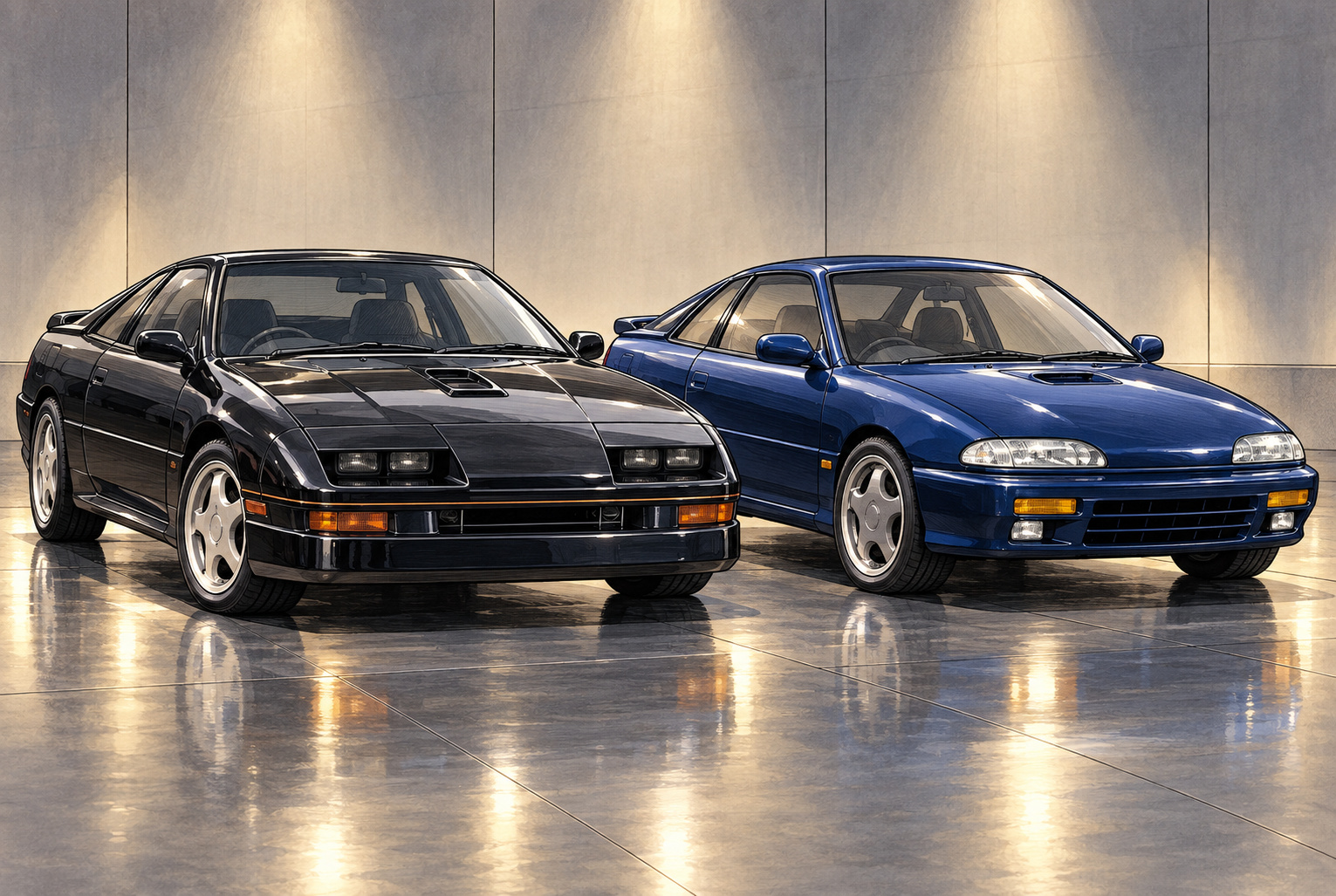
AI-generated comparison image. The left car is based on the PA Nero 160R and the right car on the Gemini Coupe Irmscher R. Details such as lighting units, wheels and bumper shapes are not exact reproductions of the production cars.
In North America, the family became the Geo Storm
The relationship becomes easier to understand once you stop looking only at the Japanese market.
In North America, another member of the same Isuzu-developed coupe family was sold by General Motors under the Geo brand as the Geo Storm.
GM’s own 1991 Storm specification document lists the manufacturer as ISUZU MOTORS LIMITED. In other words, this was not a case of an American GM coupe being brought back to Japan and rebadged. Isuzu developed and manufactured the basic vehicle family, while different markets and sales networks gave it different names, styling and identities.
Seen from that angle, the PA Nero’s slightly American flavor no longer seems quite so random.
Calling it “a flop that disappeared” is too simple
Some secondary sources put total PA Nero production at roughly 3,000 cars. I was unable to verify that figure directly in the Isuzu or Yanase primary material used for this article, so I would rather not present it as established fact.
What can be confirmed is the larger ending. Isuzu states that it stopped developing passenger cars in 1992 and ended production of its own passenger-car models in 1993. Yanase’s company history also records the end of its relationship with Isuzu in 1993 after Isuzu decided to withdraw from passenger-car development and production.
So it is too easy to say that the PA Nero simply vanished because nobody wanted one. Its fate overlapped with something much bigger: the end of Isuzu’s own passenger-car business.
The interesting part of the PA Nero 160R is not just the 180 PS
For classic Japanese-car fans, 180 PS is hardly the most outrageous number the early 1990s produced.
What makes the PA Nero 160R interesting is that Isuzu’s serious 1.6-liter turbo-AWD hardware was being sold with a different face, a different name and through an entirely different dealer network.
Look overseas and the Geo Storm appears. Look back at Japan and you find the Gemini Coupe. At roughly the same time, there was also a second-generation Piazza and a second-generation Piazza Nero. Try drawing the family tree on paper and it starts looking less like a product lineup and more like someone forgot to erase several branches.
But perhaps that is exactly why these cars are worth revisiting. This was a period just before ruthless model consolidation became normal. Manufacturers could still produce oddly overlapping derivatives that made questionable business sense—but decades later, those awkward side branches are often more interesting than the obvious mainstream models.
A Few Terms That May Need Explaining
- DOHC
- Double overhead camshaft. The engine uses separate camshafts for the intake and exhaust valves. In Japan during this period, “DOHC” was also heavily associated with high-performance engines.
- Full-time AWD
- A drivetrain that powers all four wheels during normal driving, rather than engaging the second axle only when the driver selects four-wheel drive.
- Power-to-weight ratio
- A simple way to compare vehicle performance by relating weight to engine output. Using the Japanese kg-per-PS convention, a lower number means each unit of power has less mass to move.
- Irmscher
- A German tuning and engineering company. Isuzu used the Irmscher name on several performance-oriented Japanese-market models from the 1980s onward.
Editor’s Note
I started this one thinking the PA Nero was basically “that even more obscure Nero that came after the Piazza Nero.” That turned out to be the wrong mental map entirely.
And after digging through the specifications, the thing that bothered me most was not the 180 PS. It was the duplication. The Gemini Coupe existed with the same chassis code, the same output and the same 1,190 kg weight—yet Yanase was also selling the PA Nero 160R for another ¥80,000.
Today, somebody in product planning would probably put both cars into a spreadsheet and delete one of them before lunch. Older Japanese manufacturers were much better at creating these strange little branches that make you ask, “Did this really need to exist?”
The funny thing is that, decades later, those are often the cars I want to read about. The PA Nero 160R was not historically important simply because it was fast. What sticks with me is the fact that Japan once had a Yanase-exclusive compact coupe with a 1.6-liter turbo, 180 PS, AWD and a manual gearbox—while Isuzu itself was selling an almost identical performance package under another name.
References
- Yanase, Wadachi: 100 Years of Yanase (corporate history, Japanese)
- Isuzu Motors — Investor Relations FAQ (Japanese)
- Isuzu Motors — Company and Vehicle History (Japanese)
- CarSensor — Isuzu PA Nero 1.6 Irmscher 160R 4WD specifications (Japanese)
- CarSensor — Isuzu Gemini Coupe 1.6 Irmscher R 4WD specifications (Japanese)
- CarSensor — Isuzu Gemini Coupe model history (Japanese)
- General Motors — 1991 Geo Storm Motor Vehicle Specifications