


Even a degree from a low-ranked university is still a university degree. In Part 1, we examined Japan’s wage gap between high school and university graduates and found that attending a lower-ranked institution can produce a positive economic return.
But how much does it cost to obtain that degree?
Using Japan’s 2025 education statistics, we estimated that four years at a private university would cost approximately ¥5.31 million in tuition and other university fees.
Then we added something that never appears on a university bill: the wages a high school graduate might have earned by working during those four years.
The resulting economic comparison comes to approximately ¥15.74 million.
Under one hypothetical model, even if a university graduate earns ¥800,000 more every year than someone who entered the workforce after high school, the investment is not recovered until around age 42. Account for the time value of money, and the estimated payback age moves to about 55.
That does not mean every Japanese university degree costs ¥15.74 million, or that every graduate must wait until 55 to benefit financially. The interesting part is understanding what these calculations actually include.
Four Years at a Private University: ¥5.31 Million. What About Public Universities?
Japan’s Ministry of Education, Culture, Sports, Science and Technology (MEXT) reported average first-year payments of ¥1,507,647 for students entering private universities in the 2025 academic year.
The figure includes tuition, admission fees, facility fees, laboratory and practical training charges, and other university fees.
The average admission fee was ¥240,365. Since admission fees are generally charged only in the first year, we can estimate four years of payments by assuming that the other annual charges remain unchanged.
¥1,507,647 × 4 − ¥240,365 × 3 = ¥5,309,493.
Using the same four-year approach, we also compared Japan’s national and local public universities.
| University type | Four-year fee model |
|---|---|
| National university | Approx. ¥2.43 million |
| Local public university | Approx. ¥2.53 million |
| Private university | Approx. ¥5.31 million |
Original calculations based on MEXT data. National university: standard annual tuition of ¥535,800 plus a one-time admission fee of ¥282,000. Local public university: average annual tuition of ¥536,520 plus the average admission fee of ¥382,806 for students from outside the designated local area, using 2025 figures. Private university: calculated from average first-year payments in 2025. These are comparison models, not actual four-year quotations from individual universities.
In Japan, national universities and local public universities are separate categories. The former are operated by national university corporations, while the latter are established by local governments or their public university corporations.
There are important exceptions to these averages. Some national universities charge tuition above the national standard. Public universities may offer lower admission fees to local residents. Private university averages also include expensive programs such as medicine and dentistry.
A student entering a low-ranked private university will not necessarily pay ¥5.31 million. The actual university and department’s published fee schedule matters much more than the overall average.
The Four Years of Wages You Could Have Earned Instead
Now comes the part that university brochures rarely put next to their tuition figures.
Imagine two people who finish high school at 18. One enters university and graduates at 22. The other begins full-time employment immediately.
During those four years, the second person has an opportunity to earn wages while the university student is paying for an education.
According to Japan’s 2025 Basic Survey on Wage Structure, the average monthly scheduled wage for high school graduates was ¥209,400 among workers aged 19 or younger and ¥225,200 among those aged 20–24.
For a deliberately simplified calculation, suppose the high school graduate earns the first figure for 24 months and the second figure for another 24 months.
¥209,400 × 24 + ¥225,200 × 24 = ¥10,430,400.
That is approximately ¥10.43 million in potential earnings during the four years the other person spends at university.
Economists call the value of the best alternative that is given up an opportunity cost.
There are limitations to this calculation. It combines average wages from different age groups in a single year’s survey rather than following actual 18-year-old workers for four years.
It also excludes bonuses, overtime, taxes, social insurance contributions and individual wage growth. The ¥10.43 million is a gross-wage-based hypothetical figure, not the amount of cash someone would necessarily save.
¥5.31 Million Plus ¥10.43 Million: What Does the ¥15.74 Million Actually Mean?
Putting the two figures together produces the following comparison.
| Economic cost component | Amount |
|---|---|
| Four years of private university fees | Approx. ¥5.31 million |
| Potential wages forgone during university | Approx. ¥10.43 million |
| Total comparison cost | Approx. ¥15.74 million |
This does not mean the university sends the student a ¥15.74 million bill. University fees are actual payments; forgone wages represent income that might have been earned under a different life choice.
Confusing those two categories would make the comparison misleading.
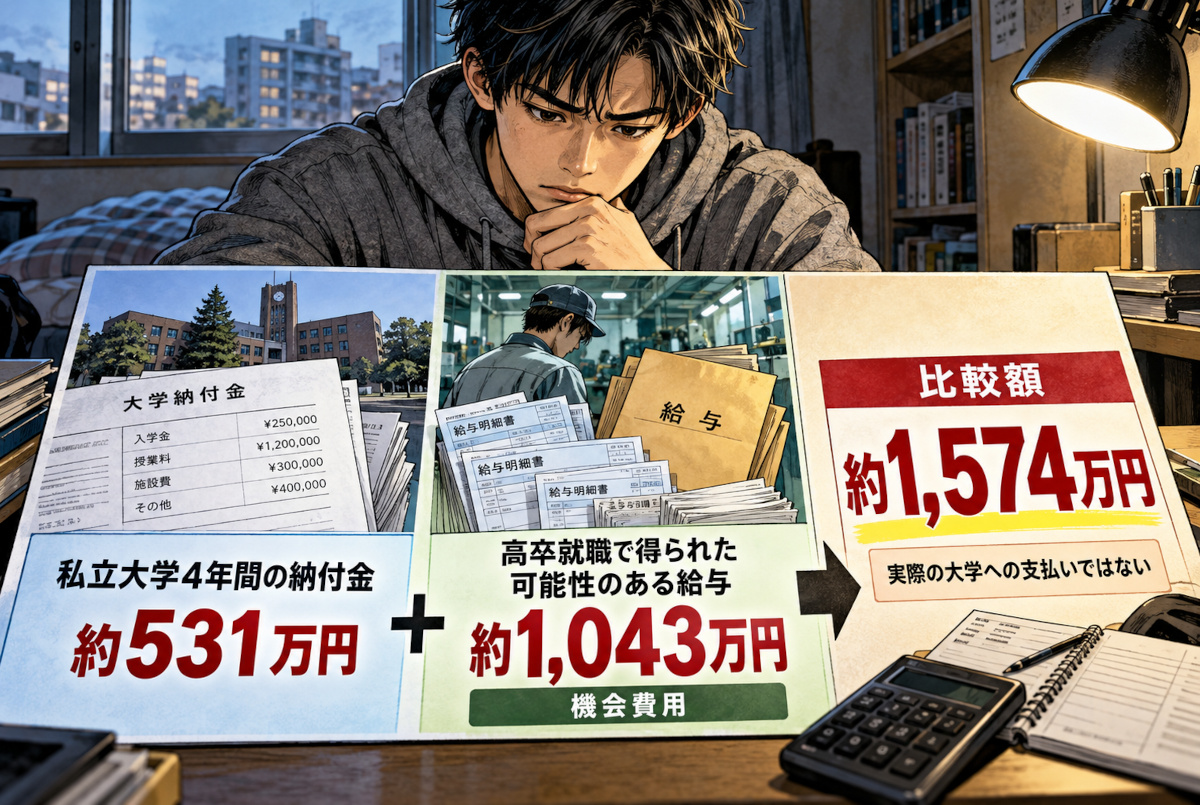
Original calculation based on MEXT’s 2025 private university fee survey and Japan’s 2025 wage statistics. The Japanese labels identify university payments (約531万円), potential wages from working after high school (約1,043万円), opportunity cost (機会費用), and the combined comparison amount (約1,574万円). The total is not an actual university payment. Detailed invoice entries, people and workplaces are fictional visual elements, not records from a particular institution or employer. AI-generated editorial illustration.
Even this ¥15.74 million model is incomplete. It does not account for differences in housing, commuting, textbooks, examination fees, student part-time earnings or living expenses.
And a high school graduate who starts working immediately still needs food, housing and other necessities. Charging every university student’s living expense as an additional cost without comparing the alternative worker’s living expenses would be unfair.
So ¥15.74 million is not the universal price of going to university. It is a starting point for comparing two economic paths.
Could Living Away at a National University Cost Less Than Staying Home at a Private One?
Japan Student Services Organization (JASSO) provides another perspective in its 2024 Student Life Survey.
The survey measures annual student expenditures, including both educational expenses and living costs.
| University type | Living at home | Renting / boarding away from home |
|---|---|---|
| National university | Approx. ¥1.203 million | Approx. ¥1.801 million |
| Private university | Approx. ¥1.905 million | Approx. ¥2.689 million |
Source: JASSO, 2024 Student Life Survey, daytime undergraduate programs. Figures include education-related expenses and living costs. They are survey estimates, not fixed fees charged by universities.
Here is the unexpected comparison.
National university students renting or boarding away from home spent an average of approximately ¥1.80 million per year. Private university students living at home spent approximately ¥1.91 million.
In those averages, living away from home to attend a national university actually cost about ¥105,000 less per year than commuting from the family home to a private university.
For private university students alone, the gap between living at home and renting or boarding was ¥783,700 per year.
If that difference continued unchanged for four years, it would amount to:
¥783,700 × 4 = ¥3,134,800.
The financial choice is not simply between expensive private tuition and cheaper public tuition. Where the student lives can change the comparison dramatically.
But do not add the full JASSO student-expenditure figures to the earlier ¥5.31 million tuition model. Tuition and other university fees are already included in those figures, so doing so would count some costs twice.
Likewise, the difference between students living at home and those renting does not represent rent alone. These are averages for different groups of students with different spending patterns.
Earn ¥800,000 More Each Year: At What Age Does University Pay for Itself?
Now suppose a university graduate begins full-time employment at 22 and earns ¥800,000 more per year than a high school graduate of the same age.
We will assume that annual difference remains constant.
Using our hypothetical comparison cost of ¥15,739,893, the basic calculation is:
¥15,739,893 ÷ ¥800,000 = approximately 19.7 years.
Starting at age 22, that means recovering the cost at around age 42.
Changing the assumed annual earnings advantage produces very different outcomes.
| Annual earnings advantage | Simple payback period | Approximate payback age |
|---|---|---|
| ¥500,000 | 31.5 years | 54 |
| ¥800,000 | 19.7 years | 42 |
| ¥1,000,000 | 15.7 years | 38 |
Original hypothetical calculations using ¥15,739,893 in university payments and forgone wages. No adjustment for differences in living expenses. The university graduate is assumed to receive the same additional gross income every year from age 22, with payments received at year-end. Taxes, social insurance, bonuses, student employment income, inflation and discounting are excluded from this simple model.
These ¥500,000–¥1,000,000 income differences are assumptions, not observed earnings premiums for graduates of low-ranked universities.
There is no reliable way to predict how much extra income a particular student will earn simply because they attend a particular university.
The purpose of this model is narrower: to show how the payback age changes depending on the income advantage that actually materializes.
From Age 42 to Age 55: What Happens When We Account for the Time Value of Money?
Now for a calculation that makes the simple result much less comfortable.
Is ¥800,000 received decades from now economically equivalent to ¥800,000 available today?
Financial analysis often uses present value to compare payments made at different points in time.
For this example, we apply a hypothetical annual discount rate of 3%.
To keep the timing consistent, we assume that the four-year economic cost of ¥15,739,893 is spread evenly across the four years of university, with each year’s cost occurring at year-end. We then express all four amounts at the point of graduation, age 22.
Under those assumptions, the comparison cost becomes approximately ¥16.46 million at graduation.
Next, assume that the graduate receives an additional ¥800,000 at the end of each working year, starting after graduation.
Once those future earnings are discounted at 3% annually, their accumulated present value does not catch up with the comparison cost until approximately 32.5 years after graduation.
That puts the estimated payback age at about 55.
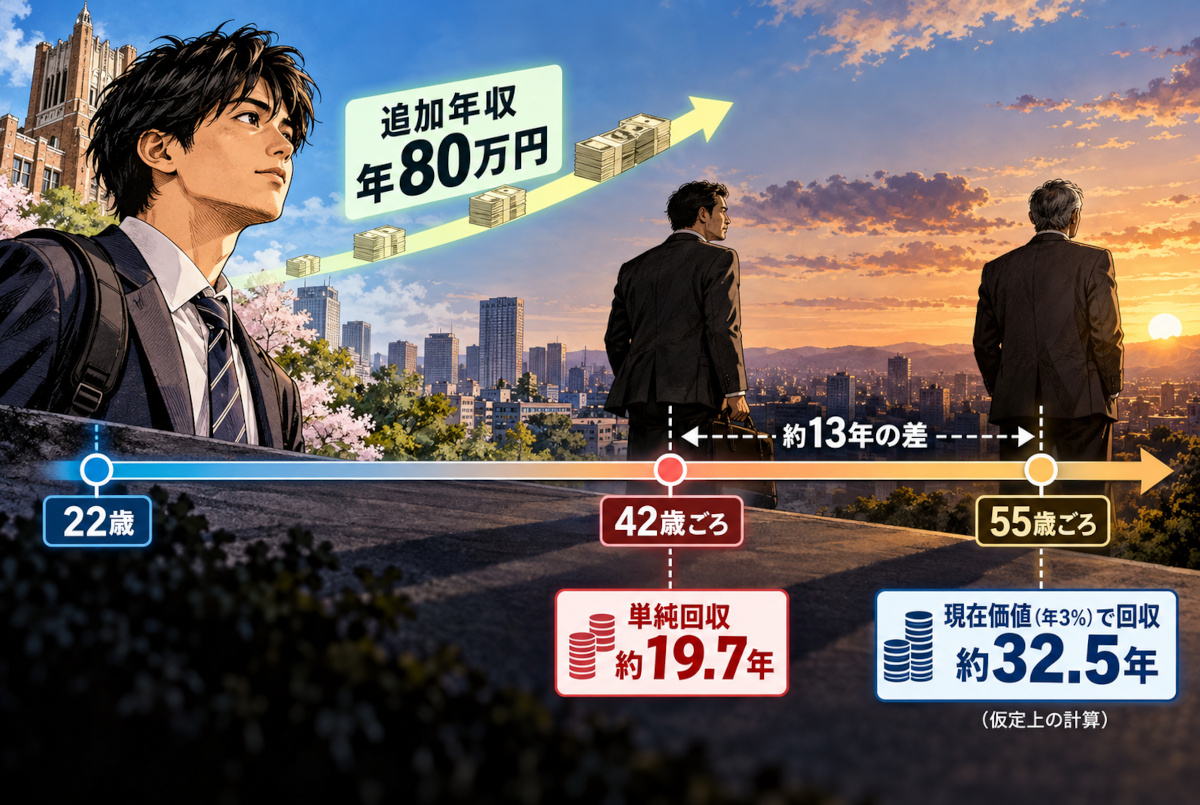
Original hypothetical model using approximately ¥15.74 million in university payments and forgone wages. With an assumed annual earnings advantage of ¥800,000, simple payback takes about 19.7 years (age 42). Discounting the costs to graduation and applying a 3% annual discount rate to later earnings produces a payback period of about 32.5 years (age 55). The Japanese labels indicate the additional annual income, simple payback and discounted payback. These are not predictions or guarantees of real earnings or career outcomes. People and background are fictional, AI-generated illustrations.
The same assumed ¥800,000 annual earnings advantage produces a difference of roughly 13 years between simple payback and discounted payback.
The 3% discount rate is an analytical assumption. It is not the interest rate on a JASSO student loan, a guaranteed investment return or a forecast of future wage growth.
Actual results would also depend on taxes, inflation, changes in earnings, unemployment, retirement and how the costs are financed.
The lesson is not that every university graduate needs until age 55 to break even. It is that the answer to “When does the degree pay off?” depends heavily on the calculation being used.
Do Student Loans Make University Cheaper—or Just Move the Bill Into the Future?
Japan’s student financial support system makes an important distinction between support that does not have to be repaid and loans that must be repaid after graduation.
JASSO offers both grant-type scholarships and loan-type scholarships. Its Type II Scholarship is an interest-bearing student loan.
Suppose a student borrows ¥100,000 each month for 48 months.
The total principal is ¥4.8 million.
JASSO’s official repayment example shows that, at an assumed 2.0% annual interest rate over 20 years, the total repayment would be ¥5,874,754, including ¥1,074,754 in interest.
In rounded figures, that is approximately ¥5.87 million repaid, of which ¥1.07 million is interest.
The ¥4.8 million principal should not simply be added again to the university-cost model. It is money borrowed to finance expenses already counted. Doing so would count the same expenditure twice.
Interest and other financing costs can add to the total economic burden. The actual rate on a JASSO Type II loan is determined when the lending period ends, and repayment conditions depend on the applicable arrangement.
A loan changes when expenses are paid. A grant or tuition reduction can actually reduce the amount that needs to be paid.
For Families With Three or More Dependent Children, the Calculation Changes Again
Japan expanded its Higher Education Support System in the 2025 academic year.
Under the expanded measures, students from households supporting at least three dependent children may qualify for tuition and admission-fee reductions up to government-set limits, without an income ceiling.
For private universities, the maximum reduction is ¥700,000 in annual tuition and ¥260,000 in admission fees.
Across a four-year degree, this creates a maximum theoretical reduction of:
¥700,000 × 4 + ¥260,000 = ¥3,060,000.
But that maximum cannot be applied mechanically to every fee model.
In our private university example, the average admission fee is only ¥240,365, below the ¥260,000 support ceiling.
Applying the eligible amounts to the hypothetical four-year payment total gives:
¥5,309,493 − (¥700,000 × 4 + ¥240,365) = ¥2,269,128.
That reduces the estimated university payments from about ¥5.31 million to approximately ¥2.27 million, assuming full eligibility throughout the four years and that the applicable tuition amounts qualify for the maximum reduction.
Actual support depends on the institution’s eligibility, academic requirements, the household’s dependent-child status and other applicable conditions.
Not every household with three children automatically receives the maximum amount for four years. Nor does this fee reduction eliminate all living expenses or the opportunity cost of time spent studying.
So At What Age Does a University Degree Pay for Itself?
Our private university model combines approximately ¥5.31 million in payments with ¥10.43 million in potential forgone wages, producing an economic comparison cost of around ¥15.74 million.
With an assumed annual earnings advantage of ¥800,000 after graduation, simple payback occurs at roughly age 42. Under the 3% discounted model, payback moves to around age 55.
Neither age is a universal answer.
Tuition, living arrangements, grants, loans, chosen occupation, actual earnings and the likelihood of completing the degree can all change the result.
For students and parents, the useful question is not merely whether a university is prestigious or easy to enter.
How much will it really cost to complete the degree, and what kind of employment opportunities does that particular program lead to?
There is also the alternative of entering employment after high school and developing technical skills or professional experience.
In the final part of this series, we will compare those career paths and ask under what circumstances a high school graduate might outperform someone holding a degree from a lower-ranked university.
Editor’s Note
I’ve always found the phrase “It’s only about five million yen for four years” a little suspicious. As if five million yen were pocket change.
But what really caught my attention was the direction of the money.
Leave school and take a job, and money starts coming in. Go to university, and money starts going out. For four years, those two cash flows are heading in opposite directions.
And then there’s the student loan. Borrow enough, and the immediate problem seems to disappear. Except it hasn’t disappeared at all. It’s simply moved to a later date, with interest potentially attached.
Of course, university offers things that cannot be reduced to a salary calculation. Knowledge, relationships, opportunities, experiences—some of those can matter enormously.
Still, if a family is about to commit several million yen, surely it makes sense to look beyond an entrance-exam ranking and check the actual fees and employment destinations.
“At least you’ll have a degree” is a remarkably convenient phrase. Sometimes I wonder whether it gets used most confidently when nobody wants to examine the receipt.
The Value of a Low-Ranked University Degree — Three-Part Series
Is a degree from a low-ranked university worth it? Across three articles, we examine wage differences, the real costs of university education, and the long-term career outcomes of university graduates compared with those who enter the workforce after high school.
- Part 1: Is a Low-Ranked University Degree Still Worth It? Japan’s Wage Data Have a Catch (Part 1)
- Part 2: ¥5.31 Million in Fees, ¥10.43 Million in Forgone Wages: Does University Pay Off? (Part 2)
- Final Part: High School vs. a Low-Ranked University: Who Comes Out Ahead After 40 Years? (Final Part) Coming soon
Terms That May Need a Quick Explanation
- Opportunity Cost
- The value of a benefit given up when choosing one option instead of another. For university attendance, it can include wages someone might have earned by entering employment after high school. It is not money paid directly to the university.
- Present Value
- The value assigned today to money received or paid at another point in time, calculated using an assumed discount rate. With a positive discount rate, money received further in the future has a lower present value.
References
- Ministry of Education, Culture, Sports, Science and Technology (MEXT), “Survey Results on Student Payments for Entrants to Private Universities and Other Institutions in Academic Year 2025” (in Japanese). Source for private university tuition, admission fees and first-year payments.
- MEXT, “Current Status of National University Corporations and Related Institutions” (in Japanese). Source for the national university standard annual tuition and admission fee used in the model.
- MEXT, “2025 Survey Results on Student Fees at Public Universities” (in Japanese). Source for the average tuition and admission fees at local public universities.
- Ministry of Health, Labour and Welfare, “2025 Basic Survey on Wage Structure,” Table 3: Wages by Educational Attainment and Age Group (in Japanese). Source for the high school graduate wage figures used to model forgone earnings.
- Japan Student Services Organization (JASSO), “2024 Student Life Survey” (in Japanese). Source for annual education and living expenses by university type and housing arrangement.
- JASSO, “Interest and Interest Rate Calculation Methods for Type II Scholarships” (in Japanese). Official repayment examples for interest-bearing student loans, including a ¥4.8 million principal.
- MEXT, “Higher Education Support System” (in Japanese). Official information on tuition and admission-fee reductions, including the expanded support for families with three or more dependent children.