

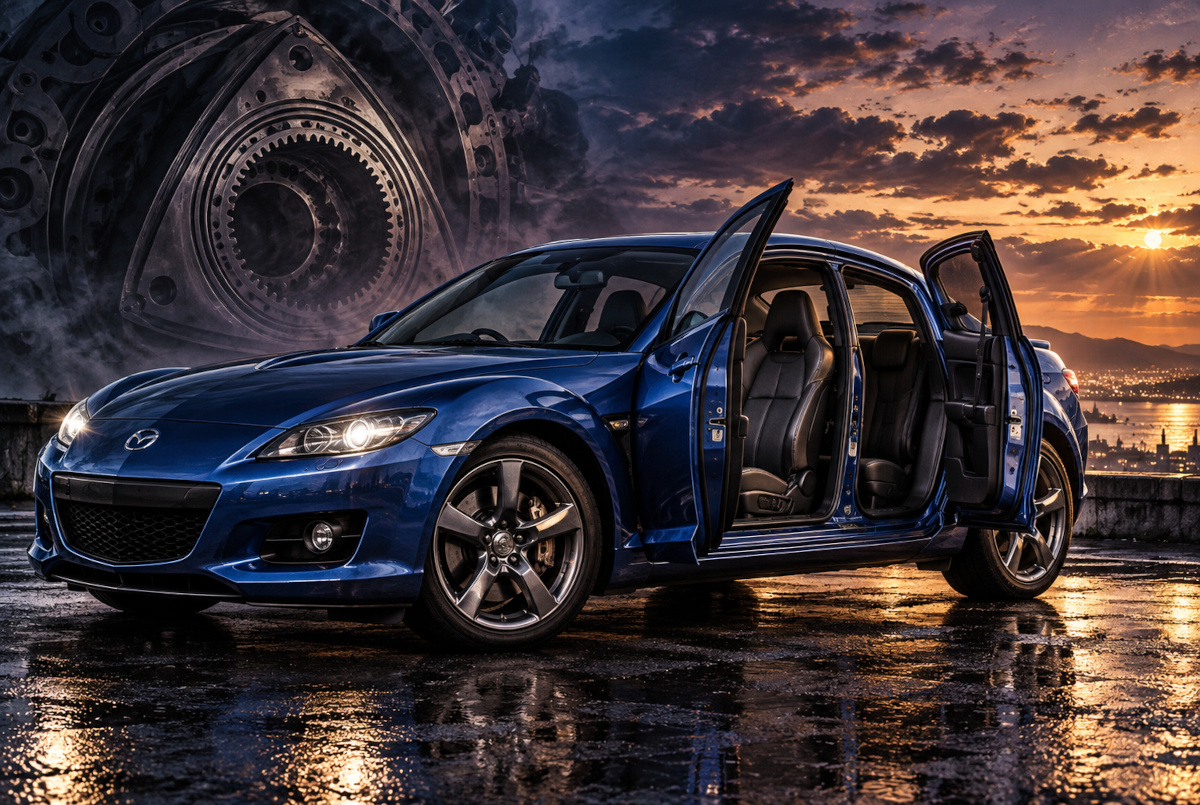
At the 1999 Tokyo Motor Show, Mazda unveiled the RX-EVOLV, a concept car built around a new naturally aspirated rotary engine called RENESIS. The proposed output was an ambitious 280 PS at 9,000 rpm—without a turbocharger.
Four years later, the production Mazda RX-8 arrived with 250 PS in its high-output Type S version. When Mazda revised the car in 2008, that figure fell to 235 PS.
How did a rotary sports-car project targeting 280 PS end up producing a four-door car with 250 PS, and later just 235 PS? For RX-7 enthusiasts expecting another two-door turbocharged machine, the change was hard to ignore.
Was Mazda abandoning performance? Or was the company trying to preserve something more important than a horsepower figure?
We went back through Mazda’s original Japanese announcements, from the 1995 RX-01 concept to the 2008 RX-8 revision, and compared the engineering, prices and specifications behind that decision.
Before the Four Doors Came a Four-Seater: The 1995 RX-01
The story begins with the RX-01, unveiled at the 1995 Tokyo Motor Show. This rotary-powered concept featured an experimental two-rotor engine producing a stated 220 PS and seating for four people.
It was not a four-door car. But the idea of combining rotary sports-car performance with space for four occupants was already taking shape.
Then came a serious setback.
In 1996, as Mazda underwent restructuring and its relationship with Ford deepened, development of a new rotary-powered sports car was frozen.
Mazda’s own centenary history describes what happened next. A small group of engineers refused to let the project disappear. Working discreetly, they modified an old MX-5 Miata (Roadster) used for driver training and fitted it with an experimental rotary engine.
They wanted management to experience what the next rotary sports car could become, rather than judge the project solely by its projected sales and costs.
In 1999, the RX-EVOLV concept emerged.
Its RENESIS engine had a striking proposed specification: 280 PS at 9,000 rpm without forced induction. Mazda also proposed two output modes tailored to driver experience—280 PS for expert drivers and 240 PS for less experienced drivers.
There is an important catch: those were concept-stage target figures, not proof that a production-ready RENESIS engine had achieved 280 PS.
The distinction matters. Otherwise, it would be easy to accuse Mazda of simply throwing away 30 PS between the concept and the showroom.
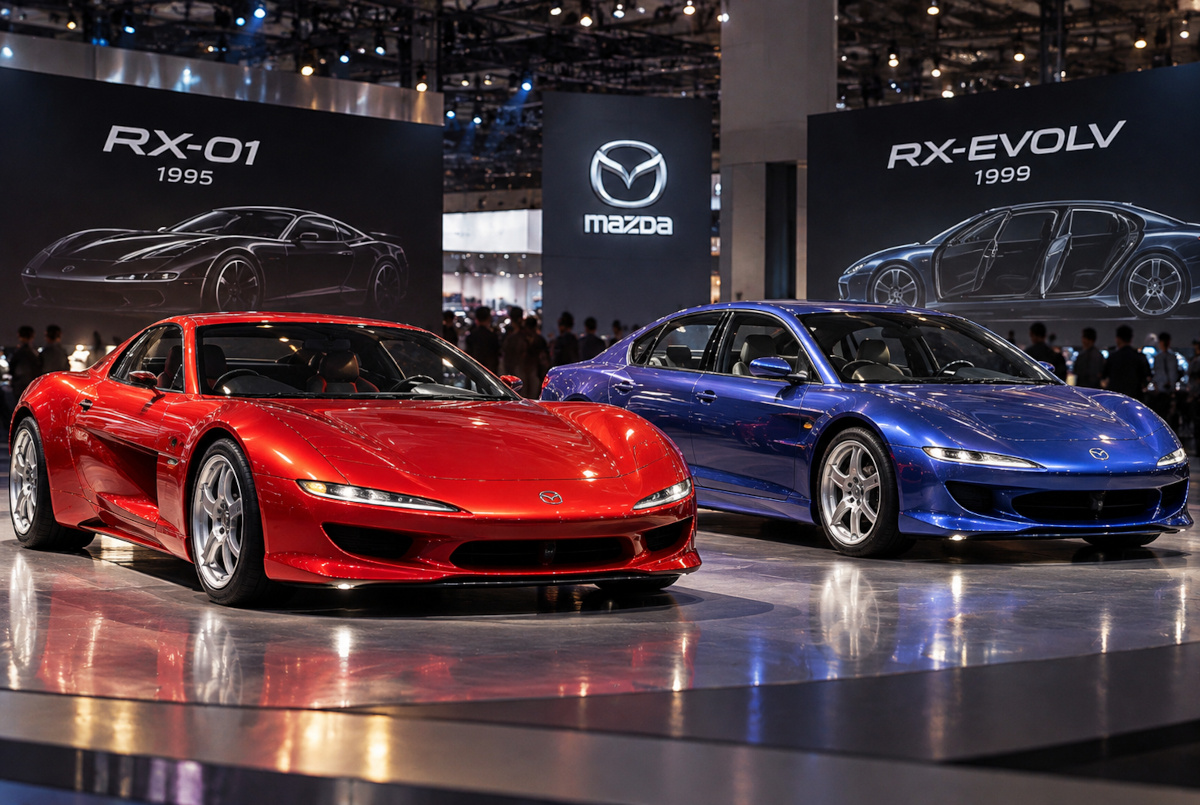
AI-generated interpretation of Mazda’s changing rotary sports-car concepts between the 1995 RX-01 and 1999 RX-EVOLV. The names and years are historically accurate, but the vehicle styling, door arrangements and exhibition setting contain fictional elements. This is not a recreation of the actual concept cars or an official Mazda display.
Why Four Doors? Mazda Had to Reinvent the Body Structure
Mazda announced the production RX-8 on April 9, 2003, with showroom sales beginning in early May.
The product brief was different from that of the RX-7. Mazda wanted to reach people who loved sports cars but had reluctantly given them up because they also needed room for family or friends.
The most obvious answer was the RX-8’s Freestyle Door system: two conventional front-hinged doors combined with two smaller rear-hinged doors.
With both doors open, the absence of a fixed center pillar creates an unusually wide opening. The catch is that the rear doors cannot be opened independently; the front doors must be opened first.
Removing the conventional center pillar also created a structural challenge, particularly for side-impact protection.
Mazda’s solution was to integrate high-strength steel reinforcement into the rear doors. Known as the built-in pillar, this structure helped provide the necessary body strength when the doors were closed.
The RX-8 was not an ordinary four-door sedan with a rotary engine dropped under its hood. Mazda engineered a sports-car body around the requirement to carry four adults.
The packaging work went further. Compared with the RX-7, Mazda positioned the new engine 40 mm lower and 60 mm farther rearward, making better use of the compact rotary layout.
The cabin could accommodate four adults, while the trunk offered 290 liters of luggage capacity under the VDA measurement method.
In other words, the four doors were not a styling gimmick added at the end of development. They influenced the vehicle’s structure and packaging from the beginning.
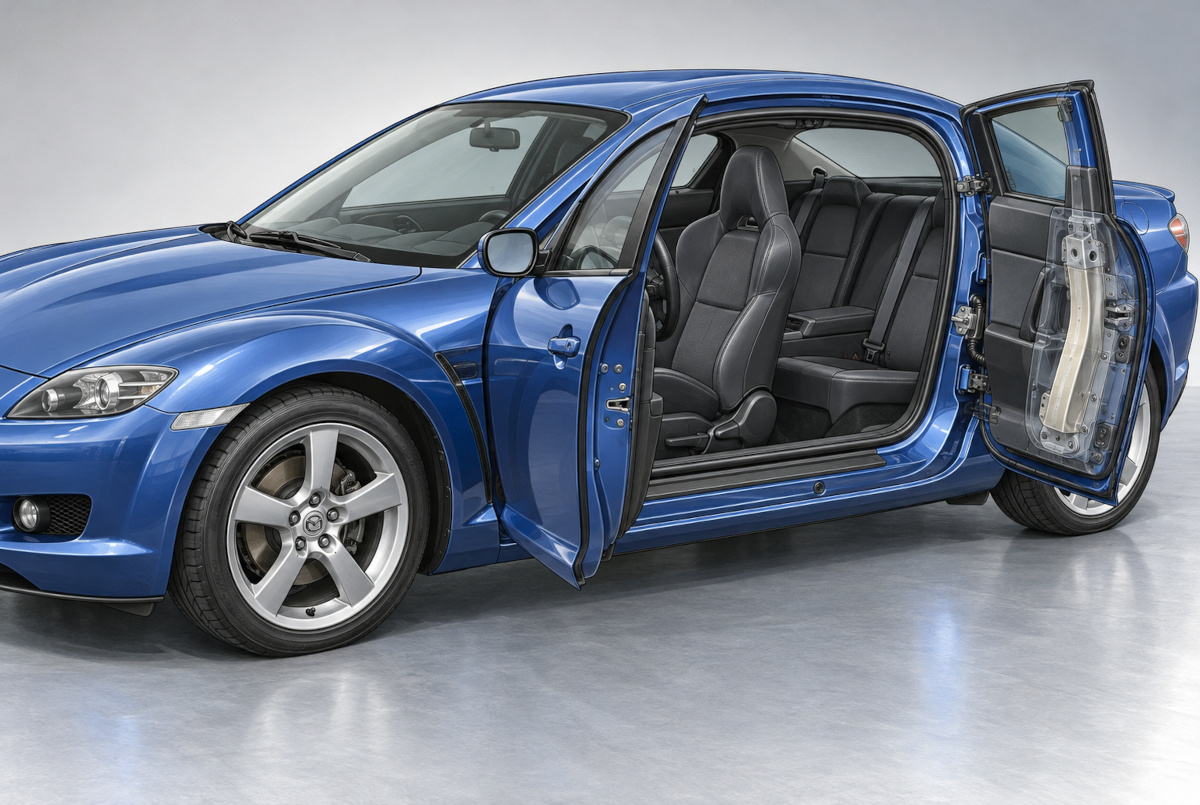
Conceptual AI illustration of the RX-8’s Freestyle Doors and built-in pillar. Reinforcement inside the rear door helps support side-impact protection in the pillarless opening. Component shapes and mounting details have been simplified and are not an exact reproduction of Mazda’s engineering drawings.
Why Did RENESIS Abandon the Turbocharger?
The late Mazda RX-7 FD3S used the sequentially twin-turbocharged 13B-REW rotary engine, eventually reaching 280 PS in certain Japanese-market versions.
The RX-8 took a different route with the naturally aspirated 13B-MSP RENESIS.
One of its defining changes was the side-exhaust-port layout. Earlier RX-7 rotary engines discharged exhaust through ports around the outer circumference of the rotor housing. RENESIS moved the exhaust ports to the side housings.
Mazda also revised the intake system, increasing intake-port area by approximately 30% compared with the previous design, according to its launch announcement.
These changes were intended to improve the engine’s breathing while addressing fuel consumption and exhaust emissions—areas in which rotary engines faced demanding engineering challenges.
At its 2003 launch, the six-speed manual Type S produced 250 PS at 8,500 rpm. The standard-output version produced 210 PS at 7,200 rpm.
But a closer look at the torque ratings reveals something curious.
The 250 PS engine developed a maximum of 216 N·m, while the 210 PS version produced 222 N·m.
The version with more peak horsepower actually had a slightly lower peak torque figure.
There is no contradiction here. Peak power and peak torque are measured at different engine speeds, and a high-revving engine can make more power without recording the highest torque peak.
RENESIS was not simply a weaker version of the RX-7’s turbocharged engine. It represented a different approach, emphasizing naturally aspirated response, high-rpm operation and improved emissions performance.
From 250 PS to 235 PS: Did the 2008 RX-8 Really Get Slower?
On March 10, 2008, Mazda introduced a substantially revised RX-8. The lineup gained a new Type RS, but even that performance-oriented model was rated at 235 PS.
The revised Type S also produced 235 PS—15 PS less than the original 2003 Type S.
Instead of comparing different trims, we examined the Japanese-market six-speed manual Type S at both ends of this period, using contemporary specifications and Mazda’s 2008 data.
| Specification | 2003 Type S | 2008 Type S |
|---|---|---|
| Maximum output | 250 PS / 8,500 rpm | 235 PS / 8,200 rpm |
| Maximum torque | 216 N·m | 216 N·m |
| Curb weight | 1,310 kg | 1,350 kg |
| Original price, excluding consumption tax | ¥2,750,000 | ¥2,800,000 |
| Weight divided by maximum output | 5.24 kg/PS | Approx. 5.74 kg/PS |
Comparison conditions: Japanese domestic-market RX-8 Type S models with six-speed manual transmissions. Prices are original nominal Japanese list prices excluding consumption tax. The 2008 curb weight may vary with factory options. Differences in standard equipment between model years have not been adjusted for. PS denotes metric horsepower; overseas-market specifications may differ.
The published figures reveal three important changes.
- Peak output fell by 15 PS, or 6.0%.
- Curb weight increased by 40 kg, or approximately 3.1%.
- Weight per unit of power rose from 5.24 to approximately 5.74 kg/PS, an increase of about 9.6%.
The last figure comes from our own recalculation of the published data:
2003 Type S: 1,310 ÷ 250 = 5.24 kg/PS.
2008 Type S: 1,350 ÷ 235 = approximately 5.74 kg/PS.
Judged strictly by the catalog power-to-weight ratio, the 2008 RX-8 Type S was at a disadvantage compared with its 2003 predecessor.
That conclusion cannot be avoided merely by saying the later car was more refined.
But neither can we assume the car’s acceleration times, cornering behavior or driving feel deteriorated by exactly 9.6%.
For the 2008 revision, Mazda introduced redesigned water and oil pumps and revised the six-speed manual transmission’s gear ratios and final-drive gearing. The company said these changes improved acceleration feel in everyday driving and helped maintain consistent engine performance.
Engineers also revised the suspension, increased rigidity in selected body areas and improved aerodynamics.
And there is another detail that rarely fits the simple story of falling RX-8 horsepower: the standard-output model actually rose from 210 PS at launch to 215 PS in the 2008 revision.
Not every RX-8 variant lost power.
The 15 PS reduction in the Type S is a documented fact. However, the precise reasons for that specific output decision—and the resulting change in measured acceleration performance—cannot be established conclusively from the official materials examined here.
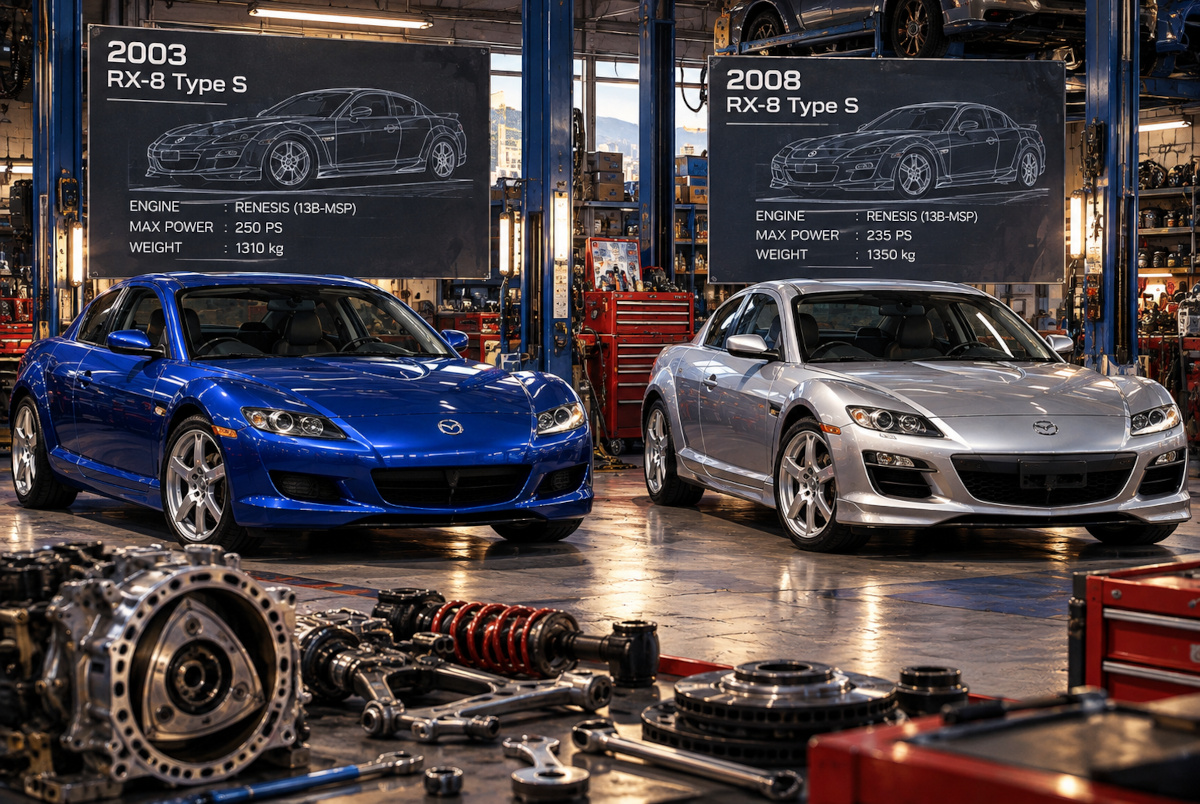
AI-generated comparison of the Japanese-market 2003 RX-8 Type S (250 PS, 1,310 kg) and revised 2008 Type S (235 PS, 1,350 kg). The numerical specifications are based on period data. Body details, wheels and workshop components contain artistic approximations and do not precisely reproduce factory specifications or an actual Mazda workshop.
From ¥3.998 Million to ¥2.75 Million: The Price Strategy Changed Too
The pricing makes the shift in Mazda’s product strategy even clearer.
In 2002, the final RX-7 Spirit R Type B was a four-seat, five-speed manual sports car producing 280 PS. Its original Japanese list price was ¥3,998,000 before consumption tax.
The RX-8 Type S, launched in 2003, also carried four people and used a manual transmission—this time a six-speed. It produced 250 PS and cost ¥2,750,000 before tax.
Subtracting the two prices gives a difference of ¥1,248,000.
That means the RX-8 Type S was approximately 31.2% less expensive than the final RX-7 Spirit R Type B on these nominal pre-tax figures.
There is an important limitation to this comparison. The RX-7 was a specially equipped final limited edition, while the RX-8 was a regular-production model. The two cars were not matched for equipment, and the calculation does not adjust for other ownership costs.
Even so, the difference points toward Mazda’s intention to reach a wider group of buyers rather than simply replace the RX-7 with an equally expensive performance flagship.
Mazda’s original RX-8 announcement provides another clue. By the end of March 2003, the company had received approximately 5,000 advance orders against a planned monthly domestic sales volume of 1,000 units.
Advance orders are not the same as completed retail sales, but they demonstrate the initial response to Mazda’s unusual four-door rotary concept.
The RX-8 Was Not Another RX-7. It Was a Different Way to Keep the Rotary Alive
Put the two models side by side and the differences seem obvious.
The late RX-7 offered a two-door body, sequential twin turbochargers and up to 280 PS. The RX-8 offered four doors, a naturally aspirated engine and 250 PS in its original high-output form.
For enthusiasts who wanted a straightforward successor to the FD3S, disappointment was understandable.
But the broader development story changes the interpretation.
Mazda had faced a development freeze, worked to keep the rotary program alive, redesigned the engine around new priorities and created a body that combined sports-car proportions with four usable seats. It also positioned the resulting car at a substantially different price.
The RX-8 was not merely an RX-7 that had lost its turbochargers. Its engine, structure and target customers were reconsidered together.
The RX-8 did not provide the same answer as the RX-7. It changed the question: how could Mazda continue selling a dedicated rotary sports car under very different conditions?
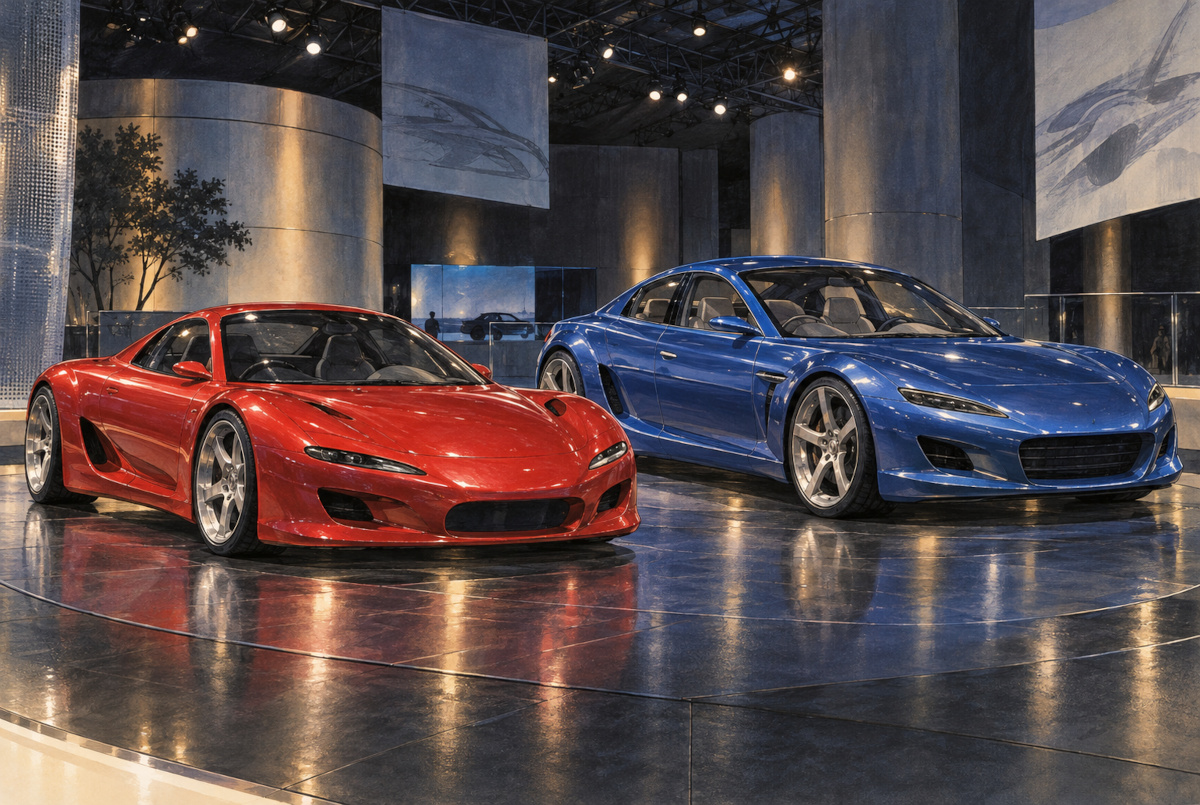
AI-generated conceptual illustration of two approaches to rotary sports-car design: a low coupe and a more practical four-seat sports car. The image refers to the development ideas behind the RX-01 and RX-EVOLV, but the depicted vehicle designs and exhibition setting are fictional rather than exact reproductions.
Editor’s Note
I’ll admit it: when I first saw the RX-8, my reaction was pretty much, “Why on earth does this thing need four doors?”
Once you’ve fallen for the FD RX-7’s low body and twin-turbo rotary, a four-door successor is not exactly what you dream about.
But while researching this story, the doors stopped being the strangest part.
The horsepower numbers bothered me more. Mazda was talking about 280 PS from a naturally aspirated rotary concept in 1999. Then the production Type S arrived with 250 PS, and the 2008 revision brought that down to 235 PS. Aren’t sports cars supposed to gain horsepower as they evolve?
Apparently not always.
And then there’s the wonderfully peculiar business of the center pillar. Mazda removed the conventional fixed pillar to make the doors work, only to build a reinforcing pillar into the rear door itself. That’s quite a lot of engineering to make a four-door sports car happen.
Would I have liked to see another low, two-door, 280 PS RX-7? Of course.
But without a viable project like the RX-8, Mazda’s production rotary sports cars might have disappeared sooner. That’s a possibility, not something the historical documents can prove.
I wouldn’t automatically rank the RX-8 above the RX-7. But after examining what Mazda actually had to do, calling it a betrayal feels like a rather lazy verdict.
Terms That May Need a Quick Explanation
- Freestyle Doors
- Mazda’s name for the RX-8’s front-hinged front doors and rear-hinged rear doors. The arrangement creates a wide opening without a conventional fixed center pillar. The rear door can only be opened after the corresponding front door.
- Side-Exhaust-Port Rotary Engine
- A rotary engine layout in which exhaust ports are located in the side housings rather than around the rotor housing’s outer circumference. The configuration was an important part of RENESIS’s improvements in emissions and fuel consumption.
Mazda Rotary: A Seven-Part Series
From the pioneering Cosmo Sport to the RX-7 and RX-8, we trace Mazda's rotary-engine ambitions, engineering breakthroughs, commercial challenges, and the technology's eventual revival. Seven articles examine the history through original comparisons, calculations, and historical records.
- Part 1: Only 1,176 Mazda Cosmo Sports: What Was Mazda Really Building? (Part 1)
- Part 2: Did Mazda’s Rotary Engine Nearly Sink the Company? The 40% MPG Mystery (Part 2)
- Part 3: When Did the Mazda Cosmo Become a Luxury Car? From the Red AP to a ¥5.3 Million Three-Rotor GT (Part 3)
- Part 4: The Cosmo Had 280 PS. Why Did the First FD RX-7 Get Only 255?
- Part 5: Mazda Aimed for 280 PS—So Why Did the RX-8 Arrive with Four Doors and 250 PS?
- Final Part: Mazda Built 100,000 RX-8s in 18 Months. So Was It a Failure? (Final Part) Coming soon
- Special Edition: Mazda’s Rotary Returned as a Generator. Is a 510-PS Coupe Next? [Special Edition] Coming soon
References
- Kanto Mazda, 1995 Mazda RX-01 Concept Car: Exhibition and Specifications (Japanese). Original specifications, including the two-rotor engine, 220 PS output and four-seat configuration.
- Mazda 100th Anniversary Virtual Museum: Motor Show Cars, Part 4 (Japanese). Official photographs of the actual RX-01 and RX-EVOLV concept cars.
- Mazda 100th Anniversary: The Secret Mission That Kept the Rotary Engine Alive (Japanese). The development freeze, experimental Roadster and efforts to preserve Mazda’s rotary sports-car program.
- Mazda News Release, October 13, 1999: RX-EVOLV Concept Unveiled (Japanese). The naturally aspirated RENESIS concept, 280 PS and 240 PS target ratings, and four-seat sports-car proposal.
- Mazda News Release, March 25, 2002: Final RX-7 Spirit R Limited Editions (Japanese). Type B seating, 280 PS rating and ¥3,998,000 pre-tax price.
- Mazda News Release, April 9, 2003: Introduction of the Four-Door, Four-Seat RX-8 (Japanese). RENESIS specifications, Freestyle Doors, vehicle packaging, original prices and marketing objectives.
- Mazda Technical Review 2003 (Japanese). Mazda engineering papers on RENESIS, side exhaust ports, RX-8 packaging and the structural design of the Freestyle Door system.
- Motor-Fan, Mazda RX-8 Type S: April 2003 Model Specifications (Japanese). Original Type S specifications, including 250 PS, 1,310 kg and ¥2,750,000.
- Mazda News Release, March 10, 2008: Revised RX-8 and New Type RS (Japanese). Engine, gearbox, suspension, aerodynamic and pricing changes.
- Mazda, 2008 RX-8 Official Specifications (PDF) (Japanese). Original manufacturer data for engine output, torque, curb weight, transmission ratios and equipment-dependent weight variation.