

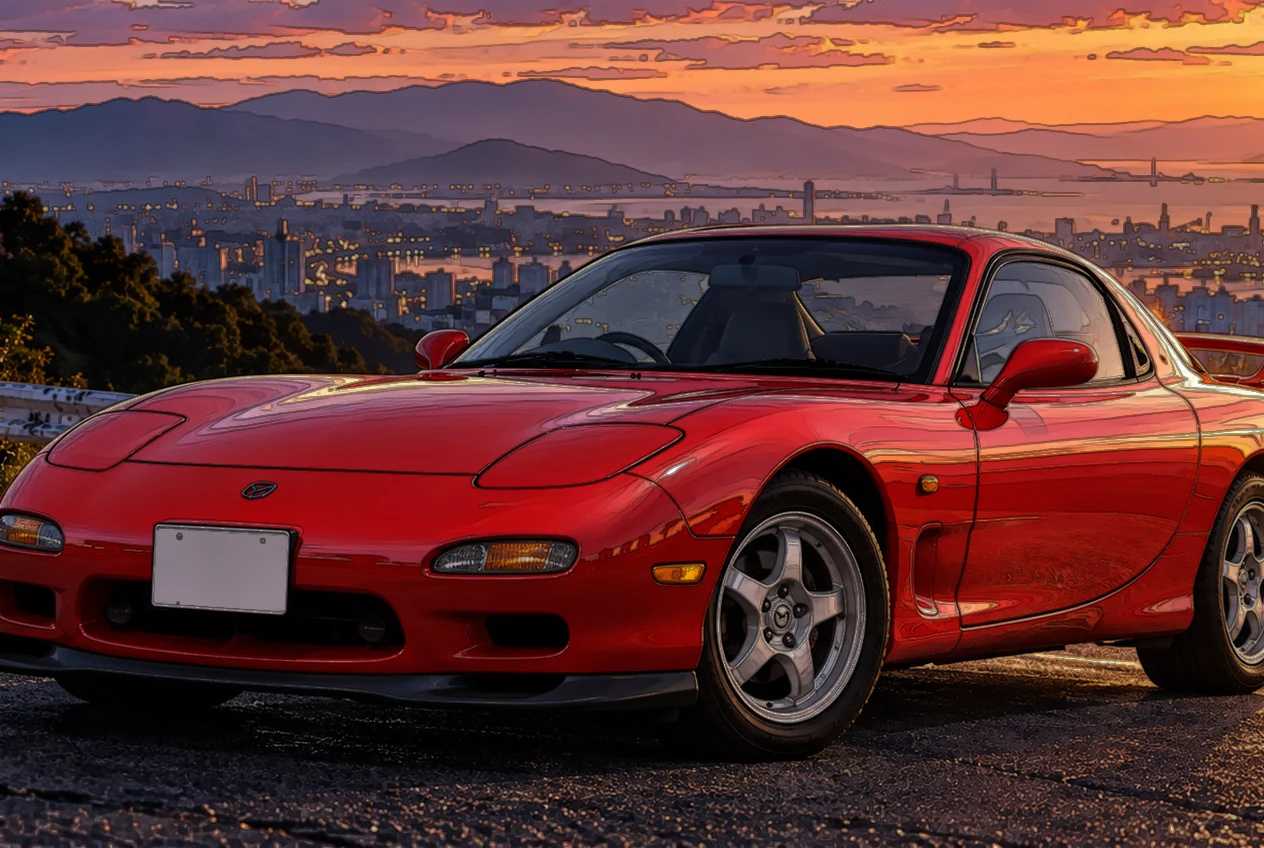
In 1990, Mazda launched the Eunos Cosmo with a three-rotor 20B engine producing 280 PS. It was the high-water mark of Mazda’s rotary-powered luxury grand tourers, as explored in the previous installment of this series.
Then, in December 1991, Mazda introduced the third-generation RX-7, better known by its FD3S chassis code. Its output? Just 255 PS—25 PS less than the Cosmo.
Mazda already had a 280 PS rotary car. So why did its dedicated sports car arrive with only 255 PS?
There is an important distinction: the Cosmo used a three-rotor 20B, while the FD used a two-rotor 13B-REW. Mazda had not simply detuned the same engine by 25 PS.
To understand what changed, we compared the SA22C, FC3S and FD3S using Japanese-market specifications—not just horsepower, but weight, suspension design and original prices. The numbers tell a more interesting story than a straightforward horsepower race.
SA vs FC vs FD: Comparing the RX-7’s Three Generations
For a consistent starting point, we selected representative four-seat, five-speed manual versions from the beginning of each generation’s Japanese production run: the SA22C GT, FC3S GT and FD3S Type R.
The three trims were not equipped to identical standards. This is a comparison of their engineering development, not a controlled test of equally equipped cars.
| Specification | SA22C | FC3S | FD3S |
|---|---|---|---|
| Japanese launch | March 1978 | October 1985 | December 1991 |
| Selected trim | GT | GT | Type R |
| Engine | 12A, naturally aspirated | 13B, turbocharged | 13B-REW, sequential twin-turbo |
| Maximum output | 130 PS (gross) | 185 PS (net) | 255 PS (net) |
| Curb weight | 1,005 kg | 1,210 kg | 1,260 kg |
| Rear suspension | Four-link live axle | Independent semi-trailing arm | Double wishbone |
| Original Japanese price | ¥1,440,000 | ¥1,971,000 | ¥3,850,000 |
Source notes: Japanese domestic-market launch specifications. The SA price is the 1978 Tokyo-area figure; the FC price comes from a tax-exclusive catalog listing; the FD price is the contemporary catalog figure. These are nominal prices from different years and trim levels, without adjustments for taxation, equipment differences or inflation. PS means metric horsepower, and the gross and net output ratings are not directly comparable. Export-market cars may have different specifications and prices.
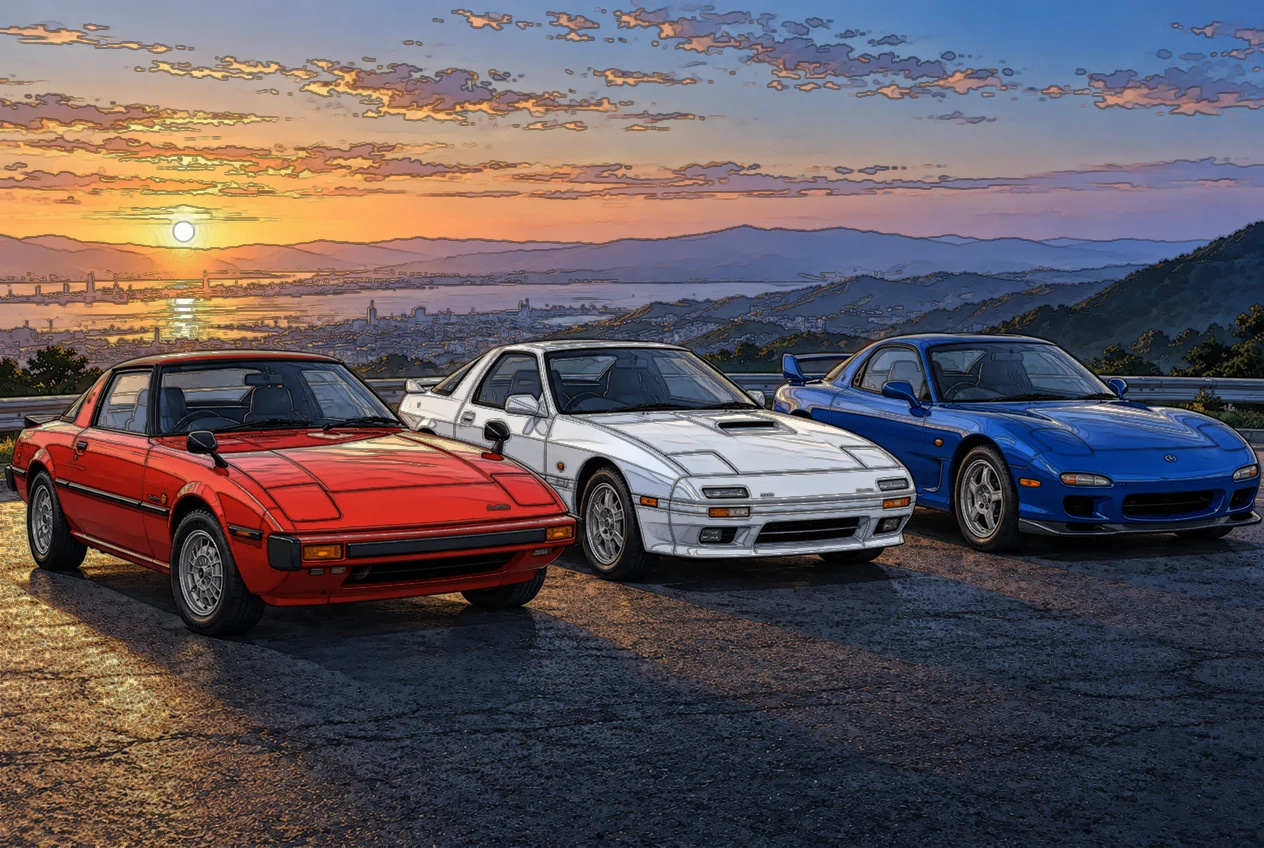
AI-generated illustration comparing the three RX-7 generations. The designs represent their general characteristics rather than exact same-scale reproductions or year-specific factory specifications.
The First Trap: 130 PS vs 185 PS Is Not a Fair Comparison
The original SA22C arrived in 1978 with Mazda’s naturally aspirated 12A rotary engine. Its wedge-shaped body, pop-up headlights and low hood made full use of the compact powerplant. The original drag coefficient was Cd 0.36, and the GT weighed just 1,005 kg.
That sounds appealing even today. But there is a catch in the engine specifications.
Mazda’s own development history identifies the SA’s 130 PS as a gross horsepower rating. The FC3S, launched in 1985, was rated at 185 PS net.
The arithmetic difference is 55 PS. But that does not establish a directly comparable 55 PS increase in engine performance.
Gross and net ratings use different test conditions. Treating them as interchangeable would make the comparison look more precise than it really is.
For anyone researching Japanese classics, this is an easy mistake to make. An old brochure can supply an accurate number without making it directly comparable to a later brochure.
The SA received a turbocharged 12A in 1983, rated at 165 PS gross. Mazda’s rotary performance development was already underway, but the measurement distinction remained important.
The FC Gained 205 kg. What Did That Extra Weight Buy?
When the FC3S appeared in October 1985, it looked and felt like a more substantial machine. The new 13B turbocharged rotary delivered 185 PS net, and the GT weighed 1,210 kg—205 kg more than the original SA GT in our comparison.
It would be tempting to dismiss that increase as the familiar story of a sports car becoming heavier and more comfortable.
But Mazda also made a major change underneath the car.
The SA’s rear suspension used a four-link live axle with a Watt’s linkage. The FC moved to an independent semi-trailing-arm arrangement with Mazda’s toe-control hub.
The toe-control hub was designed to influence rear-wheel toe behavior under changing suspension loads. It was a mechanical, passive system, not a computer-controlled rear-steering mechanism.
The FC’s evolution was not just about making the RX-7 faster in a straight line. Mazda was changing how the car responded through corners.
That distinction matters when judging the second generation. Its extra weight came alongside a fundamentally different chassis approach, not merely additional equipment.
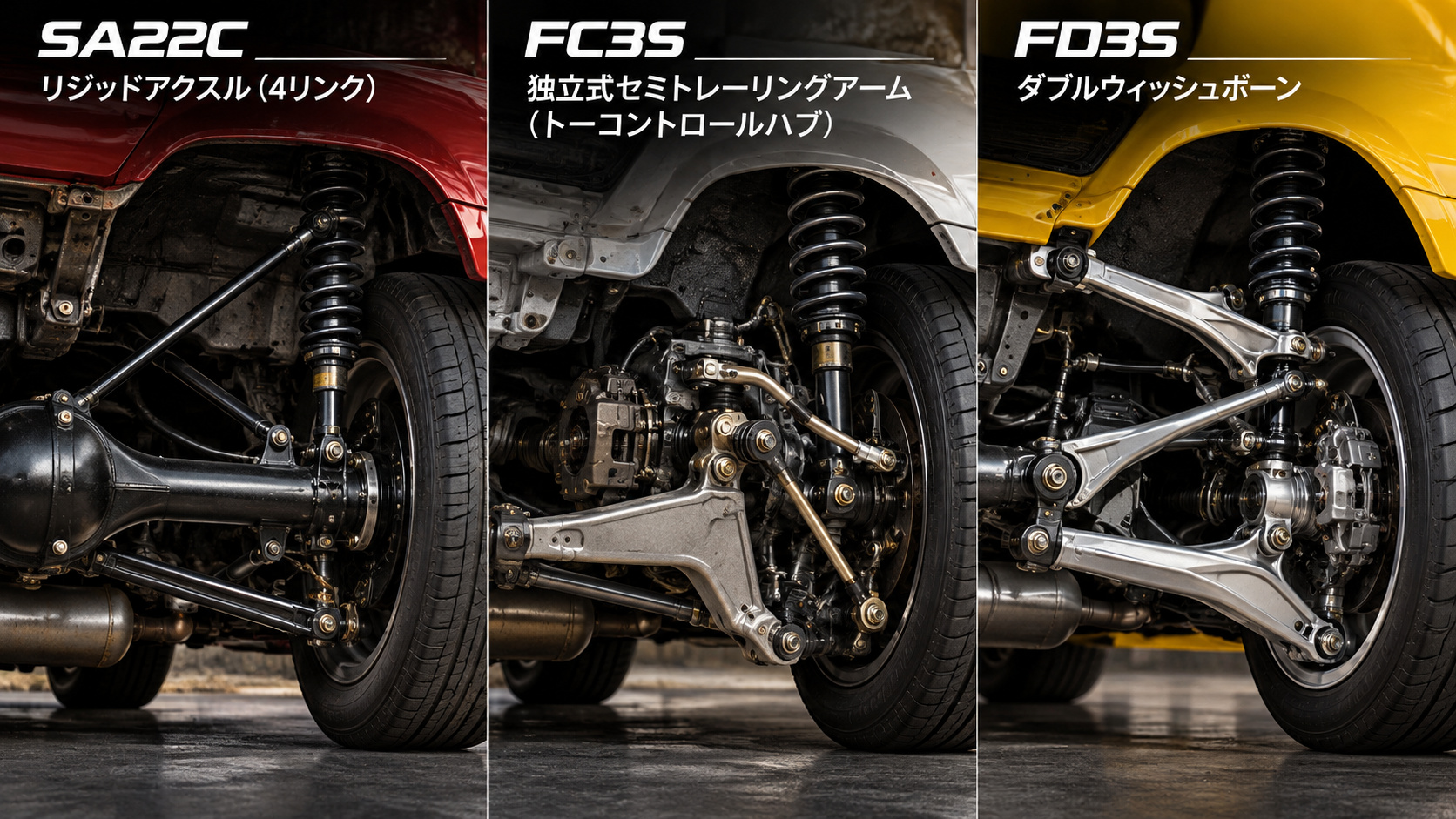
AI-generated conceptual comparison of RX-7 rear suspension development. The SA22C used a four-link live axle with Watt’s linkage; the FC3S used independent semi-trailing arms with a toe-control hub; and the FD3S used double wishbones. Individual component shapes and positions differ from the actual vehicles. This is not a factory engineering diagram.
The FD Was 50 kg Heavier—Yet Had 70 PS More
Here is where the figures become especially revealing.
Our comparison uses the original 1985 FC3S GT and the original 1991 FD3S Type R. Both have net horsepower ratings, so their power figures can be compared on the same basic measurement standard.
The FC had 185 PS and weighed 1,210 kg. The FD had 255 PS and weighed 1,260 kg.
Recalculating the published specifications gives us two very different rates of change:
- Weight: +50 kg, or approximately 4.1%
- Maximum output: +70 PS, or approximately 37.8%
In other words, power increased far more rapidly than weight.
Now consider the power-to-weight ratio, expressed here as kilograms per metric horsepower:
- FC3S GT: 1,210 ÷ 185 = approximately 6.54 kg/PS
- FD3S Type R: 1,260 ÷ 255 = approximately 4.94 kg/PS
From the launch FC to the launch FD, the amount of vehicle weight carried by each PS fell by approximately 24.5%.
That does not mean acceleration or cornering performance improved by precisely 24.5%. Gearing, torque delivery, tires, aerodynamics and many other factors influence real-world performance.
What it does show is how dramatically Mazda changed the balance between weight and output.
There is another interesting detail. Mazda’s own development history states that the FD project targeted a power-to-weight ratio below 5.0 kg/PS. The original Type R’s calculated 4.94 kg/PS meets that target.
This gives our comparison a useful connection to Mazda’s actual engineering objective: the number was not merely an impressive byproduct of a new engine.
Yet the FD was not lighter than its ancestors in absolute terms. It was 255 kg heavier than the original SA GT and 50 kg heavier than the FC GT selected here.
Mazda’s weight-reduction program, known as the Spirit of Zero, was therefore not about returning the RX-7 to its 1978 curb weight.
It was about eliminating unnecessary mass while achieving more demanding performance goals. Aluminum suspension components, carefully engineered body structures and a low center of gravity all played their part.
The FD was designed to make use of its additional power, not simply to display a larger number in a brochure.
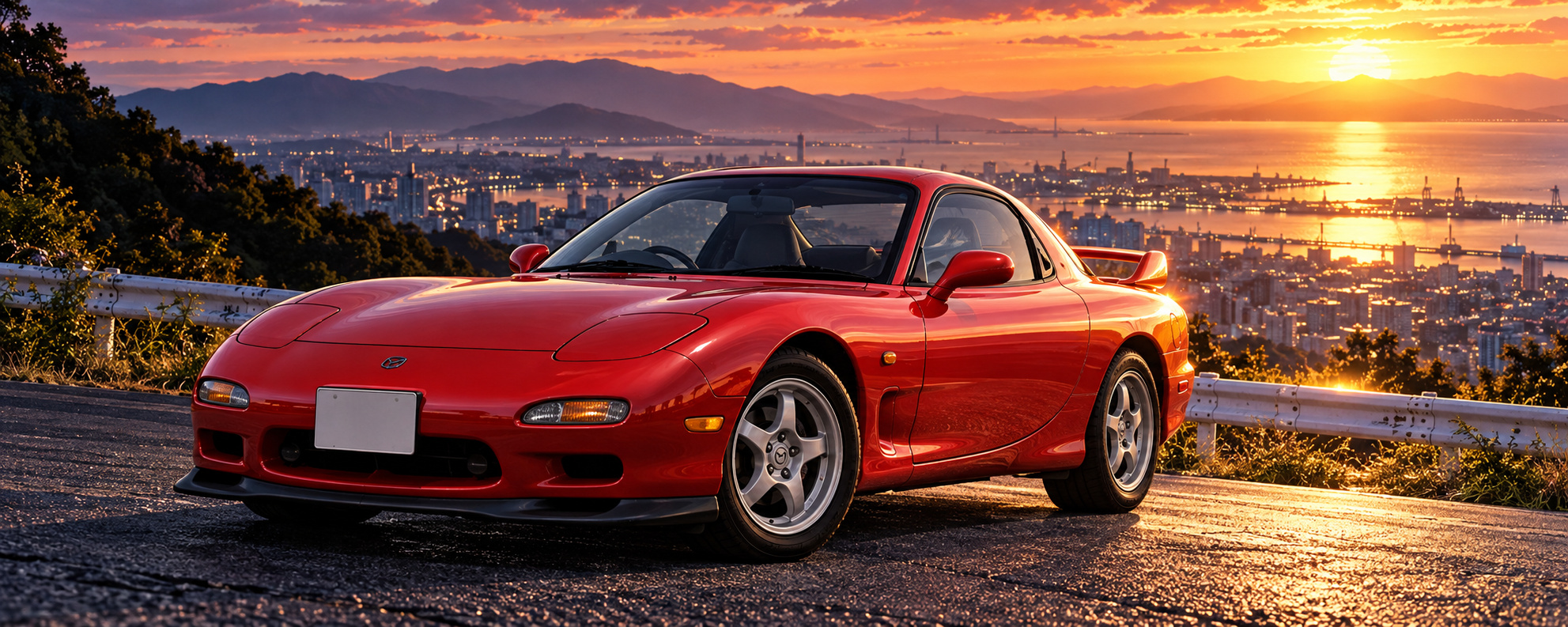
AI-generated illustration emphasizing the FD3S’s low, wide proportions. Exterior components are not intended as an exact reproduction of a particular model year or factory trim.
Why Does Mazda Say the FD Gained 50 PS, Not 70?
Here is another little puzzle hidden in the official history.
Mazda describes the FD’s 255 PS as a 50 PS improvement over its predecessor. But our launch-to-launch comparison gives an increase of 70 PS.
Which number is correct?
Both. The difference is the FC version being used as the starting point.
The FC3S launched in 1985 with 185 PS. A 1989 revision raised output to 205 PS through engine and turbocharger improvements.
- 1985 FC3S, 185 PS → 1991 FD3S, 255 PS: +70 PS
- 1989 revised FC3S, 205 PS → 1991 FD3S, 255 PS: +50 PS
Mazda was comparing the FD with the later regular-production FC. We were comparing the original versions of each generation.
There is no contradiction once the model years are made explicit.
That is precisely why old performance figures deserve closer examination. Even two correct specifications can tell a misleading story if their dates are forgotten.
The FD Did Not Reach 280 PS Until 1999—and Not Every FD Had It
The FD3S continued evolving after its 255 PS debut.
In 1996, manual-transmission models gained an increase to 265 PS. Then, on January 21, 1999, Mazda introduced a revised RX-7 with 280 PS versions of the Type RS and Type R.
But 280 PS was not universal across the range.
The Type RB with a five-speed manual retained 265 PS, while the four-speed automatic version was rated at 255 PS.
So the familiar claim that an FD RX-7 has 280 PS is correct for certain later performance variants—not for every FD3S ever sold.
This also makes the earlier Eunos Cosmo comparison more interesting.
In 1990, Mazda already offered a 280 PS three-rotor grand tourer. Yet its 1991 two-rotor RX-7 was developed around a different combination of engine output, vehicle mass, packaging and handling.
That suggests Mazda prioritized the complete driving package rather than pursuing the largest possible brochure horsepower figure for the FD at launch.
However, the available development history does not conclusively identify how much of the 255 PS decision came from durability, packaging, cost or other engineering constraints. Those individual factors should not be presented as established facts without more specific evidence.
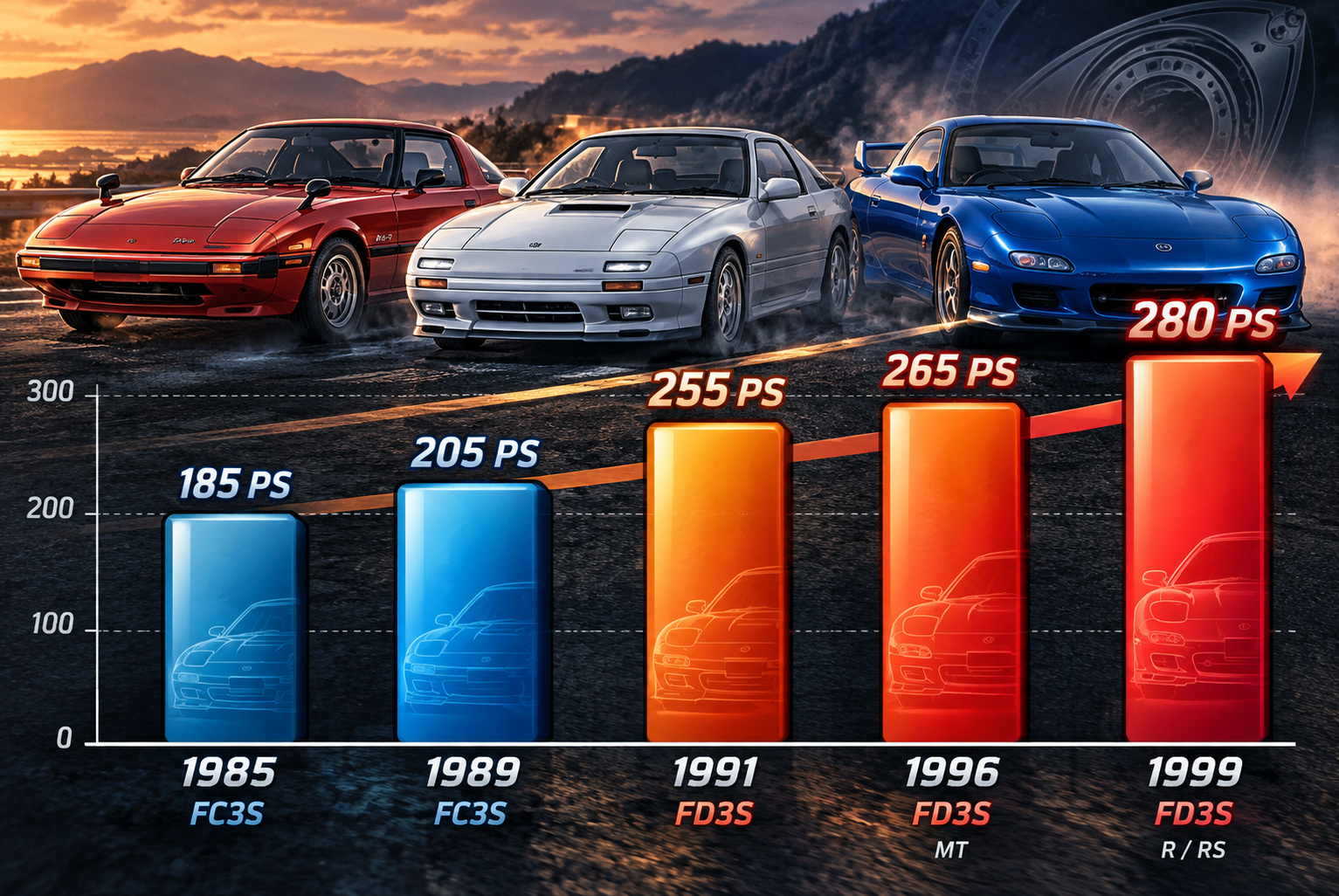
Illustrated timeline of selected Japanese-market RX-7 output ratings. The 1996 figure of 265 PS applies to manual-transmission versions, while the 1999 figure of 280 PS applies to the Type R and Type RS. Background vehicles are AI-generated interpretations. Bar heights are stylized and are not an exact proportional representation of the vertical scale.
From ¥1.44 Million to ¥3.85 Million: What Became More Expensive?
The prices in our comparison table tell their own story.
The original 1978 SA22C GT cost ¥1,440,000 in the Tokyo area. The 1985 FC3S GT was listed at ¥1,971,000, and the 1991 FD3S Type R carried a price of ¥3,850,000.
Dividing the FD price by the SA price gives approximately 2.67.
So the later car’s listed nominal price was about 2.67 times the original figure.
But these prices come from different years and are not adjusted for inflation, taxation or equipment differences. They should not be treated as a direct comparison of affordability.
What interests us more is where the RX-7 went as it became a more expensive car.
The Eunos Cosmo pursued luxury grand touring with its powerful three-rotor engine. The FD retained a two-rotor layout and concentrated its engineering on handling, weight distribution and the driver’s connection with the car.
The RX-7 was becoming more sophisticated and more expensive, but it was not simply turning into another large luxury GT.
In April 2002, Mazda introduced the final limited-edition Spirit R series. RX-7 production ended that August.
From March 1978 to August 2002, the RX-7 had survived for more than 24 years across three generations, maintaining its identity as a purpose-built rotary sports car.
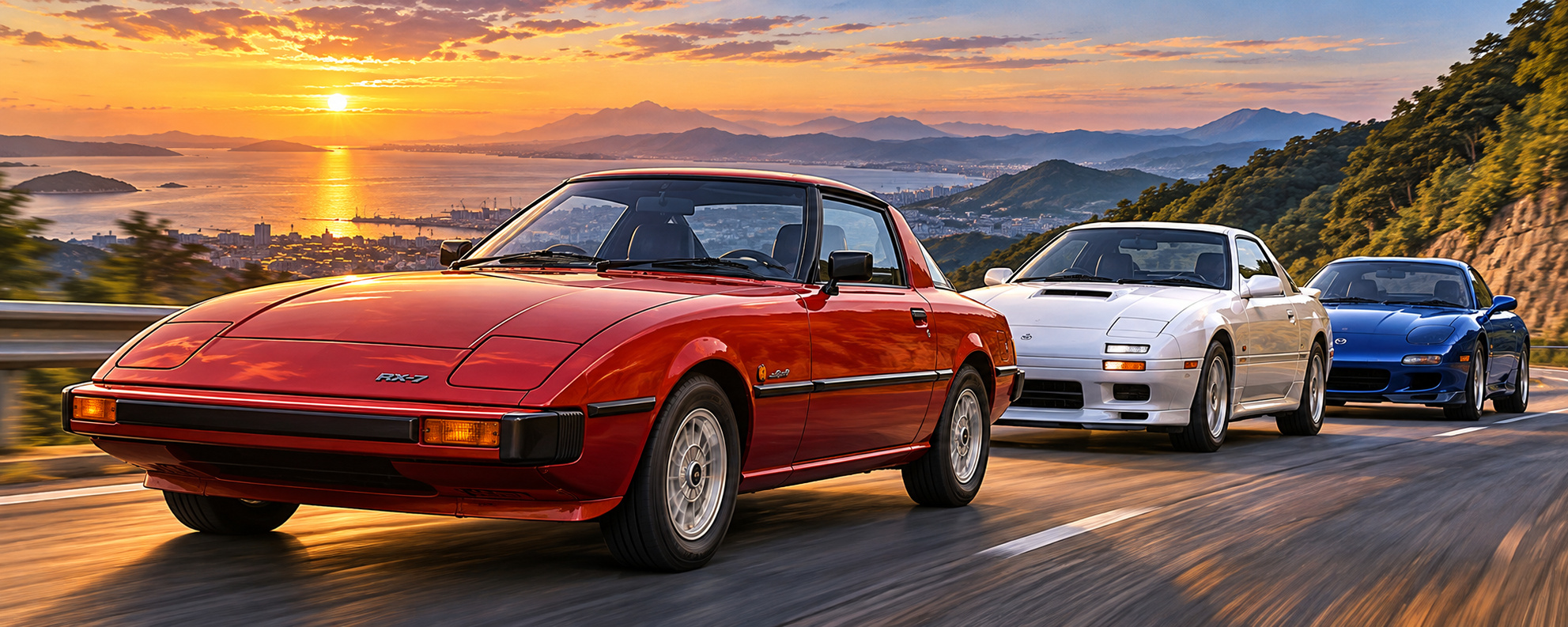
AI-generated illustration representing three generations of the Mazda RX-7. It does not reproduce an actual driving event or the precise factory specification of any particular model year.
Editor’s Note
Ask most people about the FD3S and 280 PS comes to mind. I had that number in my head, too. Then I went back through the specifications and found that the first FD made only 255 PS—one year after the Eunos Cosmo had already reached 280.
That’s a wonderfully odd detail.
The weight figures bothered me just as much. Mazda talked about its Spirit of Zero weight-reduction campaign, yet our launch-model comparison shows the FD weighing more than the FC. On paper, that almost sounds like the lightening program went backwards.
But add the extra 70 PS, examine the suspension changes, and work through the kilograms-per-horsepower calculation. Suddenly, the picture looks very different.
I think that’s where the RX-7’s appeal really lies. The SA had its lightness, the FC brought a more sophisticated approach to handling, and the FD refined the entire package.
The three cars weren’t simply chasing bigger power figures. Each generation tried to make the rotary engine work better as part of a sports car.
And that business with gross versus net horsepower? Another reminder that you really do have to read old brochures all the way down to the small print.
Terms That May Need a Quick Explanation
- Gross vs. Net Horsepower
- Two different engine-output measurement conventions. Gross ratings generally use test conditions with fewer accessory loads, while net ratings are measured with equipment closer to the engine’s production configuration. Net horsepower is still an engine rating, not power measured at the driven wheels. Figures measured under the two standards should not be compared as though they were identical.
- Power-to-Weight Ratio
- A way of comparing vehicle mass with engine output. In this article, the ratio is expressed in kilograms per metric horsepower (kg/PS), so a lower number means less vehicle weight for each unit of power. It does not by itself determine acceleration or handling performance.
Mazda Rotary: A Seven-Part Series
From the pioneering Cosmo Sport to the RX-7 and RX-8, we trace Mazda's rotary-engine ambitions, engineering breakthroughs, commercial challenges, and the technology's eventual revival. Seven articles examine the history through original comparisons, calculations, and historical records.
- Part 1: Only 1,176 Mazda Cosmo Sports: What Was Mazda Really Building? (Part 1)
- Part 2: Did Mazda’s Rotary Engine Nearly Sink the Company? The 40% MPG Mystery (Part 2)
- Part 3: When Did the Mazda Cosmo Become a Luxury Car? From the Red AP to a ¥5.3 Million Three-Rotor GT (Part 3)
- Part 4: The Cosmo Had 280 PS. Why Did the First FD RX-7 Get Only 255?
- Part 5: Mazda Aimed for 280 PS—So Why Did the RX-8 Arrive with Four Doors and 250 PS? Coming soon
- Final Part: English edition Coming soon
- Special Edition: English edition Coming soon
References
- Mazda Motor Corporation, RX-7 Development History, Chapter 1: SA / 12A Rotary (Japanese). Original model design, 130 PS gross rating, rear suspension and turbocharged version.
- Mazda Motor Corporation, RX-7 Development History, Chapter 2: FC / 13B Rotary (Japanese). The 185 PS and 205 PS versions, independent rear suspension and toe-control hub.
- Mazda Motor Corporation, RX-7 Development History, Chapter 3: FD / 13B Rotary (Japanese). The 255 PS launch specification, Spirit of Zero engineering program, power-to-weight target and chassis development.
- Mazda Motor Corporation, Corporate and Product History: 1990–1999 (English). Official English-language confirmation of the FD’s 255 PS rotary engine and approximately 4.9 kg/PS power-to-weight ratio.
- Mazda Motor Corporation, History of the Cosmo (Japanese). Eunos Cosmo, three-rotor 20B engine and 280 PS output.
- Mazda News Release, December 15, 1998: RX-7 Updated with a 280 PS Rotary Engine (Japanese). January 1999 launch and horsepower differences among Type RS, Type R and Type RB variants.
- Mazda News Release, March 25, 2002: Final RX-7 Spirit R Limited Edition (Japanese). Final limited-edition models and August 2002 production end.
- Gekkan Jikayosha, Classic Car Catalog Retrospective: Mazda Savanna RX-7 SA22C (Japanese). Period catalog material supporting the 1978 GT’s specifications, weight and ¥1.44 million price.
- Best Car, Yoshitsune Tokudaiji’s Retrospective Test Drive: 1978 Mazda Savanna RX-7 (Japanese). Contemporary specification discussion, including the early 130 PS output figure.
- Car Sensor, Mazda Savanna RX-7 FC3S GT, 1985 Model Specifications (Japanese). 185 PS engine, 1,210 kg curb weight and original Japanese listing.
- Toyota GAZOO, Mazda ɛ̃fini RX-7, December 1991 Model Catalog (Japanese). Original FD3S model range and specifications.