

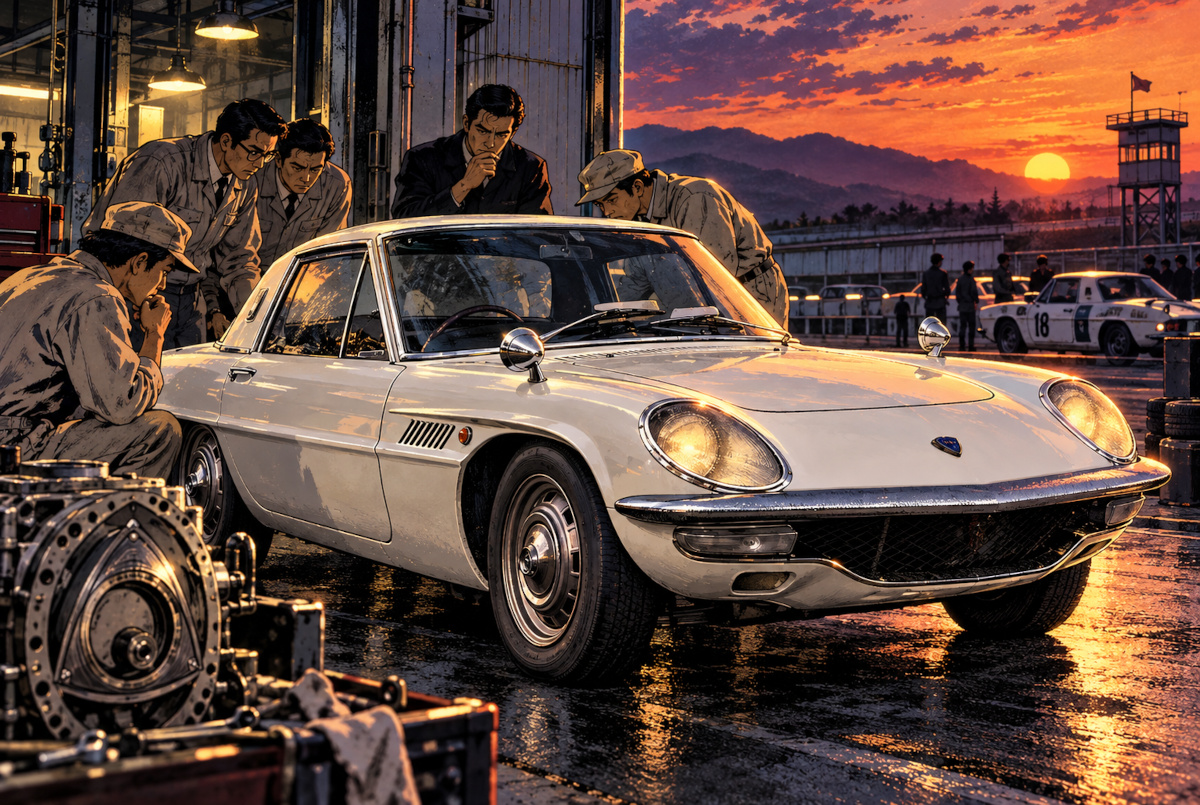
On May 30, 1967, Toyo Kogyo, the company now known as Mazda, launched a two-seat sports car that looked as though it had arrived from another planet. It was the Mazda Cosmo Sport, also known overseas as the Mazda 110S.
Standing just 1,165 mm tall, it housed a remarkably compact twin-rotor engine beneath its low hood. Each rotor had a displacement of 491 cc. The engine produced 110 PS (metric horsepower), enough for a claimed top speed of 185 km/h and a standing 400-meter time of 16.3 seconds.
Just over a year later, Mazda raised output to 128 PS and entered two Cosmo Sports in an extraordinary 84-hour endurance race at Germany’s Nürburgring. One finished fourth overall.
Yet Mazda’s officially reported production total was only 1,176 cars by the time production ended in 1972.
Six years of engine development, a major redesign barely a year after launch, and an international endurance-racing campaign. All for 1,176 cars? What, exactly, was Mazda trying to build?
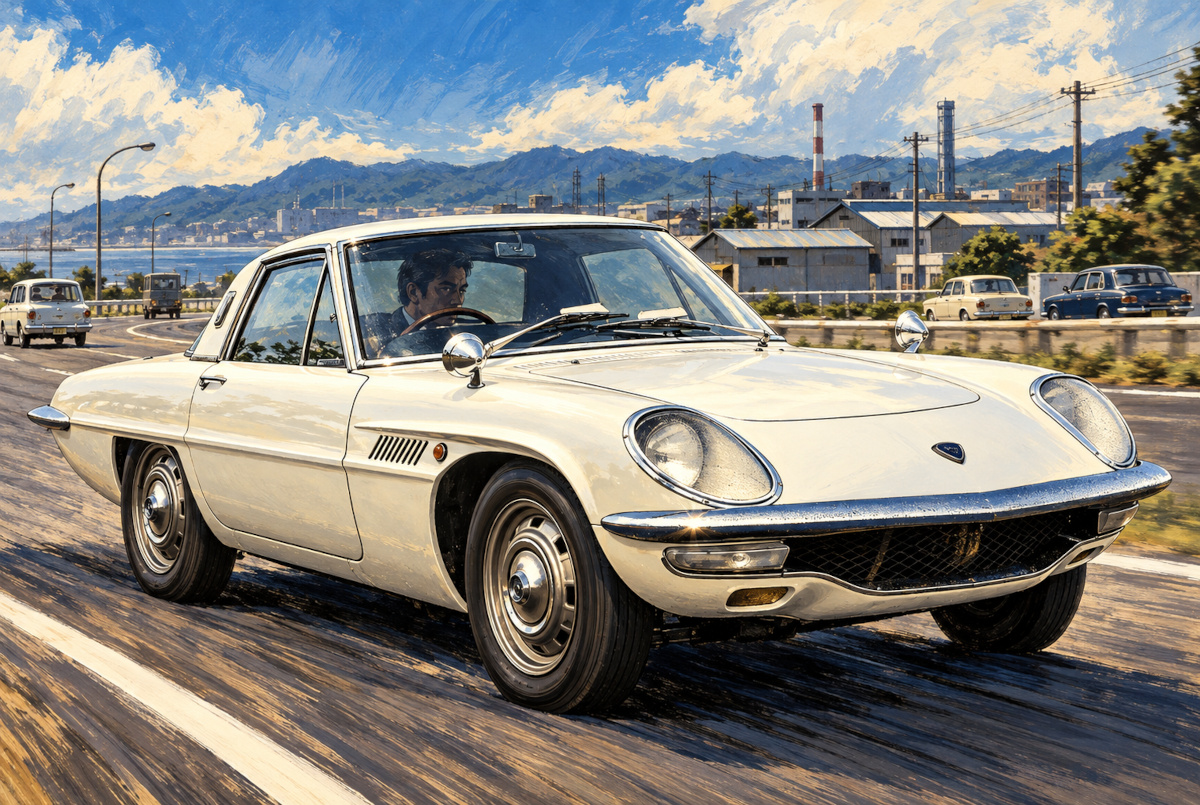 A period-inspired illustration of the Mazda Cosmo Sport, introduced in 1967. Vehicle details and the roadside setting include artistic interpretation. AI-generated illustration.
Mazda Wasn’t First to Build a Rotary Car
The Cosmo Sport was not the world’s first production car with a rotary engine. Germany’s NSU had already introduced the single-rotor Wankel Spider in 1964.
What Mazda achieved was different: the world’s first production car powered by a twin-rotor rotary engine.
In July 1961, Toyo Kogyo entered a technical partnership with NSU and Wankel. Mazda had only recently entered the passenger-car market and was looking for technology that could distinguish it from Japan’s larger automakers.
For company president Tsuneji Matsuda, the rotary engine represented a chance to establish that independence. But the design came with a serious problem, one that engineers gave a rather memorable nickname.
The Devil’s Claw Marks Inside the Engine
Unlike a conventional piston engine, a Wankel rotary engine uses a roughly triangular rotor that moves within a specially shaped housing. At each of the rotor’s three tips is an apex seal, which helps keep the combustion chambers sealed as the rotor moves.
During early development, Mazda engineers discovered that prolonged operation produced wave-shaped wear marks on the inner surface of the rotor housing. These chatter marks became known as the “Devil’s claw marks,” or, in Mazda’s official English account, the “nail marks of the Devil.”
The problem was not merely cosmetic. Damage to the sealing surface threatened compression, efficiency, and durability. An engine that could run impressively for a demonstration was of little use if its internal surfaces deteriorated in ordinary service.
Mazda eventually developed apex seals made from high-strength carbon material impregnated with aluminum. The new material helped overcome one of the most serious barriers to commercial production.
Making a rotor spin was only part of the challenge. Making it survive sustained use required an entirely different level of engineering.
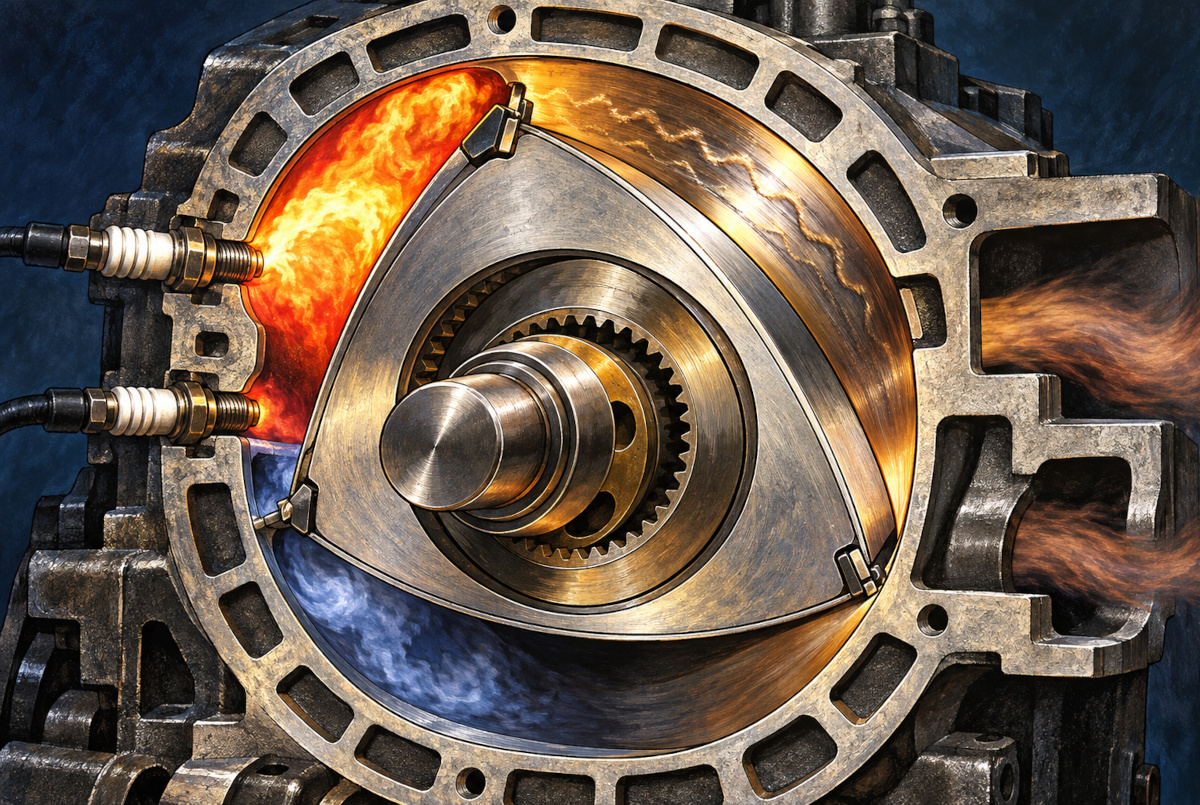 Conceptual illustration of a rotary engine showing the relationship between the rotor-tip apex seals and housing-wall wear. This is not an engineering-accurate cutaway of the original Mazda 10A engine. AI-generated illustration.
Sixty Test Cars, 600,000 Kilometers—and More Testing to Come
In 1963, Matsuda surprised visitors by arriving at the All-Japan Motor Show in an early Cosmo prototype. The car was formally presented at the following year’s show, but customers would not be able to buy one for almost another three years.
Mazda completed its Miyoshi Proving Ground in 1965. In 1966, it distributed 60 prototype cars to dealerships across Japan for extended public-road testing. According to Mazda’s centenary history, these cars collectively covered 600,000 km.
The arithmetic is straightforward:
600,000 km divided by 60 cars equals an average of 10,000 km per prototype.
That is an average, not a claim that every individual car traveled exactly the same distance. It nevertheless shows the scale of the real-world testing Mazda commissioned before allowing the new engine into customers’ hands.
There is also an intriguing discrepancy in Mazda’s own published histories. One official account refers to 700,000 km of development testing, while a later centenary account describes a total of three million kilometers of verification driving.
The available descriptions do not establish whether the two totals cover identical test vehicles, periods, or testing categories. Treating them as interchangeable would be misleading. The separately documented 60-car, 600,000-km dealer program is a clearer figure for direct calculation.
Mazda also offered a warranty of two years or 50,000 km on major mechanical systems, including the engine and drivetrain-related components. For a largely unproven engine concept, demonstrating durability was part of the product itself.
From 110 to 128 PS: The Biggest Change Wasn’t Horsepower
In July 1968, Mazda introduced the revised L10B to replace the original L10A. Looking at the period specifications reveals that this was far more than an engine upgrade.
| Specification | L10A (1967) | L10B (1968) |
|---|---|---|
| Maximum power | 110 PS | 128 PS |
| Maximum torque | 13.3 kgf·m | 14.2 kgf·m |
| Wheelbase | 2,200 mm | 2,350 mm |
| Transmission | 4-speed manual | 5-speed manual |
| Vehicle weight | 940 kg | 960 kg |
| Claimed top speed | 185 km/h | 200 km/h |
| Standing 400 m | 16.3 seconds | 15.8 seconds |
These figures are based on Mazda’s historical information and period-catalog specifications reproduced by specialist automotive publications.
Engine output increased by approximately 16.4%, while vehicle weight rose by just 2.1%. The weight-to-power ratio improved from 8.55 kg/PS to 7.50 kg/PS. In simple terms, each unit of engine power had less weight to move.
But the more revealing change was the wheelbase. Mazda lengthened it by 150 mm, an increase of approximately 6.8%.
Feedback from the dealer testing program had identified demands for greater power and better straight-line stability. Mazda responded with the longer wheelbase, 15-inch radial tires, stronger brakes, and a five-speed transmission.
The L10B wasn’t simply a faster L10A. It was a substantially reworked car intended to perform more convincingly at sustained high speeds.
For an automaker developing its first rotary-powered sports car, that much engineering change so soon after launch is worth remembering.
The Nürburgring 84 Hours: Fourth Place Doesn’t Tell the Whole Story
On August 21, 1968, Mazda began its challenge at the Marathon de la Route 84 Hours, held at the Nürburgring in West Germany.
Mazda prepared two race cars based on the revised L10B. Its historical account lists 59 entries, including established European manufacturers such as Porsche and Lancia.
Car No. 19 completed the race in fourth place overall. The other Mazda, No. 18, retired after more than 82 hours of competition.
That retirement deserves a closer look. Mazda’s later historical account describes a rear wheel coming off. A contemporary Toyo Kogyo English-language report identifies a failure involving the left-rear wheel shaft. The descriptions differ in their level of detail, but neither identifies an internal rotary-engine failure as the direct cause.
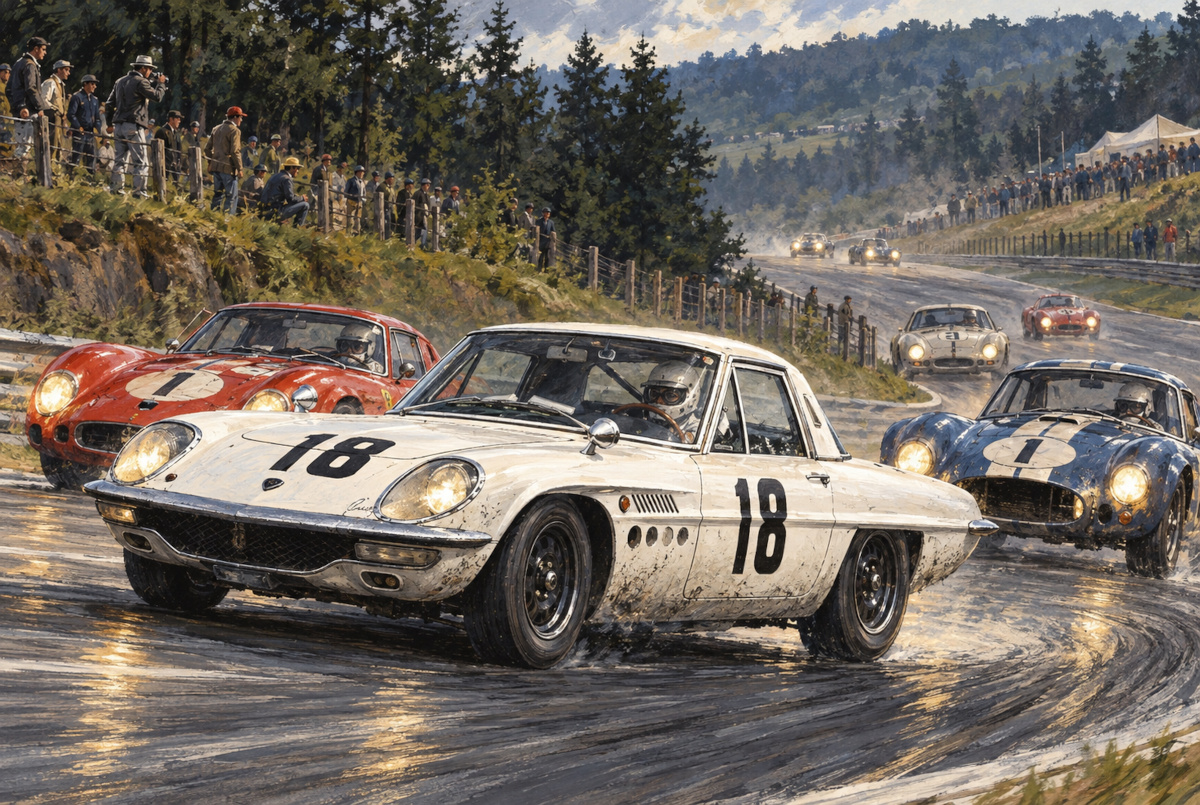 Historical interpretation of the 1968 Marathon de la Route at the Nürburgring. Car No. 18 retired late in the race; No. 19 finished fourth overall. Racing equipment, markings, surrounding vehicles, and the depicted moment include artistic interpretation. AI-generated illustration, not an archival photograph.
Digging into the period race documents reveals an even stranger detail: two different lap totals for the fourth-place Mazda.
The surviving record lists No. 19 as having completed 345 laps and approximately 9,760 km. However, a one-lap penalty reduced the official credited total to 344 laps, reported by Toyo Kogyo as 9,732 km.
Both 344 and 345 laps appear in historical accounts because one is the credited race result and the other is the distance actually driven.
The recorded elapsed time was 84 hours, 14 minutes, and 33 seconds. Using the stated actual distance:
9,760 km ÷ 84.2425 hours = approximately 116 km/h.
The contemporary race summary gives an average of approximately 115.8 km/h, including pit stops. Calculating directly from its rounded published distance and elapsed time gives about 115.9 km/h. That small difference does not materially alter the result.
For three and a half days, the car maintained an overall average of roughly 116 km/h, including time spent in the pits. That is a far more revealing measure of the achievement than the finishing position alone.
Of course, a single endurance race could not prove that every production Cosmo Sport would enjoy a trouble-free life. It did, however, provide a very public demonstration that Mazda’s rotary engine could endure far more than a short exhibition run.
Only 1,176 Built. Was That Really a Failure?
The original Cosmo Sport carried a Japanese launch price of 1,480,000 yen. Mazda’s historical account describes production beginning at a pace of roughly 20 cars per month.
The model remained in production until 1972, with September identified as the ending month in specialist automotive histories. Mazda officially reports a production total of 1,176 cars.
Counting May 1967 through September 1972 as 65 calendar months gives another useful perspective:
1,176 cars ÷ 65 months = approximately 18.1 cars per month.
This is a simple average across the period, not a reconstructed monthly production record. Still, it illustrates how small the program was compared with an ordinary mass-market passenger car.
Mazda itself describes the Cosmo Sport as an image leader for its rotary-engine program. And the engine did not remain exclusive to this expensive sports car.
The rotary-powered Familia Coupe followed in 1968, the Capella in 1970, and the Savanna in 1971. These later cars brought Mazda’s rotary technology to a much broader range of buyers.
Judged as an individual model, 1,176 cars is a tiny figure. Judged as the opening chapter of Mazda’s rotary-engine program, it tells a different story.
That does not establish that the Cosmo Sport was financially profitable. Publicly available information examined for this article does not provide a reliable model-specific development-cost and profit breakdown.
But it does suggest that measuring the Cosmo Sport’s significance by its own sales total alone misses much of what Mazda was attempting.
Editor’s Note
Here’s the number that bothers me most. Not 1,176 cars. The extra 150 mm of wheelbase.
Imagine launching your futuristic sports car and then, just over a year later, effectively admitting that it needed a longer wheelbase, more power, bigger wheels, better brakes, and another gear.
My first reaction was: Couldn’t they have sorted that out before selling it?
Then again, we’re talking about a manufacturer developing an unfamiliar engine and its first proper sports car at almost the same time. Some problems simply refuse to reveal themselves until somebody starts putting serious mileage on the machinery.
And consider the economics. Hundreds of thousands of kilometers of testing, a major early redesign, and an international 84-hour racing campaign for a car built in such small numbers. If all you care about is immediate unit sales, it sounds rather absurd.
Maybe that is the point. Mazda wasn’t merely trying to sell 1,176 attractive coupes. It was trying to establish an entirely new engine as something people could actually trust.
Next in the series: the rotary engine spreads into more affordable Mazdas, only to face a very different enemy in the 1970s—the oil crisis.
Terms That May Need a Quick Explanation
- Apex Seal
- A sealing strip fitted to each tip of a rotary engine’s rotor. It helps maintain compression by sealing the moving combustion chambers against the inner housing surface.
- Chatter Marks
- Wave-like wear patterns caused by unstable contact or vibration between moving surfaces. In Mazda’s early rotary development, such marks on the rotor housing became a major durability problem.
Mazda Rotary: A Seven-Part Series
From the pioneering Cosmo Sport to the RX-7 and RX-8, we trace Mazda's rotary-engine ambitions, engineering breakthroughs, commercial challenges, and the technology's eventual revival. Seven articles examine the history through original comparisons, calculations, and historical records.
- Part 1: Only 1,176 Mazda Cosmo Sports: What Was Mazda Really Building? (Part 1)
- Part 2: Did Mazda’s Rotary Engine Nearly Sink the Company? The 40% MPG Mystery (Part 2)
- Part 3: English edition Coming soon
- Part 4: English edition Coming soon
- Part 5: English edition Coming soon
- Final Part: English edition Coming soon
- Special Edition: English edition Coming soon
References
- Mazda 100th Anniversary Virtual Museum — Cosmo Sport (L10A/L10B) (Japanese). Manufacturer account of vehicle development, dealer testing, the L10B redesign, motorsport, and production volume.
- Mazda — Cosmo Sport 110S: A Legendary Sports Car (English). Official history covering the rotary-engine development challenges, chatter marks, and the 700,000-km testing figure.
- Mazda 100th Anniversary — Legendary Mazdas: Cosmo Sport (English). Manufacturer confirmation of the six-year development effort and the official 1,176-unit production total.
- Mazda 100th Anniversary — Episode 13: The 84-Hour Race Struggle (English). Manufacturer history of the 1968 Nürburgring endurance-racing campaign.
- Miki Press — 1968 Marathon de la Route Historical Race Documents (Japanese PDF). Includes archived Toyo Kogyo materials, lap counts, pit-stop records, penalties, and race timing.
- Miki Press M-BASE — Mazda Cosmo Sport, No. 126 (Japanese). Technical and historical discussion using surviving period catalogs and reference material.
- Miki Press M-BASE — Memories of the Cosmo Sport, No. 117 (Japanese). Firsthand recollections by a former Mazda rotary-engine development team member.
- Web Motor Magazine — Mazda Cosmo Sport (1967, L10A) (Japanese). Period specifications, model revision details, and the September 1972 production-ending date.
- Audi Tradition — Sporty, Beautiful, and Innovative: The NSU/Wankel Spider (English). Historical confirmation of the 1964 single-rotor production car.