


In October 2026, an extraordinary claim began circulating online: North Korean leader Kim Jong Un had suffered a brain hemorrhage and died.
Britain’s The Sun, America’s New York Post and India’s Economic Times all covered the story. Yet from Japan, where I was following the news, the reaction on television seemed surprisingly muted.
Why were foreign newspapers discussing Kim’s supposed death while Japanese television appeared relatively quiet? Was there some fundamental difference in editorial standards?
Then I started reading the actual reports, rather than judging them by their headlines.
The foreign newspapers had not independently confirmed Kim Jong Un’s death. And Japanese media had not ignored the story altogether. Some outlets were reporting the lack of evidence, while others were covering his reported public appearances.
By October 24, another development had complicated the picture further: China published its own account and photographs of Kim Jong Un visiting the Chinese border city of Dandong.
In the final part of this three-part investigation, the real question is no longer whether an unverified death rumor was dramatic enough to make headlines. It is how that rumor became international news, and how the evidence changed afterward.

AI-generated conceptual illustration. It symbolizes how a single unverified claim can spread across countries and news organizations. The arrows on the map and the newspaper pages do not represent actual reporting routes or published news content.
Did British and American Newspapers Actually Report Kim Jong Un’s Death?
Looking beyond the headlines revealed something more interesting than a simple contrast between sensational Western reporting and cautious Japanese journalism.
The outlets were not necessarily reporting the same thing.
I compared what five news organizations actually presented as their central story.
| News organization | What its coverage focused on |
|---|---|
| The Sun, UK (Oct. 19) | Unverified online claims that Kim had suffered a brain hemorrhage and fallen into a coma |
| New York Post, US (Oct. 19, US time) | The death rumor and photographs released by North Korea as purported evidence that Kim was alive |
| BBC News, UK (Oct. 20) | The rumor’s origins and why speculation about Kim’s death keeps returning |
| Yonhap News Agency, South Korea (Oct. 20) | The social media source of the claims and the absence of supporting evidence |
| FNN Prime Online, Japan (Oct. 20) | Kim’s reported visit to a garment and footwear exhibition with his family |
The Sun used an attention-grabbing headline about a possible coma, but its report described the allegations as unverified internet claims.
The New York Post took a different approach, focusing on photographs released by North Korea after the speculation spread.
The BBC went further into the underlying problem: why do rumors about the death of North Korea’s leader resurface so often?
These are three quite different editorial approaches to the same event.
Reporting that someone has died is not the same as reporting that people are claiming someone has died. Much of the international coverage concerned the rumor, not a verified death.
That distinction is easy to lose when a dramatic headline travels through social media without the qualifications contained in the article below it.
There are legitimate reasons for journalists to investigate such claims. A sudden leadership crisis in a nuclear-armed state could have serious consequences for neighboring countries and international security.
And once a rumor has spread widely, the spread itself can become newsworthy.
Sensational headlines may also attract readers and traffic. But without access to each newsroom’s internal editorial discussions, we cannot establish whether competition for attention was the decisive reason any particular outlet published its story.
Three Newspapers, But How Many Independent Pieces of Evidence?
Part 1 of this investigation traced a major source of the rumor’s international circulation to Wanjun Xie, a Chinese dissident living in the United States.
Several reports referred to his post on X or to online claims repeating substantially the same allegations.
That does not prove that Xie invented the story or was its original source. It identifies an important, traceable point in the rumor’s circulation.
More importantly, it raises a question that often gets lost in breaking-news coverage: how many independent sources actually support the allegation?
| What we compared | What the evidence established |
|---|---|
| Foreign newspapers covering the allegation | At least three major publications in Britain, the United States and India |
| Major traceable social media source | Wanjun Xie’s post on X |
| Publicly available independent evidence confirming Kim’s death | None verified |
| South Korean intelligence assessment | On October 23, the National Intelligence Service assessed the rumors as false |
Three publications do not amount to three eyewitnesses. Nor do they necessarily represent three separately confirmed accounts.
Once one report cites a social media post, another outlet may cite that report, and a third may summarize both. The number of articles grows, even when the original evidence does not.
More coverage is not the same thing as more proof.
This is not an argument against reporting unverified claims. It is an argument for identifying clearly whether a report is presenting new evidence, repeating an allegation, or evaluating the reliability of earlier reporting.
Was Japanese Television Really Silent?
The next question was closer to home.
Japan is geographically close to the Korean Peninsula, and developments in North Korea have obvious implications for Japanese security. So had Japanese news organizations simply decided not to cover the rumor?
The available articles did not support such a sweeping conclusion.
On October 20, Japan’s Nikkei newspaper reported that claims about Kim Jong Un suffering a brain hemorrhage were circulating without supporting evidence.
The same day, at 12:23 p.m. Japan Standard Time, FNN Prime Online, the news website of Fuji News Network, published an article about Kim visiting a garment and footwear exhibition in Pyongyang.
FNN described photographs showing the girl believed to be his daughter, Kim Ju Ae, picking up a shoe while Kim leaned toward it. It also reported his comments about improving product design and productivity.
There was an important limitation: the FNN article reported Kim’s activities but did not directly discuss the death rumor.
Then, on October 22, the Japan Fact-Check Center investigated a widely shared social media image that appeared to show Korean Central Television announcing Kim’s death.
According to its report, the post had received more than 12.7 million views and over 3,600 reposts by the time it was examined.
Those numbers sound enormous, but there is another distinction worth making.
12.7 million views do not mean 12.7 million different people saw the claim, much less that 12.7 million people believed it.
The Japan Fact-Check Center found that the image was likely AI-generated and was not an authentic North Korean television announcement.
It also examined a different misleading post that recycled a genuine Japanese television report from April 21, 2020.
That older report, from Nippon Television’s NNN network, concerned claims that Kim was in serious condition following surgery. It was real footage, but it was being presented in a way that made an old story appear relevant to the new rumor.
These were two different mechanisms of misinformation.
One involved a fabricated image resembling a television broadcast. The other reused genuine footage while obscuring its original date.
Both could reinforce the same false impression, even though one was apparently synthetic and the other was authentic but outdated.
So Japan’s media had not remained entirely silent. Some reports emphasized the absence of evidence, while others covered Kim’s reported public activities or investigated misleading online material.
But we must not stretch that finding beyond the available evidence.
This comparison is based primarily on published articles. It is not a complete audit of NHK and Japan’s commercial television networks, their broadcasts, airtime, or editorial decisions.
It would therefore be misleading to claim that Japanese television devoted fewer minutes to the rumor than British or American television. We do not have comparable broadcast-time data establishing that.
North Korea Released Photographs. Then China Added Another Source
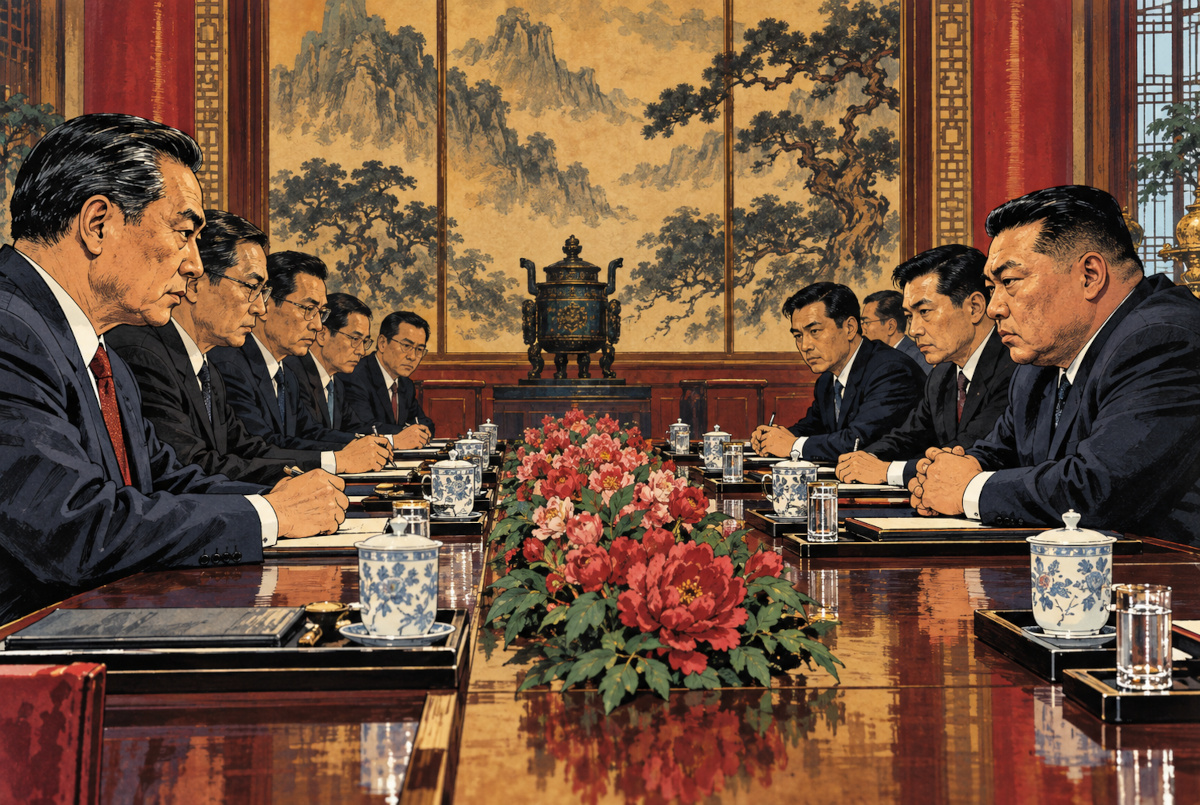
AI-generated symbolic illustration of China–North Korea diplomatic relations. It does not recreate the October 24, 2026 visit to Dandong, the actual meeting between Kim Jong Un and Wang Huning, or the real participants, venue, or seating arrangements.
North Korea’s Korean Central News Agency reported on October 20 that Kim Jong Un had visited a garment and footwear exhibition in Pyongyang the previous day.
On October 24, North Korean state media also reported that he had addressed a meeting of military company commanders held on October 22–23.
These were relevant pieces of information. But they originated from the North Korean state itself.
Outside observers could examine the released photographs and reports, yet could not independently establish every detail of when and how the images were produced.
Then the available evidence changed on October 24.
China’s state-run Xinhua News Agency reported that Kim Jong Un had visited Dandong, a Chinese border city in Liaoning Province.
He was received by Wang Huning, a member of the Communist Party of China’s Politburo Standing Committee and one of the country’s most senior political figures.
According to Xinhua, the two visited the Memorial Hall of the War to Resist U.S. Aggression and Aid Korea, which commemorates Chinese participation in the Korean War. They also visited a vehicle manufacturing plant in Dandong.
Xinhua published photographs showing the visit and the meeting between the two officials. North Korean state media provided its own account the following day, October 25.
Why does this matter?
Until then, the most prominent official photographs of Kim’s recent activities had come from North Korea. Now there was reporting and photography from a separate government’s state news agency.
That is a meaningful change in the available evidence.
It is not, however, the same as confirmation by a completely neutral and politically independent observer. China is a close partner of North Korea, and Xinhua is a Chinese state media organization.
The distinction is between two government-linked sources from different countries, not between state reporting and entirely independent journalism.
Even with that qualification, the ability to compare accounts from both governments provides more information than relying solely on North Korea’s domestic announcements.
Could Kim’s Sister or Daughter Take Power? Would China Gain the Upper Hand?
The original death rumor generated a second round of speculation: Kim’s sister, Kim Yo Jong, had supposedly assumed power and might supervise an eventual succession by his daughter, Kim Ju Ae.
But South Korea’s National Intelligence Service reportedly rejected the death rumors on October 23.
It also did not regard Kim Yo Jong’s recent inspection of border fortification work as evidence, by itself, that her political standing had changed.
Kim Yo Jong was subsequently reported to have accompanied her brother on his October 24 visit to Dandong.
She has substantial experience within the Workers’ Party of Korea. That gives her a very different political background from Kim’s young daughter.
But experience in the Party is not proof that someone has inherited the supreme leader’s powers. Nor is being discussed as a future dynastic successor equivalent to formally assuming control of the state and military.
So what about China? Could Beijing use uncertainty about Kim’s health to dictate terms to Pyongyang?
One detail might tempt observers to read the visit as a hierarchy of power: Kim was received by Wang Huning, rather than by Chinese President Xi Jinping himself.
Wang is a senior Chinese leader, commonly described as the fourth-ranking official in the Communist Party leadership. But diplomatic protocol and the rank of a host do not, on their own, establish that one country has gained political control over another.
China remains a vital economic and diplomatic partner for North Korea. At the same time, North Korea possesses nuclear weapons and has developed closer security relations with Russia.
Those realities complicate any claim that China could simply impose its preferred successor or automatically dictate North Korean policy.
The Dandong visit showed continued high-level engagement between the two countries. It did not establish Chinese intervention in a succession process, the collapse of North Korean sovereignty, or a shift in command over Pyongyang’s military.
What the Death Rumor Really Exposed
Looking back over the three-part investigation, I found it useful to separate the story into three stages.
First, an unverified allegation spread through social media. Second, international news organizations reported and interpreted that allegation in different ways. Third, journalists, fact-checkers, intelligence officials and subsequent official reports added information against which the original claim could be evaluated.
The order matters. It explains how something can become an international news story before the underlying allegation has been verified.
North Korea’s strict control over official information makes such situations especially difficult. When outsiders have limited visibility into the leadership, rumors can fill the gaps left by the absence of reliable public information.
That does not mean North Korea’s official statements should automatically be accepted as the complete truth.
But questioning state propaganda is not the same as accepting an unsupported social media claim as fact.
The lesson from this episode is not that dramatic headlines are always false or that cautious headlines are always correct.
It is much more specific.
Before deciding what a headline proves, follow the evidence behind it. Determine whether the report contains an original confirmation, an unverified allegation, or simply another retelling of the same story.
Editor’s Note
I’ll admit that the original contrast bothered me. Foreign newspapers were running stories about Kim Jong Un’s supposed death, while Japanese television seemed oddly restrained.
I wondered whether Japanese broadcasters were simply more cautious, or whether I had missed something.
Then I read the stories themselves. Japan had not completely ignored the subject, and the Western newspapers had not confirmed that Kim was dead.
It turned out I had been comparing the noise around the headlines rather than what the reporting actually established. That’s a fairly embarrassing trap for someone who used to write for magazines.
And what a rumor it was. One widely circulated social media claim, a named hospital in Beijing, a secret transfer of a body, and speculation about Kim’s sister taking over.
In the old days, a gloriously dubious pulp magazine might have splashed something like “DICTATOR DEAD?” across its cover. Today, the internet can generate that kind of excitement without waiting for a printing press.
What troubles me most, though, is the relationship between an authoritarian government that tightly controls information and an online world eager to fill every empty space with its own version of events.
I have plenty of reasons to question North Korea’s official reporting. But that doesn’t make an unsupported post on X any more reliable.
If we are angry about a government controlling the truth, it would be rather absurd to let ourselves be manipulated by a different source of unverified information.
After researching all three parts of this series, that is the point I keep coming back to.
This article is based on publicly available information reviewed through October 25, 2026. Kim Jong Un’s reported death was not substantiated, and South Korea’s National Intelligence Service assessed the rumors as false. The comparison of Japanese reporting draws primarily on published articles and does not constitute a comprehensive survey of television broadcasts or airtime. Editorial motives and diplomatic intentions are discussed as interpretations rather than established facts.
Kim Jong Un Death Rumors: Three-Part Series
Did Kim Jong Un really die? This three-part investigation traces the rumor's origins, examines the disruption of 42 North Korean websites, and compares how international and Japanese media handled the story.
- Part 1: Did Kim Jong Un Really Die? How One Rumor Reached the International Press (Part 1)
- Part 2: Kim Jong Un Death Rumors, Then 42 Websites Went Down: Was North Korea Offline for 32 Hours? (Part 2)
- Final Part: Did Japan Ignore the Kim Jong Un Death Rumor? The Headlines Told Another Story (Final Part)
References
- The Sun (October 19, 2026): Original report covering unverified online claims about Kim Jong Un’s health and alleged transfer to China
- New York Post (October 19, 2026, US time): North Korean photographs presented as possible evidence of Kim Jong Un’s survival
- BBC News (October 20, 2026): Why rumors about Kim Jong Un’s death repeatedly emerge
- Yonhap News Agency (October 20, 2026): Unverified death rumors, international social media circulation and the reported source
- FNN Prime Online / Fuji News Network (October 20, 2026): Kim Jong Un’s reported visit to a garment and footwear exhibition (in Japanese)
- Nikkei / The Nikkei (October 20, 2026): Report on the lack of evidence supporting the brain hemorrhage rumor (in Japanese)
- Japan Fact-Check Center (October 22, 2026): Investigation of a likely AI-generated death announcement and the reuse of genuine television footage from 2020 (in Japanese)
- Yonhap News Agency (October 23, 2026): South Korea’s National Intelligence Service assesses the death rumors as false
- Yonhap News Agency (October 24, 2026): North Korean state media report on Kim Jong Un’s military company commanders’ meeting
- Xinhua News Agency (October 24, 2026): Chinese state media report and photographs of Kim Jong Un’s Dandong visit and meeting with Wang Huning
- Yonhap News Agency (October 25, 2026): North Korean reporting on the Dandong visit, including Kim Yo Jong’s participation