


In October 2026, a startling rumor about North Korea’s leader Kim Jong Un began circulating internationally: he had suffered a brain hemorrhage, been flown to a hospital in Beijing, and died.
According to the story, his body had already been returned to North Korea in secret. Other unverified claims soon followed. His sister, Kim Yo Jong, had supposedly seized power. China had allegedly dispatched 9,000 troops to Pyongyang.
It sounded like the beginning of a major political crisis. But tracing the reports revealed a rather different story.
Newspapers in Britain, the United States and India covered the death rumor. Yet the trail of reporting led back to a social media post by a Chinese dissident living in America. No independent evidence of Kim’s death had emerged.
On October 23, South Korea’s National Intelligence Service (NIS) reportedly told lawmakers that the death rumors were false.
So where did the story come from, what could North Korea’s own reporting actually establish, and who could exercise power if Kim Jong Un really did die?
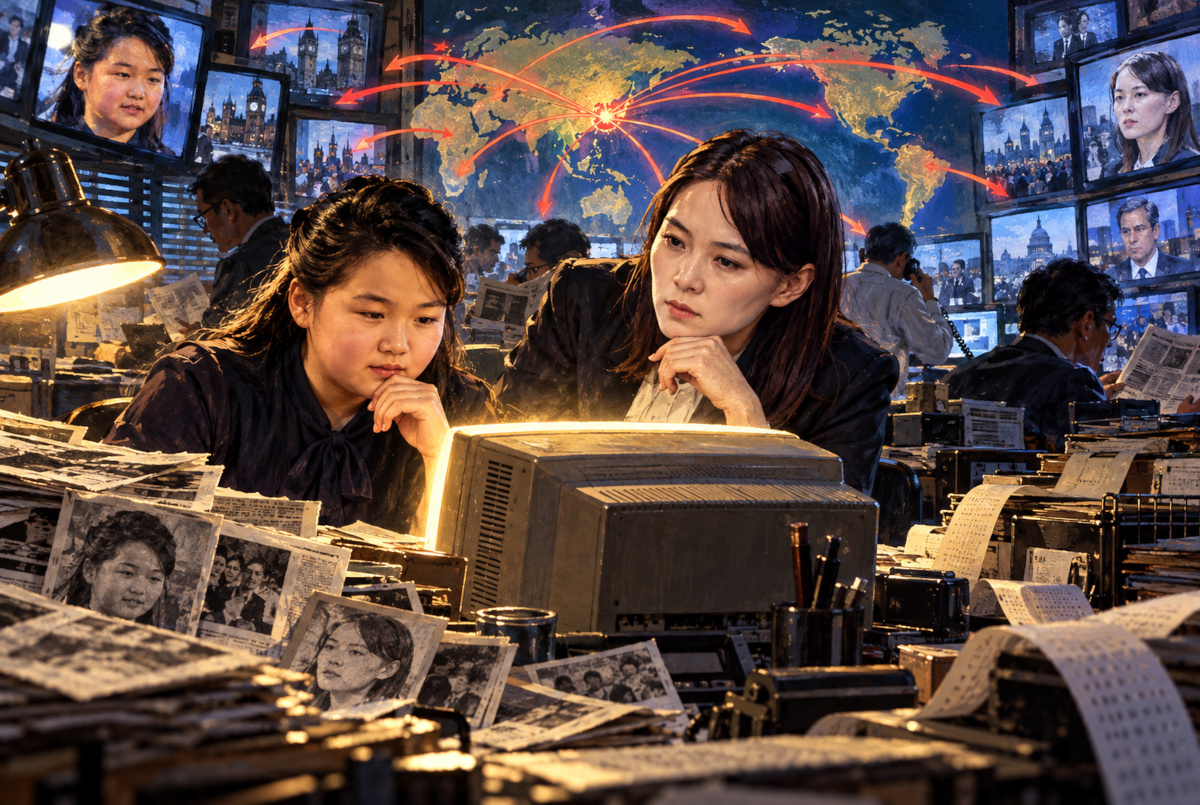 AI-generated conceptual illustration showing how an unverified rumor can spread internationally. The newsroom, screens and figures do not depict actual events or actions by the people involved.
The Death Rumor Led Back to a Chinese Dissident in the United States
On or around October 19, 2026, a post on X by Wanjun Xie, a Chinese dissident based in the United States, attracted attention.
Xie claimed that Kim Jong Un had suffered a severe brain hemorrhage, lost consciousness and been transferred to Peking Union Medical College Hospital in Beijing, where he subsequently died.
Xie identifies himself as chairman of the Chinese Democratic Party. According to Yonhap News Agency, he had previously circulated other unverified claims, including rumors about Chinese President Xi Jinping’s death and the alleged use of a body double.
In this case, too, the claims lacked supporting documentation. No verified hospital records, transfer records, medical testimony or evidence concerning the alleged return of Kim’s body were made public.
The original source of Xie’s information also remained unclear. He was a traceable source of the rumor’s international circulation, but that does not establish that he originated the story himself.
Nevertheless, Britain’s The Sun, America’s New York Post and India’s The Economic Times all covered the speculation.
There is an essential distinction here: reporting that a death rumor exists is not the same as independently confirming that a death occurred. The coverage largely concerned unverified claims circulating online.
Three Newspapers Do Not Mean Three Independent Sources
That distinction made me curious enough to separate the number of published reports from the number of sources actually supporting the allegation.
Here is what the reporting trail established.
| What was checked | What the evidence showed |
|---|---|
| Principal traceable source | Wanjun Xie’s post on X |
| International newspapers reporting the rumor | At least the three named above |
| Publicly available independent evidence of death | None verified |
| South Korean intelligence assessment | The rumors were false |
The crucial point is not that three newspapers covered the story. It is whether those reports rested on three separate bodies of evidence.
They did not establish three independent confirmations of Kim’s death. The same social media claim appeared repeatedly in the reporting trail.
Even if 100 newspapers repeat the same unverified post, the underlying evidence does not become 100 times stronger.
On October 23, South Korea’s NIS assessed the death rumors as false during a closed-door briefing to the National Assembly’s Intelligence Committee, according to people who attended the meeting.
The intelligence service did not publicly disclose the detailed information behind its assessment. That limitation matters, but so does the absence of evidence supporting the original allegation.
What Can North Korea’s Official Reporting Actually Prove?
While the rumor was spreading, North Korea’s official Korean Central News Agency (KCNA) published a report on October 20 stating that Kim Jong Un had inspected a garment and footwear exhibition in Pyongyang the previous day.
Photographs released by North Korean state media showed him accompanied by his wife, Ri Sol Ju, and his daughter, commonly known as Kim Ju Ae.
But reading the English-language KCNA report itself revealed a peculiar difference.
The article referred to senior Party and government officials accompanying Kim. It did not identify his wife or daughter by name in that accompanying-officials description.
What it did describe in remarkable detail was the exhibition’s merchandise.
| Item in KCNA’s report | Reported quantity |
|---|---|
| Garments displayed | More than 70,700 |
| Pairs of shoes displayed | More than 170,000 |
| Participating production units | More than 270 |
KCNA also described the types of clothing and footwear on display and Kim’s comments on product design and quality.
So we have a state report precise enough to count more than 170,000 pairs of shoes, yet one that did not directly address the death rumor circulating around the world.
There is a certain absurdity to that contrast.
The photographs provide important evidence concerning Kim’s reported public appearance. But their exact time and circumstances have not been fully authenticated by an independent outside observer.
That does not make the death rumor credible. It simply means that the contents of an official report, what photographs appear to show, and what independent investigators can establish are three different things.
Kim Yo Jong or Kim Ju Ae: Who Could Actually Take Power?
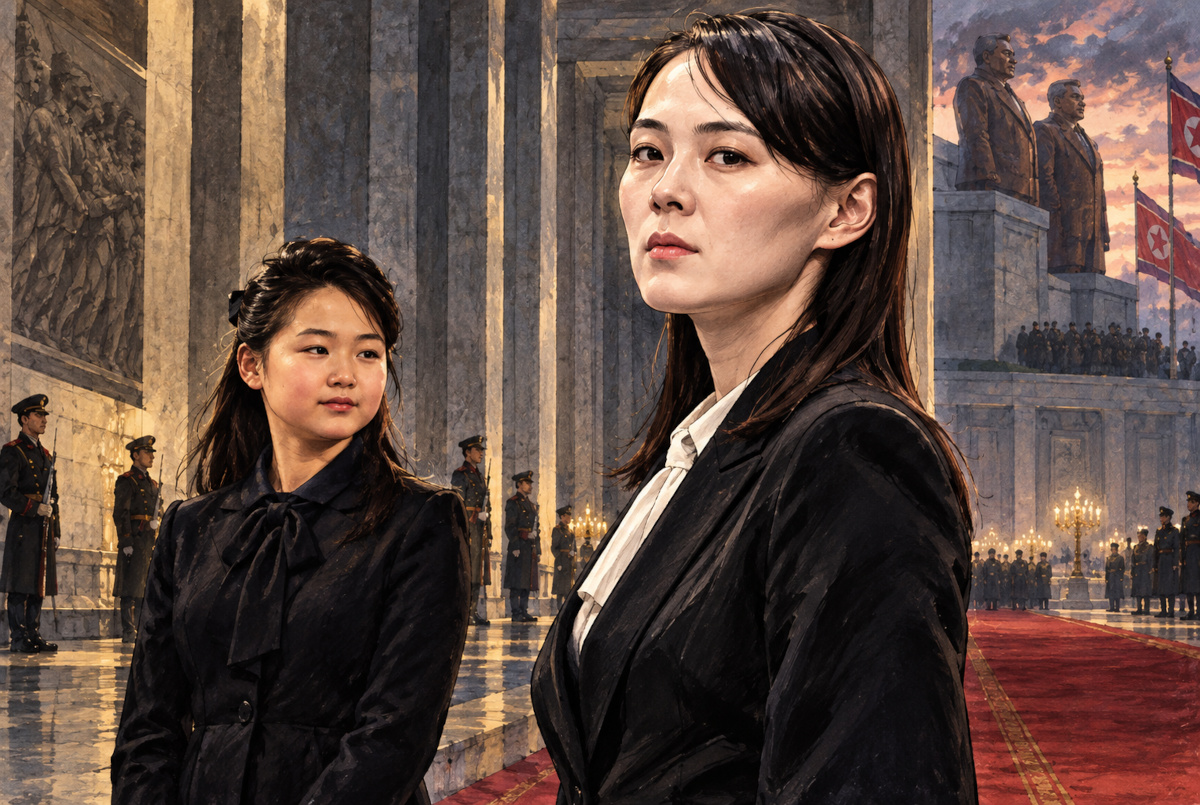 AI-generated symbolic illustration of North Korea’s succession question. The building, statues, guards and positioning of the figures are fictional and do not depict an actual ceremony, meeting or transfer of power.
Suppose Kim Jong Un were to die unexpectedly. The question would immediately shift from his condition to the survival and leadership of the political system he heads.
Two members of his family would attract particular attention, but for very different reasons.
His sister, Kim Yo Jong, was appointed director of the Workers’ Party of Korea’s General Affairs Department in February 2026.
That title may sound purely administrative. Yet an analysis published by the North Korea specialist publication 38 North explains that the department’s responsibilities extend beyond logistics and document handling to supporting information flows, strategic communication and decision-making within the Party’s central apparatus.
In other words, Kim Yo Jong holds an identifiable position within the machinery of power.
Kim Jong Un’s daughter, Kim Ju Ae, occupies a very different position in public reporting. On April 6, 2026, South Korea’s NIS director told lawmakers that she could be regarded as her father’s successor, marking a stronger assessment than previous statements.
But South Korean intelligence assessments are not the same as a publicly confirmed appointment by North Korea.
Our comparison separates formal office, political experience and expectations about succession.
| Question | Kim Yo Jong (sister) | Kim Ju Ae (daughter) |
|---|---|---|
| Political experience | Active senior Party official | Primarily known for public appearances alongside her father |
| Publicly identified Party position | Director of the General Affairs Department | No confirmed Party office |
| Succession assessment | Discussed as a possible leadership figure | Identified by South Korean intelligence as a likely successor |
| Confirmed accession as supreme leader | No | No |
Kim Jong Un himself was reelected general secretary of the Workers’ Party at its Ninth Congress in February 2026. That event illustrates that even the Party’s highest position has a formal selection process.
Family membership therefore does not automatically transfer command of the Party, military and state institutions. A young successor would still need the cooperation of powerful officials and military leaders.
One possible arrangement would involve Kim Yo Jong exercising practical influence while Kim Ju Ae is presented as the longer-term dynastic successor.
But that is a scenario, not an established succession plan.
On October 23, South Korea’s intelligence service also reportedly said that Kim Yo Jong’s recent inspection of border fortifications did not, by itself, indicate a change in her political standing.
If Kim Jong Un Died, Would the World Treat North Korea Differently?
Here is another easily overlooked point: even an actual change of supreme leader would not automatically dismantle North Korea’s international obligations, security relationships or sanctions.
Consider its agreements with China and Russia.
Article 2 of the 1961 Treaty of Friendship, Cooperation and Mutual Assistance between China and North Korea provides for assistance when a party is subjected to armed attack and enters a state of war.
The comprehensive strategic partnership treaty between Russia and North Korea, which entered into force in December 2024, likewise provides for assistance under Article 4 in the event of an armed attack resulting in a state of war.
Neither treaty treats the death of a national leader, by itself, as a condition triggering military intervention.
The same distinction applies to international sanctions.
United Nations Security Council sanctions against North Korea address matters including its nuclear and ballistic missile programs, arms transfers and related activities. They are not structured to expire automatically when a particular leader dies.
A new leader would inherit the unresolved nuclear issue, international sanctions and the surrounding security tensions. Replacing the person at the top would not make those problems disappear.
An unexpected death could raise urgent questions about the military chain of command, control of nuclear forces and the stability of a successor government.
Those would be legitimate concerns for neighboring countries and major powers. But it would be a leap to assume that leadership change must result in regime collapse or foreign military intervention.
Editor’s Note
What caught my attention first was just how detailed the death story had become. A named hospital in Beijing, a secret transfer of the body, and a supposedly settled succession. It sounded as though someone had obtained an extraordinary inside account.
Then I went looking for the evidence. There was remarkably little to examine.
But the stranger part, to me, is the sister-and-daughter question. One has an established role in the Party’s administrative machinery. The other is being watched as a potential future leader. Those are not interchangeable qualifications, especially in a state where controlling the military and Party apparatus is central to political authority.
What bothers me is the system that makes so much depend on a single individual while leaving outsiders with so little reliable information about what would happen next.
And that brings me back to the footwear exhibition. We can read an official count of more than 170,000 pairs of shoes, yet we cannot obtain a similarly clear public account of the succession structure.
For me, that contradiction says more about the problem than another sensational headline about Kim Jong Un’s supposed death.
This article is based on publicly available information reviewed through October 24, 2026. The claims about Kim Jong Un’s death, medical transfer and Chinese troop deployment are not presented as established facts. Confirmed appointments and official assessments are distinguished from hypothetical succession scenarios.
References
- Yonhap News Agency (October 20, 2026): Unverified death rumors and their reported social media source
- KBS WORLD (October 20, 2026): Online death rumors and the unverified claim about 9,000 Chinese troops
- Korean Central News Agency (October 20, 2026): Official English-language report on Kim Jong Un’s visit to the garment and footwear exhibition, reproduced by Korea News Service
- Yonhap News Agency (October 23, 2026): South Korea’s National Intelligence Service assesses the death rumors as false
- Yonhap News Agency, Japanese edition (October 23, 2026): Report on the intelligence briefing and Kim Yo Jong’s position (in Japanese)
- Yonhap News Agency (April 6, 2026): NIS director’s assessment of Kim Ju Ae as a possible successor
- 38 North, Michael Madden (June 17, 2026): On a Mission From General Affairs Department — Kim Yo Jong’s role and the Party’s administrative structure
- Yonhap News Agency (February 23, 2026): Kim Jong Un’s reelection as Workers’ Party general secretary at the Ninth Party Congress
- Ministry of Foreign Affairs of China: Treaty Database — 1961 China–North Korea Treaty of Friendship, Cooperation and Mutual Assistance (Chinese official source)
- TASS (December 5, 2024): Provisions of the Russia–North Korea comprehensive strategic partnership treaty
- United Nations Security Council: Committee established pursuant to Resolution 1718 (2006) — Sanctions concerning the DPRK