

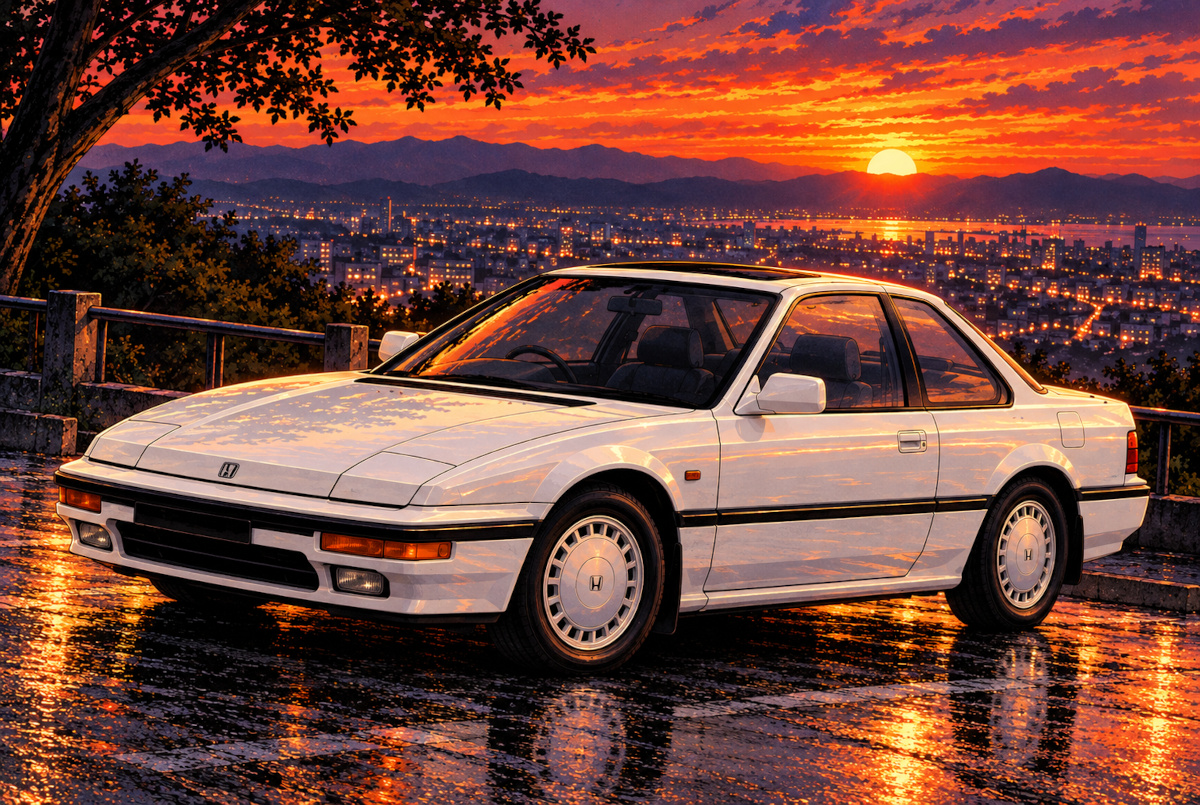
In 1980s Japan, the Honda Prelude was one of the defining “date cars”: stylish coupes associated as much with going out and making an impression as with driving itself. Its exceptionally low hood, power sunroof and, later, innovative four-wheel steering made it difficult to ignore. The second and third generations became the nameplate’s high point.
But the Prelude did not have the Japanese coupe market to itself. Buyers could choose the Toyota Soarer, the Nissan Leopard or, from 1988, the S13 Nissan Silvia. Some offered greater luxury. Others put more emphasis on rear-wheel-drive handling or sheer good looks.
So what, exactly, was the Prelude selling that its rivals were not?
That question led to a stranger one. In Japan, cumulative sales fell from 175,634 for the third-generation Prelude to just 15,127 for the fifth generation.
That is a decline of approximately 91.4%, even though the most powerful versions evolved from 145 PS in the third generation to 220 PS in the fifth.
How did a coupe famous for its style and technology lose so much of its audience? In this final installment, we will compare its Japanese-market rivals, check the original prices and dimensions, examine the sales figures—and follow the Prelude through to its 2025 return.
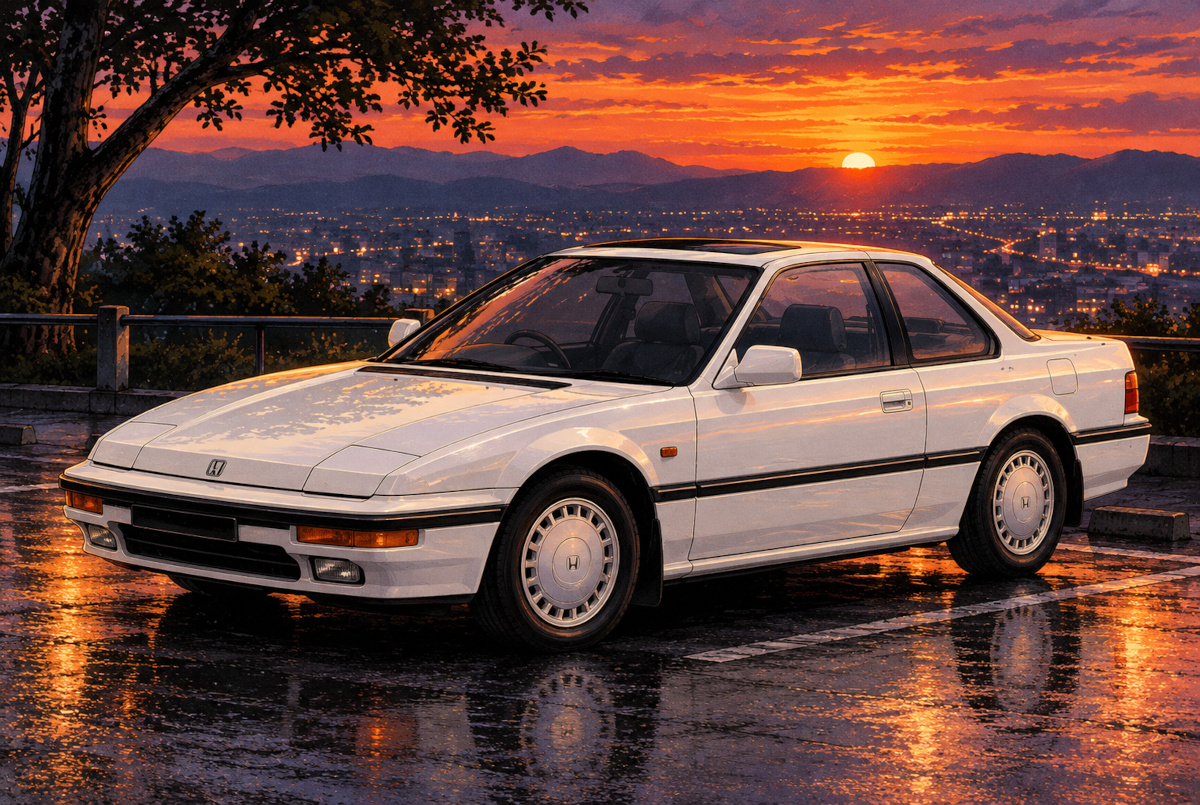 AI-generated illustration inspired by Japan’s late-1980s date-car culture. It is not a period photograph.
Prelude vs. Soarer, Leopard and Silvia: Were They Even Direct Rivals?
It is tempting to describe the Prelude as the coupe for people who could not afford a Toyota Soarer. The contemporary specifications tell a more interesting story.
We compared representative Japanese-market versions of four coupes introduced between 1986 and 1988.
| Model and representative trim | Length | Height | Drivetrain | Engine |
|---|---|---|---|---|
| Honda Prelude 2.0Si 1987 |
4,460 mm | 1,295 mm | FWD | 2.0L DOHC inline-four |
| Toyota Soarer 2.0VX 1986 |
4,675 mm | 1,345 mm | RWD | 2.0L SOHC inline-six |
| Nissan Leopard XS-II 1986 |
4,680 mm | 1,370 mm | RWD | 2.0L turbocharged V6 |
| Nissan Silvia Q’s (S13) 1988 |
4,470 mm | 1,290 mm | RWD | 1.8L DOHC inline-four |
Source: Our comparison of manufacturer launch releases and heritage records. These are representative models, not identically equipped cars, and their launch years differ. The Leopard is the F31 generation; the Silvia is the S13 generation. FWD means front-wheel drive and RWD means rear-wheel drive.
The Prelude was 215 mm shorter than the Soarer and 220 mm shorter than the Leopard. It also stood 50 mm and 75 mm lower, respectively.
Now compare it with the S13 Silvia. The difference in overall length was just 10 mm, and the difference in height just 5 mm. In terms of exterior dimensions, the Silvia was the much closer match.
The Soarer offered the refinement of a six-cylinder grand touring coupe. The Leopard combined a V6 with upscale equipment. The Prelude took a different route: a low, front-wheel-drive body with distinctly Honda technology beneath it.
They were pursuing different versions of the same idea of a desirable personal coupe. Ranking them simply by price would miss the point.
Was the Prelude Really the Budget Choice? The Silvia Could Cost Less
Price makes that distinction even clearer. Here is what selected five-speed manual versions cost when new in Japan.
| Model and trim | Japanese list price | Price source year |
|---|---|---|
| Honda Prelude 2.0Si (5MT) | ¥2,145,000 | 1987 |
| Toyota Soarer 2.0VX (5MT) | ¥2,611,000 | 1986 |
| Nissan Leopard 2.0XJ (5MT) | ¥2,321,000 | 1986 |
| Nissan Silvia Q’s (5MT) | ¥1,765,000 | 1988 |
Sources: Honda’s original Tokyo-area standard cash price for the Prelude; historical trim-price data from carview! for the Soarer and Car Sensor for the Leopard; and a Best Car account of the Silvia’s launch pricing. The price comparison uses a Leopard 2.0XJ, whereas the dimensions table uses an XS-II. Model years, equipment and the treatment of Japanese vehicle taxes were not standardized, so these are not like-for-like on-the-road purchase totals. Amounts are contemporary yen, without inflation adjustment.
Using those published figures, the Prelude 2.0Si was ¥466,000 cheaper than the Soarer 2.0VX and ¥176,000 cheaper than the Leopard 2.0XJ.
But the same Prelude was ¥380,000 more expensive than the S13 Silvia Q’s.
And the 1987 Prelude range extended well below the 2.0Si. Honda listed the 2.0XL at ¥1,485,000 and the 2.0XX at ¥1,820,000. The 2.0XX therefore cost just ¥55,000 more than the cited Silvia Q’s.
The Prelude was more accessible than the upmarket Soarer, yet its prices overlapped with the Silvia’s. Being cheap was not its defining attraction.
Nor can we prove that the Prelude was somehow more “elegant” than the Silvia. Nissan promoted the S13 as the Art Force Silvia, and the car earned both a Good Design Award and Japan Car of the Year recognition.
Honda emphasized sophistication and technical originality. The Silvia offered striking styling and the appeal of rear-wheel drive. Which mattered more depended on the buyer.
What Changed When the S13 Silvia Arrived in 1988?
The fifth-generation Nissan Silvia, known by its S13 chassis code, debuted in May 1988, roughly a year after the third-generation Prelude.
Nissan’s own heritage material highlights the S13’s balanced coupe proportions and the enthusiastic response from younger drivers. Its styling received major recognition, while the rear-wheel-drive layout gave it an appeal distinct from Honda’s front-wheel-drive approach.
Early S13 buyers could choose the naturally aspirated 135 PS Q’s or the turbocharged 175 PS K’s. Those figures are the original Japanese-market specifications, quoted in PS (metric horsepower).
While Honda was turning the Prelude’s rear wheels with 4WS, Nissan was selling the traditional virtues of driving the rear wheels. The contrast was almost too neat.
There is little doubt that buyers now had another attractive coupe to consider. But we could not establish how many Prelude customers switched to the Silvia. Without reliable buyer-level or switching data, blaming the Prelude’s decline on one Nissan model would be guesswork.
The safer conclusion is that the market for fashionable coupes was not a single, uniform audience. People wanted different things from cars that, at first glance, seemed to be competing for the same buyers.
Sales Halved, Then Fell Another 82%—Despite More Technology
The Prelude’s own sales history is the more unsettling part of the story. In October 2025, Japanese motoring magazine CAR and DRIVER published domestic cumulative sales for the first five generations. We reorganized the figures into one table.
| Generation | Launch year | Cumulative sales in Japan |
|---|---|---|
| First | 1978 | 41,190 |
| Second | 1982 | 166,904 |
| Third | 1987 | 175,634 |
| Fourth | 1991 | 85,262 |
| Fifth | 1996 | 15,127 |
Source: CAR and DRIVER, October 5, 2025; reorganized here by generation. These are cumulative Japanese sales across each generation’s life, not annual sales rates. The generations were sold for different lengths of time, so the figures should not be interpreted as directly comparable yearly demand.
From the third to the fourth generation, the cumulative total dropped by approximately 51.5%. From the fourth to the fifth, it fell by another 82.3%.
Comparing the third generation directly with the fifth gives:
(175,634 − 15,127) ÷ 175,634 × 100 = approximately 91.4%.
What makes that number so strange is that Honda was not standing still.
Launched on September 20, 1991, the fourth-generation Prelude adopted a broader, shorter-looking body measuring 1,765 mm wide. Under Japan’s registration system, it fell into the larger “3-number” passenger-car class. Honda also offered a 2.2-liter DOHC VTEC engine producing 200 PS and an electronically controlled electric Hyper 4WS system—moving beyond the earlier mechanical four-wheel steering.
The fifth-generation Prelude followed on November 8, 1996. Its shape returned to more restrained coupe proportions, while the Type S introduced a 220 PS 2.2-liter VTEC engine and ATTS, Honda’s Active Torque Transfer System for managing torque distribution during cornering.
Yet sales did not recover.
More sophisticated engineering no longer translated automatically into more buyers.
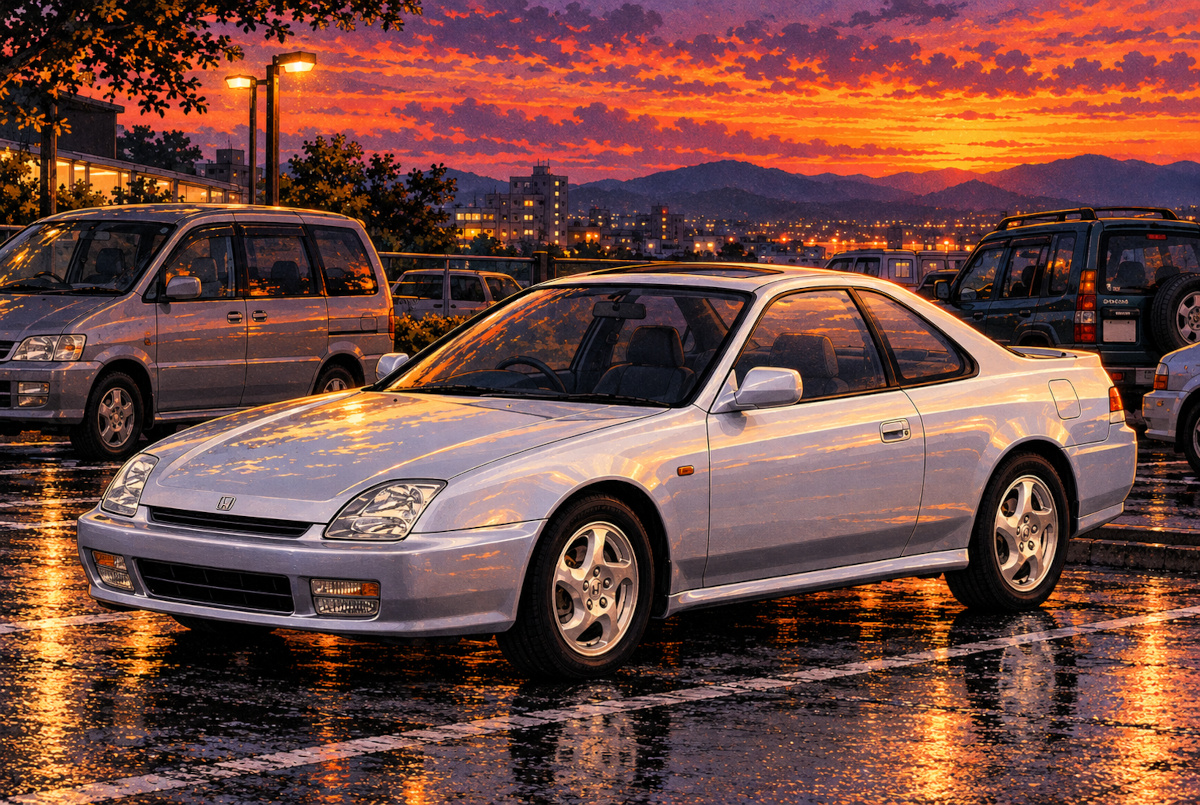 AI-generated illustration of changing car-buying preferences in late-1990s Japan. It does not depict an actual historical parking lot.
Did the Prelude Change, or Did Japanese Buyers?
It would be convenient to pin the entire decline on an unpopular redesign. But the fourth-generation Prelude adopted a bold, wide-bodied shape, and the fifth moved back toward a more conventional coupe silhouette. Sales continued downward through both approaches.
Japan’s economic bubble had burst by the 1990s. Minivans and recreational vehicles were also becoming more prominent, offering ways to combine leisure, family use and everyday practicality that a two-door coupe could not easily match.
That is a plausible part of the explanation—not proof of a precise cause. The sources examined here do not tell us what percentage of the sales decline was due to the economy, customers choosing other vehicles or changing buyer demographics.
What Honda’s own launch documents do show is that the company kept investing in handling, engines and an unusually distinctive ownership experience. What the sales record shows is that those qualities stopped attracting the same scale of domestic audience.
The Prelude did not simply disappear because it became a worse car. The more poignant possibility is that Honda kept making it technically better while the market for that kind of car was shrinking.
The 2025 Prelude Returned at ¥6,179,800
The original Prelude line ended in 2001. On September 5, 2025, Honda brought the name back with a sixth-generation model.
The revived Prelude is a front-wheel-drive coupe combining a 2.0-liter engine with Honda’s two-motor e:HEV hybrid system. Its Honda S+ Shift system simulates the feel of eight gear ratios, supported by chassis tuning intended to make driving engaging.
The Japanese price was ¥6,179,800, including consumption tax. That is a very different proposition from the affordable-to-aspirational coupes of the 1980s; a direct yen-for-yen comparison across those decades would be misleading.
But the most revealing figure may be Honda’s sales target.
When the third-generation Prelude launched in 1987, Honda planned domestic sales of 4,000 vehicles per month. For the revived 2025 model, the monthly target was just 300.
That represents a 92.5% reduction in planned monthly volume. Put another way, the newer target was roughly one-thirteenth of the old one.
These are launch sales plans, not achieved sales, so they cannot be mixed with the lifetime-sales figures in the earlier table. And the modest 2025 plan did not mean there was no initial interest. Honda announced on October 7, 2025 that it had received approximately 2,400 orders in the first month—around eight times the monthly target. Orders are not the same as completed retail deliveries or vehicle registrations.
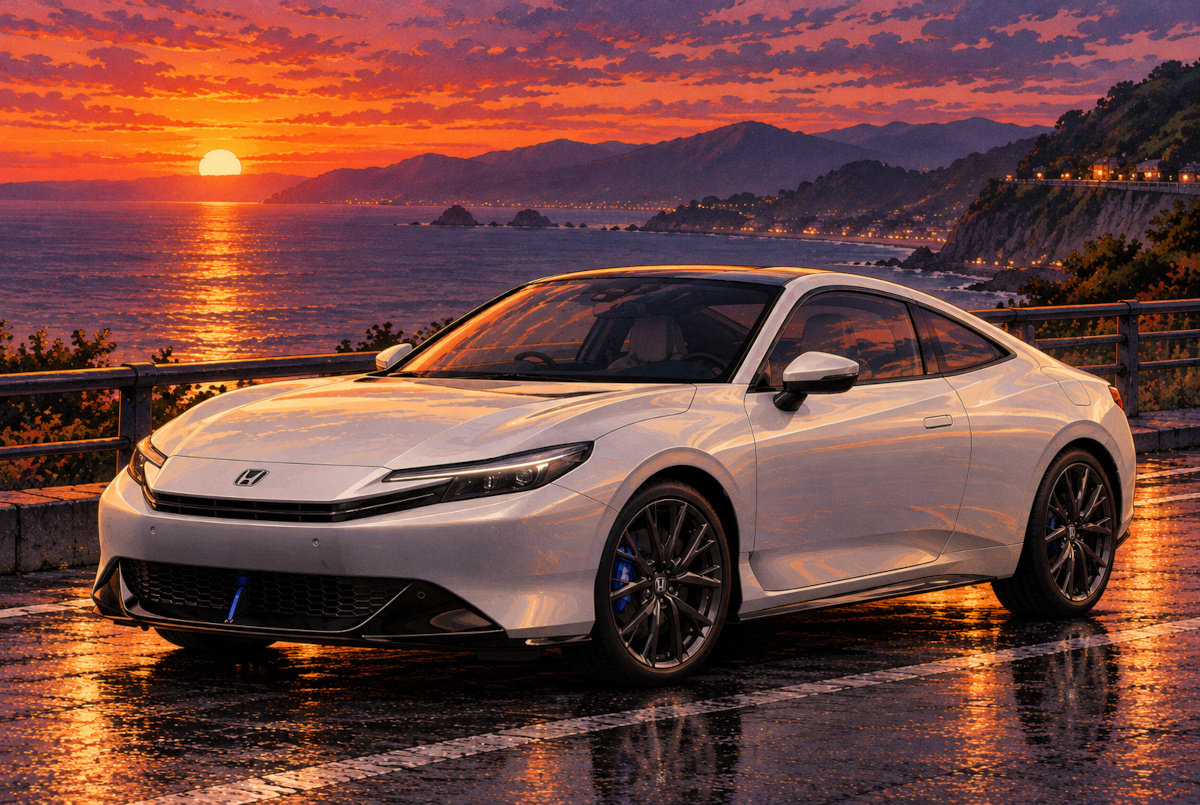 AI-generated illustration inspired by the sixth-generation Honda Prelude introduced in 2025. This is not a photograph of an actual car at that location.
The contrast suggests a different product strategy. Rather than recreating the mass-market date-car boom, Honda appears to be making room for a more specialized coupe, even at a much lower planned volume.
And the centerpiece of the 2025 model is no longer the 1987 car’s mechanical 4WS. Hybrid power delivery, simulated shifting and chassis behavior define this new version of the Prelude.
What Was Honda Really Selling With the Prelude?
Across these four articles, the Prelude has emerged as a slightly peculiar car.
There was the lever that allowed the passenger seat to be operated from the driver’s side. The power sunroof that helped establish the nameplate’s character. That extraordinarily low hood. And the mechanical four-wheel-steering system that grew out of research into accident avoidance.
The public knew it as a date car. But read Honda’s development history and launch materials, and something else comes into focus: a personal coupe meant to make ordinary driving feel special, combining striking design with advanced engineering.
Calling the Prelude the “king of date cars” is a cultural judgment, not a title established by a sales chart alone. Still, the third generation’s position as the highest-selling of the original five generations in Japan is supported by the available record.
The 2025 revival suggests that the basic idea still has a place, even if the intended audience and the economics have changed.
Editor’s Note
Of all the figures I looked at for this series, the one that really stopped me was 15,127.
That was the fifth-generation Prelude’s entire cumulative Japanese sales total. More than 90% down from the third generation. Yet the fourth had a 200 PS VTEC engine, and the fifth could be had as a 220 PS Type S. The machinery improved; the sales figures went in the opposite direction.
It is fascinating. And a little sad.
I have never thought of the Prelude as a bargain-basement Soarer. Arguing that a Silvia was sportier or that a Leopard was more luxurious does not begin to explain why the Honda was interesting.
Honda’s engineers looked at that impossibly low hood and somehow found room to put mechanisms in the car that ordinary buyers had probably never asked for. Four-wheel steering was the prime example.
And what did the car become famous for? Being a great car for picking up dates. If I had spent years developing its steering system, I might have had mixed feelings about that.
Then Honda revived the name in 2025 with a price above six million yen. Hardly the sort of car a young buyer could casually bring home as in the old days.
Still, I rather like the fact that someone at Honda decided a stylish coupe was worth building even for a much smaller audience.
Perhaps the Prelude’s real product was never horsepower, or the supposed effect it had on one’s dating prospects. It was the promise that time spent in your own car could feel like an occasion.
And that brings this four-part series to a close.
Honda Prelude: Japan's 1980s Date-Car Legend $2014 Four-Part Series
From the passenger-seat lever and the second-generation Prelude's appeal to third-generation 4WS and comparisons with the Soarer and Leopard, this four-part series examines what made the Prelude distinctive.
- Part 1: Did the Honda Prelude Really Have a “Naughty Lever”? The Passenger-Seat Mystery [Part 1]
- Part 2: The ¥1.36 Million Honda Prelude Was Built to Order—So Why Did Sales Quadruple? [Part 2]
- Part 3: The Date Car That Steered All Four Wheels: Honda Prelude’s ¥80,000 4WS Secret (Part 3)
- Final Part: Cheaper Than a Soarer, Pricier Than a Silvia: Why Did the Honda Prelude Fade? (Final Part)
References
- Honda, April 9, 1987: Third-Generation Prelude Launch Announcement (Japanese) — Original Japanese prices, vehicle dimensions, four-wheel steering and monthly sales target.
- Toyota Motor Corporation, 75 Years of Toyota: Second-Generation Soarer (Japanese) — Body dimensions, model positioning and engine lineup.
- Nissan Heritage Collection: Leopard XS-II (Japanese) — F31 Leopard dimensions, engine and equipment.
- Nissan Heritage Collection: Silvia Q’s (Japanese) — S13 introduction, dimensions, rear-wheel drive, engine specifications and awards.
- carview!: 1986 Toyota Soarer Trim-Level Price Archive (Japanese) — Listed price for the 2.0VX with five-speed manual transmission.
- Car Sensor: F31 Nissan Leopard Historical Model Guide (Japanese) — Historical price information, including the 2.0XJ.
- Best Car, October 29, 2023: Retrospective on the S13 Silvia (Japanese) — Silvia Q’s launch pricing and context on equipment and the period’s vehicle-tax treatment.
- Honda, September 19, 1991: Fourth-Generation Prelude Launch Announcement (Japanese) — Wider body, 200 PS VTEC and electronically controlled Hyper 4WS.
- Honda, November 7, 1996: Fifth-Generation Prelude Launch Announcement (Japanese) — Type S, 220 PS VTEC, ATTS and product concept.
- CAR and DRIVER, October 5, 2025: Driving All Five Generations of the Honda Prelude (Japanese) — Cumulative Japanese sales figures for the first through fifth generations.
- Honda, September 27, 2023: Development History of Honda Four-Wheel Steering (Japanese) — The role of preventive-safety research in the development of the original mechanical 4WS.
- Honda, September 4, 2025: New Prelude Launch Announcement (Japanese) — Sixth-generation pricing, hybrid technology and planned monthly sales.
- Honda, October 7, 2025: Initial Order Status for the New Prelude (Japanese PDF) — Approximately 2,400 orders in the first month.