

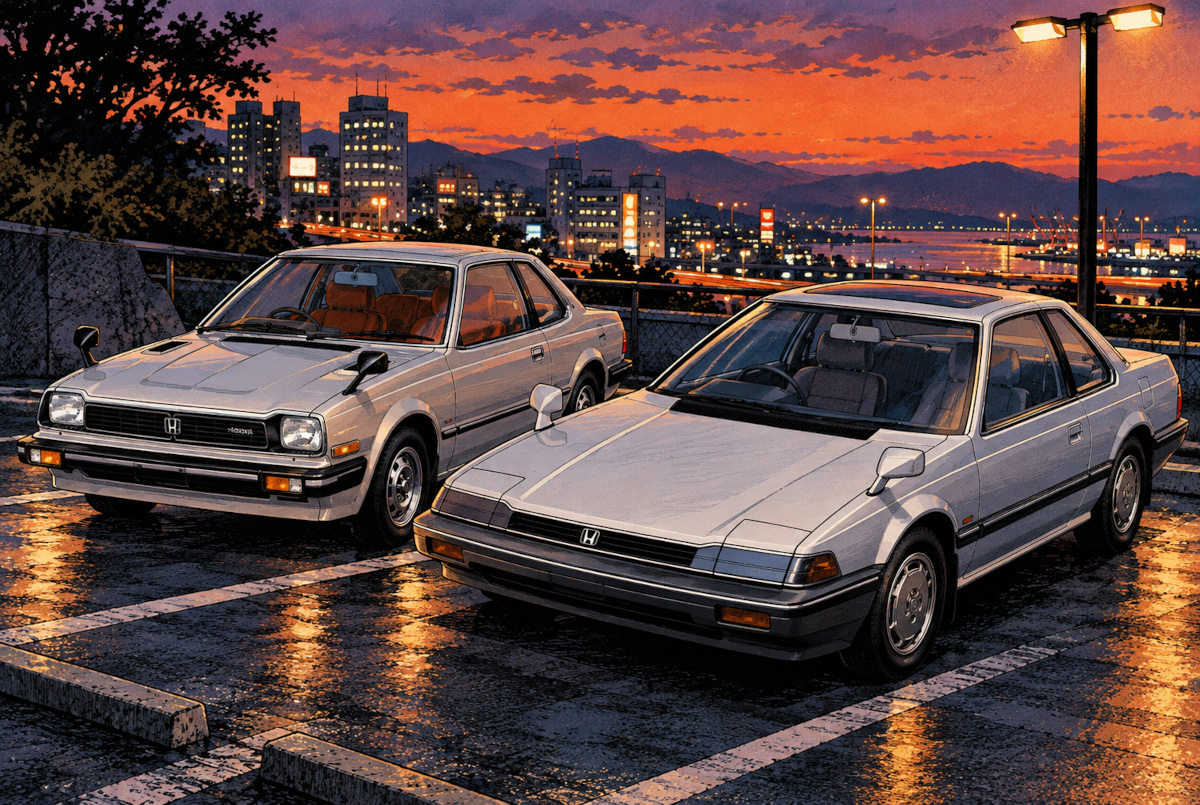
When the second-generation Honda Prelude went on sale in Japan on November 26, 1982, it looked like a car from a different era. Its pop-up headlights, remarkably low hood and sleek two-door body gave it a much more dramatic appearance than its predecessor.
It would become one of Japan’s defining 1980s “date cars”: fashionable coupes associated with young drivers, romance and the promise of a memorable night out.
And the starting price? Just ¥1.36 million in Tokyo.
That sounded like a tempting alternative to prestigious Japanese coupes such as the Toyota Soarer and Nissan Leopard. But a closer look at Honda’s original price list reveals a catch.
The ¥1.36 million Prelude XC was a built-to-order model. The better-equipped, top-of-the-range XX cost ¥1,718,000.
Yet according to a later specialist-magazine tally, the second-generation Prelude achieved roughly four times the cumulative Japanese domestic sales of the first generation.
So what made it such a hit? The answer appears to involve much more than a low advertised price.
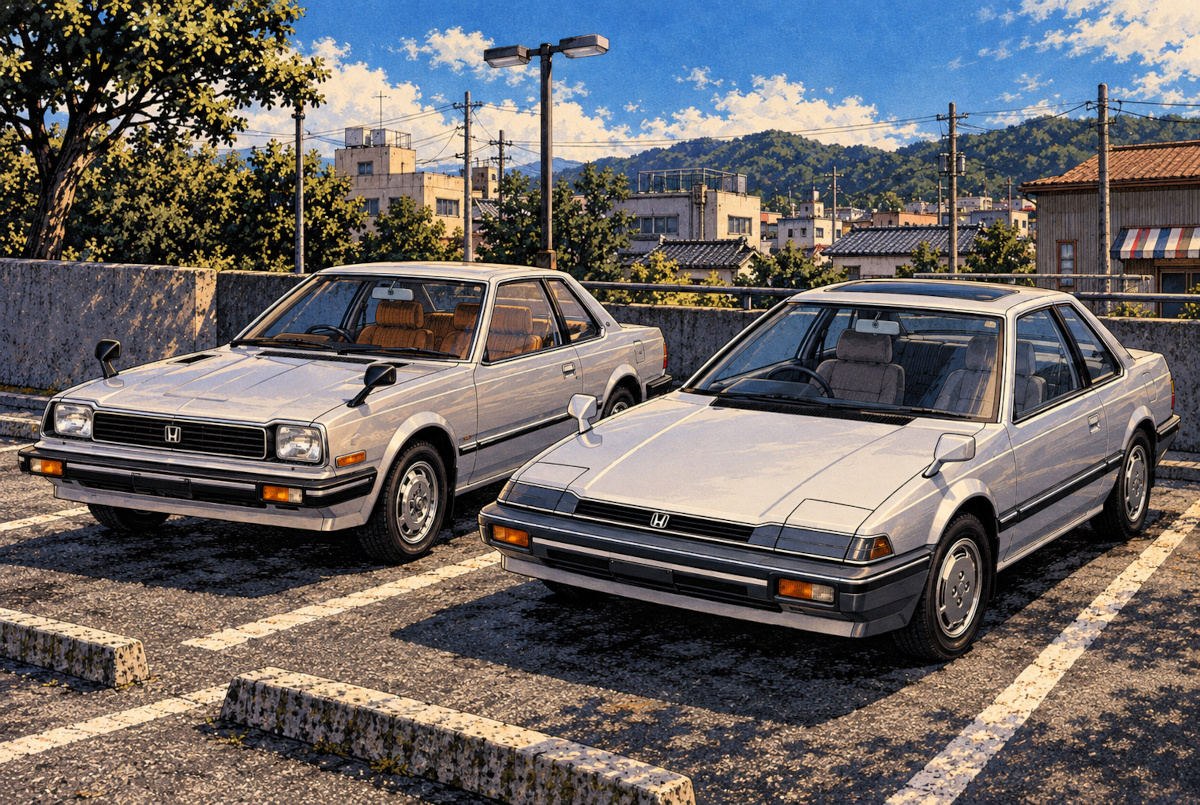
AI-generated illustration comparing the first-generation Prelude (left) with the second-generation model (right). This is an artistic recreation of the design changes; details such as grilles, wheels and relative vehicle proportions are not exact reproductions.
The Price Rose by 17.2%. Sales Still Increased Fourfold.
The original Honda Prelude debuted in Japan on November 25, 1978. Honda described the concept as a special private car: a personal coupe for people who wanted something more individual than a conventional family vehicle.
It was already an interesting proposition. The first Prelude combined front-wheel drive, a four-seat cabin that prioritized its front occupants, and equipment intended to make driving feel like a personal experience.
According to Honda’s original Japanese-market price list, the entry-level Prelude XT cost ¥1,160,000 in Tokyo with a five-speed manual transmission.
Four years later, the cheapest second-generation model, the XC, started at ¥1,360,000.
That was a ¥200,000 increase, or approximately 17.2%.
In other words, Honda did not achieve the Prelude’s dramatic growth in popularity simply by making the car cheaper.
To see what changed, I compared the two generations using Honda’s original launch specifications.
| Comparison | First Generation (1978) | Second Generation (1982) |
|---|---|---|
| Lowest Tokyo launch price | XT: ¥1,160,000 | XC: ¥1,360,000 |
| Representative upper-trim price | XE: ¥1,400,000 | XX: ¥1,718,000 |
| Overall length | 4,090 mm | 4,295 mm |
| Overall width | 1,635 mm | 1,690 mm |
| Overall height | 1,290 mm | 1,295 mm |
| Wheelbase | 2,320 mm | 2,450 mm |
| Engine displacement | 1,750 cc | 1,829 cc |
| Maximum power, 5MT | 90 PS | 125 PS |
Source: Honda’s November 24, 1978 and November 25, 1982 launch announcements. Prices are original Tokyo-area list prices for five-speed manual models. The trims and equipment levels are not identical. Power figures are the manufacturer’s period ratings. These are historical nominal prices, not inflation-adjusted equivalents.
The second-generation Prelude was 205 mm longer and 55 mm wider, with a wheelbase extended by 130 mm. Its engine also produced 35 PS more than the first-generation manual version.
Honda had not simply added a few luxury accessories. It had significantly revised the car’s proportions, performance and engineering.
Now consider the sales figures.
In October 2025, the Japanese publication CAR and DRIVER reported cumulative domestic sales of 41,190 vehicles for the first-generation Prelude and 166,904 for the second.
The calculation is straightforward:
166,904 ÷ 41,190 = approximately 4.05.
The second-generation Prelude recorded 125,714 more domestic sales than its predecessor—roughly four times as many in total.
Both generations remained on sale for approximately four years, although their exact sales periods were not identical. These totals do not reveal annual sales fluctuations, buyers’ ages or the popularity of individual trim levels.
Still, they demonstrate the scale of the Prelude’s transformation in Japan.
It Looked Much Lower—Yet It Was Actually 5 mm Taller
The defining feature of the second-generation Prelude was surely its low nose. With its retractable headlights closed, the front end looked completely different from that of the 1978 original.
But the official dimensions reveal a wonderful little contradiction.
The first-generation Prelude stood 1,290 mm tall. Its successor measured 1,295 mm.
The supposedly lower-looking car was actually 5 mm taller overall.
That is precisely the sort of detail a brochure photograph can hide.
The second-generation Prelude did not achieve its dramatic appearance by simply lowering the entire vehicle. Honda made the body wider, lengthened the wheelbase, and concentrated on creating an unusually low front hood.
Honda’s own development history explains how difficult that was.
The engineers wanted a low hood reminiscent of a high-performance sports car, but the Prelude was a front-engine, front-wheel-drive vehicle. Its front compartment had to accommodate the engine, transmission and suspension components.
Honda also insisted on a double-wishbone front suspension to achieve the handling characteristics it wanted.
Initially, the suspension would not fit beneath the proposed hood line.
Honda eventually developed an unusual wide-span arrangement with specially shaped, twisted upper suspension arms. This compact design helped make the low front end possible while retaining the desired suspension layout.
The Prelude’s appearance was not simply a styling illusion. The engineering that made the low hood possible was part of the design itself.
And that explains why a car that was technically 5 mm taller could look so much sleeker.
The Electric Sunroof Wasn’t a Second-Generation Invention
The Prelude’s electric sunroof was another major part of its appeal.
For a Japanese specialty coupe of that period, opening the roof was about more than ventilation. It changed the experience of being in the car.
But there is another historical misconception worth correcting: the second-generation Prelude did not introduce this feature.
The original 1978 Prelude was already notable for offering Japan’s first domestically produced electric sunroof as standard equipment, apart from the E trim.
Then, in January 1980, Honda announced an additional version with an electrically operated smoked-glass sunroof.
The glass-equipped version cost ¥20,000 more than its equivalent steel-panel sunroof model.
Honda used smoked-brown laminated glass and provided a manually sliding sunshade to control sunlight. With the glass closed, occupants could still enjoy light entering through the roof, even in cold or rainy weather.
So the combination of open-air driving and a more luxurious cabin atmosphere was already part of the Prelude’s identity before 1982.
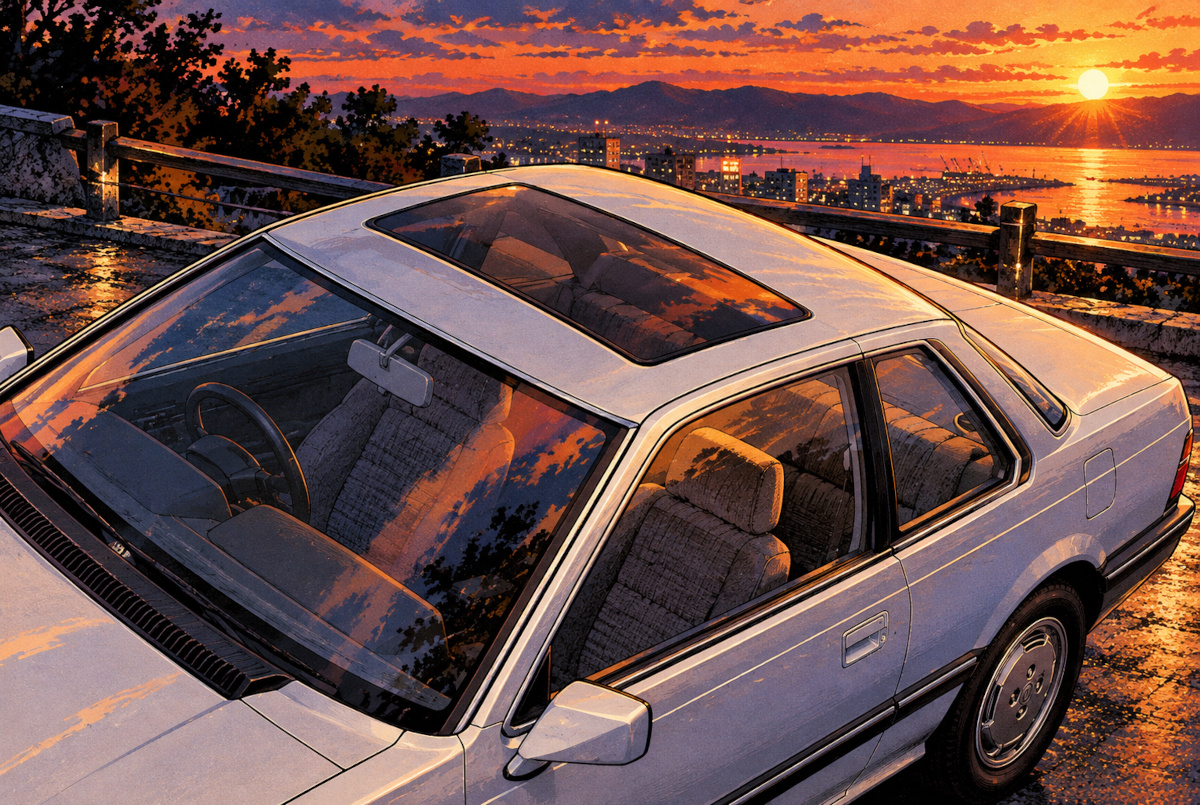
AI-generated illustration inspired by the second-generation Prelude’s electric smoked-glass sunroof. The glass panel’s exact shape, dimensions and surrounding body details are not intended as an accurate technical reproduction.
The second-generation Prelude continued this tradition.
Honda’s official archived equipment listings identify an electric smoked-glass sunroof among the features of the XC, XZ and XX models.
There is an important qualification, however. The archive describes the model range as it stood in March 1987, shortly before production ended. It should not be treated as definitive evidence that every equipment detail was identical at the November 1982 launch.
What the period documentation does establish is that Honda considered an enjoyable, personal driving environment central to the Prelude from its earliest years.
Was the ¥1.36 Million XC Really the Affordable Dream?
Let’s return to the original 1982 price list, because it contains one of the most revealing details in the entire story.
| Second-Generation Launch Trim | Tokyo Price (5MT) |
|---|---|
| XC | ¥1,360,000 |
| XZ | ¥1,520,000 |
| XX | ¥1,718,000 |
The difference between the cheapest XC and the top XX was ¥358,000.
Measured against the XC price, the XX cost approximately 26.3% more.
And in the notes beneath Honda’s official 1982 price table is the crucial statement: the XC was built to order.
That does not make the ¥1.36 million starting price false. It does mean we should be cautious about assuming this was the typical price paid by Prelude buyers.
Honda also charged extra for several desirable features.
The four-speed Hondamatic automatic transmission added ¥75,000. Versions equipped with four-wheel anti-lock brakes were available on the XZ and XX for an additional ¥130,000. The optional liquid-crystal digital instrument display for the XX added another ¥40,000.
Choose the equipment that made the car especially attractive, and the final price could move well beyond that advertised ¥1.36 million.
Which brings us to a more awkward question.
Was the Prelude simply what Japanese buyers settled for when they could not afford a Toyota Soarer or Nissan Leopard?
What If the Buyers Never Wanted a Soarer?
The idea that the Prelude was merely a cheaper alternative to a luxury coupe sounds plausible. But the period price lists complicate that interpretation.
The first-generation Toyota Soarer was launched in 1981 with a 2000VI grade priced at ¥1,662,000.
That was actually ¥56,000 cheaper than the 1982 Prelude XX.
These prices came from different launch years and the vehicles did not have identical equipment. Still, the comparison is enough to show that a Soarer was not necessarily more expensive than a Prelude.
The Nissan Leopard also occupied a somewhat different part of the market. Its first generation offered engines ranging from 1.8 to 2.8 liters, and buyers could choose between two-door and four-door hardtop bodies.
All three were Japanese specialty cars, but they did not offer precisely the same experience.
The Soarer emphasized luxury and the prestige of a larger, rear-wheel-drive coupe. The Leopard pursued a similarly sophisticated image, with advanced equipment and a broader choice of body styles.
The Prelude offered another formula: front-wheel drive, a compact body, strikingly low styling, and a blend of handling technology and comfort features.
Their price ranges overlapped, but their personalities did not.
Without reliable period surveys of buyers’ motivations, I cannot claim that young Japanese customers deliberately rejected the Soarer or Leopard.
But the specifications and original prices make one thing clear: buying a Prelude did not automatically mean settling for the cheapest option.
Honda had created a different kind of desirable car.
Before the Bubble: A Different Idea of Looking Successful
The second-generation Prelude appeared in 1982, before the Japanese asset-price bubble commonly associated with the late 1980s.
Its character was not based on the formula of a large body, a prestigious six-cylinder engine and an abundance of luxury fittings.
Instead, Honda combined an unusually low front end, a 1.8-liter four-cylinder engine, front-wheel drive, an available electric glass sunroof and serious chassis engineering.
The result was a coupe that felt special without trying to imitate the larger Soarer or Leopard.
In 1987, Honda introduced the third-generation Prelude with another remarkable technical feature: its mechanically controlled four-wheel steering system, or 4WS, offered on selected versions.
CAR and DRIVER reports cumulative Japanese domestic sales of 175,634 for that generation, slightly more than the second generation’s 166,904.
But I would argue that the essential transformation had already happened in 1982.
The first Prelude introduced Honda’s idea of a personal specialty coupe. The second turned that idea into a shape that a much larger number of Japanese buyers apparently wanted to own.
Its fourfold increase in cumulative domestic sales cannot be explained by styling alone, and the available figures do not tell us exactly what motivated every buyer.
Yet the combination of stronger performance, fresh proportions, established comfort features and a distinct position in the market offers a convincing explanation for its success.
The Prelude was not simply another sports coupe competing on horsepower. It sold the possibility of making everyday driving feel a little more glamorous.
Editor’s Note
The number that first caught my attention was ¥1.36 million.
Not bad for a brand-new specialty coupe, I thought. Then I checked Honda’s original paperwork and discovered that the bargain-basement XC was built to order. Step up to the XX and the price jumped to ¥1,718,000.
So much for the easy explanation that the second Prelude became a hit because everyone could buy one cheaply.
And then there was the height measurement. The second generation looked dramatically lower, yet it was 5 mm taller overall. I love finding contradictions like that in old specification sheets.
Personally, I do not buy the idea that every young Prelude owner secretly wanted a Soarer or Leopard and simply could not afford one.
Look at those cars. A large, luxurious Soarer and a Prelude with a nose that seemed almost impossibly thin were selling quite different versions of cool.
Maybe what some young buyers wanted was not necessarily the most expensive car they could afford. Maybe they wanted the car that made them feel a little more stylish behind the wheel.
Of course, owning a Prelude was no guarantee of romantic success. No car has ever come with that particular warranty.
Still, I can understand why someone looking over that low hood might start imagining who could be sitting in the passenger seat.
There was a time when choosing a car for how it made you feel—not just how fast it went or how much it could carry—seemed like a perfectly reasonable luxury.
Next time, I’ll move to the third-generation Prelude, introduced in 1987, and investigate Honda’s remarkable mechanical four-wheel steering system. Beneath its fashionable exterior, this so-called date car had some very serious engineering.
Honda Prelude: Japan's 1980s Date-Car Legend $2014 Four-Part Series
From the passenger-seat lever and the second-generation Prelude's appeal to third-generation 4WS and comparisons with the Soarer and Leopard, this four-part series examines what made the Prelude distinctive.
- Part 1: Did the Honda Prelude Really Have a “Naughty Lever”? The Passenger-Seat Mystery [Part 1]
- Part 2: The ¥1.36 Million Honda Prelude Was Built to Order—So Why Did Sales Quadruple? [Part 2]
- Part 3: English edition Coming soon
- Final Part: English edition Coming soon
References
- Honda — November 24, 1978: Original Prelude Launch Announcement (Japanese). Official launch date, Tokyo-area prices, electric sunroof equipment, dimensions and specifications.
- Honda — PRELUDE 1978.11 Press Information (Japanese). Original development philosophy and the “special private car” concept.
- Honda — November 25, 1982: Second-Generation Prelude Launch Announcement (Japanese). Original XC, XZ and XX prices, built-to-order status of the XC, equipment premiums, dimensions and engine output.
- Honda — January 9, 1980: Smoked-Glass Sunroof Version Added to the Prelude Range (Japanese). Electric glass sunroof construction, January 12 launch, sliding sunshade and ¥20,000 premium.
- Honda — Second-Generation Prelude Model Archive: Equipment and Grades (Japanese). XC, XZ and XX equipment details, reflecting the model range as of March 1987.
- Honda — Prelude History: A Pioneering Specialty Coupe (Japanese). Honda’s retrospective account of the first two generations, their design philosophy and the engineering behind the low hood and front suspension.
- Honda — April 9, 1987: Third-Generation Prelude Launch Announcement (Japanese). Introduction of the mechanical four-wheel steering system and model specifications.
- CAR and DRIVER — Driving the Generations of Honda Prelude, October 5, 2025 (Japanese). Retrospective evaluation and reported cumulative Japanese domestic sales totals for the first, second and third generations.
- Toyota Motor Corporation — Original 1981 Soarer Launch Materials (PDF) (Japanese). Historical Japanese-market prices, including the 2000VI trim.
- Nissan Heritage Collection — Leopard Two-Door Hardtop Turbo SGX (Japanese). First-generation Leopard’s market positioning, engine range, body styles and equipment.