

What happened to the money stolen in Japan’s notorious ¥300 million robbery?
On December 10, 1968, a man disguised as a motorcycle police officer stole nearly ¥300 million in cash in Fuchu, western Tokyo. Five days later, a 19-year-old young man known as Suspect S, who had attracted police attention, died after ingesting cyanide. His father was a serving motorcycle police officer.
Then there is a rather disturbing allegation: S’s father may have burned the stolen money after the robbery.
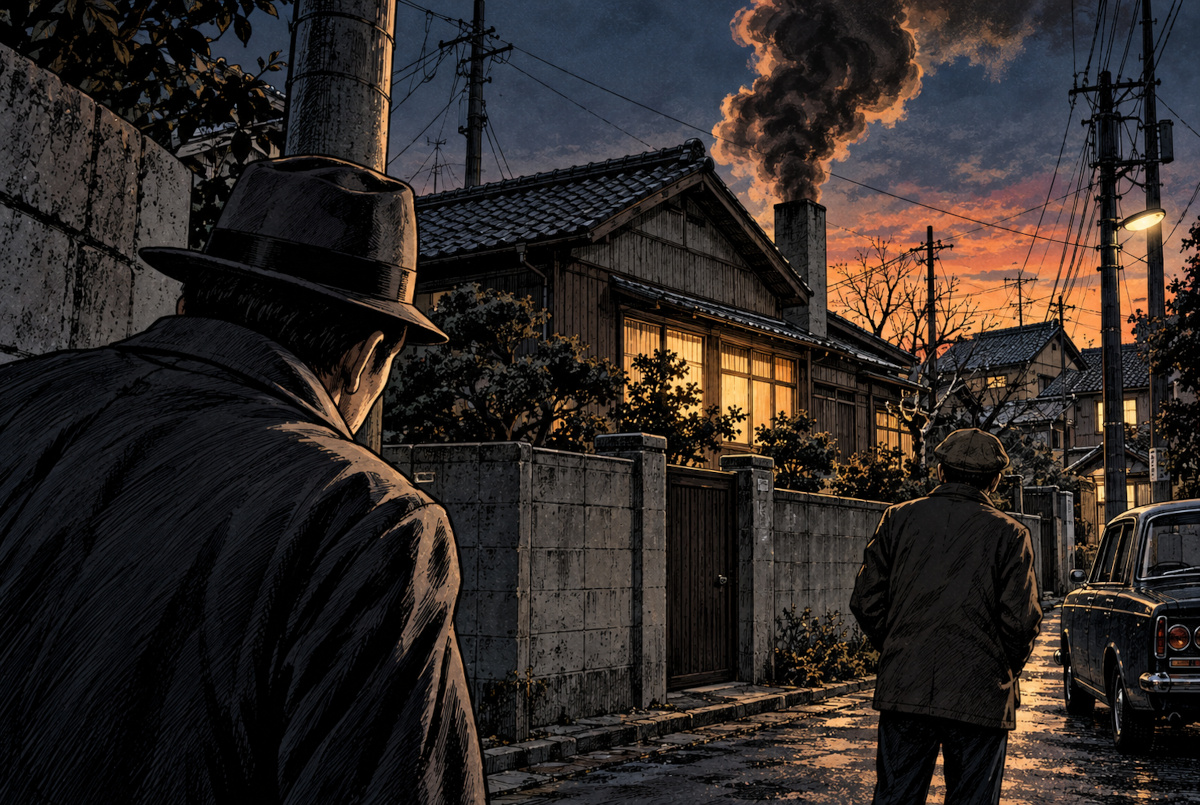
Years ago, I personally heard an account from a man who said he had worked on the original investigation. According to what he told me, neighbors had reportedly noticed unusually heavy smoke coming from a chimney. However, I have not been able to verify the original witness statement or establish exactly when this was supposed to have happened.
Could someone really burn ¥300 million in an ordinary house? And more importantly, why would anyone need to destroy all that money?
Was Chimney Smoke Evidence That ¥300 Million Had Been Burned?
The story about S’s father allegedly destroying the money appears in several forms. Some versions refer to burning something in the yard. Others mention a traditional bath furnace or unusually heavy smoke from a chimney.
The trouble is that I could not establish where each version originated or whether they describe separate incidents. They may even be variations of the same story, repeated and altered over time.
Among the publicly available materials examined for this article, I found no original witness statement, forensic report on burned material, or recovered banknote fragments that directly establish the destruction of the stolen cash.
And that creates a rather large gap in the theory.
Even if someone really saw smoke, how would they know what was burning?
Was it money? Personal belongings? Ordinary household waste? Or something entirely unrelated to the robbery?
There is a considerable difference between witnessing smoke and proving that stolen banknotes were being destroyed.
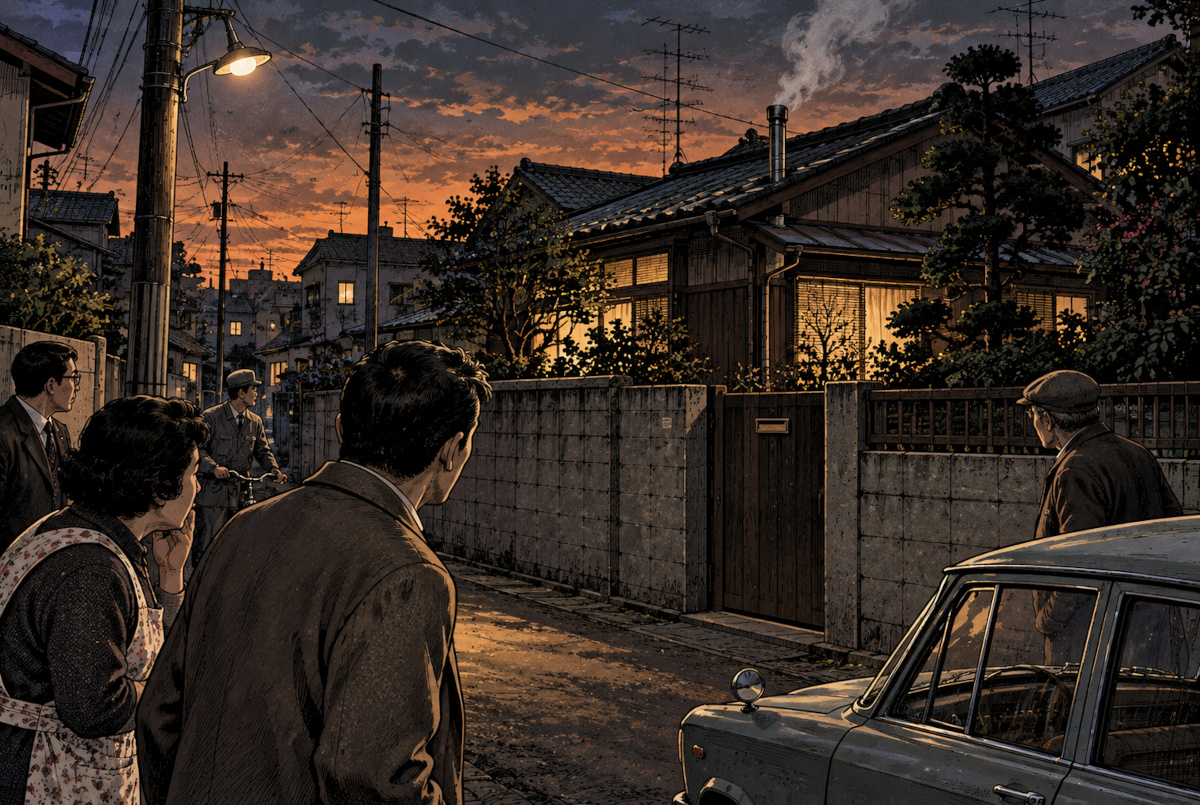
AI-generated illustration inspired by a residential neighborhood in 1968. It does not depict the actual house, witnesses or reported incident. The smoke is symbolic and does not establish that stolen cash was burned.
How Much Would ¥300 Million Actually Weigh?
Here is the question that sent me down a rather different rabbit hole.
Three hundred million yen sounds like an enormous amount of money. But how much physical material would it represent if you tried to burn it?
The reported amount stolen was ¥294,307,500. According to the Bank of Japan, banknotes currently issued weigh approximately one gram each and are about 0.1 millimeters thick.
Suppose, purely for calculation, that the full ¥300 million had consisted entirely of ¥10,000 notes.
- ¥300,000,000 ÷ ¥10,000 = 30,000 banknotes
- 30,000 notes × approximately 1 gram = 30 kilograms (about 66 pounds)
- 30,000 notes × approximately 0.1 mm = a stack roughly 3 meters (9.8 feet) high
This is a hypothetical calculation using the Bank of Japan’s measurements for modern banknotes. The actual stolen money included several denominations, so these figures do not establish its exact weight or number of notes in 1968.
Still, the calculation changes the way I picture the crime.
We tend to imagine ¥300 million as an almost unimaginable mountain of money. Physically, however, banknotes worth that amount could weigh only a few dozen kilograms, depending on their denominations.
That does not make household incineration physically impossible.
But whether something could be burned and whether it was burned are entirely different questions.
Without information about the furnace or fireplace, the timing, the ashes, or any surviving fragments, the calculation cannot establish that S’s father destroyed the cash.
Only 0.34% of the Stolen Amount Appeared in a Published Serial-Number Range
Another claim bothered me even more: that the robber could not spend the money because police already knew the banknotes’ serial numbers.
If that were true of the entire haul, burning the cash might sound like a desperate way to eliminate incriminating evidence.
But what did the police actually publicize?
In 1969, investigators distributed a wanted poster featuring evidence from the robbery, including a consecutive serial-number range covering 2,000 stolen ¥500 banknotes.
Japanese writer Keisuke Takagi examined the poster campaign using reports published in the Yomiuri Shimbun on May 22 and 23, 1969.
So I calculated how much those 2,000 notes represented compared with the total amount stolen.
| Item | Amount or proportion |
|---|---|
| Total cash stolen | ¥294,307,500 |
| ¥500 notes in the published serial-number range | 2,000 notes = ¥1,000,000 |
| Share of the total stolen amount | Approximately 0.34% |
| Remaining amount outside that 2,000-note range | Approximately 99.66% |
The calculation is straightforward:
¥1,000,000 ÷ ¥294,307,500 × 100 = approximately 0.34%.
In other words, the banknotes in that published serial-number range represented only about one-third of one percent of the stolen money’s value.
There are two important qualifications. First, this is a proportion of the money’s value, not the total number of banknotes. Second, it does not prove that every other note was impossible to trace through other investigative methods.
Nevertheless, the published serial numbers certainly did not provide a ready-made tracking list for every yen stolen.
Even if none of those identified ¥500 notes turned up, that would not prove that the remaining money had never been spent.
And it seriously weakens the simplistic argument that the entire haul was unusable because every banknote could be identified, leaving the robber or his family with no choice but to burn it.
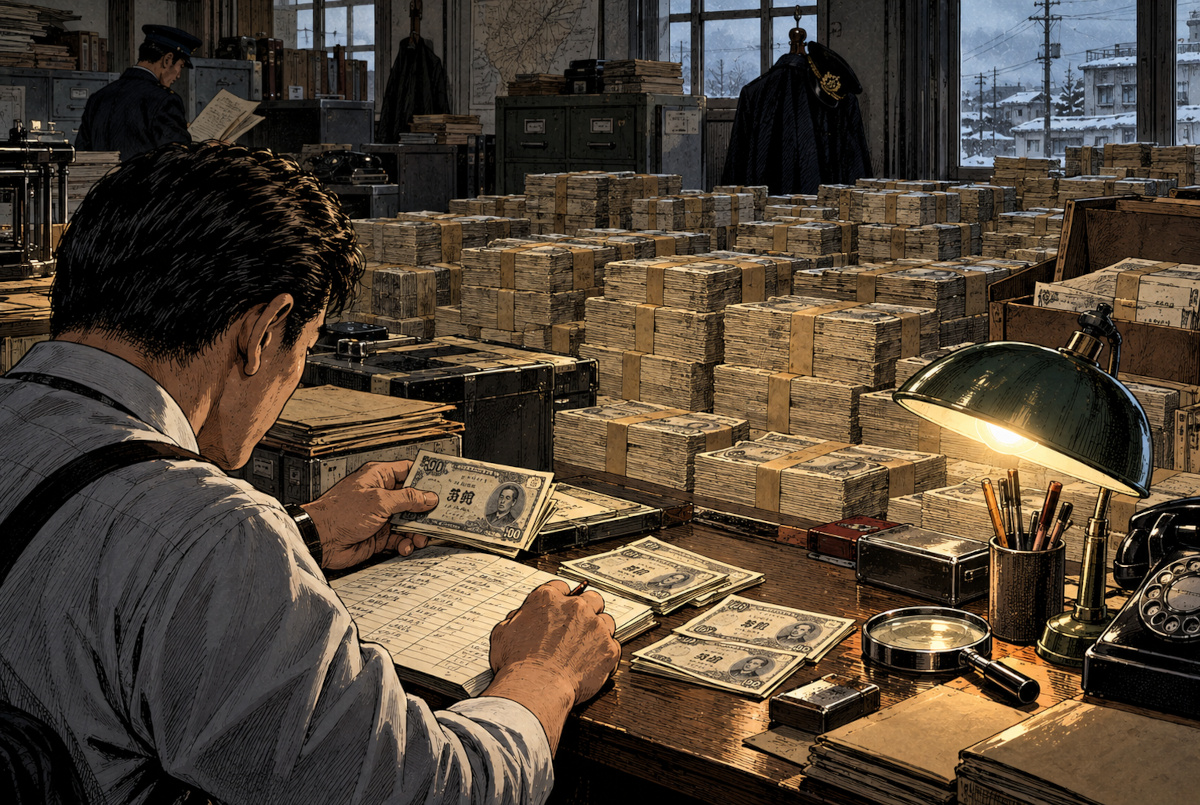
AI-generated illustration representing the contrast between the total stolen amount and the approximately 0.34% covered by the published serial-number range. The cash shown was not recovered by police. The banknote designs, quantities, investigation room and snowy scenery are fictional, not historical reconstructions.
Could the Father Have Used His Police Position to Suppress the Investigation?
That brings us to the other half of the allegation: the father’s influence within the police.
In a 2021 TV Tokyo report, investigative journalist Shoji Kondo, who spent decades researching the ¥300 million robbery, described S’s father as a unit commander in the Metropolitan Police’s motorcycle traffic division. Kondo also said the father had a background in public security police work.
Kondo claimed that the father reacted angrily when approached for an interview. It is possible he resented questions about his deceased son. But anger during an interview is not proof of a criminal cover-up.
There is also a distinction that tends to disappear in sensational accounts.
Being a police unit commander does not automatically mean having the authority to order an investigation into a major robbery to be shut down.
If the father really intervened, the next questions should be specific. Whom did he contact? What instructions were given? Were documents suppressed, evidence altered or investigators told to abandon a particular lead?
Those claims would require identifiable records or reliable testimony.
The investigation’s shortcomings were certainly debated. On December 11, 1975, immediately after the criminal statute of limitations had expired, Japan’s House of Representatives Local Administration Committee discussed possible problems with the initial police response, command structure and reliance on preconceived suspects.
But those parliamentary questions did not establish that S’s father orchestrated an institutional cover-up.
The police failed to solve the robbery. Whether one officer used his connections to help conceal the truth is a separate allegation that remains unproven.
So Where Did the ¥300 Million Go?
Was it burned? Hidden? Gradually spent? Divided among accomplices?
The available evidence does not allow us to settle the question.
But testing the burning theory has revealed something worth knowing.
Destroying the cash was not necessarily impossible from a purely physical standpoint. Yet the idea that every banknote was traceable, and therefore had to be destroyed, does not withstand scrutiny.
That leaves the supposed smoke sighting.
When did it happen? Who actually witnessed it? What did they see, and what did investigators do with the information?
If we want to test whether the father burned the money, the most useful evidence would not simply be a description of how much smoke came out of a chimney.
It would be a traceable account of who reported the smoke, what they said, and how police investigated the report.
Editor’s Note
Years ago, I heard an account about the police officer’s son, his father and the alleged burning of the stolen cash from someone who told me he had worked on the original ¥300 million robbery investigation.
That is why I have never been entirely comfortable dismissing the story as just another urban legend.
Still, checking the numbers gave me a surprise. The banknotes in the published serial-number range accounted for only 0.34% of the stolen amount. So much for the neat explanation that all the cash was impossible to spend and therefore had to be burned.
Of course, if the father really was protecting his son, he might have valued destroying evidence more than keeping the money. But that is my speculation, not an established fact.
What bothers me most is not even the alleged smoke from a police officer’s home.
It is what happened to the story afterward. Did investigators follow it up? Did anyone document the neighbors’ observations? Was there a search, a written report, or a reason to dismiss the claim?
Smoke disappears. Ashes can be cleared away. But what about the investigative paper trail?
That’s the part I still want to get my hands on.
The 300 Million Yen Robbery $2014 Four-Part Series
The police officer's son, the missing money, the fake police motorcycle, and questions about the investigation. Four articles examine the evidence, competing theories, and what remains unproven.
- Part 1: Did the Robber Die Five Days Later? Japan’s ¥300 Million Mystery and a Police Officer’s Son
- Part 2: Did the Suspect’s Father Burn ¥300 Million? The Chimney Smoke Mystery
- Final Part: Did Police Already Know the Culprit? Japan’s ¥300 Million Robbery, 57 Years On Coming soon
- Special: A Yamaha 350 R1 Disguised as a Police Bike? Japan’s ¥300 Million Heist Coming soon
References
- Encyclopaedia Britannica, Japanese Concise Edition — The ¥300 Million Robbery (via Kotobank; Japanese) — Basic information including the December 10, 1968 robbery, the reported amount stolen and the statute of limitations.
- Bank of Japan — How Large, Thick and Heavy Are Japanese Banknotes? (Japanese) — Source for the approximate weight of one gram and thickness of 0.1 millimeters per currently issued note. Official English version.
- Bank of Japan — Historical ¥500 Banknotes (Japanese) — Confirms the Iwakura Tomomi ¥500 note issued from 1951 and the later version first issued in November 1969.
- Keisuke Takagi — Distribution of the ¥300 Million Robbery Evidence Poster (May 22, 2023; Japanese) — Reviews Yomiuri Shimbun reports from May 22–23, 1969, including the police poster and the consecutive serial numbers of 2,000 stolen ¥500 notes.
- Bunshun Online — Extract from Takarajimasha’s 100 Unsolved Cases in Japan (March 24, 2026; Japanese) — Retrospective account of Suspect S, the police investigation and his death five days after the robbery.
- TV Tokyo — Investigative Journalist Shoji Kondo Discusses the ¥300 Million Robbery (July 2, 2021; Japanese) — Kondo’s account of the father’s police career, his interview with the father and the theory implicating Suspect S.
- House of Representatives, Local Administration Committee — Remarks by Seiichi Kataoka (December 11, 1975; Japanese) — Parliamentary questions concerning the initial response, command structure and suspect-focused investigation. The original proceedings can also be accessed through the National Diet Library’s official proceedings database.