

In June 1973, Mazda reached a remarkable milestone: 500,000 rotary-powered vehicles produced. Just six years earlier, the technology had made its production debut in the exotic Cosmo Sport.
By then, rotary engines were powering everything from family sedans to high-performance coupes. Mazda, still operating under the corporate name Toyo Kogyo, seemed to have turned an engineering gamble into a winning formula.
Then came the first oil crisis in the autumn of 1973. Fuel prices soared, rotary-powered Mazdas lost their appeal to economy-minded buyers, and sales plunged, particularly in North America.
In 1975, Toyo Kogyo reported a major financial loss. Yet that October, Mazda launched rotary-powered vehicles claiming a 40% improvement in fuel economy. By November 1978, cumulative rotary-vehicle production had reached one million units.
How did an engine associated with Mazda’s financial crisis manage to survive? And what did the much-celebrated “40% better fuel economy” claim actually mean?
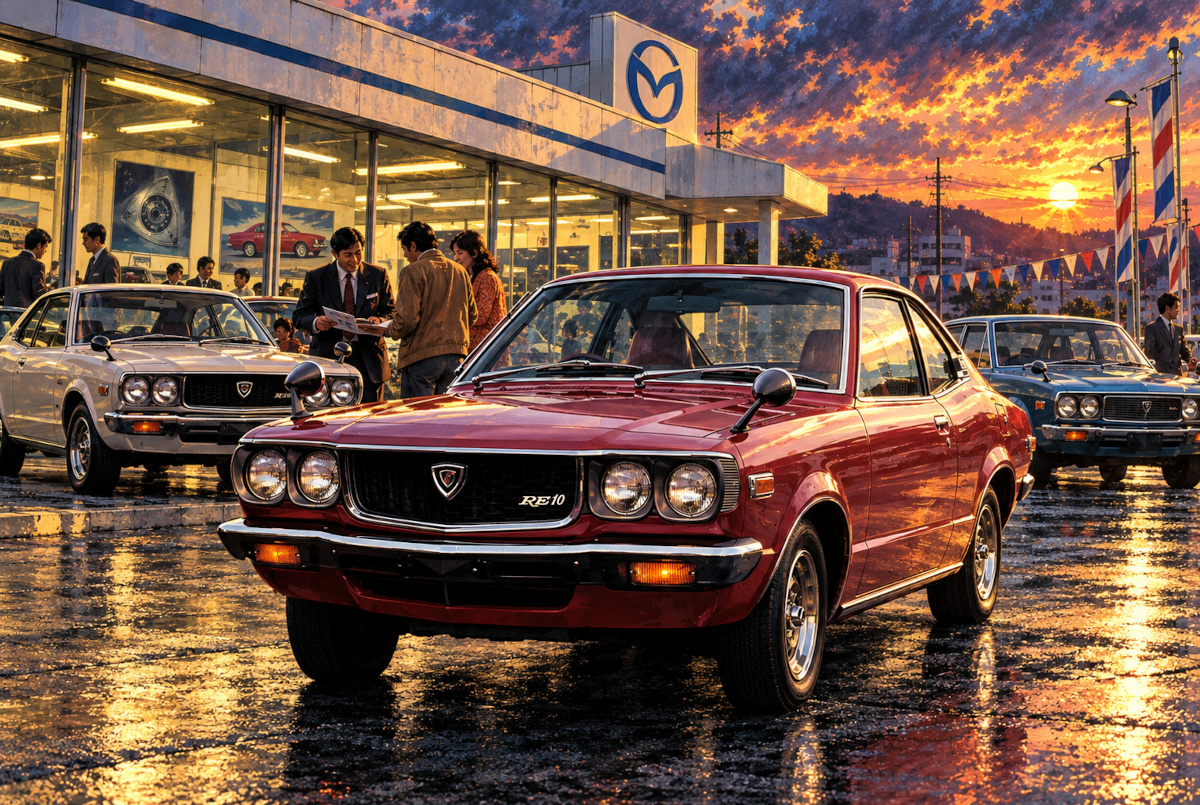
An imagined early-1970s Mazda dealership, reflecting the expansion of Mazda’s rotary-powered lineup. The building, signage and surrounding vehicles are artistic interpretations, including some design elements from other periods. AI-generated illustration.
From the Cosmo Sport to Everyday Cars: Mazda’s Rotary Expansion
The original Cosmo Sport, examined in the previous article, had a total production run of just 1,176 cars. But Mazda never intended the rotary engine to remain the preserve of an expensive, low-volume sports car.
The Familia Rotary Coupe, known internationally as the R100, arrived in 1968. The Capella rotary series, sold in export markets as the RX-2, followed in 1970. In September 1971 came the Savanna, better known outside Japan as the RX-3. A rotary-powered second-generation Luce, marketed as the RX-4, joined the range in 1972.
This was no longer an experiment aimed at a handful of enthusiasts. Mazda was trying to establish the rotary as a mainstream alternative to conventional piston engines.
The Savanna was particularly successful. Mazda recorded 5,406 orders during its launch month in September 1971. A more powerful 12A rotary version followed in 1972, and the car went on to challenge Nissan’s formidable Skyline GT-R in Japanese touring-car racing.
By May 1976, the Savanna had recorded its 100th victory in domestic motorsport competition.
Mazda’s ambitions extended beyond passenger cars. In 1974, it introduced the rotary-powered pickup truck in North America, along with the Parkway Rotary 26 bus in Japan.
Compact dimensions and impressive power output made the rotary attractive for an extraordinary variety of vehicles. Mazda wanted to exploit those advantages almost everywhere.
The EPA’s Fuel Economy Figures Were Not Flattering
There was one catch. A physically small engine is not necessarily an economical engine.
On April 15, 1974, the U.S. Environmental Protection Agency published a fact sheet titled Fuel Economy of Mazda Rotary Engine Vehicles.
Its figures were hardly encouraging.
In certification testing for the 1974 model year, a rotary-powered Mazda in the 2,750-pound test-weight class returned just 10.7 U.S. miles per gallon (mpg), equivalent to approximately 4.55 km/L.
Other vehicles in the same weight class achieved roughly 15 to more than 25 mpg. That was approximately 6.38 to more than 10.63 km/L.
The comparison matters because vehicle weight strongly influences fuel consumption. The EPA was not simply comparing Mazda’s rotary car with an entirely different class of vehicle.
Mazda Motors of America disputed the original results. The EPA subsequently conducted a special test program, examining how rotary-powered vehicles performed under city and highway driving conditions.
Based on that program and other information, the agency estimated that cold-start city fuel economy for Mazda rotary vehicles was approximately 11 to 13 mpg, depending on engine tuning.
Converted into metric terms, that is roughly 4.7 to 5.5 km/L.
These were historical U.S. test results and estimates, not an average of every rotary Mazda on the road. They cannot be treated as the real-world fuel economy of Japanese-market cars or compared directly with today’s testing standards.
But they demonstrate why the engine’s fuel consumption had become such a serious commercial problem.
The rotary engine’s long, narrow combustion chamber has a relatively large surface area through which heat can escape. Mazda was also relying on emissions-control technology, including a thermal reactor, to reburn pollutants in the exhaust system.
Reducing harmful exhaust emissions and reducing the amount of gasoline consumed were not necessarily the same engineering problem.
It Wasn’t Just Poor MPG. Unsold Cars Were Piling Up.
When the first oil crisis pushed petroleum prices sharply higher in late 1973, the car-buying public became much more concerned about fuel economy.
That shift hit Mazda’s rotary-heavy lineup especially hard.
According to Mazda’s own corporate history, sales fell dramatically, particularly in North America. Inventories rose, and Toyo Kogyo recorded an unprecedented major deficit in 1975.
Unsold cars create problems that go well beyond disappointing sales charts. Manufacturing costs have already been incurred, capital is tied up in inventory, storage brings additional expenses, and the expected cash from customers fails to arrive on schedule.
Mazda responded by cutting production, reducing expenses and selling assets. In January 1975, it also began the “All Mazda Dispatch” program, temporarily assigning employees to dealerships across Japan.
The rotary engine’s poor fuel economy was not the entire financial problem. Mazda had built much of its product strategy around an engine whose biggest commercial weakness became impossible to ignore when the market changed.
That distinction is essential. The historical record supports a connection between Mazda’s rotary-centered strategy, falling sales, excessive inventory and the company’s financial crisis.
It does not establish that every yen of the 1975 loss was attributable to the rotary-engine business alone. A separate, reliable breakdown of model-level profitability would be needed to make that claim.
The Phoenix Project: What Did “40% Better Fuel Economy” Mean?
Mazda did not respond by abandoning its rotary engine.
Instead, Toyo Kogyo launched the Phoenix Project, an ambitious engineering effort aimed at improving rotary-engine fuel economy by 40%.
The work went well beyond tweaking the carburetor. Engineers pursued improvements in internal sealing, combustion efficiency, exhaust treatment, secondary-air control and related systems. Vehicle and drivetrain adjustments also formed part of the broader efficiency effort.
In Mazda’s official corporate timeline, October 1975 is recorded as the month the company introduced rotary-powered vehicles featuring a 40% improvement in fuel economy.
But that figure raises a deceptively simple question.
Does 40% better fuel economy mean the car uses 40% less gasoline?
Not necessarily. It depends on which measurement is being improved.
To see why, suppose a car originally achieves 5.0 kilometers per liter. This is a hypothetical example, not a documented fuel-economy figure for a particular Phoenix Project vehicle.
If its distance traveled per liter improves by 40%, it would achieve:
5.0 × 1.40 = 7.0 km/L.
Now calculate how much gasoline the car needs to travel the same distance.
| Measurement | Before improvement | After 40% higher km/L |
|---|---|---|
| Fuel economy | 5.0 km/L | 7.0 km/L |
| Fuel used over 100 km | 20.0 L | Approx. 14.3 L |
| Fuel used over 10,000 km | 2,000 L | Approx. 1,429 L |
Over 10,000 km, that hypothetical vehicle saves approximately 571 liters of gasoline.
That is substantial. But the reduction in fuel consumed is only about 28.6%, not 40%.
The calculation is:
(2,000 − 1,428.57) ÷ 2,000 × 100 = approximately 28.6%.
Now reverse the question.
What if “40% improvement” meant reducing fuel consumption per 100 km by 40%, rather than increasing the distance traveled per liter?
Starting at 20 liters per 100 km, a 40% reduction would bring consumption down to 12 liters.
That works out to approximately 8.33 km/L, an increase of roughly 66.7% when measured in kilometers per liter.
A 40% increase in mpg or km/L is mathematically different from a 40% reduction in fuel consumed per mile or kilometer. The two claims should not be treated as interchangeable.
Mazda’s official timeline confirms the introduction of vehicles with a claimed 40% fuel-economy improvement. However, that timeline alone does not provide the complete comparison vehicles, test conditions or calculation method behind the figure.
The example above therefore explains the mathematics, not Mazda’s actual before-and-after test results. It must not be combined directly with the EPA’s 1974 figures as though both sets of numbers came from the same test program.

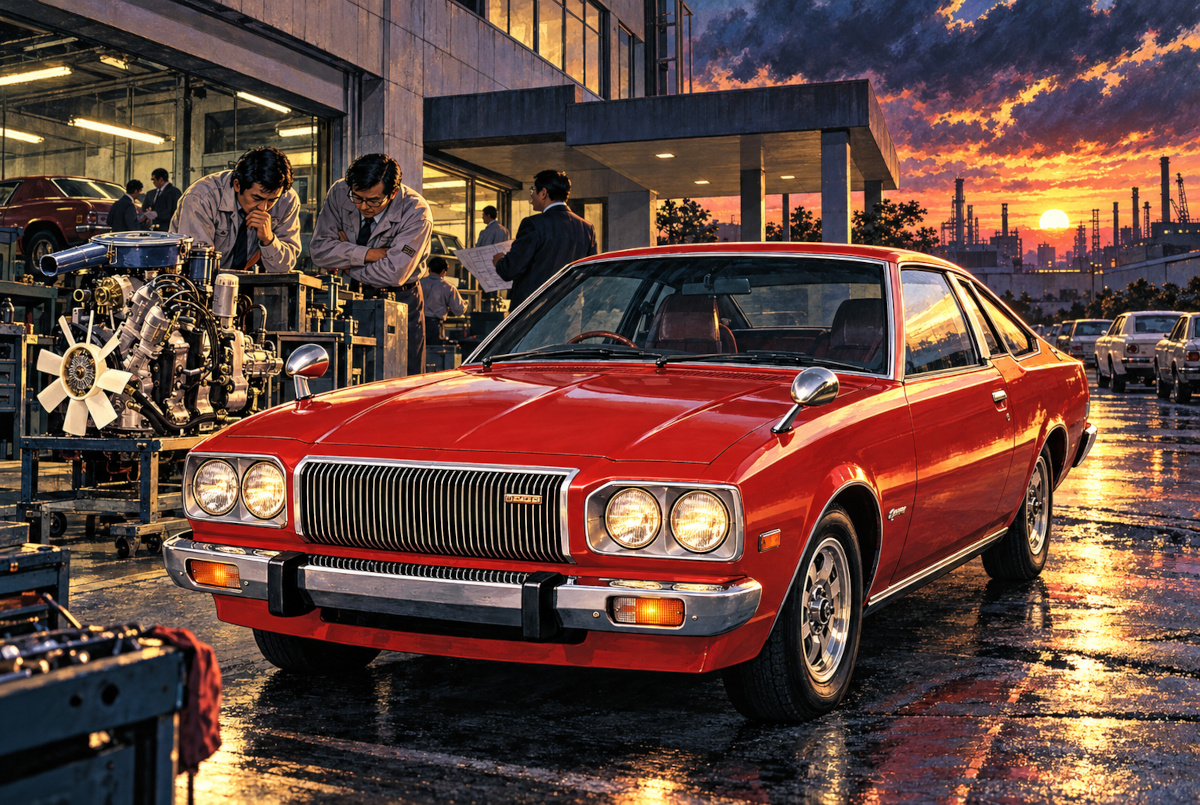
An imagined mid-1970s engineering workshop representing efforts to improve rotary-engine fuel economy. The people, machinery, engine components and accessories are artistic interpretations, not accurate reproductions of Mazda 12A or 13B hardware or the actual Phoenix Project facilities. AI-generated illustration.
A Red Cosmo AP Arrived in the Middle of the Crisis
Then, in October 1975, Mazda unveiled the Cosmo AP.
This was no return to the low-slung, almost spacecraft-like Cosmo Sport of 1967. The new Cosmo was a luxurious two-door specialty coupe, with a striking vertical-bar grille and styling aimed partly at the American market.
The letters AP stood for Anti-Pollution, reflecting the emphasis on cleaner exhaust emissions.
The rotary-powered versions incorporated the company’s emissions-control and fuel-efficiency improvements. Despite arriving in the aftermath of the oil crisis, the Cosmo AP attracted considerable attention.
Mazda reports that cumulative Cosmo AP sales exceeded 20,000 units in less than six months.
Compare that with the original Cosmo Sport’s lifetime production total of 1,176 vehicles.
20,000 ÷ 1,176 = approximately 17 times as many vehicles.
That comparison illustrates the difference in market scale between the two cars, but it requires a qualification: the Cosmo AP was also offered with conventional piston engines.
The 20,000-unit figure must not be presented as sales of rotary-powered versions alone. Nor is a six-month sales result directly equivalent to a model’s lifetime production total.
The next major step came in March 1978 with the original Savanna RX-7, a sports car designed to exploit the rotary engine’s compact size and relatively high power output.
By November of that year, Mazda had built a cumulative total of one million rotary-powered vehicles.
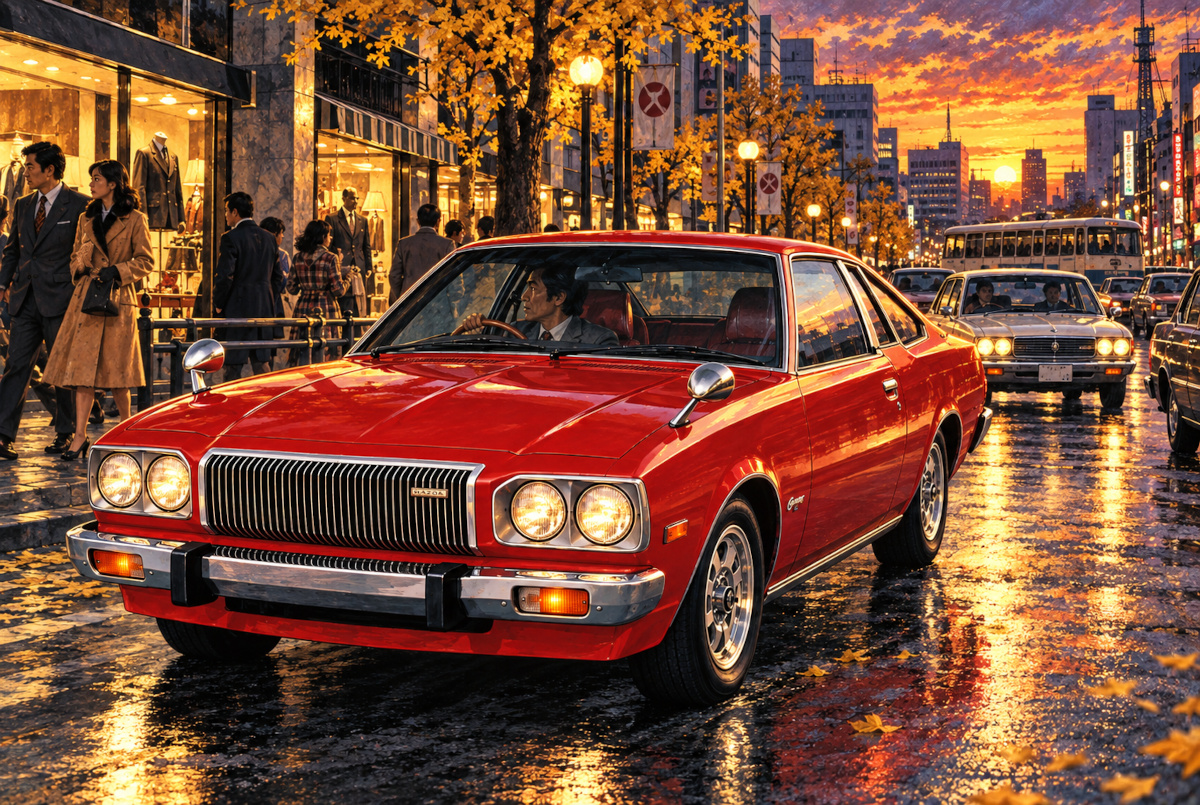
A period-inspired illustration of the first-generation Mazda Cosmo AP, introduced in 1975. The vehicle’s general styling reflects the original model, while smaller details and the surrounding cityscape include artistic interpretation. AI-generated illustration.
Saving the Rotary Required More Than a Better Engine
Mazda reached 500,000 rotary-powered vehicles in June 1973 and one million in November 1978.
In other words, despite the financial crisis, Mazda produced another 500,000 rotary-powered vehicles between those milestones.
That does not mean sales were consistently strong throughout the period. Production figures are not the same as retail sales, and neither tells us how profitable the cars were.
What the figures do establish is that the 1975 crisis did not mark the end of Mazda’s rotary-engine program.
But the company changed more than the engines themselves.
Mazda’s own history describes a shift away from its technology-first, rotary-centered product strategy toward a more customer-focused approach. Rotary engines would increasingly be reserved for vehicles capable of exploiting their compact dimensions and high output.
The Phoenix Project tackled fuel efficiency. The revised model strategy tackled a different problem: finding the right vehicles for an engine with unusual strengths and very real weaknesses.
Both changes mattered to the rotary engine’s survival.
Editor’s Note
The figure that sent me digging through the old documents wasn’t Mazda’s financial loss. It was that supposedly straightforward promise: 40% better fuel economy.
Classic-car histories have a habit of presenting the Phoenix Project as a neat little comeback story. Fuel economy improved by 40%, the rotary survived, and everybody went home happy.
Fine. But 40% of what, exactly?
If you don’t establish the measurement and the baseline, you can repeat an impressive percentage without understanding what it means for a driver buying gasoline.
What I find even stranger is how stubbornly Mazda kept backing the rotary after its business got into trouble. The company had tried putting it in family cars, coupes, pickup trucks and even a bus. You can’t accuse its engineers of lacking enthusiasm.
And perhaps that was precisely the problem. A technically fascinating engine isn’t automatically the right engine for everything on four wheels.
In the end, the rotary didn’t survive because Mazda found a way to install it in every possible vehicle. It survived because the company began choosing vehicles where its peculiar strengths actually made sense.
To me, the 1978 RX-7 is the clearest expression of that change.
Next in this series: the Cosmo AP, the Eunos Cosmo, and Mazda’s other extraordinary idea—turning the rotary engine into the heart of a luxury grand tourer.
Terms That May Need a Quick Explanation
- Thermal Reactor
- An exhaust-emissions device that introduces additional air and uses high exhaust temperatures to oxidize or reburn pollutants, including carbon monoxide and unburned hydrocarbons. Mazda employed this technology in its rotary-powered cars during the 1970s.
Mazda Rotary: A Seven-Part Series
From the pioneering Cosmo Sport to the RX-7 and RX-8, we trace Mazda's rotary-engine ambitions, engineering breakthroughs, commercial challenges, and the technology's eventual revival. Seven articles examine the history through original comparisons, calculations, and historical records.
- Part 1: Only 1,176 Mazda Cosmo Sports: What Was Mazda Really Building? (Part 1)
- Part 2: Did Mazda’s Rotary Engine Nearly Sink the Company? The 40% MPG Mystery (Part 2)
- Part 3: English edition Coming soon
- Part 4: English edition Coming soon
- Part 5: English edition Coming soon
- Final Part: English edition Coming soon
- Special Edition: English edition Coming soon
References
- Mazda 100th Anniversary Virtual Museum — Chapter 4: Financial Difficulties During the Oil Crisis (Japanese). Mazda’s corporate account of the 1975 financial loss, inventory problems, All Mazda Dispatch program and Phoenix Project. Official English edition.
- Mazda Newsroom — Rotary-Engine Vehicle Production Surpasses Two Million Units (Japanese, October 30, 2023). Includes the chronology of rotary models and production milestones. Official English edition.
- Mazda — History of the Savanna, 1971 Onward (Japanese). Launch orders, 10A and 12A models, motorsport achievements and emissions-control technology. Official English edition.
- U.S. Environmental Protection Agency — Fuel Economy of Mazda Rotary Engine Vehicles (April 15, 1974). Fact Sheet FS-11, included in Mobile Source Fact Sheets. Original certification fuel economy, comparisons by vehicle weight, the special test program and the EPA’s estimated city-driving range.
- Mazda — History of the Cosmo, 1975 Onward (Japanese). The Cosmo AP’s development, Anti-Pollution designation, original styling and early sales. Official English edition.
- Mazda — Corporate and Product History, 1920–1979 (Japanese). Historical information about the original Savanna RX-7 and Mazda’s vehicle lineup. Official English edition.
- clicccar — Fuel Economy Improvements Under the Phoenix Project (Japanese, July 18, 2020). A specialist automotive-history account of Mazda’s rotary-engine efficiency work and technical measures.
- Web Motor Magazine — Mazda Cosmo AP Limited, October 1975 (Japanese). Period-model specifications and the availability of rotary and conventional piston-engine versions.