

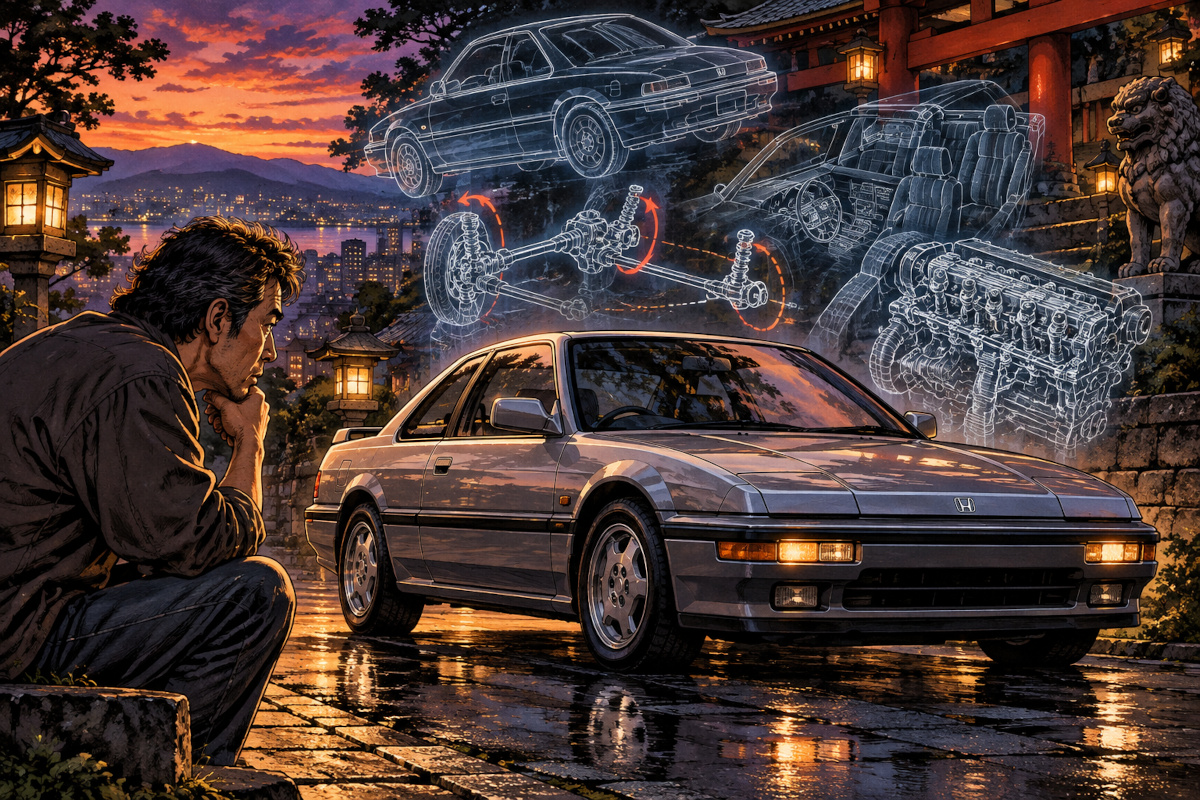
Show two people the same old Japanese sports car. One sees an outdated machine. The other starts talking about engine variants, trim levels, production years, and the manufacturer’s financial troubles.
Meet the classic car enthusiast: someone who can get ridiculously excited about the shape of a taillight or the design of a wheel fitted forty years ago.
To everyone else, these details may seem completely pointless.
But I began wondering whether enthusiasts simply know more about cars—or whether their experience actually changes what they notice.
As it turns out, psychologists have studied precisely that question.
People who know cars well appear to be better at spotting them. And, rather wonderfully, that expertise can sometimes get in the way of noticing something else.
To investigate, I compared a visual perception experiment involving 34 car enthusiasts with Honda’s original technical information on the 1987 Prelude. The result is a curious intersection of psychology, engineering, and automotive obsession.
34 Car Enthusiasts, 960 Photographs: What Did the Experiment Find?
A study published online in June 2015 and subsequently appearing in the 2016 volume of Psychonomic Bulletin & Review examined an intriguing possibility: Are people who are good at identifying cars also better at detecting them in a complicated scene?
Researchers recruited 34 self-described car experts from communities around Rovereto and Trento, Italy. Participants ranged from 19 to 63 years old, with an average age of 26.
This was not a study specifically about vintage cars. The researchers used relatively recent automobiles to assess general car recognition skills.
Participants first completed a task involving pairs of car photographs. They had to decide whether the two vehicles belonged to the same model or different models. A separate bird-identification task helped the researchers assess whether the results reflected general visual discrimination ability.
Then came the particularly interesting experiment.
The researchers assembled 960 photographs of real-world scenes containing cars, people, both, or neither. On each trial, two photographs appeared briefly, one above the other, for just 67 milliseconds (0.067 seconds).
Participants had to indicate which photograph contained the specified target: a car or a person.
The 960 photographs formed the experimental image collection. They were not all shown individually to every participant as 960 separate trials. Instead, participants completed eight to ten blocks of 64 trials, after a practice block.
Now for the result.
The correlation between car discrimination ability and car detection accuracy was 0.576.
A correlation coefficient measures how two variables tend to change together. It does not mean that participants correctly identified 57.6% of the cars.
Those who performed better at distinguishing car models also tended to be more accurate at detecting cars in natural scenes.
But there was a twist. Car discrimination ability was not significantly correlated with accuracy at detecting people.
In other words, the relationship was specific to the participants’ area of expertise. Knowing cars well did not automatically make someone better at spotting everything.

AI-generated conceptual illustration. It does not reproduce the actual participants, laboratory, or experimental display.
There are limits to what this experiment proves. The researchers compared differences in ability among self-described car enthusiasts rather than directly comparing a group of enthusiasts with a separate group of complete novices.
And because the study measured existing abilities, it cannot prove that acquiring more knowledge caused someone’s visual detection skills to improve.
Still, the association was clear: people who were better at distinguishing cars also tended to be better at finding them.
The 1987 Honda Prelude: What Could an Extra ¥80,000 Buy?
Enough laboratory psychology. Let’s put an actual car under the microscope.
On April 10, 1987, Honda launched the third-generation Prelude in Japan. Its low hood, wide stance, and sleek two-door body made it one of the defining Japanese specialty coupes of the late 1980s.
Yet beneath that elegant body was something quite unusual.
The rear wheels could steer, too.
Honda called the system 4WS, short for four-wheel steering.
With a small steering-wheel input, the rear wheels turned slightly in the same direction as the front wheels. With a larger input, they turned in the opposite direction.
This allowed the system to support stable responses during gentle steering maneuvers while improving maneuverability during tight turns.
And here’s the clever part: the original Prelude system was mechanically linked. Rear-wheel steering direction depended on how far the steering wheel was turned, rather than being electronically selected according to road speed.
Honda’s original April 9, 1987, announcement listed the 4WS option at an additional ¥80,000.
According to Honda’s published specifications, the minimum turning radius decreased from 5.3 meters in the conventional two-wheel-steering version to 4.8 meters with 4WS.
I wanted to know what those numbers meant in practical terms.
| 1987 Honda Prelude 2.0XX | Standard Steering | 4WS |
|---|---|---|
| Tokyo list price, 5-speed manual | ¥1,820,000 | ¥1,900,000 |
| Minimum turning radius | 5.3 m | 4.8 m |
| Twice the turning radius | 10.6 m | 9.6 m |
The extra ¥80,000 amounted to approximately 4.4% of the standard car’s list price.
Calculation:
¥80,000 ÷ ¥1,820,000 × 100 ≈ 4.4%
Meanwhile, the reduction in minimum turning radius was:
(5.3 − 4.8) ÷ 5.3 × 100 ≈ 9.4%
Double the published turning-radius figures, and the difference is exactly one meter: 10.6 meters versus 9.6 meters.
That comparison does not mean that the car necessarily required one meter less parking space. A turning-radius figure is not a complete measurement of the room needed for every parking maneuver.
Nevertheless, the numbers are revealing.
For an additional 4.4% of the vehicle’s base price, Honda offered a mechanical system that reduced the specified minimum turning radius by approximately 9.4%.
Not a bad example of engineers spending serious effort on something most casual observers would never notice.
The feature was not standard across the Prelude range. Honda offered 4WS-equipped versions of the 2.0Si and 2.0XX.
That Low Hood Wasn’t Just a Styling Trick
There’s another detail worth examining.
At first glance, the third-generation Prelude looks remarkably low and sleek. That shape helped establish its identity, but it wasn’t achieved through exterior styling alone.
Honda’s original announcement describes an engine layout tilted 18 degrees rearward.
Along with efforts to make the engine more compact, that packaging helped Honda lower the central section of the hood by 30 millimeters compared with the previous generation.
So the low hood wasn’t merely a line drawn by a designer. Engineers had to arrange the machinery beneath it to make the shape possible.
Without that background, you might simply say, “Nice-looking car.”
Knowing the engineering story changes the questions you ask.
How did Honda fit the engine beneath such a low hood? Why did the company choose a mechanically linked four-wheel-steering system? What did the driver actually gain by paying an extra ¥80,000?
An enthusiast isn’t necessarily seeing a different car. They’re seeing more of the decisions that made the car what it is.
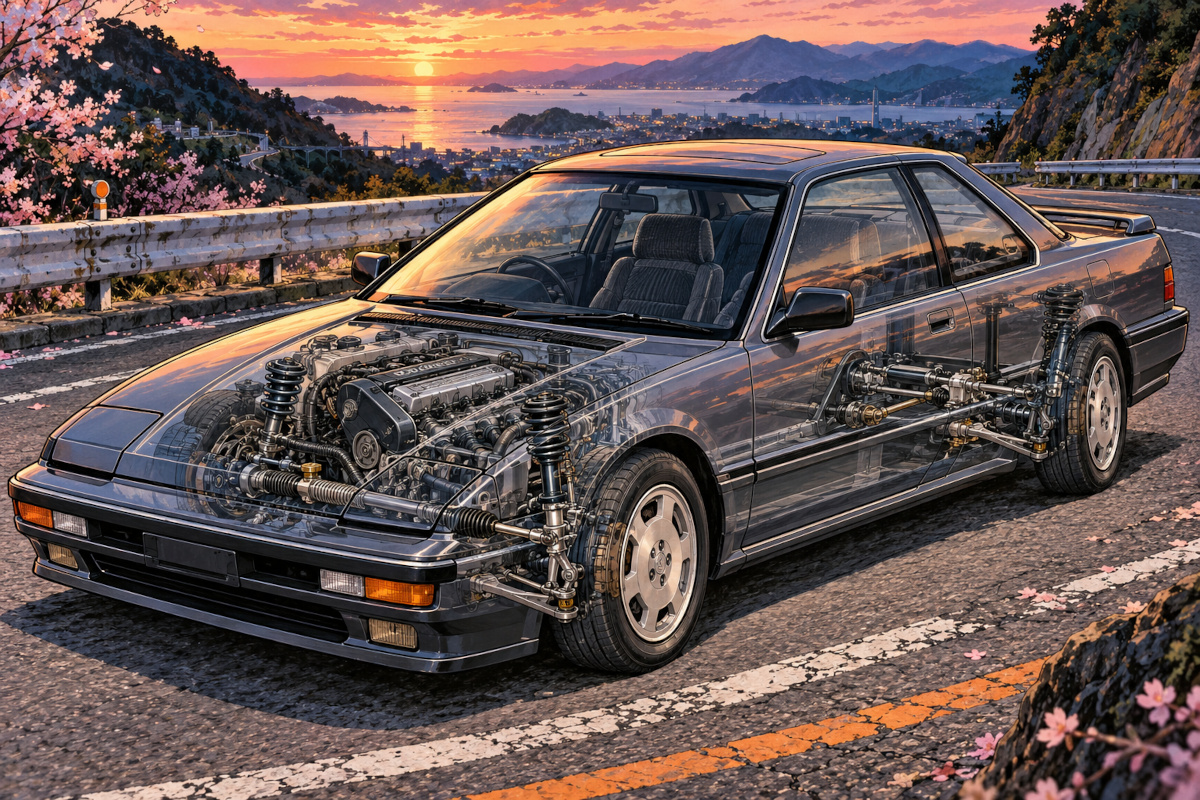
AI-generated conceptual illustration, not an accurate mechanical cutaway. The engine orientation, suspension layout, and four-wheel-steering components differ from the actual vehicle. See Honda’s official technical documentation in the references for the correct design.
But Expertise Has a Rather Annoying Downside
Now for the part that made me smile.
Being knowledgeable about cars may help you notice them. But under certain conditions, that same expertise can make another visual task more difficult.
A 2011 study published in Attention, Perception, & Psychophysics examined what happened when participants searched for faces while irrelevant car images appeared among the objects on the screen.
The researchers found that greater expertise with cars was associated with reduced efficiency in searching for faces as the number of irrelevant car images increased.
Yet when participants searched for sofas instead of faces, the same interference associated with car expertise was not observed.
That’s the strange part.
Cars weren’t simply distracting experts from everything. The interference depended on what participants were trying to find.
Of course, this was a controlled laboratory task. It doesn’t mean car enthusiasts have trouble recognizing people in everyday life.
But it does challenge a tempting assumption.
Greater expertise doesn’t automatically give someone a universally superior pair of eyes.
Expertise may make certain things easier to notice while, in particular situations, making something else harder to process.
Rather than a magical ability to see everything, perhaps expertise is a way of becoming especially sensitive to a particular corner of the world.
Why Does One Person See Junk While Another Sees Treasure?
The findings don’t suggest that classic car enthusiasts are inherently more intelligent or observant than everyone else.
Someone who knows cars notices differences between engines and body styles. A keen gardener might recognize unusual plants growing beside the road. A skilled cook may notice ingredients or preparation techniques that escape everyone else.
Each has an area of experience that changes what stands out.
And none of this means you must understand a car’s engineering to appreciate its beauty. Plenty of people enjoy classic cars without knowing the first thing about steering geometry.
But learning to distinguish details can open up possibilities that weren’t obvious before.
The same street, the same scenery, the same old machinery—yet different people find different things worth stopping for.
The world itself hasn’t changed. What changes is how much information you can pick out of it.
Editor’s Note
Classic car enthusiasts can be spectacularly tiresome people. We notice a slightly different headlight, an unusual wheel, or a piece of trim fitted to a car nobody has manufactured for decades—and somehow find this thrilling.
To anyone outside the hobby, it must seem faintly ridiculous.
What I didn’t expect was to find psychologists investigating whether people who know cars well actually notice them more accurately. Better still, there is research suggesting that car expertise can sometimes interfere with another kind of visual search.
Apparently, even an enthusiast’s brain can be a little too enthusiastic.
But perhaps someone who loves plants is having exactly the same experience with a weed growing beside the road while I’m busy admiring a forty-year-old coupe.
Neither of us necessarily understands what the other finds so fascinating.
And I still find Honda’s ¥80,000 four-wheel-steering option extraordinary. Engineers managed to make the rear wheels steer through a mechanical linkage, all while maintaining the Prelude’s elegant, low-profile design.
Once you know that, it’s hard to look at the car quite the same way again. I know I’d be tempted to crouch down and examine the rear wheels.
Maybe that’s the real appeal of learning.
The more you know, the more things there are to get curious about. And perhaps a surprising amount of life’s entertainment is hiding in precisely those small details.
The More You Know, the More You See $2014 A 3-Part Series
Does learning make life more interesting? From the pleasures hidden in classic cars to curiosity in midlife, three articles explore why the same world can look so different to different people.
- Part 1: Does Life Get Boring When You Stop Learning? The Things You Never Knew You Were Missing
- Part 2: Do Car Enthusiasts See More? A 34-Person Study and Honda’s ¥80,000 4WS Secret
- Final Part: Can You Be Happy Without Knowing What You’re Missing? Curiosity After 50 [Final Part] Coming soon
References
- Reeder, R. R., Stein, T. & Peelen, M. V. (2016), “Perceptual expertise improves category detection in natural scenes,” Psychonomic Bulletin & Review, 23, 172–179. Full research paper.
- Honda Motor Co., Ltd., April 9, 1987, original Japanese press release announcing the third-generation Prelude, its four-wheel-steering system, prices, equipment, and specifications. Official Honda press release (Japanese).
- Honda Motor Co., Ltd., September 27, 2023, “The Technology Behind Honda’s Four-Wheel Steering System (Honda 4WS), 1987,” in the Honda Super Handling technical series. Includes the mechanical system layout and development background. Official Honda technical explanation (Japanese).
- McGugin, R. W., McKeeff, T. J., Tong, F. & Gauthier, I. (2011), “Irrelevant objects of expertise compete with faces during visual search,” Attention, Perception, & Psychophysics, 73, 309–317. Full research paper.