

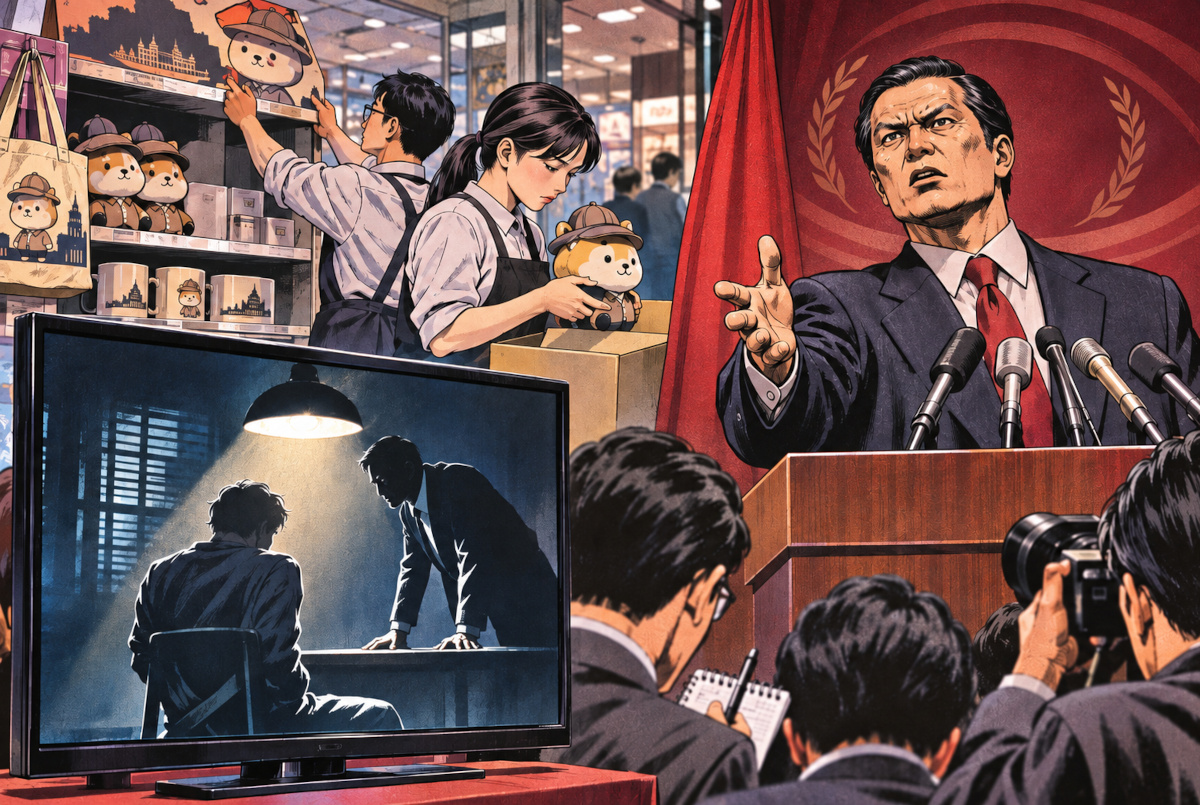
In October 2026, a Japanese television drama became a topic at a Chinese Foreign Ministry press briefing. Not a documentary or a government statement, but a fictional spy thriller.
The show was VIVANT, the second season of TBS’s popular Sunday-night series. Its portrayal of a Chinese-linked intelligence organization torturing Japanese operatives drew fierce criticism from Chinese state media.
On October 29, Foreign Ministry spokesperson Guo Jiakun joined the criticism.
How did a fictional villain in a television drama become a matter for a national government’s foreign ministry?
The question becomes even stranger when compared with an incident 18 years earlier, when Myanmar’s military government banned vendors from selling DVDs of Sylvester Stallone’s fourth Rambo film.
Why Did China Object to VIVANT?
The controversy centered on Episode 19, broadcast on October 4, 2026. The story featured Shinshi, a fictional Chinese-linked intelligence organization, detaining and brutally interrogating members of Beppan, a covert Japanese intelligence unit in the drama. The violence included the severing of a finger.
On October 25, Chinese state broadcaster CCTV’s news coverage criticized the portrayal, arguing that methods of torture inflicted on Chinese people by Imperial Japanese forces had effectively been reassigned to a contemporary Chinese organization. The Communist Party-affiliated Global Times also criticized the drama on October 26, accusing it of promoting the idea of China as a threat.
These were accusations made by Chinese media, not established findings about the program’s creators or their intentions.
At a press conference on October 28, TBS president Masamine Ryuho explained that the drama was entirely fictional and was not intended to disparage or portray any particular country as an enemy.
The following day, Reuters asked Chinese Foreign Ministry spokesperson Guo Jiakun about Sanrio’s decision to end a merchandise collaboration with the drama. Guo responded by alleging that certain forces in Japan were using cultural productions to portray China negatively and encourage anti-China sentiment.
The distinction matters: China’s official transcript shows that Guo was answering a Reuters journalist’s question. It does not show a formal diplomatic demand that Japan stop broadcasting VIVANT. No separate formal protest to the Japanese government was confirmed in the sources examined.
The reaction did not end there. On November 1, China’s Ministry of National Defense published criticism through its official WeChat account. It accused the drama of transferring atrocities committed by Imperial Japanese forces onto Chinese characters and attempting to whitewash Japan’s wartime aggression.
By that point, the controversy had spread from Chinese media commentary to statements by both the Foreign Ministry and the Defense Ministry.
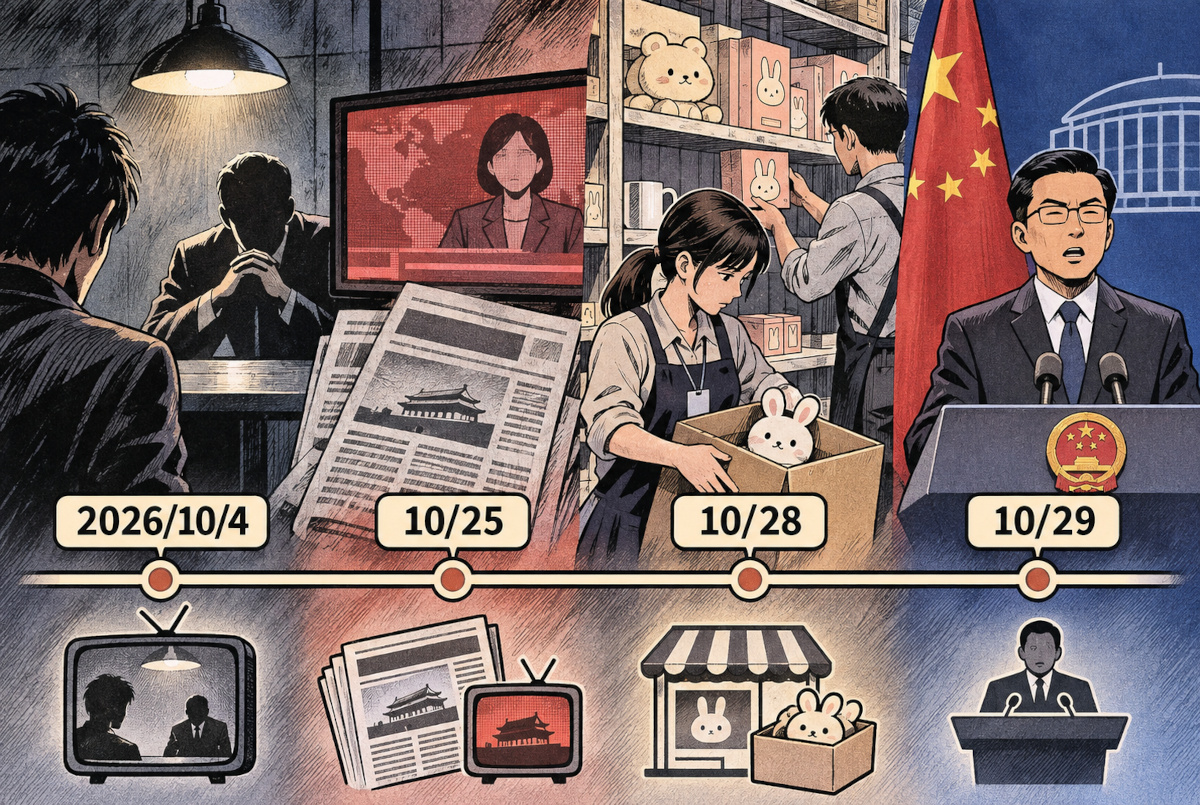
Illustrated timeline of the October 2026 controversy. October 28 refers to China local time. The people, merchandise, and press conference setting are fictional representations, not depictions of actual events.
Sanrio Acted Before China’s Foreign Ministry Spoke
Here is where the timeline gets particularly interesting.
As criticism spread across Chinese media and social platforms, Sanrio’s Chinese subsidiary announced late on October 28, local time, that it was ending its VIVANT collaboration. On October 29, the Japanese parent company issued its own statement, saying that content associated with the collaboration included expressions inconsistent with Sanrio’s corporate philosophy. It cancelled the related initiatives, future plans, and promotional activities.
Sanrio China’s announcement came before the Chinese Foreign Ministry spokesperson’s remarks.
That sequence rules out one tempting but unsupported interpretation: that the Foreign Ministry publicly ordered Sanrio to cancel the project. The company’s response preceded the ministry’s comment. No evidence was found that the ministry directed Sanrio to take that action.
There is also a business dimension worth examining.
Reuters reported that Sanrio recorded approximately ¥9.8 billion in first-quarter sales in China. Sanrio’s financial statement for the first quarter of the fiscal year ending March 2027 reported consolidated sales of ¥52.035 billion.
A simple comparison gives:
¥9.8 billion ÷ ¥52.035 billion × 100 = approximately 18.8%.
This is an editorial calculation using two published figures, not an officially reported China revenue share. The regional and consolidated figures may differ in their accounting periods and consolidation adjustments.
Nevertheless, the numbers illustrate the commercial scale of Sanrio’s Chinese market. That makes the business context relevant, although it does not establish why the company decided to end the collaboration. Sanrio’s internal decision-making cannot be determined from these figures alone.
There is another complication. Concern about the show’s violent content was not confined to China.
On September 29, Japan’s Broadcasting Ethics & Program Improvement Organization (BPO) discussed viewer complaints about unusually graphic violence in the second season of a drama apparently referring to VIVANT. The concerns focused on the possible effects on younger viewers watching a program broadcast at 9 p.m., rather than on its portrayal of China.
Those complaints concerned episodes broadcast before October 4. The committee did not formally find a broadcasting ethics violation.
In 2008, Myanmar Tried to Keep Rambo 4 Off DVD Shelves
The case has an unlikely predecessor: the fourth Rambo film, released in 2008 under the simple title Rambo and known in Japan as Rambo: Saigo no Senjo.
Starring Sylvester Stallone, the film depicts violence by Myanmar’s military against ethnic Karen communities and follows John Rambo as he confronts soldiers while rescuing captured aid workers.
Myanmar, then commonly called Burma in English-language reporting, was under military rule. Police instructed DVD sellers not to distribute the film.
According to an Australian Broadcasting Corporation report published on February 18, 2008, one vendor said police had warned that selling the film could result in a prison sentence of up to seven years.
That was the vendor’s account of a police warning, not an independently verified legal sentencing provision.
Another vendor told ABC that at least 20 customers a day were asking whether he had a copy of the film.
That figure is a shopkeeper’s reported experience, not a nationwide estimate of demand. Even so, it reveals something the prohibition failed to accomplish: it did not eliminate people’s interest in seeing the movie.
Stallone later referred to being banned from Burma in a 2008 public-awareness video, as reported by the Los Angeles Times. However, a formal government immigration order specifically banning the actor could not be independently verified.
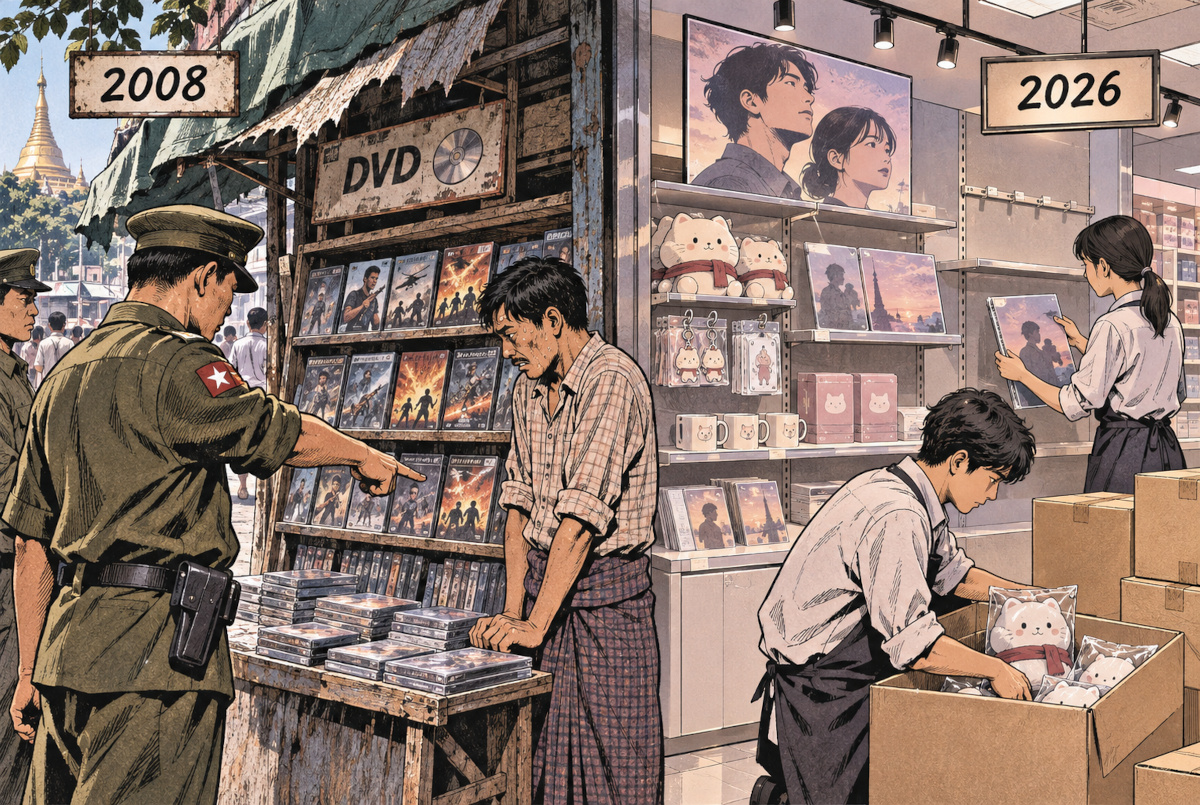
Conceptual illustration comparing Myanmar’s 2008 DVD sales restrictions with the 2026 VIVANT collaboration cancellation. The shops, people, and products are fictional. Contemporary reports attributed the DVD sales warnings to police, not to the specific uniformed figures shown here.
Eighteen Years Apart: Two Very Different Ways to Stop a Screen Story
What makes the two incidents worth comparing is not simply that a government objected to something on screen.
In 2008, police operating under Myanmar’s military government restricted the sale of a film. In 2026, criticism from Chinese media and social networks was followed by a company’s decision to withdraw from a television merchandising collaboration.
One involved direct restrictions on selling a film. The other involved a corporate decision to end a commercial partnership. Those are fundamentally different mechanisms, even if both controversies began with how a country was portrayed on screen.
Neither case tells us precisely how many viewers changed their political opinions. There is no verified measurement in the sources examined showing how much VIVANT altered attitudes toward China, or how much the fourth Rambo film increased opposition to Myanmar’s military government.
What can be documented is the response surrounding the works: an official foreign-policy briefing, a defense ministry statement, a cancelled merchandise collaboration, and, in the earlier case, DVD vendors warning that the police had prohibited sales.
A fictional television series had consequences beyond television. But the evidence also shows why government criticism, corporate risk management, and changes in public opinion should never be treated as the same thing.
Editor’s Note
It started with a fairly simple irritation: why should the appearance of a Chinese-linked villain in a Japanese spy drama require a response from China’s Foreign Ministry?
A fictional Chinese intelligence operative is not a stand-in for every Chinese citizen. The distinction should not be especially difficult to make.
Of course, television writers are not automatically beyond criticism simply because their stories are fictional. A drama can reinforce stereotypes, and viewers have every right to question how a real country is portrayed.
But once foreign ministry officials and defense officials start commenting on the villains in a television series, the whole affair begins to resemble a plot twist of its own.
There is another irony I cannot shake. Government criticism may introduce a program to people who would never otherwise have heard of it. Whether that happened on any measurable scale with VIVANT remains unknown, but the possibility is difficult to ignore.
In 2008, it was Rambo DVDs that authorities wanted off the shelves. In 2026, a Hello Kitty collaboration fell apart.
Sometimes the real-world reaction to a fictional villain turns out to be a stranger story than the script itself.
References
- Ministry of Foreign Affairs of China — Regular Press Conference, October 29, 2026 (Chinese; official transcript of spokesperson Guo Jiakun’s response).
- China Youth Network — Report on the Ministry of National Defense’s Criticism of VIVANT (Chinese; November 1, 2026). See also China News Service’s independently accessible report on the ministry’s official WeChat statement.
- TBS Television — VIVANT, Episode 19 Official Synopsis (Japanese; episode broadcast October 4, 2026).
- CCTV News Commentary on VIVANT, Republished by Sina Finance (Chinese; October 25, 2026).
- Kyodo News, via Oita Godo Shimbun — TBS President Says VIVANT Does Not Target a Specific Country (Japanese; October 28, 2026).
- Sanrio Co., Ltd. — Notice Regarding the Termination of the VIVANT × Sanrio Characters Collaboration (Japanese; official corporate statement, October 29, 2026).
- Reuters — Hello Kitty Maker Sanrio Cuts Ties With TV Spy Show After China Backlash (English; October 29, 2026; includes China sales and the cancellation background).
- Sanrio Co., Ltd. — First-Quarter Financial Results for the Fiscal Year Ending March 2027 (Japanese; official financial disclosure dated August 10, 2026, reporting consolidated sales of ¥52.035 billion).
- Broadcasting Ethics & Program Improvement Organization — Youth Committee Meeting No. 293 (Japanese; September 29, 2026; viewer complaints concerning violent television drama content).
- ABC News — Banned Rambo a Hot Commodity in Burma (English; February 18, 2008; contemporary reporting on DVD sales restrictions and vendor testimony).
- Los Angeles Times — Stars Publicize Myanmar Issues (English; May 23, 2008; includes Stallone’s remarks about being banned from Burma).