

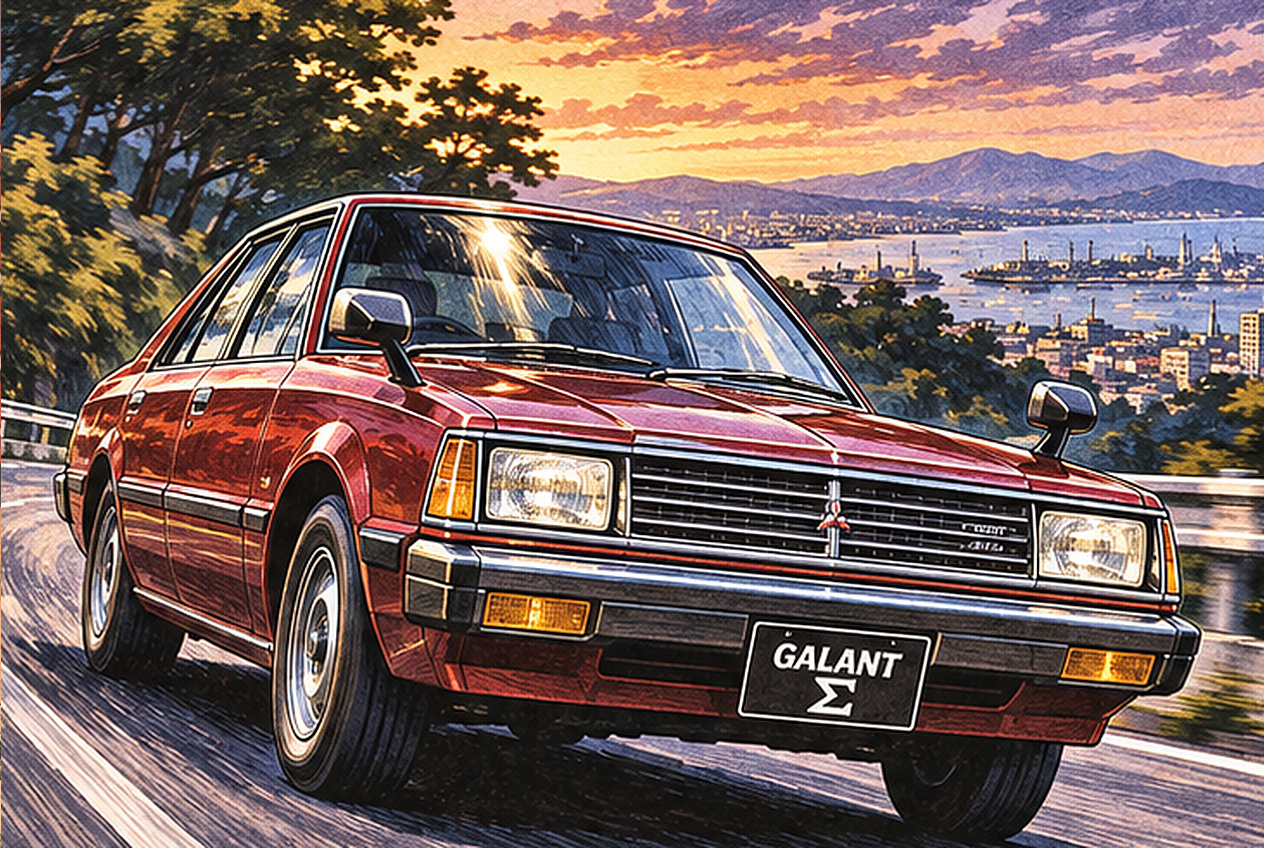
In May 1976, Mitsubishi Motors introduced the third-generation Galant with a new name: Galant Σ (Sigma). The Greek letter was intended to represent the culmination of Mitsubishi’s engineering expertise. The car became a success, with the wider Galant series sustaining sales of around 10,000 vehicles per month.
A smooth-running engine equipped with Silent Shaft technology, an upmarket interior, and a low, elegant body made the Sigma a convincing example of what Mitsubishi wanted a comfortable family sedan to be.
Then, in September 1983, the fifth-generation Galant Sigma abandoned the traditional front-engine, rear-wheel-drive (RWD) layout in favor of front-wheel drive (FWD).
Why would Mitsubishi change the basic drivetrain layout of a successful sedan? Looking beyond the usual model history, the recollections of Mitsubishi’s original designers and a comparison of three generations reveal a long-running conflict between stylish proportions and passenger space.
The Original Sigma Sacrificed 25mm of Height for Better Styling
The 1976 Galant Sigma stood out with its low, wide proportions and distinctly European-influenced styling. Getting that shape into production, however, was far from straightforward.
Shinichi Mitsuhashi, a designer who worked on the project, later described how Mitsubishi revised the car’s basic dimensions after company president Tomio Kubo approved a promising styling proposal.
The team lowered the intended overall height by 25mm, bringing it down to 1,360mm.
There was a price to pay. Passenger accommodation suffered, and some people inside Mitsubishi complained that the result was more like a four-door coupe than a proper family sedan.
The designers were pursuing a lower, more distinctive profile, but the space needed by the occupants had not magically disappeared. The Sigma’s appearance and its practicality were pulling the project in different directions.
Despite that compromise, the car proved popular. Mitsubishi’s official history states that monthly sales of the Galant series remained around the 10,000-unit level. That figure should not be mistaken for verified sales of the Sigma sedan alone.
Another revealing story concerns the upper-grade Super Saloon.
According to Haruo Okamoto, who worked on the Sigma’s interior, Mitsubishi initially planned production of just 500 Super Saloons per month. Interior components and manufacturing methods were selected with those modest numbers in mind.
But demand exceeded expectations, creating difficulties when the company needed to increase production.
Buyers wanted more luxury than Mitsubishi had initially planned to supply. Okamoto’s account establishes that demand surpassed the original production assumptions, although it does not provide a verified monthly sales total for the Super Saloon.
The Silent Shaft Was Famous in the Sigma—but It Actually Came Earlier
Ask a longtime Mitsubishi enthusiast what defined the Galant Sigma, and the Silent Shaft engine is likely to come up.
Mitsubishi demonstrated the technology by placing a glass of water on an engine running at 6,000 rpm. The idea was simple: let people see how effectively the engine’s vibration had been reduced.
Conventional inline-four engines produce secondary vibrations resulting from the reciprocating motion of their pistons. Mitsubishi addressed this with two balance shafts rotating in opposite directions at twice crankshaft speed.
Its additional innovation was to position one shaft higher than the other, helping reduce vibration and the resulting rocking motion across the operating range.
There is a historical catch, though. The Sigma did not introduce the Silent Shaft system.
Mitsubishi had already fitted the technology to the 4G52 Astron 80 engine used in the Galant GTO in February 1975. The following year’s Sigma made smoothness and refinement a much more prominent part of Mitsubishi’s sedan identity.
In 1981, Mitsubishi supplied Silent Shaft technology to Porsche. The technology was also licensed to European manufacturers including Volvo and Saab.
That is quite a journey for a system developed to make an economical four-cylinder engine more pleasant to use.
Still, Mitsubishi’s period claim of eight-cylinder-like smoothness should be understood as an engineering and marketing comparison. It does not mean that an inline-four equipped with Silent Shaft technology matches the noise and vibration characteristics of every V8 engine under all driving conditions.
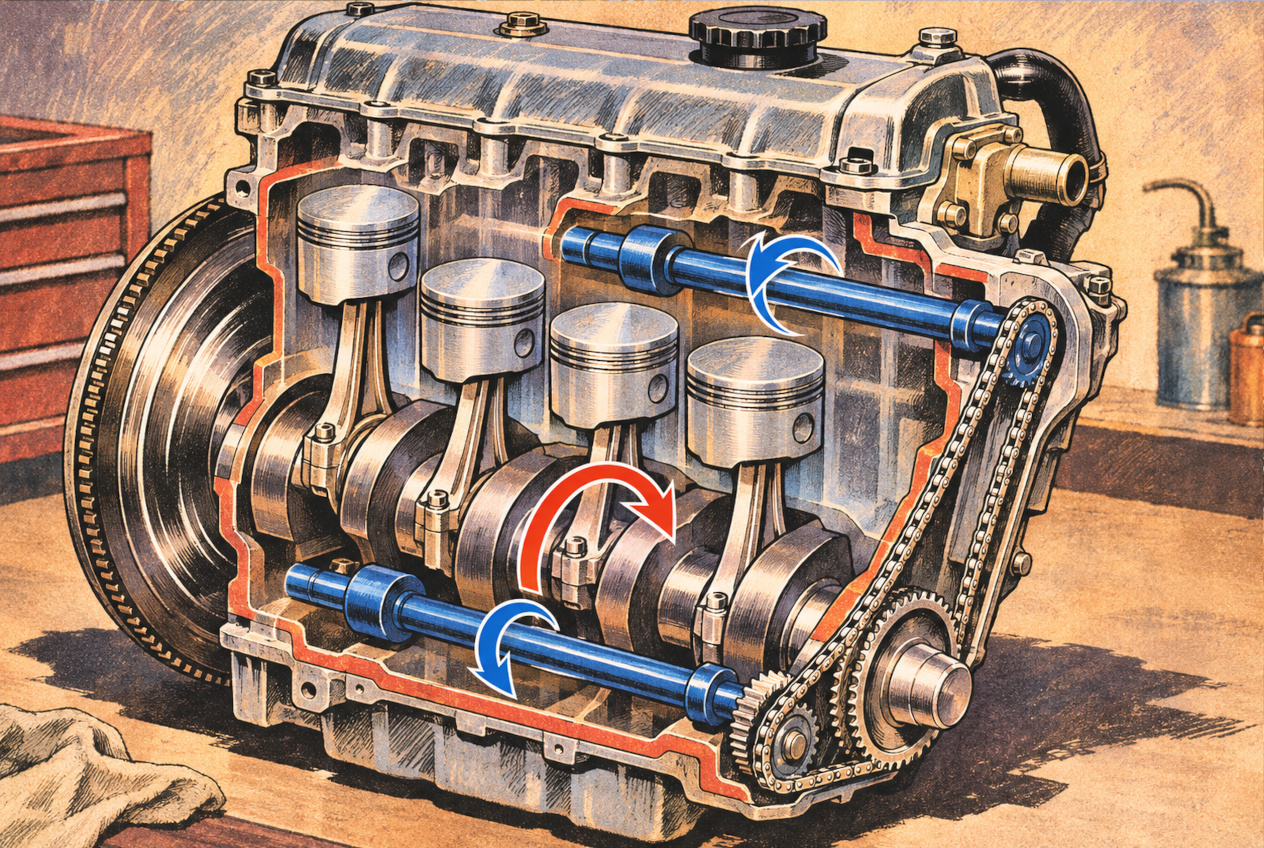
Conceptual illustration of Mitsubishi’s Silent Shaft system. Two balance shafts rotate in opposite directions at twice crankshaft speed to reduce engine vibration. This AI-generated illustration is not an accurate mechanical cutaway: the piston positions, shaft placement, rotation arrows, and chain routing do not precisely reproduce the production engine.
Six Months Later, Mitsubishi Gave the Sigma a Much Flashier Sibling
In December 1976, Mitsubishi launched the Galant Λ (Lambda), a two-door specialty car developed alongside the practical four-door Sigma.
Although the two cars shared important chassis components, their characters were deliberately different.
The Lambda featured four rectangular headlights—an unusual and pioneering design in Japan at the time—along with a long, sloping nose and a wraparound rear window. Its distinctive single-spoke steering wheel was intended to look sophisticated while improving visibility of the instruments.
Outside Japan, the model was marketed as the Mitsubishi Sapporo. According to Mitsubishi, the name was chosen because Sapporo had gained worldwide recognition after hosting the 1972 Winter Olympics.
This was a straightforward but effective product strategy.
Mitsubishi used related engineering to serve two different buyers: the Sigma offered the practicality of a family sedan, while the Lambda delivered the style and presence of a personal coupe.
The pair also shows that Mitsubishi was not treating comfort purely as a matter of interior dimensions. Styling, atmosphere, and the feeling of owning something distinctive were part of the equation.
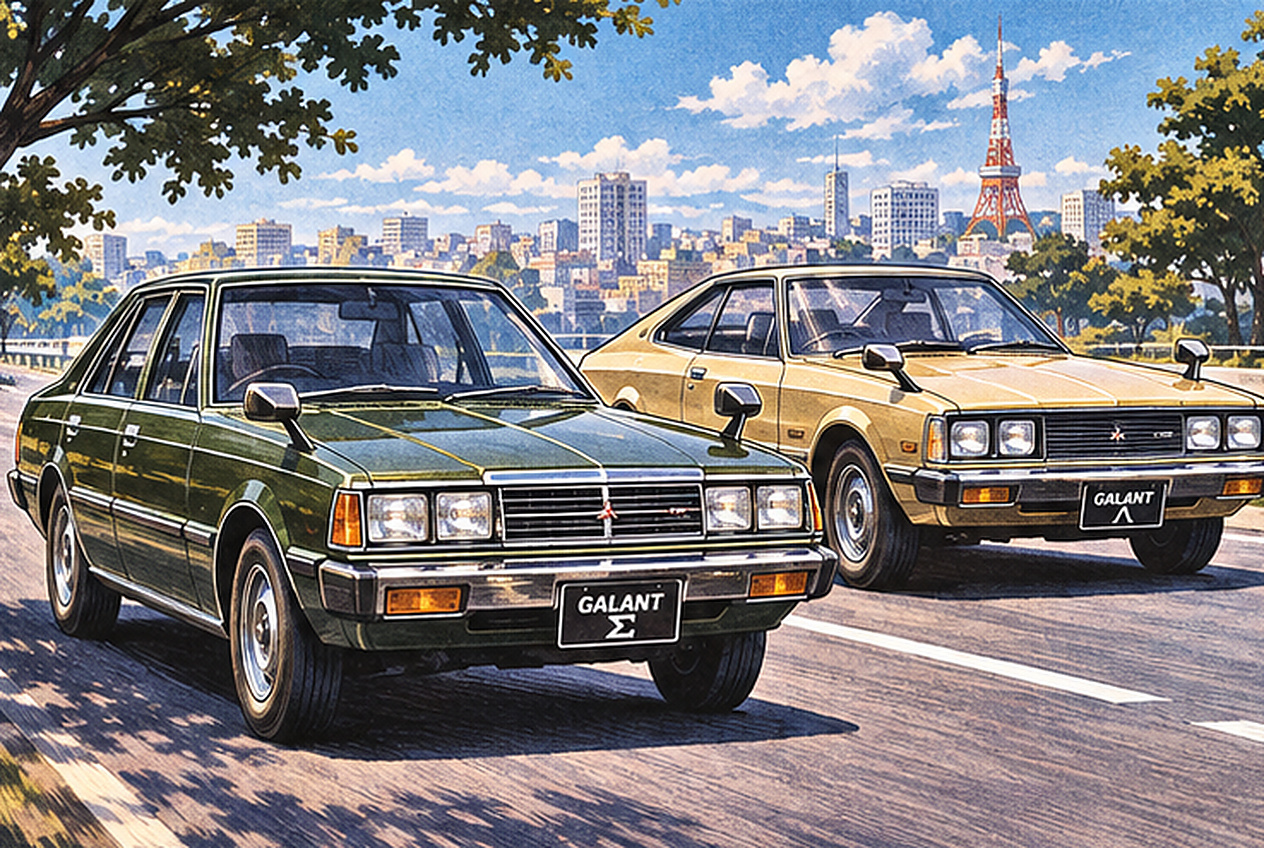
Historical illustration comparing the Galant Sigma four-door sedan (left) and the Galant Lambda two-door specialty car (right), both introduced in 1976. The Sigma’s front end resembles the later rectangular-headlight version introduced after the original launch. This AI-generated artwork does not reproduce every production-year trim detail accurately.
The 1980 Sigma Gained 50mm of Legroom Without Abandoning RWD
In May 1980, Mitsubishi launched redesigned versions of the Galant Sigma and Lambda, together with their Eterna counterparts. The new Sigma represented the fourth generation of the wider Galant family.
And it was still rear-wheel drive.
Yet Mitsubishi had clearly not stopped working on interior comfort. Its official vehicle history reports that the redesigned range offered 50mm more legroom, partly with the needs of larger European and American occupants in mind.
The equipment list had become impressively ambitious, too.
There was VELNAS, an electronic driving-information system capable of displaying fuel consumption. Mitsubishi also introduced ETACS electronics for coordinating certain vehicle functions, along with features such as automatic climate control and cruise control.
A 2.3-liter turbocharged diesel joined the range, while a gasoline turbo followed in November 1980. The Galant Sigma 2000GSR Turbo produced 145 PS (metric horsepower).
High-performance versions also offered Mitsubishi’s ECI electronic fuel injection, independent suspension at all four wheels, and four-wheel disc brakes.
So the old RWD Sigma was hardly standing still. Mitsubishi was improving roominess, refinement, equipment, and performance without changing which wheels drove the car.
That makes the next question more interesting: if Mitsubishi could find another 50mm of legroom while retaining RWD, what made FWD worth adopting in 1983?
The 1983 Sigma Grew Just 90mm Longer—but Its Wheelbase Increased by 70mm
To investigate the change, we compared representative dimensions from the 1976, 1980, and 1983 Galant Sigma generations using Mitsubishi’s official vehicle history and period-specification references.
| Specification | 1976 3rd Gen. |
1980 4th Gen. |
1983 5th Gen. |
|---|---|---|---|
| Drive layout | RWD | RWD | FWD |
| Overall length | 4,330mm | 4,470mm | 4,560mm |
| Overall width | 1,655mm | 1,680mm | 1,695mm |
| Wheelbase | 2,515mm | 2,530mm | 2,600mm |
These figures compare representative versions across three model generations, rather than identical trim grades. Mitsubishi’s official history lists the 1976 model’s representative width as 1,655mm, whereas a 1976 specification listed by GAZOO gives 1,670mm. Similarly, the 1980 2000GSR Turbo listed by GAZOO is 4,570mm long, rather than the 4,470mm representative length shown above. Wheelbase means the distance between the front and rear axle centers.
Now look at how the proportions changed.
Between 1976 and 1980, the representative Sigma grew by 140mm in overall length, but its wheelbase increased by only 15mm.
Between 1980 and 1983, overall length increased by just 90mm, while the wheelbase grew by 70mm.
| Generation change | Length increase | Wheelbase increase |
|---|---|---|
| 1976 to 1980 | +140mm | +15mm |
| 1980 to 1983 | +90mm | +70mm |
That second change represents an increase of approximately 2.8% in wheelbase: 70mm divided by 2,530mm.
The striking point is not that the 1983 car became enormously longer. It did not. Rather, a much larger proportion of its increase in overall length went into the distance between the axles.
The switch to FWD was more than a change in which wheels received engine power. It allowed Mitsubishi to rethink how the car’s limited overall dimensions were allocated between its mechanical components and usable space.
In a conventional front-engine RWD car, a propeller shaft carries power toward the rear differential. Moving to a transverse-engine FWD layout removes the need for that long rearward driveline, giving engineers different options for packaging the cabin and luggage compartment.
But there is an important limitation to this comparison.
An extra 70mm of wheelbase does not automatically produce another 70mm of interior length. Proving the exact cabin-space improvement would require comparable interior measurements from both generations.
Mitsubishi’s official history supports the broader intention: the 1983 Galant adopted FWD to provide a roomier passenger compartment and trunk. Our dimensional comparison helps show how its packaging changed, not the precise amount of additional cabin space.
There is another small historical qualification. The 1983 redesign shifted Mitsubishi’s mainstream Galant passenger sedan to FWD, but older RWD-based commercial and taxi versions did not all disappear immediately. Some remained in service or production during the transition.
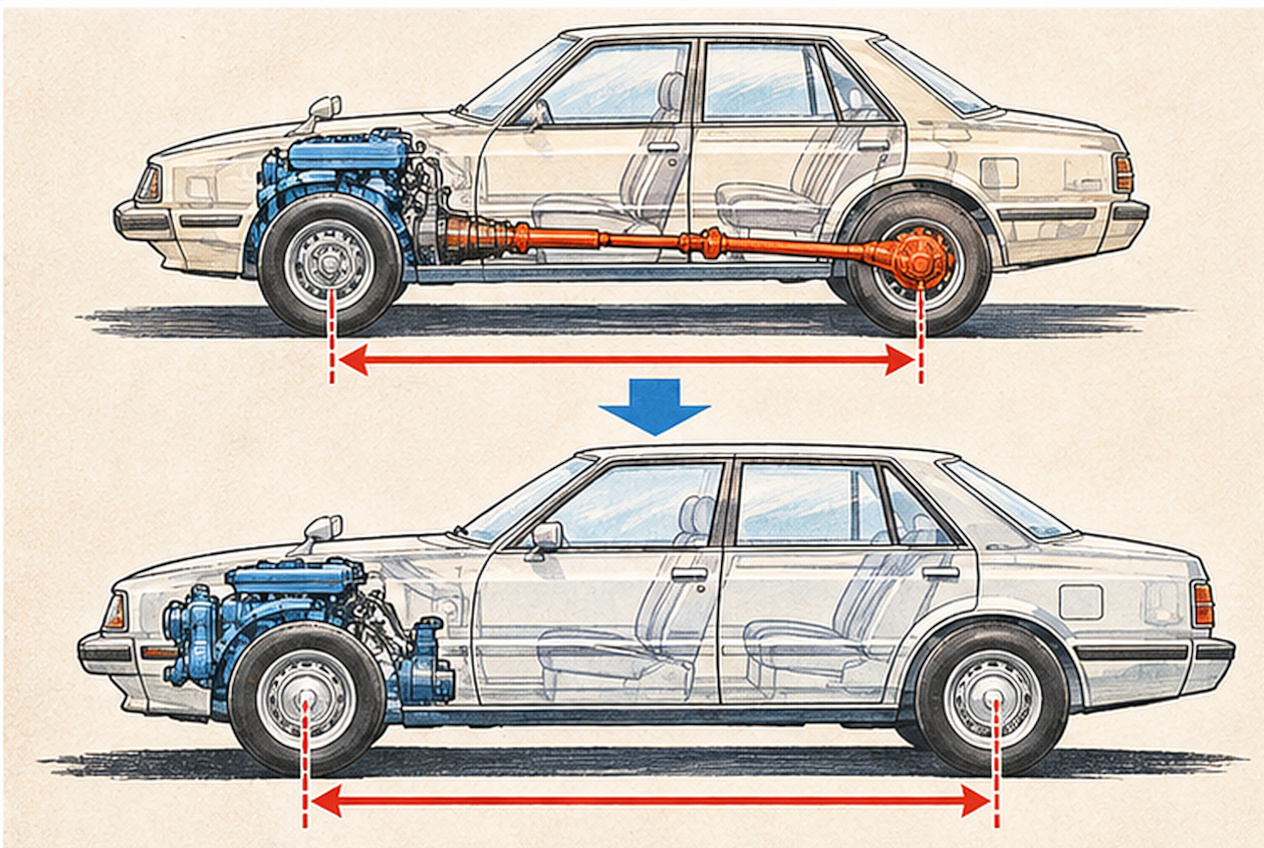
Conceptual comparison of the 1980 rear-wheel-drive Galant Sigma (top) and the 1983 front-wheel-drive model (bottom). The wheelbase increased from 2,530mm to 2,600mm. This AI-generated illustration exaggerates the dimensional difference and does not accurately reproduce the engine orientation or detailed mechanical packaging of either production vehicle.
Japan Stopped at 1,695mm Wide. Australia’s Magna Went Another 65mm
Mitsubishi’s packaging decisions were not limited to the Japanese market.
In 1985, Mitsubishi Motors Australia introduced the Magna, a sedan developed from the fifth-generation FWD Galant. Australian engineers widened the body by 65mm for local market requirements.
The arithmetic is straightforward:
1,695mm + 65mm = 1,760mm.
Why does such a modest difference matter?
In Japan, one of the dimensional requirements for the smaller 5-number passenger-car registration class was an overall width of no more than 1,700mm. The Japanese Galant Sigma’s representative width of 1,695mm left just 5mm to spare.
The Australian market was not constrained by that Japanese vehicle classification. The Magna could be made wider to suit local expectations of a comfortable family sedan.
In other words, Mitsubishi was taking two different approaches with related engineering.
For Japan, it sought to improve space efficiency within a tightly limited width. For Australia, it could also enlarge the body itself.
The same underlying FWD concept was adapted to different markets rather than applied as a single fixed-size formula.
The Sigma’s move to FWD did not mean Mitsubishi had abandoned high performance, either. In 1984, the range gained the 200 PS Sirius Dash 3×2 engine, along with a four-door hardtop variant that continued the company’s pursuit of more sophisticated styling and equipment.
What we have not found is an internal management document establishing one definitive reason for abandoning RWD.
Still, Mitsuhashi’s account of the 1976 styling compromise, Mitsubishi’s 1980 cabin improvements, and the redesigned packaging of the 1983 model tell a consistent story.
The company’s understanding of a comfortable sedan had been evolving for years. By 1983, Mitsubishi was willing to change the entire drivetrain layout in pursuit of it.
Editor’s Note
The question that started bothering me was simple: if the Galant Sigma had been selling so well, why throw away its rear-wheel-drive layout?
Then I found Mitsuhashi’s account of the 1976 car. Mitsubishi had actually lowered the roof by 25mm in pursuit of a better-looking sedan, only to be criticized because the cabin had suffered. You have to admire the determination, even if it created a problem the engineers then had to live with.
And the Super Saloon story is even better. Mitsubishi planned for 500 a month, only to discover that customers wanted more of them than expected. The engineers and designers had carefully worked out how to build an upmarket car in small numbers, and the buyers promptly complicated the plan. That is exactly the sort of behind-the-scenes detail I love about old Japanese cars.
By 1980, Mitsubishi had found another 50mm of legroom without abandoning RWD. Three years later, it adopted FWD anyway. It is tempting to ask why the company did not just build a spacious sedan in the first place. But making something low, elegant, comfortable, and practical—all at once—was clearly a tougher problem than the brochures suggested.
The Galant Sigma was not simply Mitsubishi’s quiet sedan. It was a car through which the company spent nearly a decade changing its idea of what a comfortable sedan ought to be.
In Part 3, the story moves to the sixth-generation Galant VR-4, introduced in 1987. The family sedan that had spent years pursuing refinement would become the foundation for a formidable turbocharged all-wheel-drive rally car.
Terms That May Need a Quick Explanation
- Balance Shaft
- A rotating shaft used to counteract vibration produced by an engine’s moving components. Mitsubishi’s Silent Shaft system employs two counter-rotating balance shafts to reduce the secondary vibration associated with inline-four engines.
Mitsubishi Galant: Seven-Part History Series
From the original Colt Galant and the Galant Sigma to the rally-winning VR-4, GDI technology, and the end of the Galant name. Across seven articles, we explore the cars, engineering, motorsport history, and legacy of one of Mitsubishi's defining model lines.
- Part 1: The Colt Galant Came Before Mitsubishi Motors—and Led to the GTO and FTO (Part 1)
- Part 2: The Galant Sigma Was a Hit—So Why Did Mitsubishi Abandon RWD? (Part 2)
- Part 3: English edition Coming soon
- Part 4: English edition Coming soon
- Part 5: English edition Coming soon
- Part 6: English edition Coming soon
- Final Part: English edition Coming soon
References
- Mitsubishi Motors — Car History (English). Official model histories covering the 1976 Galant Sigma and Lambda, the 1980 redesign, the 1983 FWD Galant, and later developments.
- Mitsubishi Motors — Vehicle History (Japanese). Original company descriptions, representative dimensions, model introductions, and equipment details.
- Mitsubishi Motors — Company History (Japanese). Silent Shaft development, the Galant GTO application, and licensing to European manufacturers.
- Shinichi Mitsuhashi and Haruo Okamoto — “Galant Sigma (1976),” Mitsubishi Car Design History (Japanese). Firsthand accounts of the 25mm height reduction, its effect on passenger space, the Super Saloon’s original 500-unit monthly production plan, and demand exceeding expectations.
- GAZOO — Mitsubishi Galant Sigma, 1976 Specifications (Japanese). Original-generation specifications including a 2,515mm wheelbase and the published 1,670mm width for the listed version.
- Auto Messe Web — The High-Tech Second-Generation Galant Sigma and Lambda (Japanese, via carview!). An examination of period brochures covering the 1980 models, their equipment, and technical changes.
- GAZOO — Mitsubishi Galant Sigma 2000GSR Turbo Specifications (Japanese). Rear-wheel-drive specification, 2,530mm wheelbase, 145 PS engine, and 4,570mm overall length of the listed grade.
- B-Cles — Fifth-Generation Mitsubishi Galant Sigma History (Japanese). The transition to FWD, the 2,600mm wheelbase, and the continuation of older commercial variants.
- GoAuto — Mitsubishi TM Magna (1985) (English). Australian-market background and the 65mm body-width increase from the Japanese FWD Galant.