
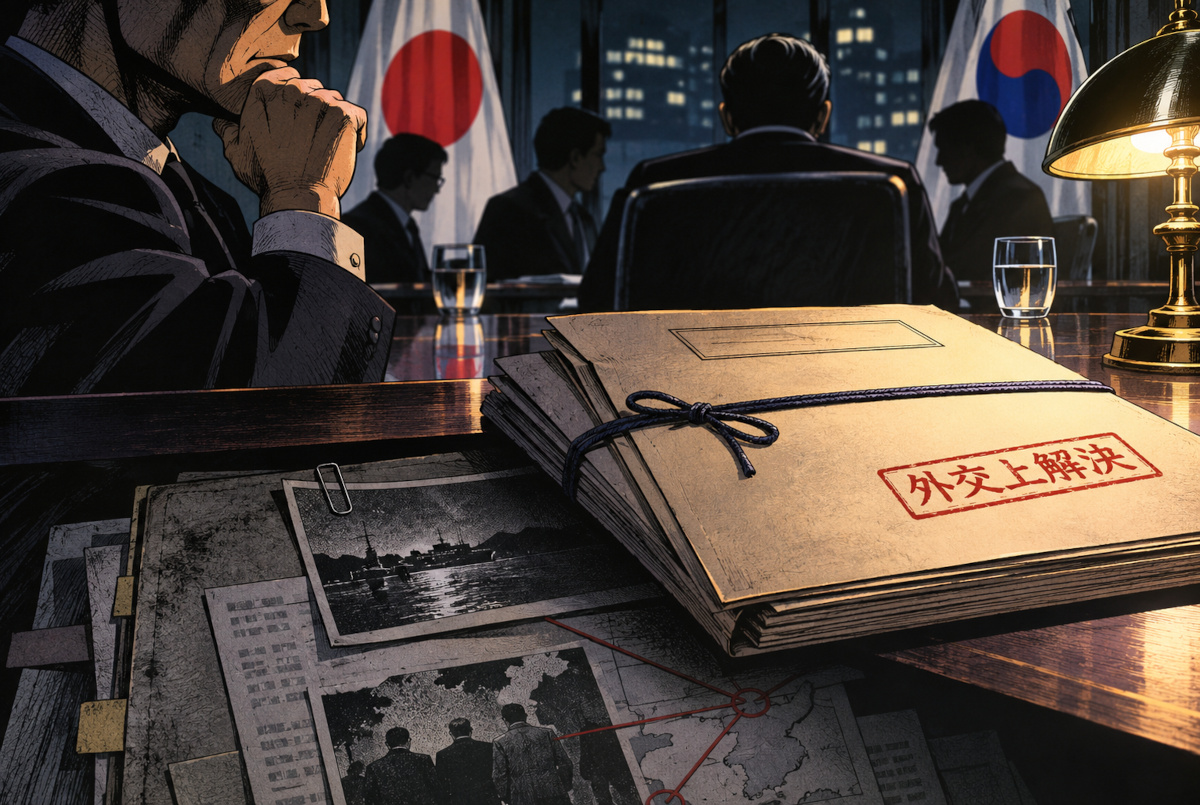
Can a government declare a criminal case settled while the police are still investigating it? And if two governments reach an agreement, does that mean the truth has been established?
Japan has a historical case that raises exactly these questions. In August 1973, South Korean opposition leader Kim Dae-jung was kidnapped from a Tokyo hotel. Japanese police launched a major search, recording a combined 46,000 officer deployments for checkpoints and accommodation checks.
Yet Japan and South Korea reached their first diplomatic settlement just 86 days after the abduction.
The uncomfortable distinction is this: political authorities can decide how an incident is officially handled, but they cannot change what actually happened.
To see what that distinction means in practice, I compared Japanese police records, government statements and the outcomes of three other criminal cases.
46,000 Police Deployments, Then a Diplomatic Deal in Just 86 Days
On August 8, 1973, Kim Dae-jung, a prominent opponent of South Korea’s authoritarian government, was abducted from the Hotel Grand Palace in Tokyo. Five days later, he was released near his home in Seoul.
Japan’s police response was extensive. According to the National Police Agency’s 1974 White Paper, police deployed a cumulative 22,000 officers for checks at airports, ports and major connecting roads, plus another 24,000 for checks at hotels and other accommodation facilities.
That adds up to 46,000 officer deployments. It does not mean 46,000 different officers were simultaneously searching for Kim. The figures count deployments and may include the same officers more than once.
Investigators also examined approximately 8,500 vehicles and 1,800 motorboats, looking for clues to the abductors’ movements.
The Tokyo Metropolitan Police Department came to suspect Kim Dong-un, a first secretary at the South Korean Embassy, of involvement in the kidnapping. On September 5, Japan requested his voluntary appearance for questioning through diplomatic channels. South Korea refused.
Then came the political agreement.
On November 2, 1973, Japanese Prime Minister Kakuei Tanaka met South Korean Prime Minister Kim Jong-pil. Their talks produced what became known as the first political settlement of the affair.
South Korea subsequently sent Japan a diplomatic note on July 22, 1975, concerning its investigation of the former embassy official. That became part of a further effort to resolve the bilateral dispute.
The first diplomatic settlement came only 86 days after the kidnapping.
The figure is a straightforward calculation: August 8 to November 2, 1973. But placed alongside the scale of Japan’s initial police response, it raises a less straightforward question. What, exactly, had been settled?
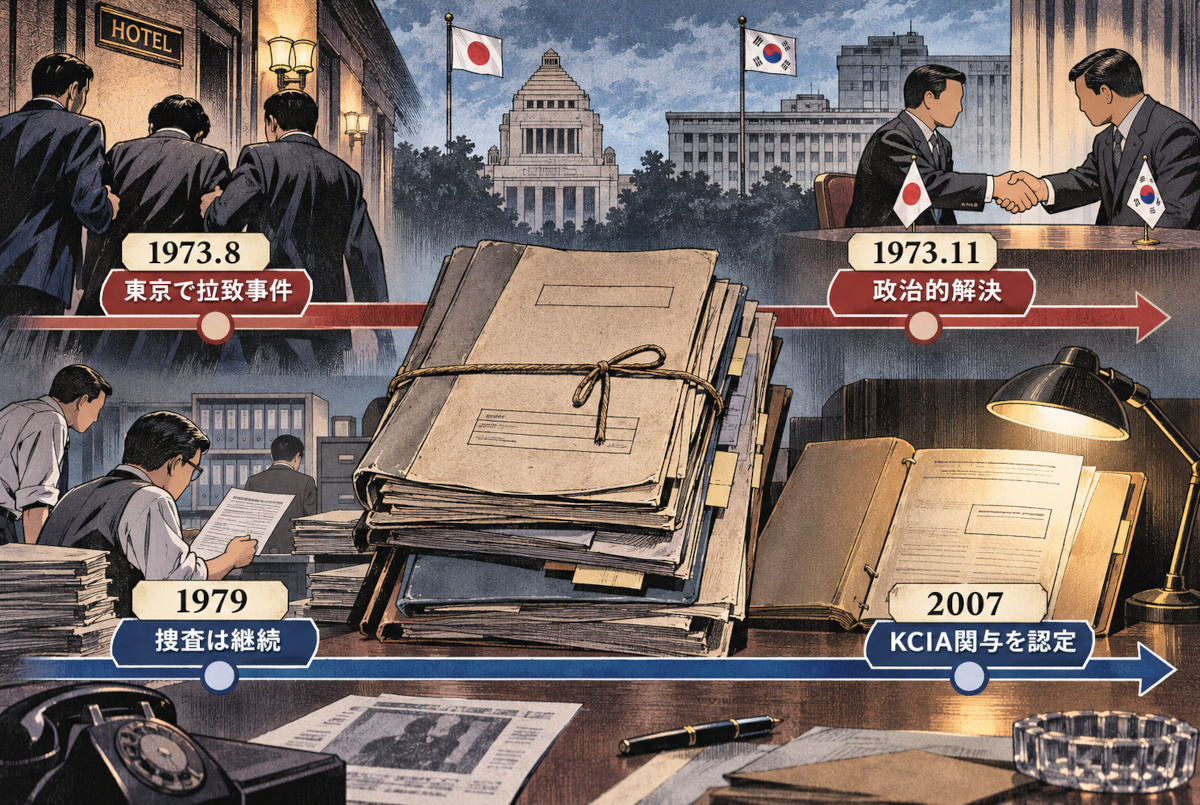
AI-generated historical illustration. The timeline distinguishes the 1973 diplomatic settlement from Japan’s 1979 statement that its investigation continued and South Korea’s 2007 findings on KCIA involvement. The people, meeting, buildings and documents are symbolic representations, not actual photographs or reproductions of historical records.
Japan Said the Police Were Still Investigating
If the matter had been settled diplomatically, had Japan’s criminal investigation ended as well?
A written response from the Japanese government, dated July 6, 1979, complicates that assumption.
Prime Minister Masayoshi Ohira’s government acknowledged the political settlement but stated that Japanese investigators had continued treating the kidnapping as a criminal case. It also maintained that the diplomatic agreement had not obstructed the investigation.
The government explained that the absence from Japan of the principal suspect, the victim and other important individuals had already made the investigation difficult. It also declined to disclose certain diplomatic communications, citing potential harm to diplomatic activities.
There was another important distinction in the government’s position. In 1979, Japan said the available evidence did not yet allow it to conclude definitively that South Korean state authority had been exercised on Japanese territory.
That position became much harder to maintain after October 24, 2007.
On that date, a truth-investigation committee established under South Korea’s National Intelligence Service released findings that the operation had been carried out on the orders of the head of the Korean Central Intelligence Agency (KCIA).
Japan protested the exercise of South Korean governmental authority on Japanese soil. After South Korea expressed regret for the violation of Japanese sovereignty and promised to prevent a recurrence, Japan said the international-law dispute had been addressed.
Compare the two official responses: in 1979, Japan said it could not definitively establish a violation of its sovereignty. In 2007, it protested the exercise of South Korean state power on its territory.
Approximately 34 years had passed since the kidnapping.
But resolving an international dispute between governments is not the same as establishing every participant’s criminal responsibility in a court of law. Nor does the 86-day interval, by itself, prove that politicians ordered the police to abandon the case.
When Japan’s Police Chief Was Shot, the Police Announcement Became the Controversy
On March 30, 1995, Takaji Kunimatsu, then Commissioner General of Japan’s National Police Agency, was shot and seriously wounded in Tokyo.
The attacker was never conclusively identified. The prosecution deadline under Japan’s statute of limitations expired on March 30, 2010.
Yet on that same day, the Tokyo Metropolitan Police Department publicly attributed the attack to an organized group of followers of Aum Shinrikyo, the religious movement associated with the Tokyo subway sarin attack earlier in 1995.
The statement became the subject of a civil defamation lawsuit. The resulting judgment ordered the Tokyo Metropolitan Government to pay one million yen in damages, and the damages award became final.
The police had failed to establish the perpetrator’s identity through criminal proceedings, yet issued a statement identifying the supposed perpetrators after prosecution was no longer possible. The manner of that announcement was subsequently found unlawful.
That judgment did not establish that Aum followers were uninvolved. Nor is there verified evidence that a politician intervened to stop the criminal investigation.
There is also a curious coincidence in the dates.
Just 28 days after the case became time-barred, Japan enacted reforms on April 27, 2010, abolishing the statute of limitations for murder and certain other crimes causing death.
But Kunimatsu survived. His case involved attempted murder, which was not covered by that abolition. So it would be wrong to claim that a law passed 28 days earlier would automatically have kept the case open.
The Matsukawa Incident: Twenty Defendants, Five Death Sentences, and No Convicted Perpetrator
In August 1949, a train derailed in Fukushima Prefecture, killing three crew members. Police arrested and prosecuted 20 people connected with labor unions at Japan National Railways and Toshiba.
At the first trial, all 20 were convicted, with five receiving death sentences.
But years of appeals and challenges to the prosecution’s evidence changed the outcome. In 1963, Japan’s Supreme Court upheld the acquittals of all 20 defendants.
The people responsible for the derailment were never conclusively identified.
The political backdrop matters: Japan was undergoing major industrial restructuring, and labor disputes were intense. Yet theories that a particular political organization orchestrated the derailment have not been established as fact.
The disturbing question is narrower, and more concrete. While the authorities were pursuing 20 people who would ultimately be acquitted, how effectively were other possible perpetrators being investigated?
The Sekihotai Attacks: Political Claims, but No Identified Killer
On May 3, 1987, a gunman attacked the Hanshin bureau of the Asahi Shimbun newspaper in Hyogo Prefecture. Two journalists were shot. One was killed, and the other was seriously wounded.
Claims of responsibility were issued under the name Sekihotai, or “Red Report Corps.” Police linked the attack to a wider series of offenses involving a group using that name.
Despite extensive investigations, the perpetrators were not identified. The limitation period for the Hanshin bureau murder expired in 2002.
In a May 8, 2026, session of Japan’s House of Representatives Committee on Judicial Affairs, a National Police Agency official confirmed that the limitation periods for all five related incidents had expired by March 2003.
The claims of responsibility suggested a political motive. They did not establish that political authorities had obstructed the police investigation.
Four Cases, Four Very Different Ways an Investigation Can End
Putting these cases side by side reveals something that can get lost in sensational accounts of political scandals: an event can be declared resolved in several entirely different senses.
| Case | What the records establish |
|---|---|
| Kim Dae-jung kidnapping (1973) | A diplomatic settlement was reached; official findings identifying KCIA involvement emerged decades later. |
| National Police Agency chief shooting (1995) | The perpetrator was not conclusively identified before the case became time-barred; the police’s subsequent announcement was found unlawful in civil proceedings. |
| Matsukawa Incident (1949) | All 20 defendants were ultimately acquitted; the actual perpetrators remained unidentified. |
| Sekihotai attacks (1987 onward) | The perpetrators were not identified, and the prosecution deadlines expired. |
None of these four cases provides established proof that politicians ordered the police to deliberately leave a crime unsolved.
What they do reveal is that diplomacy, police findings, criminal verdicts and statutes of limitations follow different rules. They do not necessarily reach the same destination at the same time.
Political power can influence how an incident is officially treated or announced. But a diplomatic agreement, a police statement or an expired prosecution deadline cannot rewrite the underlying historical facts.
Editor’s Note
I started with a rather cynical question: can powerful people simply have a quiet conversation, shake hands, and make an awkward criminal case go away?
Then I looked at the Kim Dae-jung kidnapping. The police had mobilized enormous resources, and Japan later insisted the investigation was continuing. Yet the governments had reached their first diplomatic settlement in just 86 days.
That’s the part I still can’t get past.
Of course, relations between two countries matter. But when a government says an incident has been settled, settled for whom? For the victim? For the investigators? Or for the officials trying to keep international relations functioning?
There is only one set of events that actually happened. What governments are willing to acknowledge about those events is another matter entirely.
References
- National Police Agency, 1974 Police White Paper, Chapter 8: The Kim Dae-jung Incident (Japanese; includes police deployment figures and investigative details).
- Ministry of Foreign Affairs of Japan, Diplomatic Bluebook 1976: Relations with South Korea (Japanese; records the July 1975 diplomatic note).
- House of Representatives of Japan, Government Written Response Concerning the Kim Dae-jung Kidnapping (July 6, 1979; Japanese).
- House of Representatives of Japan, Government Written Response on Japan’s Sovereignty and the Kim Dae-jung Incident (November 2, 2007; Japanese).
- Law Library of Congress, “South Korea: Kim Dae-jung Kidnapping by KCIA Affirmed” (December 2, 2007; English-language summary of the South Korean findings).
- Hiroshima Bar Association, Statement on the Tokyo Police Announcement Concerning the National Police Agency Chief Shooting (May 13, 2010; Japanese).
- Religious Information Research Center, Report on the Aleph Defamation Appeal (2013; Japanese).
- National Police Agency, Explanation of the 2010 Statute of Limitations Reform (2011; Japanese).
- Ohara Institute for Social Research, Hosei University, Matsukawa Incident: Final Supreme Court Decision (September 12, 1963; Japanese).
- National Police Agency, 1988 Police White Paper, Case No. 116 (Japanese; background on the Sekihotai attacks).
- House of Representatives of Japan, Committee on Judicial Affairs, Meeting No. 8 (May 8, 2026; Japanese; discussion of the Sekihotai cases and prosecution deadlines).