

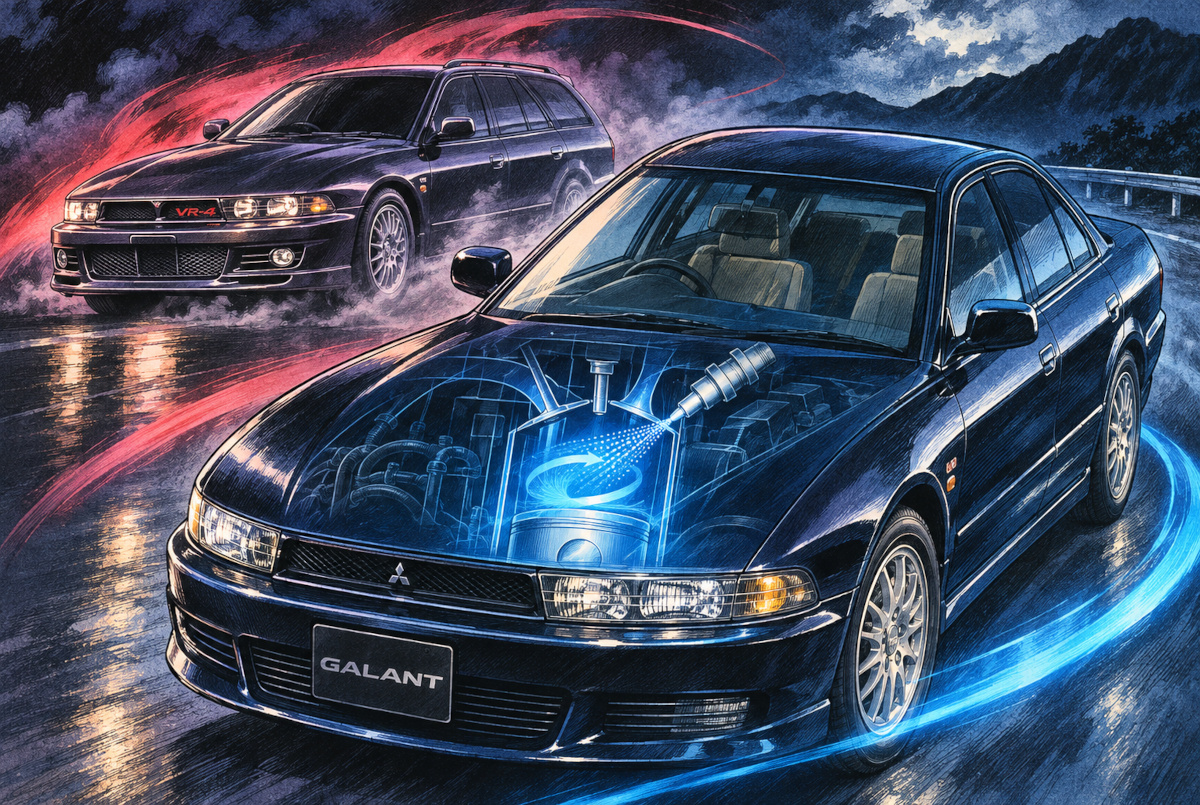
In August 1996, Mitsubishi launched the eighth-generation Galant in Japan with a bold promise under the hood. Its new Gasoline Direct Injection engine, or GDI, was promoted as the “Engine of the 21st Century.” Mitsubishi claimed roughly 10% more power and 35% better fuel economy than its previous engine technology.
Yet the very same Galant range also included the VR-4: a four-wheel-drive sports sedan powered by a 2.5-liter twin-turbocharged V6 producing 280 PS (approximately 276 mechanical horsepower).
One model chased fuel efficiency. The other chased serious performance. Mitsubishi apparently wanted both, and it wanted them in the same family of cars.
The Galant and its Legnum wagon sibling went on to win the 1996–1997 Japan Car of the Year award. But GDI later faced reliability and maintenance concerns, while the original Japanese-market Galant line came to an end in 2005.
Was GDI really the engine of the future? And what exactly did Mitsubishi mean by “35% better fuel economy”? Did that translate into using 35% less gasoline?
To find out, we went back to contemporary engineering papers, Mitsubishi’s own historical records, period vehicle specifications, and official service-campaign notices. The numbers tell a more interesting story than the advertising slogan alone.
Was Mitsubishi GDI Really the World’s First Gasoline Direct-Injection Engine?
Mitsubishi announced GDI technology in May 1995. In August 1996, its 1.8-liter 4G93 engine entered production in the new Galant sedan and Legnum station wagon.
It was a major achievement, but there is an important historical distinction: Mitsubishi did not invent gasoline direct injection.
The Mercedes-Benz 300 SL Gullwing had already used mechanical gasoline direct injection in 1954, more than four decades earlier. Its Bosch injection system was an extraordinary achievement in its own right.
So what made Mitsubishi’s GDI so significant?
The breakthrough was bringing electronically controlled direct injection and stratified-charge lean combustion into high-volume passenger-car production, with the ability to switch between operating modes according to driving conditions.
At light engine loads, the 4G93 GDI injected fuel late in the compression stroke. Instead of distributing the fuel evenly throughout the cylinder, it concentrated a combustible mixture near the spark plug. The overall mixture could therefore contain considerably more air than a conventional gasoline engine would normally use.
Under higher loads, the system injected fuel during the intake stroke, producing a more homogeneous mixture to support stronger power output.
Making those two operating modes work required several distinctive components: upright intake ports, a curved-crown piston, a high-pressure fuel pump, and a high-pressure swirl injector.
The intake ports helped generate a strong reverse-tumble motion inside the cylinder. Together with the shaped piston crown, this motion helped position the fuel-air mixture near the spark plug for reliable ignition.
GDI was not simply an engine that burned a weaker mixture. It controlled when fuel entered the cylinder, how the air moved, and where the combustible mixture formed.
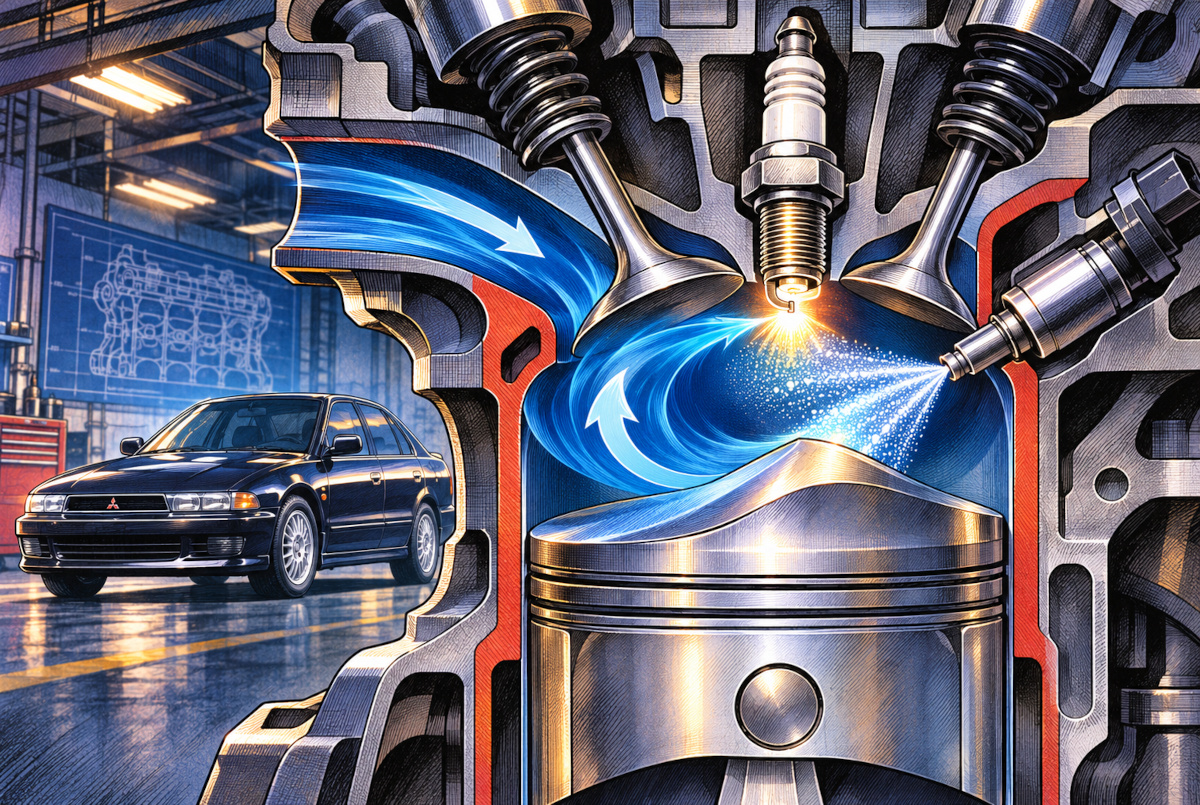 Illustration of the 4G93 GDI combustion concept. The curved piston crown and reverse-tumble airflow helped concentrate a combustible mixture near the spark plug. This is a simplified technical illustration, not an exact engineering cross-section or a depiction of simultaneous injection and ignition. Editorial illustration.
If Fuel Economy Improved by 35%, Did Gasoline Consumption Fall by 35%?
This was the number that made us stop and reach for a calculator.
Mitsubishi’s official vehicle history describes a 35% improvement in fuel economy alongside a 35% reduction in CO2 emissions. The Society of Automotive Engineers of Japan also records an approximately 35% fuel-economy improvement compared with Mitsubishi’s earlier engine-equipped vehicles.
But an engineering paper on GDI development provides a crucial detail. The fuel-economy improvement was measured against a previous-generation engine-equipped vehicle under Japan’s 10–15 mode driving cycle.
For readers unfamiliar with Japanese vehicle testing, the 10–15 mode was a standardized fuel-economy test used before Japan adopted later measurement systems such as JC08 and WLTC. It was a laboratory-based test cycle, not a guarantee of fuel economy on real roads.
The 1996 Galant with the 1.8-liter GDI engine and five-speed manual transmission recorded 18.8 km/L under that cycle. That is approximately 44.2 miles per US gallon, or 53.1 miles per imperial gallon.
Now comes the interesting part.
Working Backward from Mitsubishi’s 35% Claim
Suppose that 18.8 km/L represents a 35% improvement over the earlier vehicle. We can estimate the original figure by dividing the new result by 1.35:
18.8 ÷ 1.35 = approximately 13.93 km/L.
Using those two fuel-economy figures, how much gasoline would each vehicle need to travel the same 1,000 kilometers?
| Comparison | Fuel economy | Fuel used over 1,000 km |
|---|---|---|
| Earlier vehicle (calculated baseline) | Approx. 13.93 km/L | Approx. 71.8 L |
| 1996 GDI (published figure) | 18.8 km/L | Approx. 53.2 L |
Calculation note: The earlier vehicle’s 13.93 km/L is not a separately verified factory specification. It is calculated on the assumption that 18.8 km/L represents a 35% improvement over the original figure. The fuel-consumption comparison also assumes identical driving distance and comparable test conditions.
Under those assumptions, the saving is approximately 18.6 liters per 1,000 kilometers.
That works out to a reduction in fuel consumption of about 25.9%.
A 35% increase in kilometers per liter is not mathematically equivalent to a 35% reduction in liters consumed over the same distance.
The difference comes from the fact that fuel economy and fuel consumption are reciprocal measurements.
Fuel economy measures how far a vehicle travels per unit of fuel. Fuel consumption measures how much fuel is required to travel a given distance.
For a direct comparison under identical conditions:
Fuel-consumption reduction = 1 − (1 ÷ 1.35) = approximately 25.9%.
Conversely, a genuine 35% reduction in fuel consumption would correspond to an improvement in distance per liter of approximately 53.8%.
Then Why Did Mitsubishi Also Claim 35% Lower CO2 Emissions?
This deserves its own distinction.
Mitsubishi’s historical materials do indeed state a 35% reduction in CO2 emissions. That statement should not simply be erased or dismissed because our reciprocal calculation produces a different percentage.
What we could verify from the GDI development literature was the 35% improvement in fuel economy under the 10–15 mode comparison and the published 18.8 km/L figure.
We could not establish from the available documentation whether the separate CO2 reduction figure used precisely the same comparison vehicle, baseline, measurement conditions, and calculation method.
Our calculation shows what happens when the stated improvement in km/L is converted into fuel consumed over an equal distance. It does not, by itself, prove that Mitsubishi’s separately reported CO2 reduction figure was false.
But it does establish something useful for anyone reading historical fuel-economy claims: a percentage improvement in km/L cannot automatically be interpreted as the same percentage saving in gasoline purchases.
That seemingly minor distinction changes the way the headline figure should be understood.
Why Did an Economy-Focused GDI Engine Require Premium Gasoline?
There was another curious detail in Mitsubishi’s supposedly economical new engine.
The original 1.8-liter 4G93 GDI specified premium unleaded gasoline.
Its compression ratio was 12.0:1, unusually high for a mainstream gasoline engine of the period. Such a design raised the importance of knock resistance, especially when the engine was operating under heavier loads.
Direct injection offered advantages such as charge cooling, but Mitsubishi’s production specification still called for premium fuel.
That brings up a question that the efficiency claims alone cannot answer: what about the cost of running the car?
A Simple Fuel-Cost Comparison
Imagine that premium gasoline costs 10% more per liter than regular gasoline, while the GDI vehicle achieves the claimed 35% improvement in fuel economy over the comparison vehicle.
The relative fuel cost per kilometer would be:
1.10 ÷ 1.35 = approximately 0.8148.
In other words, fuel expenditure per kilometer would fall by approximately 18.5%, despite the more expensive gasoline.
This is only a conditional calculation. It does not reconstruct actual Japanese pump prices in 1996, nor does it compare real-world fuel consumption measured in owners’ cars. It also assumes that the previous vehicle uses regular gasoline.
Nevertheless, it reveals another useful distinction.
Premium fuel did not automatically cancel out GDI’s fuel-economy advantage. But neither did a 35% improvement in the official test figure mean that owners would spend 35% less on fuel.
That difference mattered to anyone considering the running costs of a family sedan.
The 280 PS Galant VR-4 Took an Entirely Different Route
While the regular Galant concentrated on direct-injection efficiency, Mitsubishi’s performance flagship went in almost the opposite direction.
The eighth-generation Galant VR-4 used the 6A13 engine, a 2,498 cc, DOHC 24-valve V6 with twin turbochargers and intercooling.
In its five-speed manual configuration, it produced 280 PS, approximately 276 mechanical horsepower, and a maximum torque of 37.0 kgf·m, approximately 363 N·m.
For comparison, the seventh-generation 2.0-liter Galant VR-4 had produced 240 PS. The 1996 model therefore gained 40 PS, an increase of approximately 16.7%, while engine displacement grew by roughly one quarter.
And here is a detail that can get lost in discussions of Mitsubishi’s 1990s technology: the 280 PS VR-4 was not powered by a GDI engine.
It used Mitsubishi’s ECI-MULTI electronic fuel-injection system rather than the direct-injection arrangement of the 4G93.
| Specification | 1996 Galant GDI 1.8 | 1996 Galant VR-4 |
|---|---|---|
| Engine code | 4G93 | 6A13 |
| Displacement | 1,834 cc | 2,498 cc |
| Configuration | Inline-four, naturally aspirated | V6, twin-turbocharged |
| Fuel injection | GDI direct injection | ECI-MULTI |
| Maximum output | 150 PS | 280 PS (5MT) |
| Specified fuel | Premium unleaded | Premium unleaded |
Specifications refer to representative Japanese-market versions launched in 1996. The GDI figure refers to the 1.8-liter model, while the VR-4 output refers to the 2.5-liter five-speed manual version. The VR-4 Type S with the five-speed automatic transmission was rated at 260 PS. PS denotes metric horsepower; 1 PS is approximately 0.9863 mechanical horsepower.
The VR-4 also featured full-time four-wheel drive, with Mitsubishi’s Active Yaw Control (AYC) system available in the performance lineup.
For an international reader, AYC is worth a brief explanation: it is an active handling system designed to influence how a car turns by controlling the distribution of driving force between the rear wheels.
The contrast within the Galant family was extraordinary.
One engine tried to extract more distance from every liter of fuel. The other used a twin-turbo V6 to deliver power that would have been impressive even in a dedicated sports car.
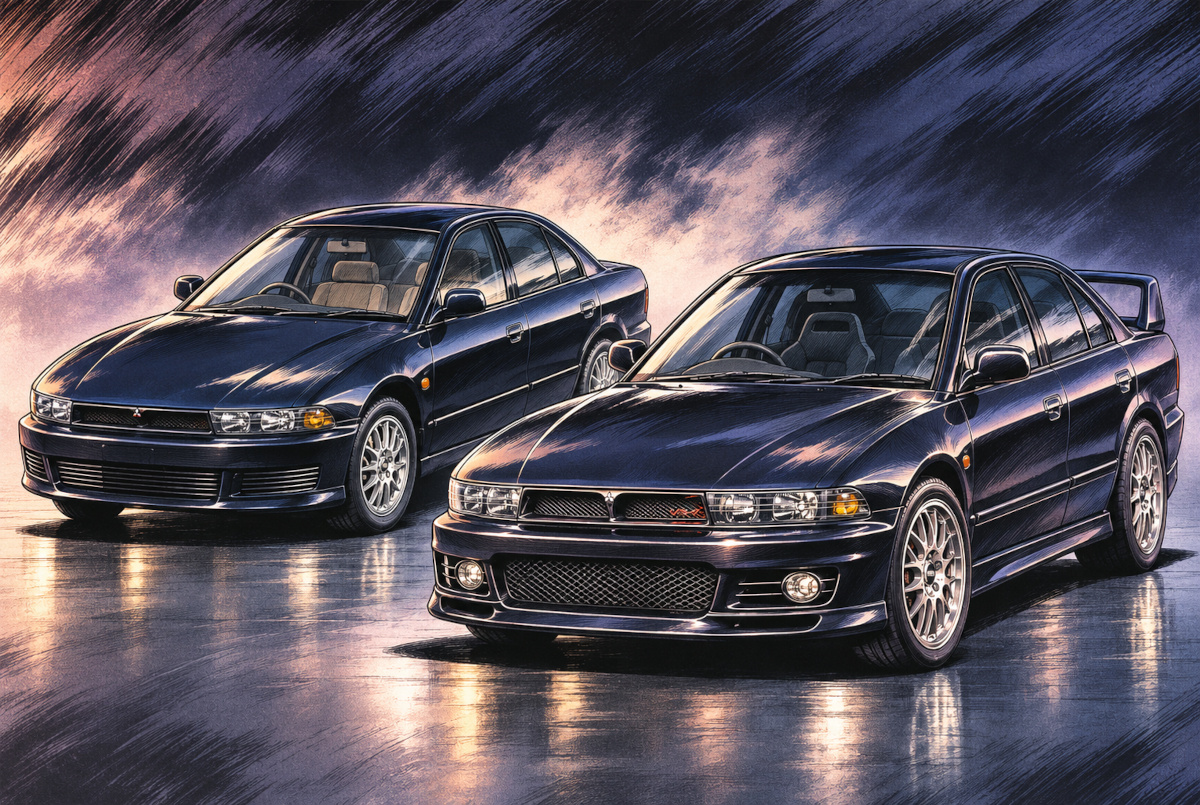 Two different personalities within the eighth-generation Galant family. The standard 1.8-liter GDI sedan is shown on the left, with the 2.5-liter twin-turbo VR-4 on the right. Exterior trim, wheels, and other details have been artistically reconstructed rather than reproduced as exact factory specifications. Editorial illustration.
Then Mitsubishi Put 280 PS into a Station Wagon—and Won Car of the Year Again
The Galant story became even more unusual with the arrival of the Mitsubishi Legnum in August 1996.
The Legnum was a station wagon developed from the Galant, but it was not merely a sedan with an extended roof.
Its rear overhang was extended by 50 mm to provide a dedicated cargo area, while Mitsubishi retained the fundamental platform and offered performance versions alongside the practical family models.
The Legnum VR-4 used the same 6A13 twin-turbocharged V6 as the Galant VR-4, together with four-wheel drive and advanced handling technology.
In five-speed manual form, the Legnum VR-4 also produced 280 PS.
Consider what that meant in the mid-1990s: a five-door station wagon, capable of carrying luggage and passengers, with a twin-turbocharged engine producing around 276 mechanical horsepower.
It was the sort of car that appeared sensible until somebody looked at the engine specifications.
The Galant and Legnum jointly won Japan’s 1996–1997 Car of the Year award, a major annual Japanese automotive prize selected by an industry judging panel.
For the Galant nameplate, it was the second such victory. The sixth-generation Galant had already won the 1987–1988 award.
GDI technology, the VR-4 performance sedan, and a twin-turbo station wagon all belonged to one model family.
Mitsubishi had packed an extraordinary range of ambitions into the Galant and Legnum: lower fuel consumption, technical sophistication, and serious performance, all at once.
 Illustration of the 1996 Mitsubishi Legnum VR-4 (EC5W). The five-speed manual version combined a practical station-wagon body with a 2.5-liter twin-turbo V6 rated at 280 PS. Vehicle details and the driving scene have been artistically reconstructed. Editorial illustration.
The Trouble with GDI Wasn’t Confined to the Combustion Chamber
If Mitsubishi’s original GDI concept was so clever, why did its reputation become more complicated over time?
One area of concern involved deposits forming in the engine, including deposits affecting combustion chambers, injectors, and intake valves.
A gasoline direct-injection engine differs from a conventional port-injected engine in an important way: fuel is sprayed directly into the cylinder rather than into the intake port.
In a port-injection system, the incoming gasoline can help wash deposits from the backs of the intake valves. Direct injection does not provide that same fuel-washing action.
This does not mean every GDI engine was destined to fail. It means that deposit control became an important engineering and maintenance consideration.
In 2003, researchers published an SAE technical paper investigating injector deposits, combustion-chamber deposits, and intake-valve deposits in direct-injection spark-ignition engines, using Mitsubishi’s 1.8-liter 4G93 among the engines studied.
That research provides evidence that deposit formation was a serious technical subject worthy of investigation.
It does not, however, establish the failure rate of every early GDI-equipped Galant, nor should it be treated as proof that all of those vehicles suffered the same problems.
What Did Mitsubishi’s 2002 Service Campaign Actually Cover?
There is also a useful official record from June 17, 2002.
Mitsubishi launched a Japanese service campaign covering certain Galant, Legnum, and other models because of engine-control and throttle-position-sensor issues.
The official notice identified two main concerns.
First, under certain accessory-load conditions, inappropriate engine ECU idle-speed compensation could occasionally produce an unexpected momentary forward surge sensation.
Second, inadequate wear resistance inside the throttle position sensor could increase electrical contact resistance. That could trigger a warning light and fail-safe operation, limit engine output, or occasionally cause stalling. Unstable idle operation was also possible.
Mitsubishi’s corrective measures included revised engine ECU programming and replacement of the throttle position sensor with an improved component.
But the affected Galant models listed in the notice included later 2.4-liter GDI variants, not every 1996 1.8-liter GDI Galant.
And the service notice did not attribute those particular faults to the carbon or deposit problems discussed in the engineering research.
These distinctions matter.
It is tempting to combine every historical GDI-related problem into one story about a fundamentally defective engine. The documentary record does not justify that shortcut.
GDI demonstrated an impressive combustion concept, but a production engine also had to cope with deposits, electronic controls, component durability, and the realities of long-term ownership.
That is a more useful assessment than simply declaring GDI either a triumph or a disaster.
By 2005, the Original Japanese Galant Line Had Reached Its End
Mitsubishi did not abandon GDI immediately after its introduction.
In August 1998, a 2.4-liter GDI variant joined the Japanese Galant range. In May 2000, a 2.0-liter GDI engine replaced the original 1.8-liter version.
The company continued developing and applying the technology as the model family evolved.
But the high-performance Galant VR-4 disappeared from the range in 2002, and Japanese-market Legnum production also came to an end that year.
The eighth-generation Galant itself remained available until 2005, ending the continuous domestic lineage that had begun with the Colt Galant in 1969.
Published catalog sources differ slightly on whether November or December 2005 should be treated as the final month, so the end of domestic availability is described here simply as 2005.
Was this the direct result of early GDI reliability concerns?
That would be too simple an explanation.
Changes in the Japanese sedan market, Mitsubishi’s product strategy, and wider business conditions also need to be considered. We could not establish from the available direct evidence how much each factor contributed to the decision to end the original Galant line.
The Galant name returned to Japan in 2007 with the Galant Fortis. But this was not merely the eighth-generation Galant continuing under a revised badge. It was a new model within a different product strategy.
As for GDI, it was neither the universal solution that a futuristic slogan might suggest nor a technical achievement that should be dismissed outright.
The 1996 Galant captured both sides of ambitious automotive engineering: the excitement of getting a new technology into production and the much harder challenge of making it work reliably throughout the life of an ordinary car.
Editor’s Note
What caught my attention wasn’t the 280 PS figure. It was the supposedly boring number: 35%.
Tell an ordinary buyer that a car delivers 35% better fuel economy, and how many will immediately think of the reciprocal relationship between kilometers per liter and liters per kilometer? Most people will simply imagine saving 35% at the pump.
Yet under the same comparison assumptions, the arithmetic gives us a reduction in fuel consumption of about 26%, not 35%. That’s a surprisingly revealing difference for such a familiar advertising claim. To be fair, Mitsubishi also published a separate CO2 reduction figure, and I couldn’t verify all the assumptions behind that calculation. So the two claims should not be casually treated as identical.
Then there was my assumption about direct injection itself. I had associated the great breakthrough with Mitsubishi, only to run straight into the Mercedes-Benz 300 SL of 1954. More than forty years earlier! Mitsubishi’s real accomplishment was not inventing direct injection but finding a way to use electronically controlled, stratified-charge combustion in a mass-produced family car.
And while the engineers were chasing fuel economy, another team was apparently perfectly happy to build a 280 PS twin-turbo V6 Galant. They even put that engine into the Legnum wagon.
A fuel-saving four-cylinder on one side of the showroom and a twin-turbo family wagon on the other. That kind of contradiction is exactly why I enjoy digging into Japanese cars of this era. Mitsubishi seemed unwilling to choose between restraint and excess.
In the end, I can’t bring myself to call GDI a simple failure. The combustion strategy made technical sense, and Mitsubishi succeeded in putting it into production. But a car is not a laboratory demonstration. It has to start every morning, survive years of ordinary use, and remain practical to maintain.
Was GDI fully ready to be the “Engine of the 21st Century” in that broader, everyday sense? That is the question I am still left with.
In the next installment, we follow the Galant name beyond the end of the original Japanese sedan line, comparing the overseas Galant models with the Galant Fortis introduced in Japan in 2007. What, exactly, survived of the original Galant tradition?
Mitsubishi Galant: Seven-Part History Series
From the original Colt Galant and the Galant Sigma to the rally-winning VR-4, GDI technology, and the end of the Galant name. Across seven articles, we explore the cars, engineering, motorsport history, and legacy of one of Mitsubishi's defining model lines.
- Part 1: The Colt Galant Came Before Mitsubishi Motors—and Led to the GTO and FTO (Part 1)
- Part 2: The Galant Sigma Was a Hit—So Why Did Mitsubishi Abandon RWD? (Part 2)
- Part 3: The Galant VR-4 Won Six WRC Rallies. Why Did Mitsubishi Replace It? (Part 3)
- Part 4: The Evo Got the 4G63—So Why Did the Galant VR-4 Still Make 240 PS? (Part 4)
- Part 5: Mitsubishi’s “Engine of the 21st Century”: Did GDI Really Deliver 35% Better Fuel Economy? And Why Was There a 280 PS VR-4?
- Part 6: Why Were There Two Different Mitsubishi Galants—and Two Different RALLIARTs? Coming soon
- Final Part: English edition Coming soon
Terms That May Need a Quick Explanation
- Lean-Burn and Stratified-Charge Combustion
- Lean-burn combustion uses an overall air-fuel mixture containing more air than the chemically ideal ratio for conventional gasoline combustion. In a stratified-charge GDI engine, the mixture is deliberately uneven: fuel is concentrated near the spark plug so ignition can occur even when the overall cylinder mixture is very lean.
References
- Mitsubishi Motors — Vehicle History (Japanese) — Official historical descriptions of the 1996 eighth-generation Galant, GDI performance claims, the VR-4 and Legnum, and subsequent engine updates.
- Mitsubishi Motors — Corporate History (Japanese) — Mitsubishi’s May 1995 GDI announcement and the development of direct-injection technology.
- Society of Automotive Engineers of Japan — 4G93 Gasoline Direct Injection Engine (Japanese) — Engine construction, operating modes, 1,834 cc displacement, 12.0:1 compression ratio, 150 PS output, and reported fuel-economy improvement.
- JSAE Review — Development of In-Cylinder Gasoline Direct Injection Engine (1998) — Engineering paper associated with GDI development and its fuel-economy measurements, including the Japanese 10–15 mode comparison.
- Society of Automotive Engineers of Japan — Control of Mixing and Combustion for Mitsubishi GDI Engine (1998) — Technical discussion of mixture formation and combustion control in the early GDI system.
- Mercedes-Benz — History & Brand World — Official English-language account of the 1954 300 SL Gullwing and its mechanical gasoline direct-injection system.
- Car and Driver Japan — Reprinted 1996 Mitsubishi Galant Catalog Feature (Japanese) — Contemporary “Engine of the 21st Century” advertising, fuel-economy claims, premium-fuel specification, and period vehicle information.
- GAZOO — 1996 Mitsubishi Galant VR-G Specifications (Japanese) — 4G93 GDI, 1,834 cc displacement, 150 PS output, and specified fuel.
- GAZOO — 1996 Mitsubishi Galant VR-4 Specifications (Japanese) — 6A13 twin-turbo V6, 280 PS five-speed manual version, and ECI-MULTI fuel injection.
- GAZOO — 1996 Mitsubishi Galant VR-4 Type S Specifications (Japanese) — Five-speed automatic version rated at 260 PS.
- GAZOO — 1996 Mitsubishi Legnum VR-4 Specifications (Japanese) — EC5W wagon configuration, 6A13 engine, and 280 PS manual-transmission specification.
- Japan Car of the Year — 1996–1997 Official Award Record (Japanese) — Mitsubishi Galant and Legnum joint victory.
- Japan Car of the Year — 1987–1988 Official Award Record (Japanese) — The sixth-generation Mitsubishi Galant’s earlier award.
- SAE International — A Study of Injector Deposits, Combustion Chamber Deposits and Intake Valve Deposits in DISI Engines (2003), Paper 2003-01-3162 — Technical investigation involving the Mitsubishi 4G93 direct-injection engine.
- Mitsubishi Motors — June 17, 2002 Service Campaign SC049 (Japanese) — Official description of engine ECU idle-control and throttle-position-sensor concerns, affected vehicles, and corrective actions.
- CarSensor — Eighth-Generation Mitsubishi Galant Model History (Japanese) — Japanese-market model history and the end of the original Galant line in 2005.