

There was a time when being a hacker seemed to require a special talent: knowing exactly what to type into a black terminal full of mysterious commands. Today, even someone who cannot write a program can ask an AI to help create one.
And this is no longer just a hypothetical concern. AI has already been used in real cybercrime cases, including attacks on business systems.
So can someone with very little programming knowledge use AI to pull off the kind of cyberattack that once required a skilled professional? The evidence points to two surprisingly different answers: AI is lowering the technical barrier, but it has not made expertise irrelevant.
A 17-Year-Old, Generative AI, and 7.24 Million Malicious Commands
In March 2026, Japan’s National Police Agency (NPA) published a report describing how generative AI had been used in actual cybercrime.
One case involved a 17-year-old high school student. According to the NPA, in January 2025 the teenager used generative AI in connection with an attack on the servers of a membership app operated by a Japanese internet and entertainment cafe business.
The attack involved approximately 7.24 million malicious commands, resulted in the exposure of membership information, and disrupted part of the app’s functionality. The teenager was arrested in December 2025 on suspicion of violating Japan’s unauthorized access law and obstructing business operations through deception.
One number needs particular care: 7.24 million refers to the commands sent during the attack. It should not be interpreted as proof that 7.24 million individual customers had their information exposed.
The NPA’s report also includes a diagram showing that the suspect modified a malicious program using responses provided by generative AI.
But there is an important limit to what this case proves. The official report does not establish how much programming knowledge the teenager already possessed. Being 17 does not automatically make someone a complete beginner.
What the case demonstrates is the use of AI in a real attack—not that an entirely untrained person could have carried it out.
A Criminal With Basic Coding Skills Used AI to Build Ransomware
An overseas case gets closer to the question of whether a beginner can create dangerous software.
On August 27, 2025, AI company Anthropic published a threat intelligence report describing a criminal who relied heavily on its Claude AI system to develop several variants of ransomware.
Ransomware is malicious software that can encrypt files or otherwise make data inaccessible, typically as part of an attempt to demand payment.
According to Anthropic, the person had only basic coding skills and depended on AI to implement and troubleshoot technical components that would normally require substantial programming knowledge.
The ransomware packages were sold on criminal forums for $400 to $1,200.
That is a meaningful change: someone without deep technical expertise can, in some circumstances, use AI to produce functioning malicious software.
Still, two different achievements should not be confused. Developing ransomware is one thing. Successfully breaking into a protected business network is another.
Anthropic’s account of the software being sold does not, by itself, establish how many buyers successfully attacked organizations with it.
The 157-Person Test: Beginners Went From 14% to 32%, With a Catch
That brings us to the more interesting question. Does AI actually make inexperienced people better at offensive cybersecurity tasks?
A study published by RAND Europe in May 2026 provides a rare controlled comparison. Funded by the UK’s AI Security Institute, the research involved 157 participants who attempted simulated cyberattack challenges between September 2025 and January 2026.
Some participants could use AI models; others could not. Among the participants were 54 novices with little technical computing experience, alongside 103 people with more technical backgrounds.
In the easiest simulated attack challenge, the completion rates were as follows.
| Participant group | Without AI | With AI | Difference |
|---|---|---|---|
| Novices | 14% | 32% | +18 percentage points |
| Technical participants | 54% | 59% | +5 percentage points |
Source: RAND Europe (2026). Completion rates for the easiest simulated attack challenge. Not all 157 participants completed this particular task. The technical group included people with varying cybersecurity experience; they were not necessarily professional hackers.
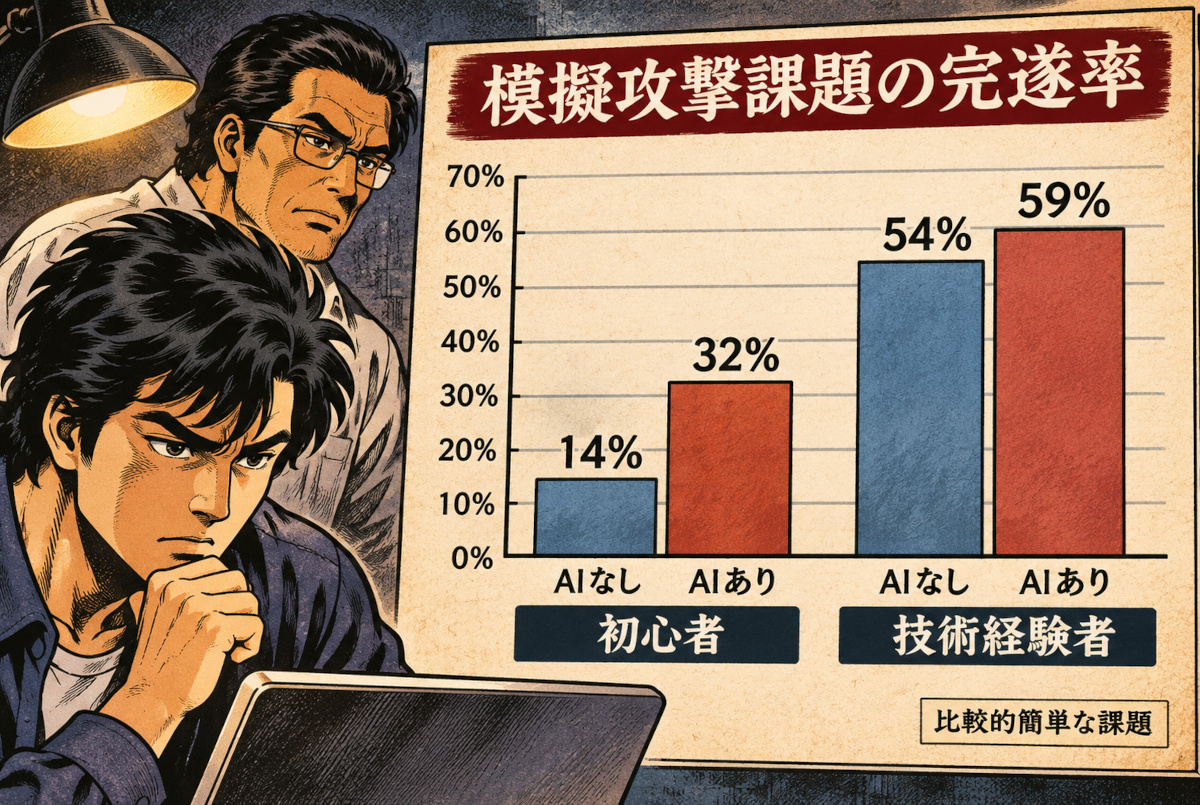
Completion rates in RAND’s easiest simulated cyberattack challenge. The observed differences were not statistically significant and should not be treated as real-world hacking success rates. AI-generated illustration; the people shown are fictional. Chart based on RAND Europe (2026).
Now for the arithmetic that makes the numbers more revealing.
For novices, 32 divided by 14 equals approximately 2.29. In other words, the reported completion rate with AI was about 2.29 times the rate without AI.
But that is not the same as saying AI improved success by 18%. The difference was 18 percentage points.
Turn the figures around, and another detail appears: 68% of AI-assisted novices still failed to complete even this relatively easy challenge.
There was also a 22-percentage-point gap between novices using AI (32%) and technical participants working without AI (54%).
That is worth noticing. AI may help narrow a skills gap, but the results do not suggest that prior technical experience has suddenly become worthless.
There is a statistical warning, too. RAND’s researchers explicitly stated that the differences in completion rates were not statistically significant. The experiment was not large enough to establish that the observed improvement was a reliable effect rather than a possible result of sampling variation.
The harder challenges were even more revealing. Almost nobody completed them, regardless of AI access.
So the study suggests AI may help beginners, particularly on easier tasks. It does not prove that beginners can suddenly perform at the level of expert attackers.
Then a Specialized AI Agent Outperformed Nine of Ten Professionals
Just when the evidence seems reassuring, another study complicates the picture.
In December 2025, researchers from Stanford University and collaborating institutions reported an experiment involving a university network with approximately 8,000 hosts across 12 subnets.
They compared AI systems with ten human cybersecurity professionals performing authorized penetration testing—security assessments designed to identify weaknesses before criminals exploit them.
The researchers’ specialized AI agent, called ARTEMIS, identified nine valid vulnerabilities. Its submissions had an 82% validity rate, and it outperformed nine of the ten human participants under the study’s evaluation conditions.
That is an impressive result. But the distinction matters: ARTEMIS was a purpose-built system developed by researchers, not simply an ordinary person asking a general-purpose chatbot for hacking instructions.
Its performance also came with limitations, including false-positive findings and difficulties with tasks involving graphical user interfaces.
This means the Stanford study and the RAND trial do not contradict each other. They tested different things.
RAND investigated how much AI assistance helped human participants with varying levels of technical experience. Stanford evaluated specialized AI agents designed to carry out cybersecurity work more independently.
The situation continued to evolve. In September 2026, Anthropic reported cases in which individuals and organized threat actors used AI across multiple stages of cyber operations, helping them sustain campaigns against several targets.
According to that report, AI was increasingly being used not merely to answer questions, but to coordinate and execute parts of complex workflows.

Conceptual illustration of a basic chatbot workflow versus a tool-enabled AI agent. Actual capabilities depend on the product, connected tools and permissions. Some chat-based AI products also support tool execution. This is not a depiction of a real cyberattack or a specific AI system.
Here is the distinction that matters: AI is not necessarily turning an amateur into an expert. It is making some expert-level tasks possible without the operator personally mastering every technical step.
Of course, the same capabilities can help legitimate security professionals find vulnerabilities and protect systems.
A tool that can identify a weakness is not inherently criminal. What matters is who uses it, whether they have permission, and what they choose to do with the result.
Editor’s Note
Here is what bothers me about all this.
It is not simply that hacking tools are becoming more sophisticated. Technology has always become more sophisticated.
What gets under my skin is that some of the things that once required considerable technical skill can now be attempted by people who never acquired that skill themselves.
In the old days, you could have a terrible idea and still lack the ability to carry it out. That was hardly a noble form of protection, but at least there was a practical barrier.
Now AI can help remove part of that barrier.
And to be fair, that is also the wonderful thing about this technology. People who cannot code can build useful software. Someone with a good idea no longer has to spend years becoming a programmer before getting started.
But the machine does not magically improve the intentions of the person using it.
We may eventually reach a point where the difference between a novice and an expert matters less for certain technical tasks. That does not mean the difference between good judgment and bad judgment will disappear.
Perhaps the real measure of a person in the AI age will be less about what they are capable of doing, and more about what they choose not to do.
A machine might teach you how to make something dangerous. It cannot make the moral decision to leave it alone on your behalf.
And frankly, I would rather have a society full of people who understand that distinction than one full of amateurs borrowing professional-grade power without giving its consequences a second thought.
Terms That May Need a Quick Explanation
- AI Agent
- An AI system that can use external tools or software to carry out tasks, assess results and potentially repeat or revise its actions. The degree of autonomy depends on its design, available tools and permissions. Unlike a basic question-and-answer chatbot workflow, an agent can perform some actions rather than merely describe how to do them.
References
- National Police Agency of Japan (March 2026). Cybersecurity Threat Landscape in 2025 (Japanese-language report, Special Feature I, p. 9). Official account of the 17-year-old suspect, the approximately 7.24 million malicious commands and the use of generative AI.
- Anthropic (August 27, 2025). Detecting and countering misuse of AI: August 2025. Threat intelligence report describing the development and sale of AI-generated ransomware by an actor with basic coding skills.
- RAND Europe (May 2026). Investigating the Potential Use of Frontier AI Models for Offensive Cyberattacks: A Human Uplift Study. Randomized study involving 157 participants; see the completion-rate results on p. 15 and the discussion of statistical uncertainty.
- Stanford University and collaborators (December 2025). Comparing AI Agents to Cybersecurity Professionals in Real-World Penetration Testing. ARTEMIS evaluation on a university network with approximately 8,000 hosts.
- Anthropic (September 2026). Detecting and countering misuse of AI: September 2026. Report on AI-assisted cyber operations and the increasing use of AI to coordinate complex workflows.