

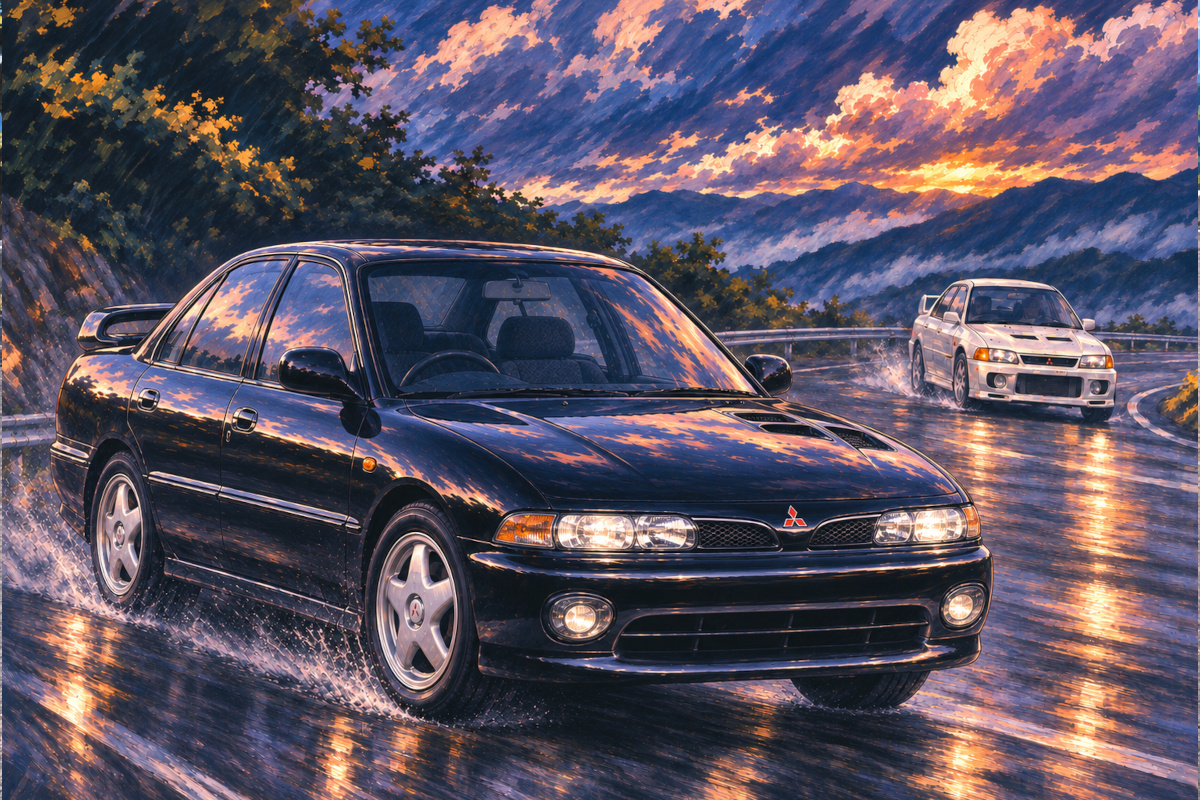
In 1992, Mitsubishi made a curious decision. Its rally-proven 4G63 turbo engine was moving into the new Lancer Evolution, but the Galant VR-4 wasn’t about to surrender its performance credentials.
The sixth-generation Galant VR-4 had won six rounds of the World Rally Championship (WRC). Its 2.0-liter turbocharged four-cylinder engine had become central to Mitsubishi’s rally program. When the seventh-generation Galant arrived in May 1992, however, the VR-4 badge was still there.
Under the hood was something entirely different: a newly developed 6A12 2.0-liter V6 twin-turbo producing 240 PS. Remarkably, that was exactly the same peak output as the outgoing Galant VR-4’s late-model five-speed manual version.
Why develop a new twin-turbo V6 just to retain 240 PS? And which technologies went to the Lancer Evolution while others remained with the Galant?
To find out, we compared three Japanese-market Mitsubishi performance sedans, examined their suspension systems and calculated their power-to-weight ratios. The results reveal two rather different approaches to building a fast four-wheel-drive car.
A New V6 Engine, Yet the Same 240 PS
When the seventh-generation Mitsubishi Galant arrived in May 1992, the engine lineup moved away from its previous emphasis on inline-four powerplants. The new generation placed 1.8-liter and 2.0-liter V6 engines at the center of its range.
The most powerful version was the Galant VR-4, equipped with the 6A12 engine: a 1,998 cc V6 with DOHC 24-valve cylinder heads, twin turbochargers and an intercooler.
In five-speed manual form, it produced 240 PS and 31.5 kg-m of peak torque (approximately 309 Nm).
According to Mitsubishi Motors’ corporate history, the 6A12 was the first engine in its displacement class to combine twin turbochargers with an intercooler. This was not a mild revision of the previous 4G63. It was a fundamentally different engine design.
There is an important qualification, though. The 240 PS figure belongs to the five-speed manual VR-4. The four-speed automatic version was rated at 215 PS. Not every seventh-generation VR-4 had the same maximum output.
On paper, the new manual VR-4 offered no more peak power than its predecessor. But replacing a turbocharged inline-four with a twin-turbocharged V6 involved much more than preserving a horsepower figure.
The new configuration may have offered Mitsubishi an opportunity to pursue smoother engine operation alongside strong performance. That is a reasonable interpretation of the change, not a conclusion established by directly comparable vibration measurements. We could not verify such test data.
The Galant Grew Wider. The Lancer Evolution Stayed Compact.
Here is where the story becomes more revealing.
We compared three domestic-market five-speed manual models: the late sixth-generation Galant VR-4, its seventh-generation replacement and the original Lancer Evolution GSR.
All three used turbocharged 2.0-liter engines and four-wheel drive, but their specifications tell very different stories.
| Specification | 6th-Gen Galant VR-4 1990 |
7th-Gen Galant VR-4 1992 |
Lancer Evolution I GSR 1992 |
|---|---|---|---|
| Engine | 4G63 | 6A12 | 4G63 |
| Configuration | Inline-four | V6 | Inline-four |
| Displacement | 1,997 cc | 1,998 cc | 1,997 cc |
| Peak output | 240 PS | 240 PS | 250 PS |
| Peak torque | 31.0 kg-m | 31.5 kg-m | 31.5 kg-m |
| Length | 4,560 mm | 4,630 mm | 4,310 mm |
| Width | 1,695 mm | 1,730 mm | 1,695 mm |
| Wheelbase | 2,600 mm | 2,635 mm | 2,500 mm |
| Curb weight | 1,410 kg | 1,430 kg | 1,240 kg |
| Power-to-weight ratio | 170.2 PS/t | 167.8 PS/t | 201.6 PS/t |
Comparison based on representative Japanese-market five-speed manual specifications. The sixth-generation VR-4 is the October 1990 version, the seventh-generation VR-4 is the May 1992 version, and the Lancer Evolution is the original GSR. Equipment and transmission choices can affect vehicle weight. Power-to-weight ratios were calculated independently by dividing rated output in PS by vehicle mass in metric tonnes.
The seventh-generation Galant was 70 mm longer, 35 mm wider and had a 35 mm longer wheelbase than its predecessor.
That extra width mattered particularly in Japan. The previous car measured 1,695 mm across, just inside the 1,700 mm width limit for the country’s smaller “5-number” passenger-car registration class. At 1,730 mm, the new Galant moved into the larger “3-number” classification.
These Japanese classifications are based on vehicle dimensions and engine displacement, rather than simply identifying luxury or performance models. Mitsubishi described the wider body as part of an effort to improve interior accommodation.
Meanwhile, the original Lancer Evolution remained 1,695 mm wide. Compared with the new Galant, it was 35 mm narrower and a substantial 320 mm shorter.
Now consider their weights and power outputs.
The seventh-generation Galant VR-4 produced 240 PS and weighed 1,430 kg. The first Lancer Evolution produced 250 PS while weighing just 1,240 kg.
Our calculations are:
Galant VR-4: 240 ÷ 1.430 = approximately 167.8 PS per tonne.
Lancer Evolution I: 250 ÷ 1.240 = approximately 201.6 PS per tonne.
Comparing those two results gives (201.6 ÷ 167.8 − 1) × 100, or approximately 20.1%.
The original Lancer Evolution therefore had a roughly 20.1% higher power-to-weight ratio than the contemporary Galant VR-4.
That does not mean it accelerated 20.1% faster, nor does it establish a corresponding difference in rally performance. These are calculations based on showroom specifications, not acceleration tests or Group A competition-car data.
What they do show is a striking difference in priorities: the Galant had become a larger performance sedan, while the Evolution concentrated its power in a shorter, lighter body.
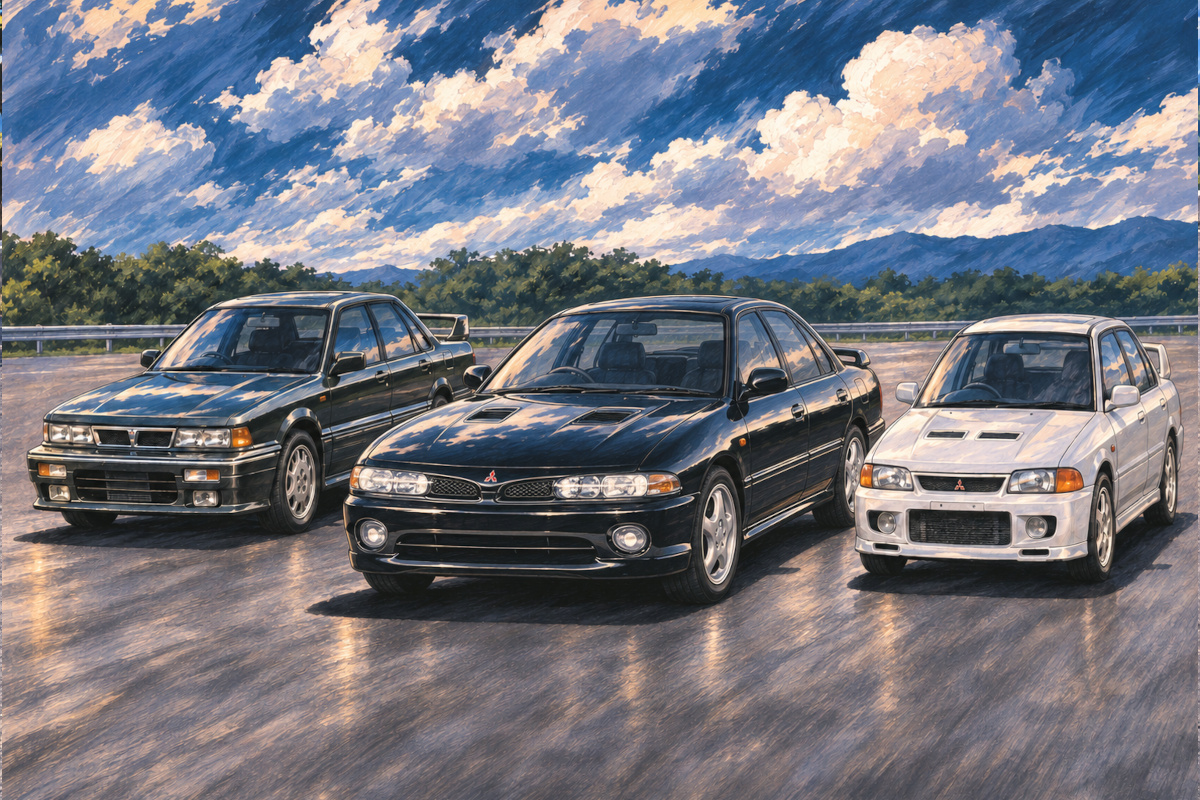
From left: 1990 sixth-generation Galant VR-4, 1992 seventh-generation Galant VR-4 and first-generation Lancer Evolution. AI-generated comparison illustration, not an exact scale drawing. Some exterior details differ from the production vehicles. Refer to the specification table for actual dimensions.
Both Made 240 PS, but Their Suspension Designs Were Different
The engine was not the only major change in the seventh-generation Galant.
Mitsubishi introduced multi-link suspension at both ends, pursuing a balance between handling stability and ride comfort.
Mitsubishi described the adoption of four-wheel multi-link suspension as a world first for a front-wheel-drive passenger car. The four-wheel-drive VR-4 also used multi-link suspension front and rear.
This was a substantial departure from the preceding VR-4, which used MacPherson struts at the front and a double-wishbone arrangement at the rear.
The original Lancer Evolution, by comparison, combined MacPherson struts at the front with multi-link suspension at the rear. Even these two Mitsubishi performance cars, launched in the same year, did not share identical suspension layouts.
Of course, the term “multi-link” alone does not prove that one vehicle handles better than another. Geometry, spring rates, damping and overall tuning all matter. What can be established is that Mitsubishi substantially revised the Galant’s suspension architecture.
At the same time, the company was expanding its use of electronic vehicle controls.
In April 1992, Mitsubishi announced INVECS, short for Intelligent & Innovative Vehicle Electronic Control System. Rather than one single component fitted to every car, INVECS was a family of control technologies covering functions such as fuzzy-logic automatic shifting, traction control, electronically controlled full-time 4WD, active four-wheel steering and electronically controlled suspension.
For example, the fuzzy-shift four-speed automatic transmission could adjust its shift behavior according to driving conditions such as gradients and corners.
Another technology, Active Preview ECS, used ultrasonic sensing of the road ahead as an input for suspension control. Such features were equipment-dependent; they were not all fitted as a complete package to every Galant or VR-4.
One further distinction matters when looking back at early-1990s Mitsubishi technology. INVECS-II, announced in September 1994, introduced a more advanced automatic-transmission control system capable of adapting to a driver’s habits and preferences. It should not be confused with the original INVECS announced in 1992.
While the Lancer Evolution took Mitsubishi’s rally-developed 4G63 and four-wheel-drive experience into a compact performance car, the Galant pursued a different combination: V6 power, multi-link suspension, a roomier body and increasingly sophisticated electronic controls.
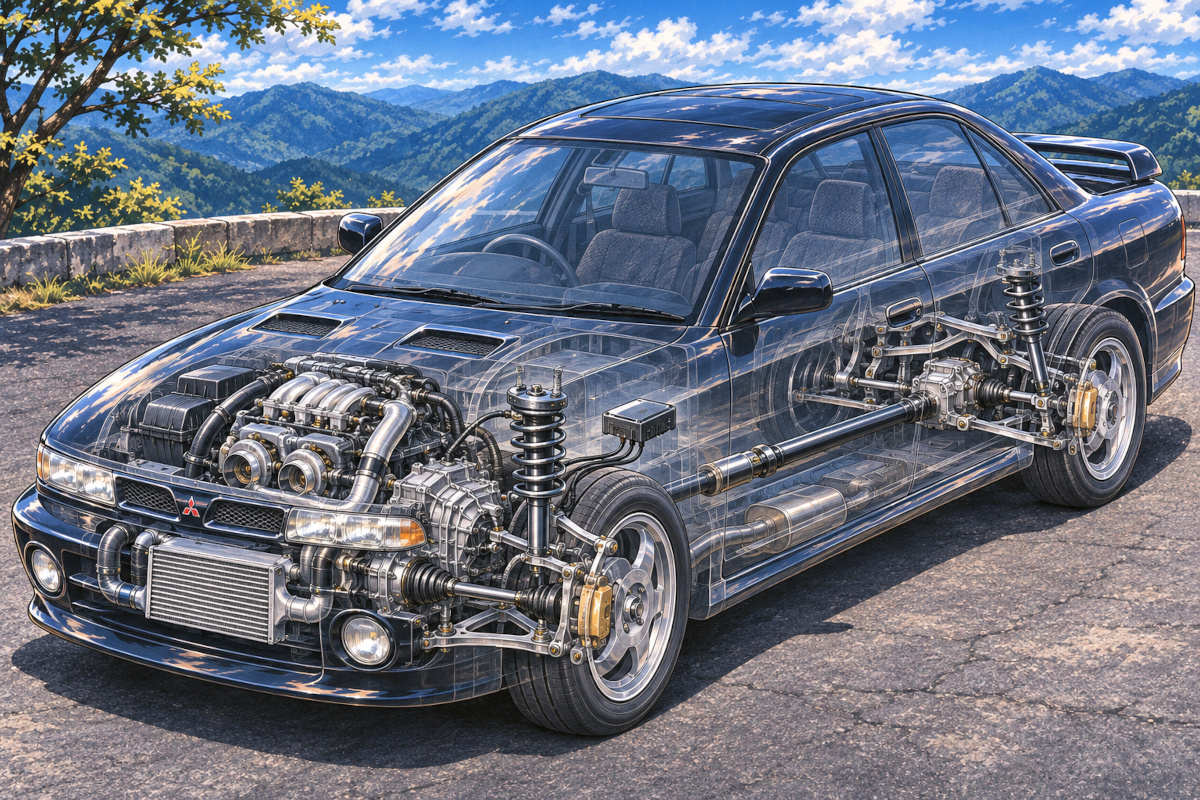
AI-generated conceptual illustration inspired by the 1992 Galant VR-4 and its V6 engine, four-wheel-drive system, multi-link suspension and electronic controls. Turbocharger plumbing, transmission components, drivetrain parts, suspension links and control-unit locations are simplified or stylized. This is not an accurate engineering drawing of the production vehicle.
Then Mitsubishi Built a 240 PS Galant With a Hatchback
Just when the Galant’s new direction seemed clear, Mitsubishi introduced an even stranger variation.
In August 1994, it launched the Galant Sports.
This was not merely a conventional Galant sedan with a spoiler bolted onto its trunk. It had a five-door body with a large rear hatch, roof rails and styling intended to combine sporting appeal with the recreational-vehicle tastes of the period.
The luggage compartment offered a maximum published capacity of 660 liters, measured using the VDA method. A 60:40 split-folding rear seat added flexibility for passengers and cargo.
The standard Galant Sports used a naturally aspirated 2.0-liter engine and front-wheel drive. But Mitsubishi also offered the Galant Sports GT, with full-time four-wheel drive and the 6A12 V6 twin-turbo.
In five-speed manual form, the Sports GT produced the same 240 PS as the Galant VR-4.
Yes, Mitsubishi put its 240 PS twin-turbo V6 into a practical five-door car with a large luggage opening.
That combination says a great deal about the Galant’s changing role. The Lancer Evolution was developing its identity as the company’s rally-focused performance model, while the Galant family was exploring ways to combine speed, passenger comfort and everyday usefulness.
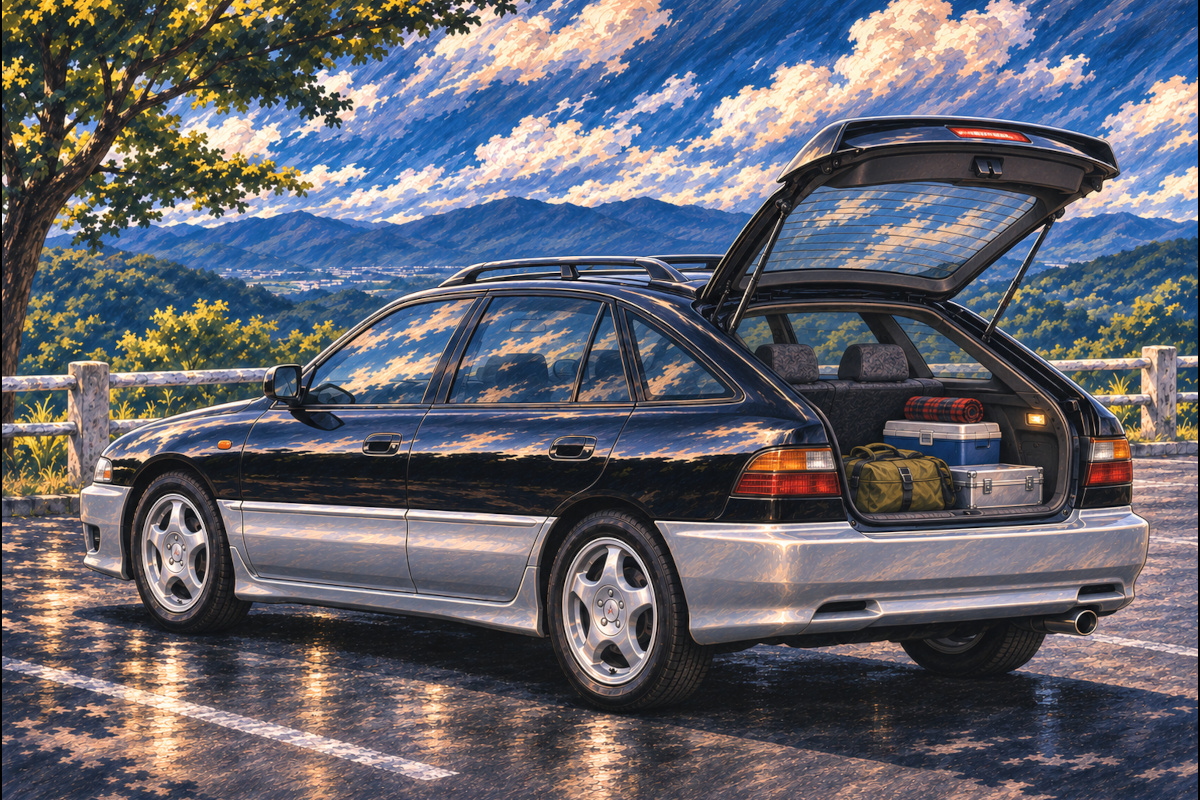
AI-generated illustration inspired by the 1994 Galant Sports GT (E74A), emphasizing its five-door body and cargo-carrying practicality. Details including the rear hatch angle, taillights, rear spoiler and exhaust arrangement differ in places from the actual production car.
By 1996, the Galant Had Taken Another Step
Between 1992 and 1996, the Galant’s identity expanded considerably.
Its rally-leading role had passed to the Lancer Evolution, but the Galant itself gained a twin-turbocharged V6, a wider body, four-wheel multi-link suspension, more advanced electronic systems and even a practical five-door offshoot.
Comparing the 1992 Galant VR-4 with the original Lancer Evolution shows how differently Mitsubishi approached two cars built around turbocharged 2.0-liter engines and four-wheel drive.
There is an important limit to this interpretation. We could not verify internal development-meeting records that directly explain how Mitsubishi executives decided to divide performance technologies and market roles between the two models.
The idea of two distinct development directions is therefore our editorial interpretation of Mitsubishi’s published model histories, product descriptions and vehicle specifications—not a documented quotation from the company’s decision-makers.
In August 1996, the eighth-generation Galant took another step. Its VR-4 adopted the 6A13, a 2.5-liter twin-turbocharged V6 producing 280 PS.
The Galant’s high-performance story was far from over. It was simply moving into a different chapter.
Editor’s Note
The question that originally bothered me was simple: once the Lancer Evolution inherited the 4G63, what on earth was left for the Galant VR-4?
I half expected Mitsubishi to hand over the performance crown and turn the Galant into a more ordinary sedan. Instead, the engineers developed an entirely different V6 twin-turbo engine and kept the output at 240 PS. They certainly weren’t taking the easy way out.
Then I put the 1992 Galant and the first Evolution side by side. The Galant had grown wider and longer, while the Evo was shorter and lighter. Calculate their power-to-weight ratios and the difference comes out at roughly 20%. Suddenly, the distinction between the two cars becomes much clearer.
And then there’s the Galant Sports GT. A 240 PS twin-turbo V6 in a practical five-door body with room for luggage? Is it a family car, a performance sedan or an enthusiast’s oddball? Apparently, Mitsubishi saw no reason it couldn’t be a bit of everything.
That’s what I find most entertaining about this period. Mitsubishi didn’t simply give the Evolution all the interesting hardware and leave the Galant behind. It kept developing the Galant as a performance car in its own right, with a different set of priorities.
For a sedan that could easily have slipped into a supporting role, the Galant was remarkably determined to stay in the spotlight.
Next in the series: the eighth-generation Galant, introduced in 1996. Its 280 PS VR-4 shared the spotlight with Mitsubishi’s pioneering mass-produced GDI engine technology—a particularly ambitious period for the company’s engineers.
Mitsubishi Galant: Seven-Part History Series
From the original Colt Galant and the Galant Sigma to the rally-winning VR-4, GDI technology, and the end of the Galant name. Across seven articles, we explore the cars, engineering, motorsport history, and legacy of one of Mitsubishi's defining model lines.
- Part 1: The Colt Galant Came Before Mitsubishi Motors—and Led to the GTO and FTO (Part 1)
- Part 2: The Galant Sigma Was a Hit—So Why Did Mitsubishi Abandon RWD? (Part 2)
- Part 3: The Galant VR-4 Won Six WRC Rallies. Why Did Mitsubishi Replace It? (Part 3)
- Part 4: The Evo Got the 4G63—So Why Did the Galant VR-4 Still Make 240 PS? (Part 4)
- Part 5: Mitsubishi’s “Engine of the 21st Century”: Did GDI Really Deliver 35% Better Fuel Economy? And Why Was There a 280 PS VR-4? Coming soon
- Part 6: Why Were There Two Different Mitsubishi Galants—and Two Different RALLIARTs? Coming soon
- Final Part: English edition Coming soon
Terms That May Need a Quick Explanation
- Multi-link suspension
- A suspension layout that uses multiple links or arms to control wheel movement. It offers engineers considerable flexibility when designing wheel geometry and handling characteristics, but actual performance still depends on the specific layout and tuning.
References
- Mitsubishi Motors, “Vehicle History” (Japanese) — Official model history covering the 1992 Galant’s wider body, four-wheel multi-link suspension, INVECS, the 1994 Galant Sports and the 1996 eighth-generation Galant.
- Mitsubishi Motors, “Company History” (Japanese) — Official records of the 6A12 twin-turbo V6, the original INVECS system announced in 1992 and INVECS-II announced in 1994.
- Mitsubishi Motors, “World Rally Championship, 1988–1992” (Japanese) — Official account of the earlier Galant VR-4’s six WRC victories and the development of Mitsubishi’s rally four-wheel-drive technology.
- GAZOO, “Mitsubishi Galant VR-4, October 1990, 5MT” (Japanese) — Source for the previous-generation 4G63 engine, 240 PS output, 1,410 kg vehicle weight and body dimensions.
- GAZOO, “Mitsubishi Galant VR-4, May 1992, 5MT” (Japanese) — Source for the 6A12 engine, 240 PS output, 1,430 kg vehicle weight, dimensions and front/rear multi-link suspension.
- GAZOO, “Mitsubishi Galant VR-4, May 1992, 4AT” (Japanese) — Confirms the automatic model’s 215 PS output, fuzzy-shift four-speed automatic transmission and 1,460 kg vehicle weight.
- GAZOO, “Mitsubishi Lancer GSR Evolution, 1992” (Japanese) — Source for the original Evolution’s 4G63 engine, 250 PS, 1,240 kg vehicle weight, dimensions and suspension arrangement.
- GAZOO, “Mitsubishi Galant Sports, August 1994” (Japanese) — Documents the five-door body, maximum 660-liter luggage capacity, split-folding seats and the Sports GT’s V6 twin-turbo engine and transmission-dependent outputs.