

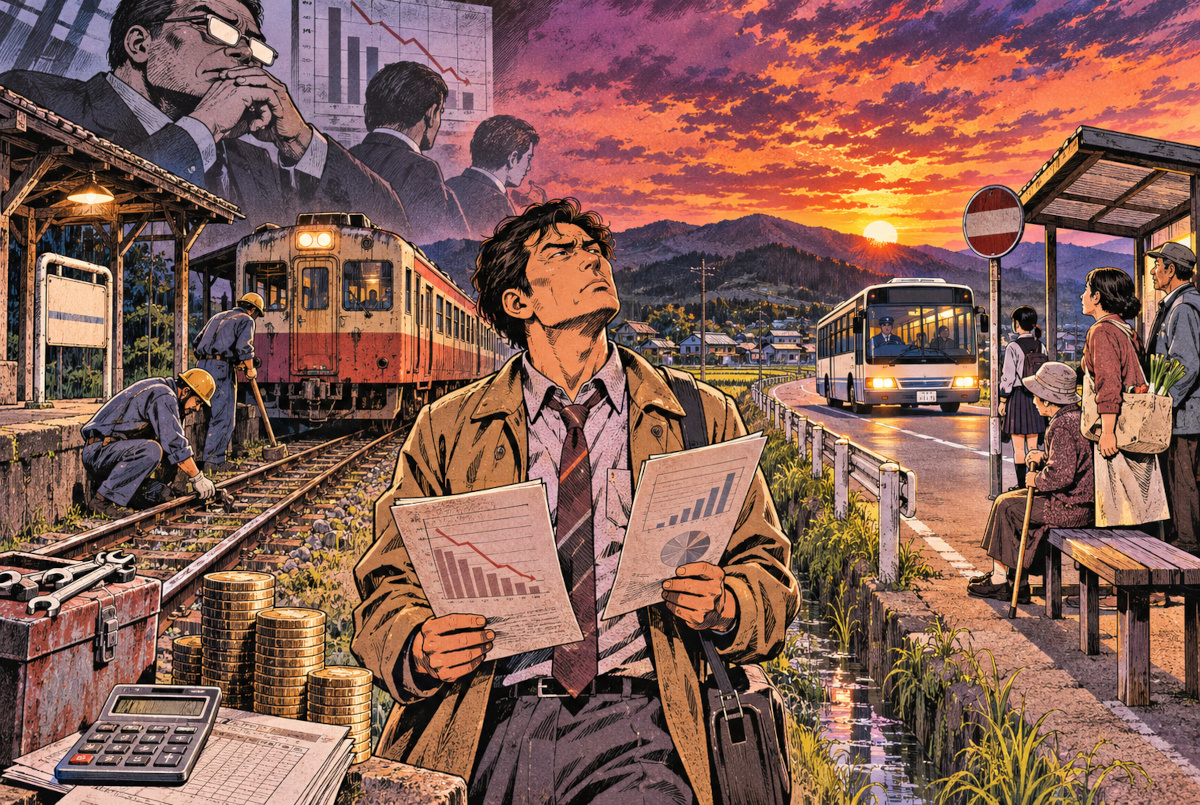
A money-losing railway in rural Japan might seem like someone else’s problem. But closing a railway does not make the people who depend on it disappear. Someone still has to pay for their buses. Roads still need maintenance. And before pulling up the tracks, shouldn’t we ask whether the railway company did everything reasonably possible to attract passengers?
Consider JR East’s Kururi Line in Chiba Prefecture, southeast of Tokyo. One short section reported an annual operating deficit of nearly ¥200 million. Yet JR East has agreed to contribute ¥2 billion toward 18 years of replacement transport.
Those figures cover different periods and represent different kinds of costs. So rather than declaring railway closure either a brilliant saving or a terrible mistake, we went through the railway company’s figures, government bus statistics, and local transport plans to see what the numbers actually tell us.
A Railway That Spends ¥6,694 to Earn ¥100
The section in question runs just 9.6 kilometers (6 miles), between Kururi and Kazusa-Kameyama stations. According to JR East’s published figures for fiscal 2024, its financial performance was as follows:
| Fiscal 2024 financial results | Amount |
|---|---|
| Passenger transport revenue | ¥3 million |
| Operating expenses | ¥202 million |
| Operating deficit | ¥199 million |
Passenger revenue covered just 1.5% of operating expenses. JR East also reported an operating coefficient of 6,694. In plain English, the railway spent approximately ¥6,694 for every ¥100 it earned from passenger transport. That is not a minor financial problem.
The section’s average daily passenger density was only 76 in fiscal 2024. This does not mean exactly 76 people boarded the trains each day. It is a distance-weighted measure of passenger traffic across the route.
Meanwhile, the combined population of the Kururi, Matsuoka, and Kameyama districts fell from 10,835 in 1995 to 6,275 in 2020, a decline of approximately 42%.
Keeping a railway running under those conditions is undeniably difficult. But does removing it automatically produce an equivalent saving for the community?
How Much Would Closing the Railway Actually Save?
On February 16, 2026, JR East and Kimitsu City reached a basic agreement covering replacement transport for the section scheduled to close. JR East committed ¥2 billion to fund 18 years of bus-based and other road transport services.
Dividing ¥2 billion equally across 18 years gives approximately ¥111.11 million per year. That is about ¥87.89 million less than the railway’s reported annual deficit of ¥199 million.
Tempting conclusion: close the railway and save nearly ¥88 million every year.
Except that the calculation does not establish such a saving.
JR East’s published railway deficit is an accounting estimate based on specified assumptions and allocated expenses. The ¥2 billion, by contrast, is an agreed financial contribution toward a different transport system. Neither figure tells us exactly which railway costs will disappear after closure or what replacement transport will ultimately cost.
So we tried another approach: estimating the bus operation from the available transport plans and national cost data.
A 2025 proposal from Kimitsu City envisaged 13 round trips per day, with routes measuring approximately 12.5 to 16.5 kilometers one way.
If all 13 round trips operated every day of the year, that would mean:
13 × 2 × 365 = 9,490 one-way journeys annually.
At the stated route lengths, annual vehicle mileage would range from approximately 118,625 to 156,585 kilometers.
Japan’s Ministry of Land, Infrastructure, Transport and Tourism (MLIT) reported an average operating cost of ¥604.07 per actual vehicle-kilometer for regular bus services in fiscal 2024.
Applying that national figure to our estimated mileage produces approximately ¥71.66 million to ¥94.59 million per year.
That is our own simplified estimate, not Kimitsu City’s official operating budget. The national figure covers bus operators with fleets of at least 30 vehicles. Our calculation also assumes daily operation of every proposed service and does not reproduce the actual timetable, deadhead mileage, contract arrangements, or local operating conditions.
Nevertheless, it offers a useful benchmark: replacing this lightly used railway with buses could substantially reduce the direct cost of providing transport. The precise amount remains unproven.
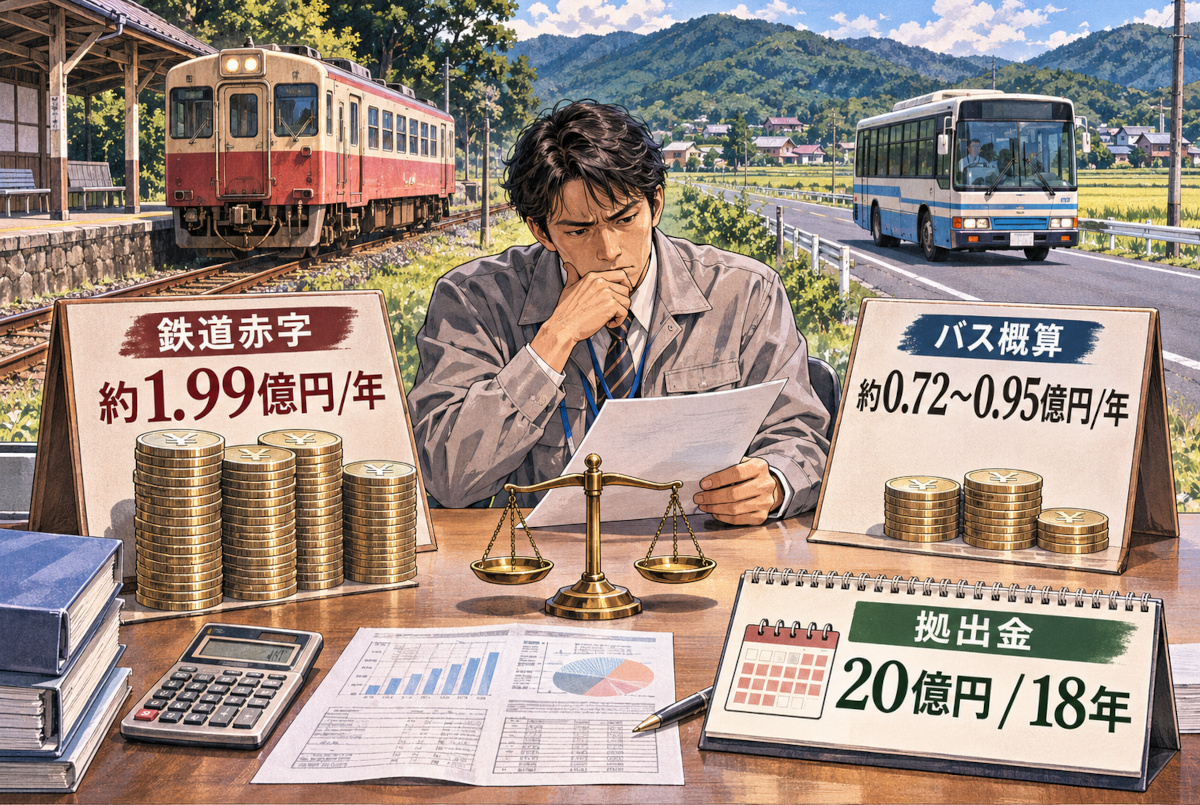
AI-generated cost comparison illustration. The railway figure is JR East’s reported fiscal 2024 operating deficit; the bus figure is our estimate based on a proposed service plan and national average costs. The ¥2 billion contribution covers 18 years. These figures represent different accounting categories and time periods, not a directly measurable saving. The vehicles and scenery are illustrative, not depictions of the actual railway or bus service.
Railway Tracks Cost Money. But Are Roads Free?
Railway operators must maintain their own tracks, signaling systems, crossings, bridges, and other infrastructure. Buses generally use roads that already exist, avoiding much of that railway-specific burden.
But roads are not free. They require public spending on maintenance, and new bus services may need additional stops, turning areas, or passenger facilities.
That does not mean the full cost of maintaining an existing road should be charged to a replacement bus. Other vehicles would continue using that road even if the bus service disappeared.
The meaningful question is how much additional expenditure the shift from railway to road transport would create.
There is another complication. JR East has stated that it will continue managing the land and assets of the discontinued section after the railway closes.
Closing the line does not instantly eliminate every railway-related expense.
Based on the public information reviewed, we could not establish a reliable net saving for the community after accounting for additional road costs and the continuing management of former railway assets.
Could Railway Fans Save the Line by Spending More?
Now for a less conventional question. Could railway enthusiasts, special train experiences, and local tourism help turn the financial situation around?
The Kururi Line runs through an area with historic Kururi Castle Town, Lake Kameyama, and attractive rural scenery. There are obvious possibilities for photography trips, themed train journeys, local food, and regional tourism.
JR East has not ignored those opportunities. It has promoted special services featuring local sake, including the Kururi Shinshu Festival Kakuuchi Train. A March 2025 service operated between Kisarazu and Kururi, outside the 9.6-kilometer section scheduled for closure.
In September 2026, the company also advertised a special railway experience covering the entire Kururi Line, with standard tickets priced at ¥15,000 and premium tickets at ¥25,000 per person. The event was scheduled for October 17, 2026, but was ultimately canceled.
Still, the advertised prices give us something interesting to calculate.
Suppose the railway tried to cover its ¥199 million annual deficit entirely through ¥15,000 experience tickets.
¥199,000,000 ÷ ¥15,000 = approximately 13,267 paying participants.
That is equivalent to roughly 36 participants every day of the year.
And here is where the numbers become more revealing.
The advertised special experience had capacity for 38 standard-ticket holders and two premium-ticket holders. Even with every place sold, the maximum ticket revenue for one event would have been:
| Ticket category | Maximum revenue |
|---|---|
| 38 standard tickets × ¥15,000 | ¥570,000 |
| 2 premium tickets × ¥25,000 | ¥50,000 |
| Total at full capacity | ¥620,000 |
At that rate, matching the annual deficit would require the equivalent of approximately 321 completely sold-out events.
This is deliberately a revenue-only calculation. It ignores staffing, special train operations, administration, and all other event expenses. Nor would every yen generated by a whole-line railway experience necessarily be attributable to the short section facing closure. The calculation does not imply that 321 such events could realistically be organized.
Still, it illustrates the enormous gap between a promising enthusiast product and the finances of maintaining a railway.
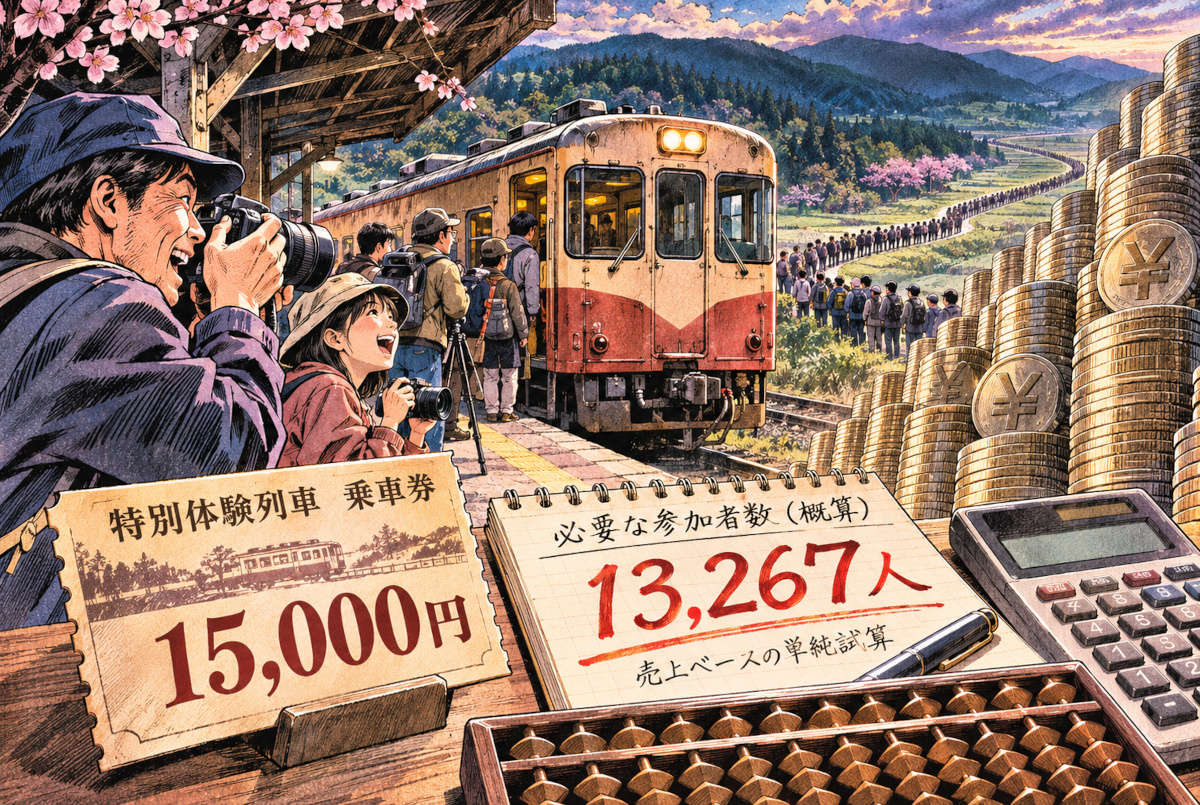
AI-generated conceptual illustration, not a photograph or record of an actual event. The ¥15,000 price was advertised for a special JR East railway experience scheduled for October 17, 2026; that event was canceled. The figure of 13,267 represents a hypothetical revenue-only calculation, not actual attendance or profit. The train, season, and scenery are illustrative.
Chiba Prefecture’s regional transport review also discussed ideas for combining railway infrastructure with local tourist attractions to develop new visitor experiences.
But how many extra passengers did such initiatives actually attract? How much additional railway revenue did they produce?
The materials reviewed do not provide enough evidence to measure their overall commercial impact reliably.
That distinction matters. Holding an event is one achievement; demonstrating that it improves the railway’s finances is another.
Spending by visitors in local shops and restaurants may benefit the regional economy, but it should not be confused with fare revenue earned by the railway operator.
What If People Stopped Riding Because the Trains Became Too Infrequent?
Residents have also raised a different concern: the service itself was not particularly convenient.
Public consultation records include complaints about gaps of more than five hours between daytime trains and schedules that did not suit students, leaving parents to provide rides.
That raises the possibility of a vicious circle: fewer trains make the railway less useful, falling passenger numbers encourage further service reductions, and still fewer people choose to ride.
Of course, increasing train frequency would also increase operating expenses. There is no guarantee that enough passengers would return to justify the additional cost.
The proposed bus network offers potential advantages, including more frequent departures than the existing rail service, connections to schools, and relatively low fares. For someone trying to reach a hospital, school, or supermarket, practical mobility may matter more than whether the vehicle runs on rails.
But buses have a serious vulnerability of their own: Japan’s shortage of professional drivers. Across the country, bus services have faced reductions and closures. Funding a service is only half the problem if there are not enough qualified people to operate it.
The Kururi–Kazusa-Kameyama railway section is scheduled to close on April 1, 2027. After Typhoon No. 25 damaged the line in 2026, JR East announced on October 23 that it would not restore railway operations on the affected section.
Importantly, the decision to replace the railway had already been made before the typhoon damage. The storm affected the restoration decision; it was not the original reason for the planned closure.
Editor’s Note
I understand why a railway company would want to shut down a line that loses nearly ¥200 million a year. That is a genuine financial problem, not something railway enthusiasts can simply wish away.
And I am not convinced that spending millions to keep almost-empty trains running is automatically the right answer either.
What bothers me is how often the discussion begins and ends with the railway company’s reported loss.
If enthusiasts are willing to pay ¥15,000 or even ¥25,000 for a special experience, surely there is a business worth investigating. Could tourism, recurring events, and better connections with local attractions have been developed into something more substantial? Perhaps. But I would like to see the actual results, not just a collection of promotional announcements.
If the numbers still do not work, replacing the railway with buses may well be the sensible decision. Yet that leaves other questions: Who pays for the buses after the funding arrangement ends? Can enough drivers be hired? Will residents really find the new service more convenient?
Removing a railway deficit from a company’s accounts does not make a community’s transport problems disappear.
Even people who have never set foot on the Kururi Line should care about that distinction. Across Japan, similar decisions affect municipal budgets and the public services that compete for limited resources.
In the end, that is what I want to know: not merely whether closing the railway saves the operator money, but whether the entire community actually comes out ahead.
Terms That May Need a Quick Explanation
- Average Daily Passenger Density
- A Japanese railway statistic calculated by dividing passenger-kilometers by route length and the number of days in the period. It indicates the average number of passengers carried across a route per day, rather than the total number of individual boardings.
References
- JR East, Financial Information for Low-Usage Railway Sections, Fiscal 2024 (October 27, 2025; Japanese-language PDF). Source for passenger revenue, operating expenses, deficit, operating coefficient, and passenger density.
- JR East, Basic Agreement on Funding Replacement Transport for the Planned Kururi Line Closure (February 17, 2026; Japanese-language PDF). Source for the ¥2 billion contribution over 18 years and continuing asset management.
- Chiba Prefecture, Kururi Line Regional Transport Review Committee: Final Report (October 28, 2024; Japanese-language PDF). Source for population trends, residents’ transport needs, and regional tourism proposals.
- Kimitsu City, First Regional Public Transport Council Meeting Materials, Fiscal 2025 (June 2025; Japanese-language PDF). Includes the proposed replacement bus service plan used in our mileage estimate.
- Kimitsu City, Fourth Regional Public Transport Council Meeting Materials, Fiscal 2025 (March 2026; Japanese-language PDF). Replacement transport planning materials.
- Ministry of Land, Infrastructure, Transport and Tourism, Financial Performance of Regular Bus Operators, Fiscal 2024 (Japanese-language PDF). Source for the national average operating cost of ¥604.07 per vehicle-kilometer.
- JR East JRE Media, Kururi Line Sake Tasting Train for the Kururi Shinshu Festival (January 27, 2025; Japanese). Example of an existing tourism initiative.
- JR East JRE Media, Special Kururi Line Train Ride and Photography Experiences (updated September 10, 2026; Japanese). Source for the advertised ¥15,000 and ¥25,000 ticket prices.
- JR East JRE MALL Ticket, Boso Railway: Autumn Journey to the Kururi Line Terminus (Japanese). Official booking listing confirming the event capacity and cancellation.
- Kimitsu City, JR East’s Announcement on Restoration of the Uchibo and Kururi Lines (October 23, 2026; Japanese). Official information on typhoon damage and the decision not to restore railway operations.