
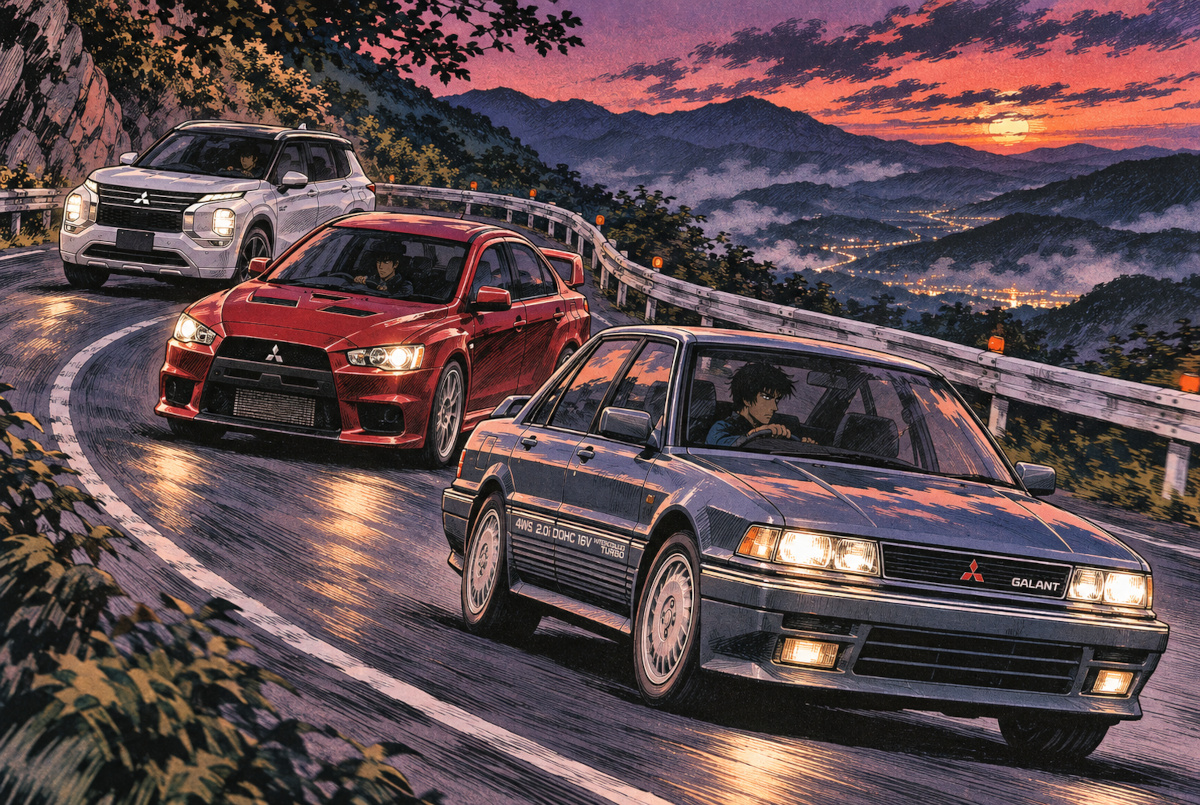
In March 2015, Mitsubishi ended production of the Galant Fortis for the Japanese market. The same year also brought the Lancer Evolution Final Edition, marking the end of the company’s celebrated performance-sedan line.
For enthusiasts who grew up with Mitsubishi’s turbocharged, all-wheel-drive sedans, it felt like the end of an era. But did the technology behind those cars disappear along with their badges?
Take a look at the Outlander PHEV in 2026. Its front and rear wheels are driven by separate electric motors, while the braking system also helps control how the vehicle turns. The technology coordinating these actions is called S-AWC—Super All Wheel Control.
That name should sound familiar. The Lancer Evolution X used S-AWC too.
The Galant VR-4’s twin-turbo V6 is gone. So is its GDI engine. Yet the idea of making a car turn precisely where the driver wants it to go may still be alive inside a plug-in hybrid SUV. Is that really the case?
To find out, we traced Mitsubishi’s S-AWC history through original manufacturer documents, compared the hardware across generations, and checked the Outlander PHEV’s published specifications. The interesting part isn’t simply what survived. It’s what didn’t.
The 1987 Galant VR-4 Was About More Than Four-Wheel Drive
To understand the Outlander PHEV, we first need to return to 1987.
That year, Mitsubishi introduced the sixth-generation Galant, including the high-performance VR-4. It featured a collection of technologies known as ACTIVE FOUR.
Four-wheel drive was only part of the package. The system concept also included four-wheel steering (4WS), four-wheel independent suspension (4IS), and four-wheel anti-lock brakes. Mitsubishi was trying to improve acceleration, cornering, braking, and stability as a coordinated package.
In its official retrospective on the development of all-wheel control, Mitsubishi identifies the 1987 Galant VR-4’s ACTIVE FOUR as a starting point for the philosophy it calls AWC, or All Wheel Control.
That is a significant connection. It also needs to be understood carefully.
The Galant’s original 4WS system was not the same thing as the AYC technology Mitsubishi introduced later.
Four-wheel steering physically changes the direction of the rear wheels. Active Yaw Control (AYC), on the other hand, uses differences in driving force between the left and right wheels to generate a yaw moment, helping the vehicle rotate through a corner.
The first production application of AYC came with the Lancer Evolution IV in August 1996. Some versions of the eighth-generation Galant and its Legnum wagon counterpart also received AYC.
In other words, it would be wrong to suggest that the Galant invented a specific AYC unit and simply handed it over to the Lancer Evolution. Mitsubishi was developing a broader family of vehicle-control technologies and applying them to different performance models.
The connection was in the engineering objective, not in the continued use of one unchanged piece of hardware.
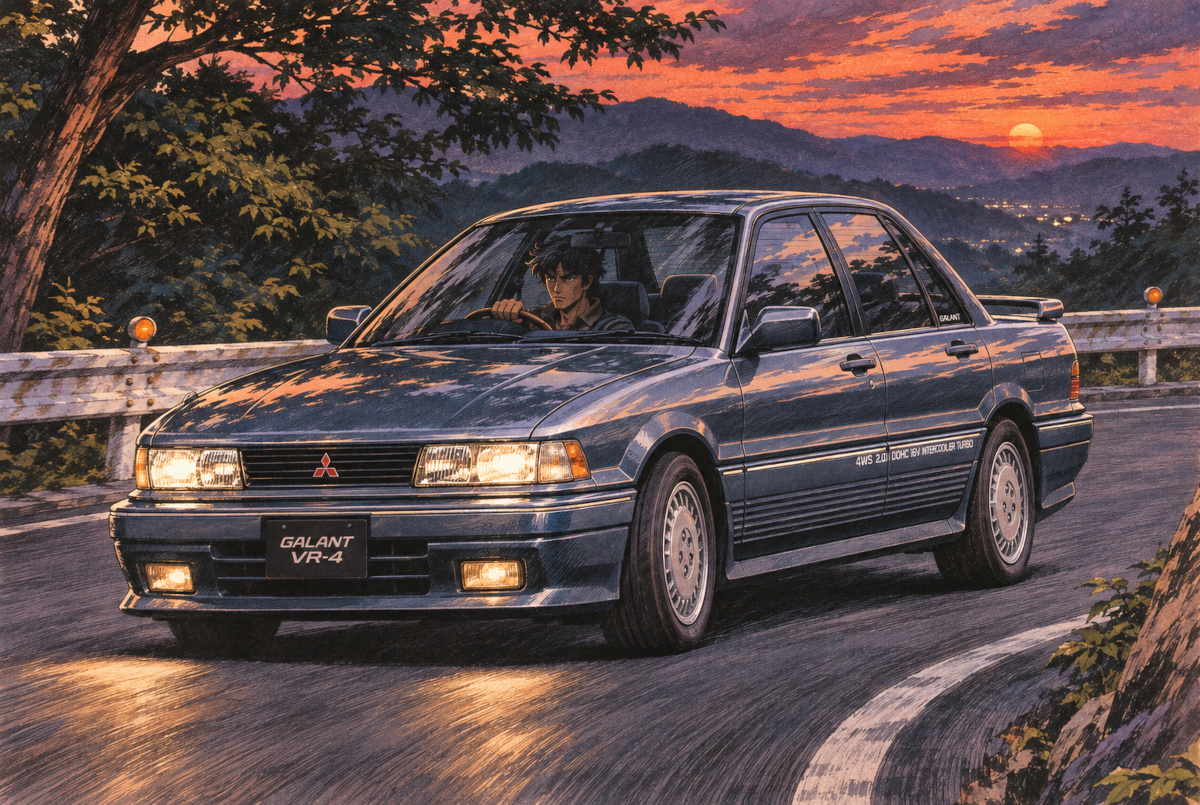 An illustration of the 1987 sixth-generation Galant VR-4, whose ACTIVE FOUR concept combined technologies including four-wheel drive and four-wheel steering to improve handling and stability. Exterior details and the driving scene have been artistically reconstructed rather than reproduced as an exact factory specification. AI-generated editorial illustration.
In 2007, the Lancer Evolution X Turned S-AWC into an Integrated System
In October 2007, Mitsubishi launched the Lancer Evolution X in Japan. This was the first production model to feature S-AWC (Super All Wheel Control).
The system integrated several technologies that had developed over the preceding years.
Super AYC controlled differences in driving force between the rear wheels. The Active Center Differential (ACD) managed the behavior of the center differential and the distribution of driving force between the front and rear axles. Active Stability Control (ASC) and Sport ABS added further vehicle-stability and braking functions.
The objective was no longer simply to put more power through all four wheels. Mitsubishi wanted the drivetrain and braking systems to work together so that the car would respond more naturally to steering inputs while maintaining stability.
To see how the philosophy developed, we can compare the principal systems across five milestones.
| Year and vehicle | Main technology | What was controlled? |
|---|---|---|
| 1987 Galant VR-4 |
ACTIVE FOUR | Combined 4WD, 4WS, ABS and other chassis technologies |
| 1996 Lancer Evolution IV / eighth-generation Galant family |
AYC | Differences in left-right rear-wheel driving force to influence cornering |
| 2007 Lancer Evolution X |
S-AWC | Integrated front-rear drive control, left-right torque control and braking |
| 2013 Outlander PHEV |
Twin Motor 4WD + S-AWC | Front and rear electric-motor outputs combined with braking control |
| 2021 onward New-generation Outlander PHEV |
Further-developed S-AWC | Front-rear motor control and expanded brake-based AYC functions |
Editorial comparison based on Mitsubishi Motors’ official technology history and vehicle announcements. This table simplifies each system’s principal functions. It does not imply that the mechanical components or control mechanisms remained identical between generations. AYC was not fitted to every 1996 Galant.
The progression wasn’t simply from a less powerful engine to a more powerful one. Mitsubishi was also changing how it used the available grip at each tire to control the movement of the entire vehicle.
That distinction becomes especially important once electric motors enter the picture.
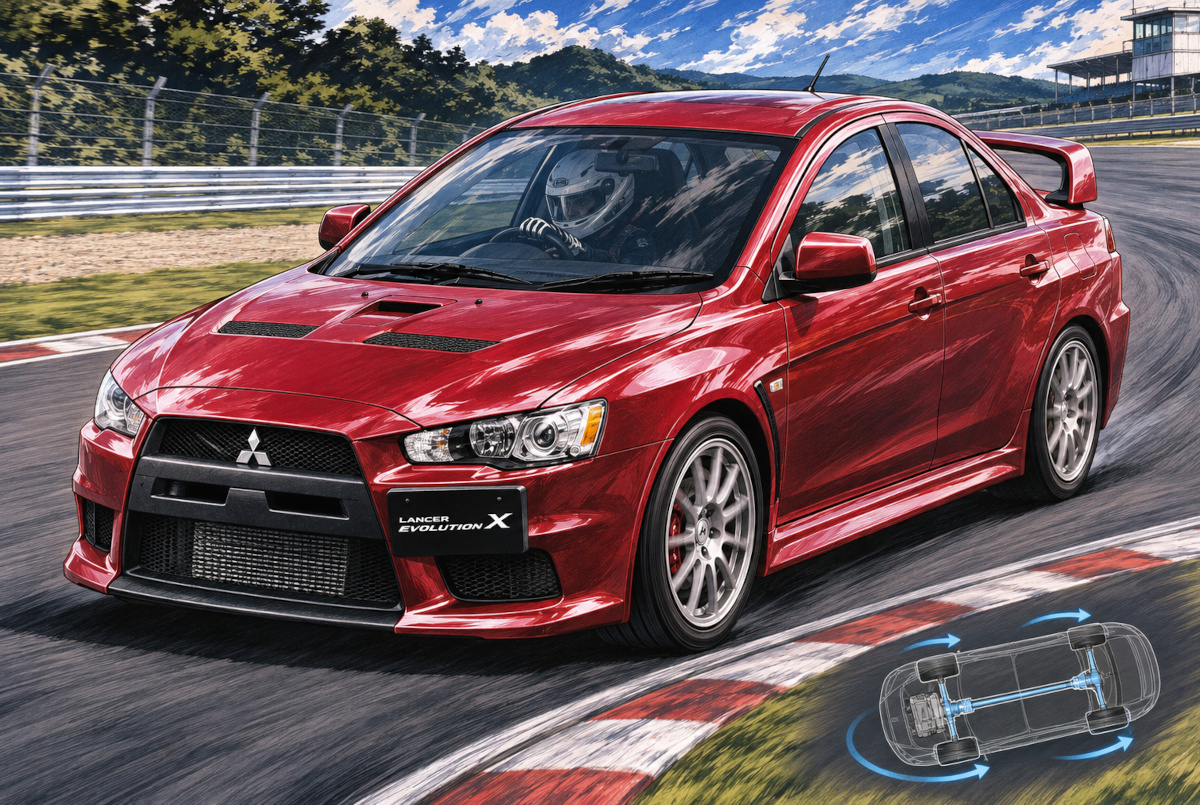 Introduced in 2007, the Lancer Evolution X combined front-rear drivetrain control, left-right torque management and braking functions through S-AWC. The small diagram and arrows illustrate the general control concept, not the exact layout of mechanical components or measured torque distribution. AI-generated editorial illustration.
In 2013, Mitsubishi Began Replacing Mechanical AWD Connections with Motors
Here’s a detail that often gets lost when people talk about the end of the Lancer Evolution.
Mitsubishi launched the Outlander PHEV in Japan in January 2013, while the Evolution X was still in production. Electrified all-wheel-drive development did not begin only after the famous performance sedan disappeared.
The two engineering paths overlapped.
In the Evolution X, engine power reached the front and rear axles through a mechanically connected drivetrain, including a propeller shaft and center differential system.
The Outlander PHEV took a different approach. It used separate electric drive motors at the front and rear, with their outputs coordinated electronically.
There was no conventional front-to-rear drive propeller shaft transferring engine torque between the axles.
The distinction became more pronounced with the new-generation Outlander PHEV introduced in 2021. Its brake-based AYC system expanded from control centered on the front wheels to coordinated braking control involving both front and rear wheels.
That doesn’t mean the modern SUV has the same Super AYC rear differential as a Lancer Evolution X.
Instead, the Outlander PHEV combines front and rear electric-motor output control with brake-based vehicle-motion control. The mechanical arrangement is different, even though both vehicles are pursuing a similar handling objective.
What survived was not the original hardware. It was the ambition to coordinate the forces acting at all four wheels so the vehicle could turn and remain stable in a predictable way.
98 kW + 85 kW + 100 kW: Does That Make the Outlander PHEV a 385 PS SUV?
While examining the modern Outlander PHEV’s specifications, I came across the sort of figures that can send a car enthusiast straight for a calculator.
For the Japanese-market Outlander PHEV in 2026, Mitsubishi lists a 2.4-liter gasoline engine producing 98 kW. The front electric motor is rated at 85 kW, while the rear motor is rated at 100 kW.
| Power source | Maximum output | Maximum torque |
|---|---|---|
| 2.4L gasoline engine | 98 kW | 195 N·m |
| Front electric motor | 85 kW | 255 N·m |
| Rear electric motor | 100 kW | 195 N·m |
Source: Mitsubishi Motors’ published Japanese-market GN0W Outlander PHEV specifications. These figures describe the maximum output and torque of individual power sources, not the vehicle’s combined system output. PS refers to metric horsepower, which is not numerically identical to the mechanical horsepower unit commonly abbreviated hp.
Now for the tempting calculation:
98 + 85 + 100 = 283 kW.
Converting 283 kW to metric horsepower gives approximately 385 PS.
That’s more than 100 PS above the 280 PS rating of the 1996 Galant VR-4’s 2.5-liter twin-turbo V6.
So can we say the Outlander PHEV is a 385 PS vehicle?
No. That would be a misleading claim. Adding the three individual maximum-output figures does not establish the PHEV’s actual maximum system output.
For a start, the gasoline engine and electric motors reach their individual maximum outputs under different operating conditions. Battery output, energy management and drivetrain operation also determine how much power can be delivered at any given moment.
There’s another complication: the Outlander PHEV operates in three different driving modes.
In EV mode, the electric motors drive the vehicle using battery power. In Series Hybrid mode, the engine generates electricity while the motors provide propulsion. In Parallel Hybrid mode, the engine can also contribute mechanical driving force, alongside the electric-motor system.
The gasoline engine is not continuously delivering its full rated output directly to the wheels in every mode.
The same caution applies to torque. Simply adding 195, 255 and 195 N·m would ignore the different rotational speeds, reduction ratios and paths through which torque reaches the wheels.
In other words, an old-fashioned engine rating of 280 PS and a calculated sum of three PHEV power-source ratings are not directly comparable measures of vehicle performance.
It’s an easy numerical trap—and precisely the kind of one worth checking before making a grand horsepower claim.
The Outlander PHEV Did Not Inherit the Galant’s Original GDI Engine
Now consider another famous chapter in the Galant story: Mitsubishi’s early gasoline direct-injection technology.
The 1996 Galant’s 4G93 GDI engine injected gasoline directly into the combustion chamber. It was one of Mitsubishi’s most ambitious attempts to improve gasoline-engine efficiency through advanced combustion control.
The current Outlander PHEV uses a different approach.
Its 2.4-liter 4B12 gasoline engine is identified in Mitsubishi’s official specifications as using ECI-MULTI electronic fuel injection, rather than the old 4G93 GDI direct-injection arrangement.
So it would be inaccurate to claim that the original Galant GDI combustion system survived unchanged inside the Outlander PHEV.
Both were developed in the pursuit of efficiency, but the engineering methods were different.
And the electrified SUV has made measurable progress of its own.
The Battery Grew 13.5%, but Electric Range Rose 21.8%
Mitsubishi’s October 2024 update to the Outlander PHEV increased traction-battery capacity from 20.0 kWh to 22.7 kWh.
For the Japanese-market M trim, the published WLTC-mode electric driving range increased from 87 km to 106 km.
Those two improvements aren’t the same percentage.
Battery capacity increased by:
(22.7 – 20.0) ÷ 20.0 × 100 = 13.5%.
Electric driving range increased by:
(106 – 87) ÷ 87 × 100 = approximately 21.8%.
The range increase was therefore proportionally larger than the increase in nominal battery capacity.
That is a useful observation, but we should not jump to the conclusion that a single component produced the entire difference.
Mitsubishi also describes battery revisions, changes to aerodynamic performance and running resistance, and improvements in PHEV-system efficiency. The available information does not establish exactly how many of those additional kilometers came from each individual change.
The 87 km and 106 km figures refer to the same M trim under the Japanese WLTC test method. They are official test-cycle figures, not guaranteed real-world distances in every driving condition.
On June 25, 2026, Mitsubishi introduced further Outlander PHEV updates involving driver-assistance functions and convenience features.
Long after the Galant badge had left Japanese showrooms, Mitsubishi was still refining its electrified SUV and the systems surrounding its four-wheel-control philosophy.
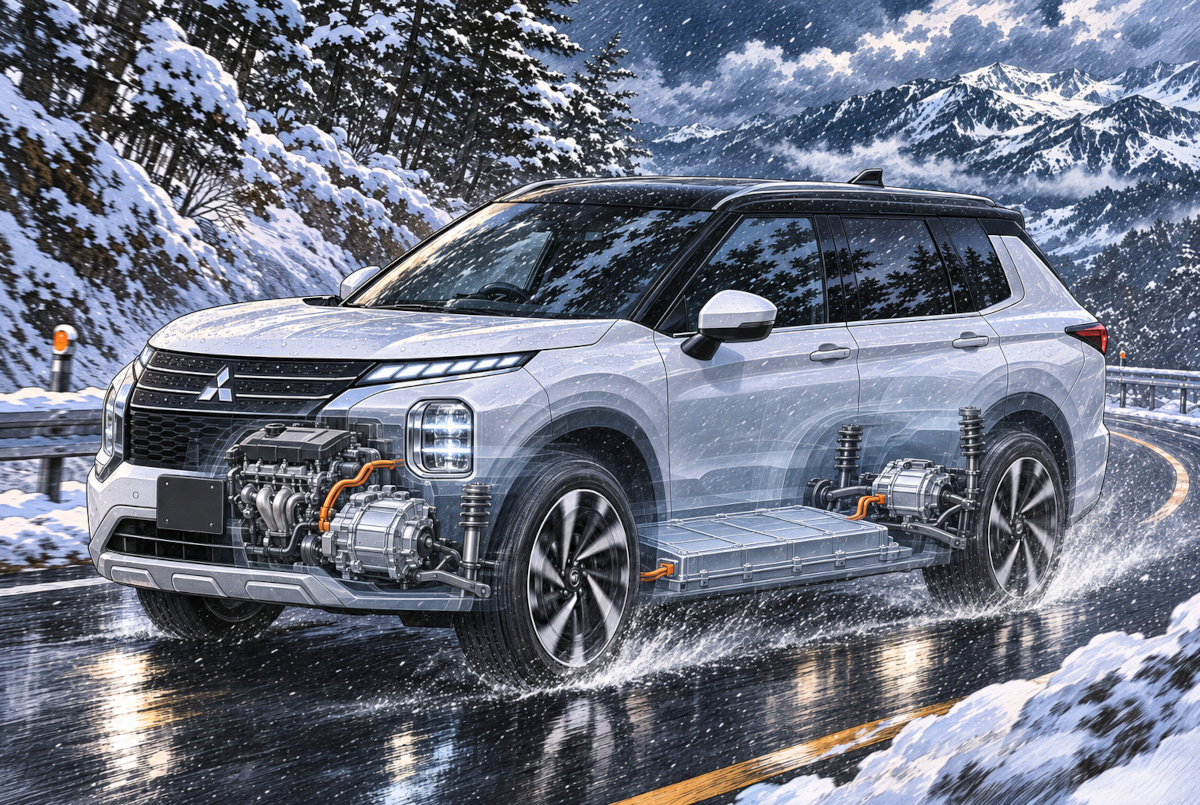 A post-2024 Outlander PHEV, illustrating its front-mounted gasoline engine, front electric drive motor, underfloor battery and separate rear drive motor. The mechanical components are shown farther outward and lower than their actual installed positions for clarity; this is not an accurate engineering cutaway. Some systems, including the generator, are omitted. AI-generated editorial illustration.
So Did the Mitsubishi Galant Die—or Did Something More Important Survive?
As of November 2026, the Japanese Mitsubishi lineup and official announcements examined for this article do not identify a confirmed plan to launch a new Galant.
That doesn’t prove the name will never return. It simply means there’s no verified basis here for assigning a probability—or a launch date—to a revival.
What we can examine is the technology.
The 6A13 twin-turbo V6 from the 1996 Galant VR-4 is not powering the current Mitsubishi SUV lineup. The old 4G93 GDI engine’s injection system was not carried over unchanged into the Outlander PHEV. Nor does today’s SUV share the Galant’s body structure or the Evolution X’s mechanical AWD hardware.
But the engineering philosophy is a different matter.
Mitsubishi’s own technical history connects the 1987 Galant VR-4’s ACTIVE FOUR with the later development of AYC and S-AWC. And its modern electric-motor-based four-wheel control continues to pursue the same broad goal: extracting useful grip from all four tires to deliver predictable handling and stability.
The Galant nameplate and its original vehicle lineage came to an end. But the all-wheel-control philosophy that the VR-4 helped establish continued through the Lancer Evolution and into Mitsubishi’s electrified SUVs. That is what survived—and that is the answer to our seven-part investigation.
Editor’s Note
When I started digging through the Galant’s history, I expected this final chapter to end with the usual old-car lament: the glory days are over, the sedans are gone, and now everything is an SUV.
And yes, I still miss the VR-4. Especially the idea of a fairly ordinary-looking four-door sedan hiding a twin-turbo V6 and an elaborate all-wheel-drive system. Mitsubishi used to make cars that seemed determined to put every clever engineering idea into one body.
But discovering Mitsubishi’s own description of the 1987 ACTIVE FOUR as a foundation for AWC made me reconsider the story.
Look at the Outlander PHEV. Separate motors drive the front and rear axles, and the braking system helps control the way the car turns. In the old days, Mitsubishi was experimenting with four-wheel steering and torque-managing differentials. Now electric-motor control is doing part of the work.
And the numbers are every bit as capable of causing mischief as they were back in the 1990s.
Add the engine and motor ratings and you can produce a wonderfully dramatic figure of about 385 PS. It’s exactly the kind of number I’d have circled in red in an old car magazine. But it isn’t the system’s verified maximum output, and pretending otherwise would spoil the whole point of checking the specifications.
Personally, I’d still like to see another low, square-shouldered sedan wearing a GALANT VR-4 badge. I don’t know whether Mitsubishi will ever build one again, and I won’t pretend a new model is just around the corner.
Still, preserving an engineering philosophy may be harder than bringing back a familiar badge.
From the original Colt Galant of 1969 to the GTO, the VR-4, GDI and Galant Fortis, the car changed its character repeatedly. It was never simply one unchanging formula.
After following the history all the way to 2026, one thing seems clear: Mitsubishi is still asking how to make better use of the grip available at all four wheels.
The Galant name has disappeared, but that slightly obsessive fascination with vehicle control hasn’t.
And with that, our seven-part Mitsubishi Galant series comes to an end.
Mitsubishi Galant: Seven-Part History Series
From the original Colt Galant and the Galant Sigma to the rally-winning VR-4, GDI technology, and the end of the Galant name. Across seven articles, we explore the cars, engineering, motorsport history, and legacy of one of Mitsubishi's defining model lines.
- Part 1: The Colt Galant Came Before Mitsubishi Motors—and Led to the GTO and FTO (Part 1)
- Part 2: The Galant Sigma Was a Hit—So Why Did Mitsubishi Abandon RWD? (Part 2)
- Part 3: The Galant VR-4 Won Six WRC Rallies. Why Did Mitsubishi Replace It? (Part 3)
- Part 4: The Evo Got the 4G63—So Why Did the Galant VR-4 Still Make 240 PS? (Part 4)
- Part 5: Mitsubishi’s “Engine of the 21st Century”: Did GDI Really Deliver 35% Better Fuel Economy? And Why Was There a 280 PS VR-4?
- Part 6: Why Were There Two Different Mitsubishi Galants—and Two Different RALLIARTs?
- Final Part: Did the Mitsubishi Galant Really Die? The VR-4 Legacy Behind S-AWC
Terms That May Need a Quick Explanation
- AYC (Active Yaw Control)
- A Mitsubishi vehicle-control technology that influences how a car rotates through a corner. Early mechanical AYC systems used differences in left-right wheel driving force; later brake-based AYC implementations achieve yaw control using selective braking. The mechanical arrangements are not identical.
- Yaw Moment
- The rotational effect that turns a vehicle left or right when viewed from above. Differences in the driving or braking forces acting at individual tires can produce a yaw moment.
- S-AWC (Super All Wheel Control)
- Mitsubishi’s integrated vehicle-dynamics control system, coordinating driving and braking forces to improve handling and stability. The Lancer Evolution X and Outlander PHEV use different drivetrains and control mechanisms despite sharing the S-AWC name.
References
- Mitsubishi Motors — The Evolution of All-Wheel Control, Part 1 (Japanese) — Manufacturer’s technical retrospective covering the 1987 Galant VR-4’s ACTIVE FOUR, the development of AWC, and AYC on the Lancer Evolution IV.
- Mitsubishi Motors — The Evolution of All-Wheel Control, Part 2 (Japanese) — Development of ACD, Super AYC and the integrated S-AWC system used by the Lancer Evolution X.
- Mitsubishi Motors — The Evolution of All-Wheel Control, Part 3 (Japanese) — Official discussion of the transition from mechanically connected AWD systems to electric-motor-based AWD in Mitsubishi SUVs.
- Mitsubishi Motors — Company History (Japanese) — Corporate timeline documenting Mitsubishi’s development and introduction of technologies including AYC and S-AWC.
- Mitsubishi Motors — Official Vehicle History (Japanese) — Historical information on the Galant, ACTIVE FOUR, Legnum and Lancer Evolution X.
- Car Watch — Mitsubishi’s 1,000-Unit Lancer Evolution Final Edition Sells Out (August 20, 2015, Japanese) — Contemporary reporting on the Final Edition and the end of Lancer Evolution production.
- Mitsubishi Motors — Notice of the 46th Ordinary General Meeting of Shareholders (English translation), p. 22 — Primary evidence that Japanese-market Galant Fortis production under that name ended in March 2015 while overseas production continued under the Lancer name.
- Mitsubishi Motors — Launch Announcement for the New Outlander PHEV (October 28, 2021, Japanese) — New-generation plug-in hybrid powertrain, Twin Motor 4WD and S-AWC technology.
- Mitsubishi Motors FAQ — How Has S-AWC Evolved on the Outlander PHEV? (Japanese) — Manufacturer’s explanation of expanded brake-based AYC control involving both front and rear wheels.
- Mitsubishi Motors — Major Outlander PHEV Update (October 9, 2024, Japanese) — Battery changes, increased electric driving range and efficiency-related improvements.
- Mitsubishi Motors — An Evolving PHEV System: Greater Performance and Range (2025 Technical Material, Japanese PDF) — Manufacturer’s figures for battery capacity (20.0 versus 22.7 kWh), M-trim WLTC electric range (87 versus 106 km), motor output and the three driving modes.
- Mitsubishi Motors — Outlander PHEV Technical Specifications (Japanese) — Official specifications for the 4B12 engine, ECI-MULTI fuel injection, individual engine and motor outputs, and maximum torque.
- Mitsubishi Motors — Partial Update to the Outlander PHEV (June 25, 2026, Japanese) — Official announcement of revised driver-assistance and convenience features and continued domestic availability.