

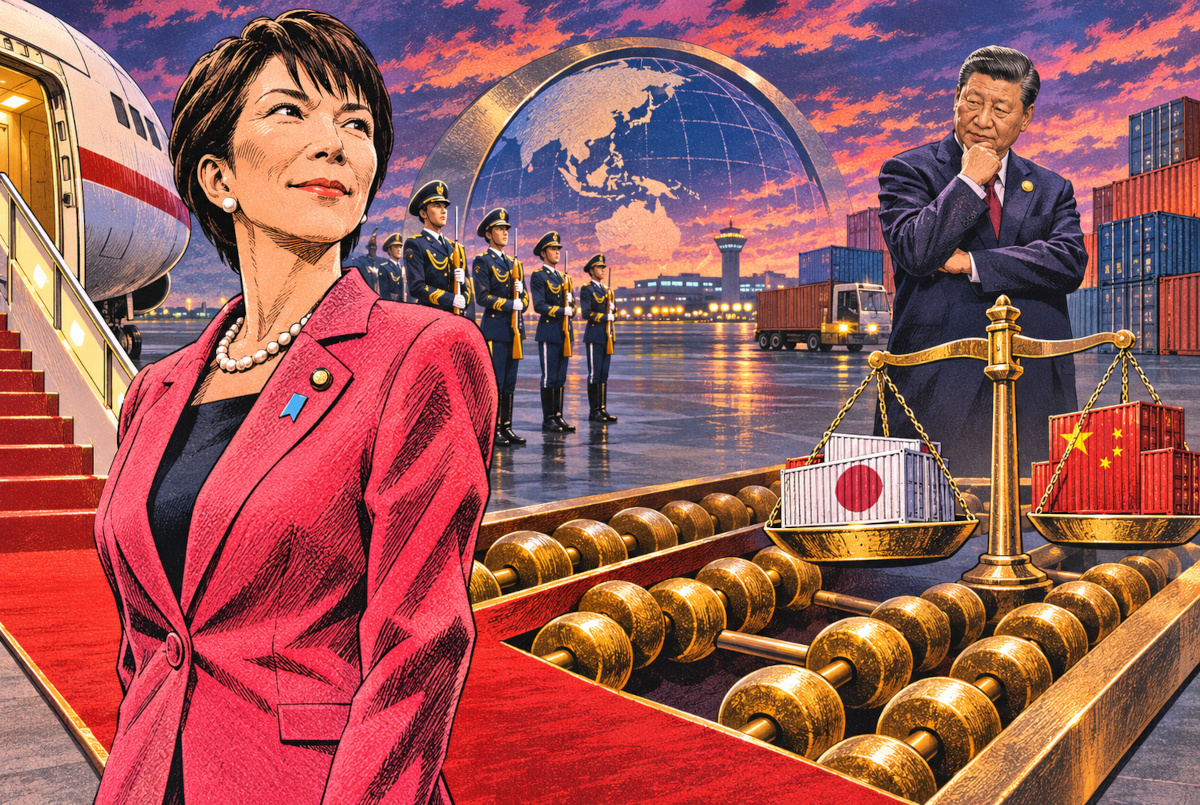
No flowers for Japan’s prime minister. A low-key airport reception. Meanwhile, other leaders arriving in Shenzhen for the November 18–19, 2026 Asia-Pacific Economic Cooperation (APEC) summit received considerably more elaborate welcomes.
Japan’s Prime Minister Sanae Takaichi was hardly given the red-carpet treatment reserved for some of her fellow leaders. That was the headline. But one detail bothered me more than the missing flowers: China trades more with Japan than it does with Russia.
So what exactly was Beijing trying to gain by making its diplomatic displeasure so visible? And what might such a gesture cost?
Checking the trade figures and China’s own official statements revealed a much more interesting puzzle than the airport photographs alone.
Xi Welcomed Trump. Who Welcomed Takaichi?
The difference in treatment was difficult to miss. As foreign leaders arrived in Shenzhen, their receptions varied considerably.
| Visiting leader | Reception in China |
|---|---|
| Donald Trump (United States) | Personally welcomed at the airport by President Xi Jinping. |
| Vladimir Putin (Russia) | Received by Cai Qi, a senior Communist Party leader. |
| Lee Jae Myung (South Korea) | Welcomed with a ceremonial performance involving young participants. |
| Sanae Takaichi (Japan) | Received by protocol diplomat Zhang Qiyue, with no comparable flower-bearing welcome party. |
It would be misleading to describe Japan’s arrival as receiving no official attention whatsoever. There was a formal reception, but the scale and presentation were noticeably more restrained.
Nor was Trump’s welcome an ordinary benchmark. Xi personally greeting an American president at the airport was itself exceptional, reflecting the particularly high-profile circumstances of the US-China relationship and an earlier welcome Trump had extended to Xi.
South Korea makes a more useful comparison. Its leader received a visible welcoming performance, whereas Japan’s prime minister did not.
The question is not whether every leader must receive an identical bouquet. It is why differences in diplomatic protocol became such a conspicuous part of an international economic summit.
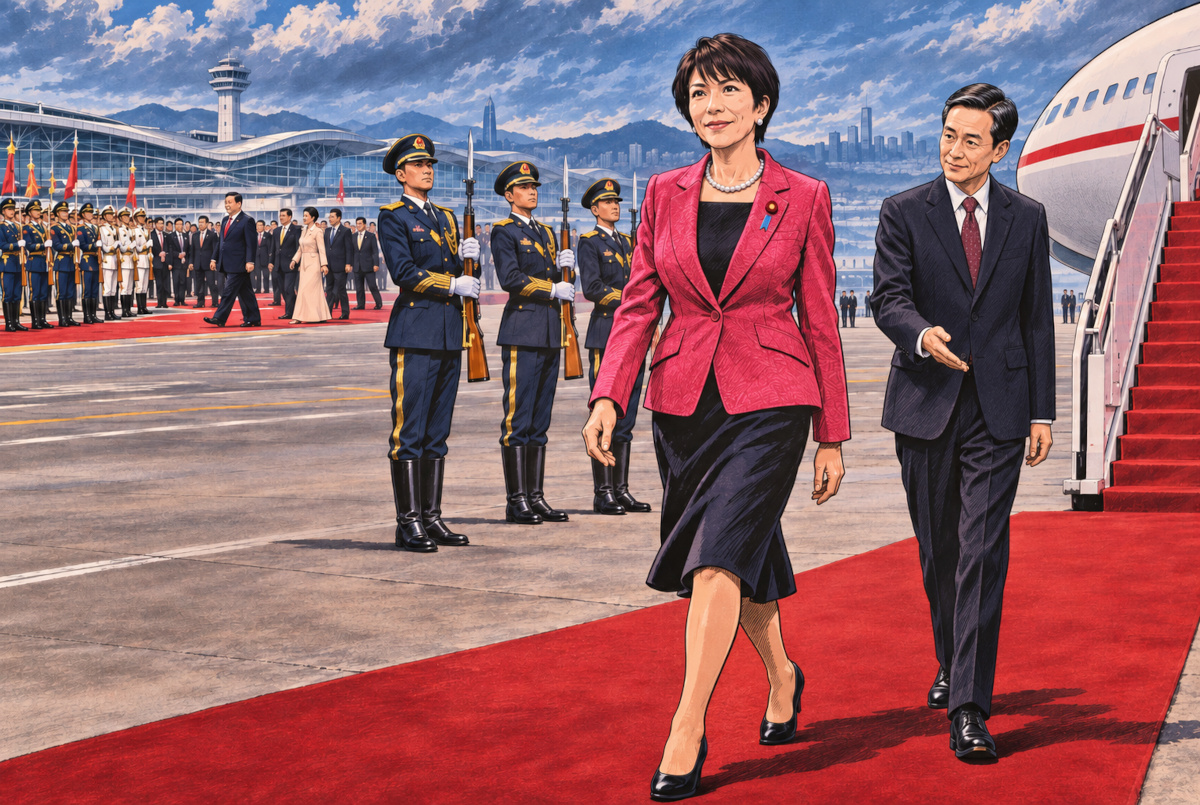
AI-generated editorial illustration comparing diplomatic welcomes. It combines symbolic elements from separate arrivals and does not reproduce an actual scene. The Chinese official who received Takaichi was Zhang Qiyue, a woman; the male escort pictured here is fictional. The background reception did not take place simultaneously with Takaichi’s arrival.
Li Qiang Was Absent, but the Dispute Began a Year Earlier
To understand the atmosphere in Shenzhen, we need to return to autumn 2025.
On October 31, 2025, Takaichi and Xi held a summit in South Korea. According to Japan’s Ministry of Foreign Affairs, they reaffirmed their intention to build a constructive and stable relationship.
Just one week later, on November 7, Takaichi told Japan’s parliament that a military conflict involving Taiwan could, depending on the circumstances, constitute a survival-threatening situation for Japan.
Beijing objected strongly. Japan maintained that its basic position had not changed. The disagreement helped produce a prolonged deterioration in relations.
Fast-forward to November 17, 2026. At the ASEAN Plus Three summit in Manila, Chinese Premier Li Qiang was absent. He had returned to China the previous day, and Agriculture and Rural Affairs Minister Zhang Zhu attended on China’s behalf.
Takaichi shook hands and briefly spoke with Zhang Zhu, but there was no direct encounter with Li.
Was Li’s absence intended to avoid the Japanese leader? That possibility attracted speculation, but the available evidence does not establish his motive. Treating it as a proven diplomatic snub would go beyond what the records show.
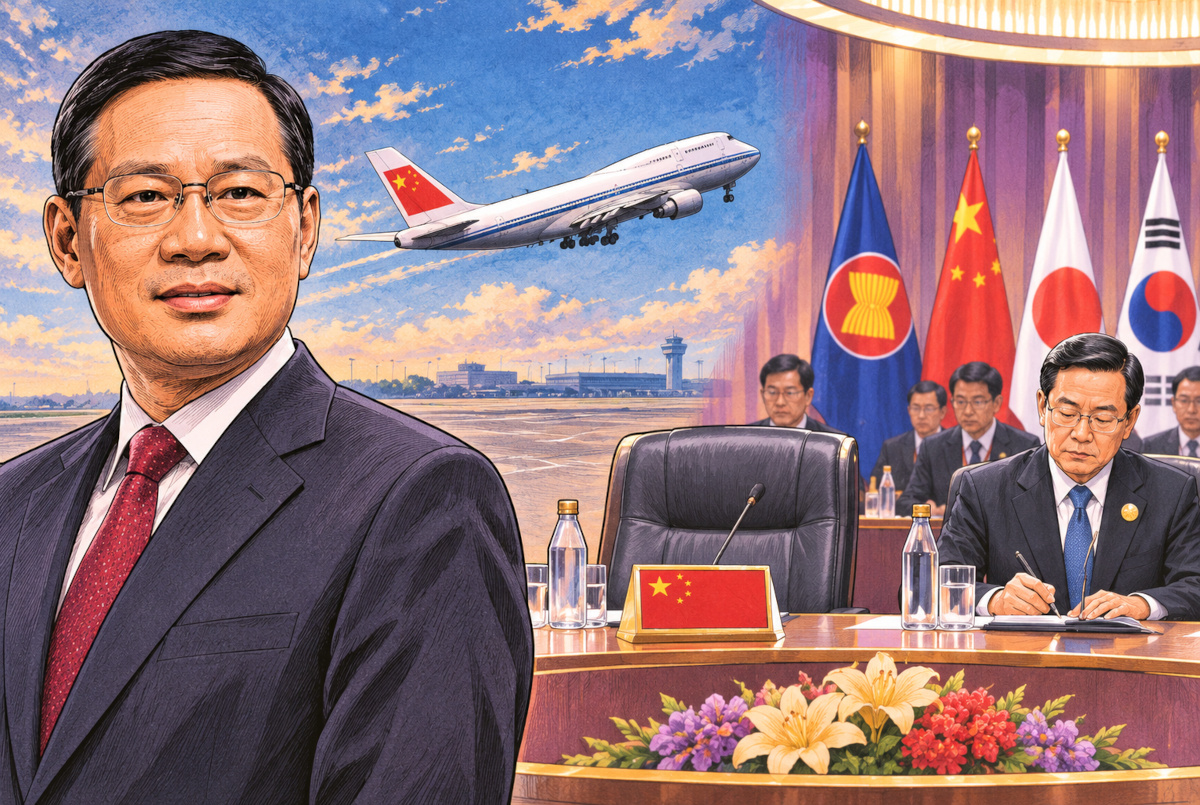
Li Qiang returned to China on November 16, 2026, and Agriculture Minister Zhang Zhu represented China at the ASEAN Plus Three summit on November 17. This AI-generated illustration uses a symbolic aircraft, empty chair and fictionalized conference setting; it does not reproduce the actual seating arrangement or depict the substitute delegate with photographic accuracy.
China’s Trade With Japan Was 1.41 Times Its Trade With Russia
Here is where the story became much more interesting to me.
Instead of comparing diplomatic photographs again, I opened the 2025 Chinese customs statistics published by the Japan External Trade Organization (JETRO).
I took China’s exports to Japan and Russia, added its imports from each country, and compared the resulting totals. Both figures come from the same reporting country and year, avoiding the complications of mixing Japanese and Russian national statistics.
| China’s merchandise trade, 2025 | Japan | Russia |
|---|---|---|
| China’s exports | $157.347 billion | $103.309 billion |
| China’s imports | $164.835 billion | $124.796 billion |
| Combined trade | $322.182 billion | $228.105 billion |
The calculation is straightforward:
$322.182 billion ÷ $228.105 billion = approximately 1.41.
In 2025, China’s total merchandise trade with Japan was roughly 41% larger than its trade with Russia, a difference of about $94.1 billion.
That is not a trivial gap. Japan is an economically important trading partner for China, even during periods of political tension.
Of course, countries are not ranked diplomatically by trade volume alone. Russia occupies a different place in China’s security and energy relationships. And bilateral trade is not the same thing as profit, strategic leverage or the economic cost of a diplomatic dispute.
Still, the numbers expose something that airport coverage alone cannot: China’s diplomatic treatment of these countries cannot be explained simply by how much business it does with them.
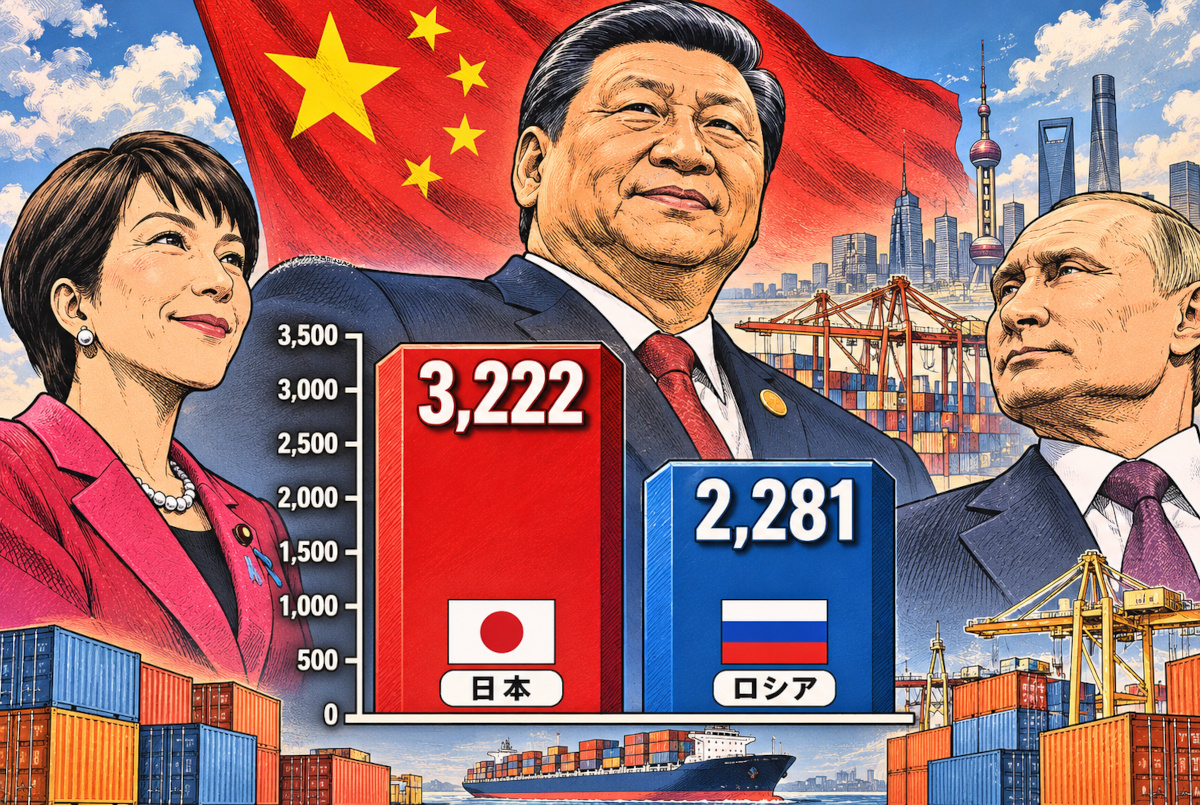
Original calculation using 2025 Chinese customs data published by JETRO. China’s combined merchandise trade was approximately $322.2 billion with Japan and $228.1 billion with Russia, a ratio of about 1.41 to 1. The chart and background are illustrative rather than a precision-scaled statistical graphic. The figures shown in the image use units of US$100 million.
Xi Called for Dialogue. The Airport Sent a Different Signal
Another detail deserves attention: Xi Jinping’s own speech on November 18.
Speaking at the APEC CEO Summit in Shenzhen, Xi emphasized regional cooperation and the need to resolve disagreements through dialogue and consultation. His remarks were published by China’s Ministry of Foreign Affairs.
That creates an uncomfortable contrast. At a gathering devoted to Asia-Pacific cooperation, China’s official message favored dialogue, while Japan’s comparatively subdued airport reception could be interpreted as an expression of political displeasure.
But diplomatic protocol and a refusal to communicate are not the same thing.
Later that evening, Takaichi shook hands with Xi during the APEC welcome event. They exchanged a few words. It was not a formal bilateral summit, but neither was it a total diplomatic freeze.
One possible reading is that Beijing sought to communicate dissatisfaction while leaving some room for contact. Another is that different parts of the occasion simply served different diplomatic purposes. China’s precise intention behind the airport arrangements has not been publicly established.
And that is the unanswered question: does a visible diplomatic slight create leverage, or does it make an already difficult relationship harder to manage?
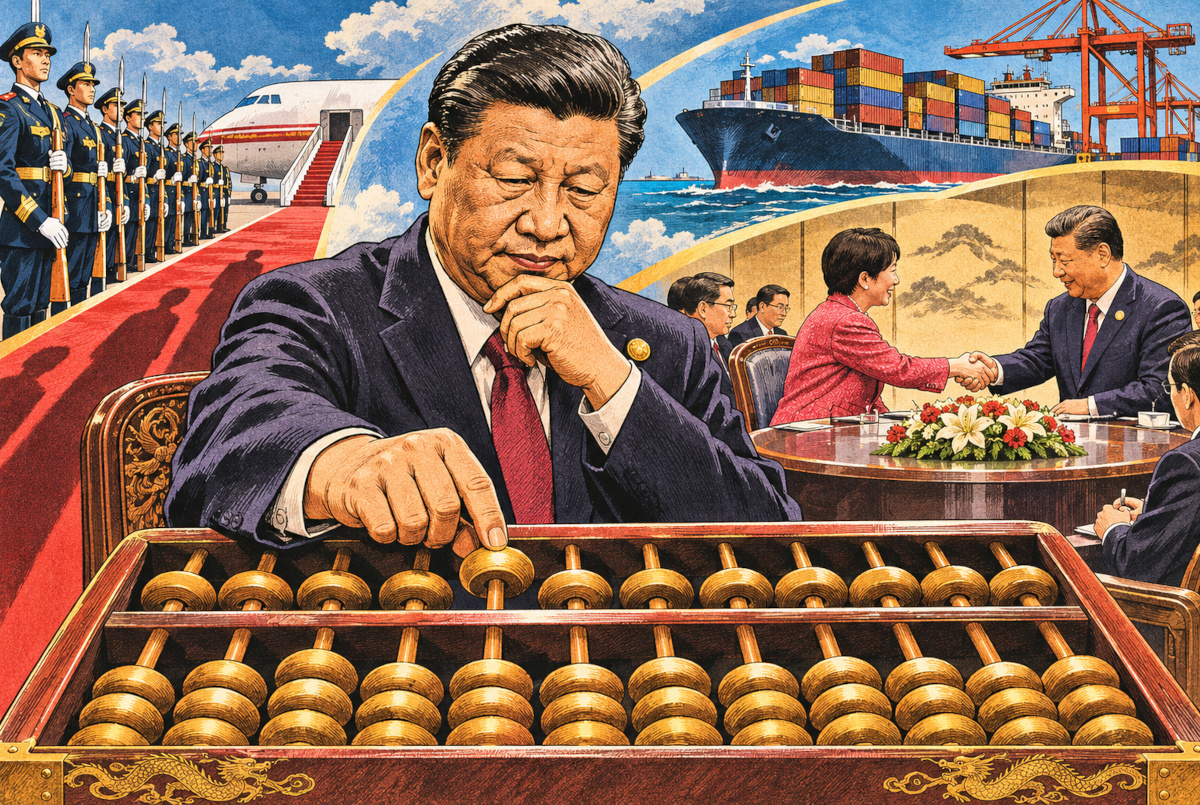
AI-generated satirical illustration. The abacus represents diplomatic calculation, while the cargo ship and handshake symbolize trade and communication. Takaichi and Xi exchanged greetings at the November 18 welcome event, but the illustrated meeting room is fictional and does not depict an actual formal bilateral summit.
Could Japan Simply Walk Away From China?
After an incident like this, it is tempting to ask whether Japan should stop dealing with China altogether.
But another trade figure complicates that idea.
According to the World Trade Organization’s country profile, China accounted for 23.6% of Japan’s merchandise imports in 2025. Put another way, approximately $24 of every $100 Japan spent on imported goods went toward imports from China.
The connection extends across everyday consumer electronics, computers, industrial products and complex manufacturing supply chains. A sudden, comprehensive halt to trade could create significant supply and cost problems for Japan as well.
That does not mean the existing level of dependence must remain unchanged. Diversifying suppliers, strengthening domestic production where feasible and managing economic-security risks are all different from severing economic relations outright.
Reducing dependence on China and cutting China off completely are two very different propositions.
The trade data cannot tell us whether China’s diplomatic approach was a success or a failure. But it does make the stakes clearer. Neither side is dealing with an economically insignificant neighbor.
Terms That May Need a Quick Explanation
- Survival-threatening situation
- A category under Japan’s security legislation in which an armed attack against a country closely related to Japan could threaten Japan’s survival and fundamentally endanger its people’s rights. Any government determination depends on the specific circumstances; the category does not mean automatic military intervention in a Taiwan conflict.
Editor’s Note
What bothered me most was never the bouquet itself. It was the sight of an international economic summit becoming a story about who got the warmer airport welcome, while hundreds of billions of dollars in annual trade sat quietly in the background.
That is a strange set of accounts.
China’s trade with Japan is about 1.41 times its trade with Russia. Yet the ceremonial treatment moved in the opposite direction. There may be strategic reasons for that, but I would still like to know what Beijing expects the return on this particular diplomatic investment to be.
Japan cannot pretend its own supply chains are independent of China, either. The numbers make that clear enough.
In the end, the most peculiar part is not whether someone remembered to hand over flowers. It is why two countries with so much business between them find even the entrance to a conversation so difficult to navigate.
Editorial scope: This article reflects information confirmed through the evening of November 18, 2026, Japan time. Developments on November 19 are not included. The bilateral trade comparison uses China’s 2025 merchandise trade statistics on a consistent reporting basis. It is not an estimate of economic losses or diplomatic effectiveness. All illustrations are AI-generated editorial artwork, not documentary photographs.
References
- Reuters (November 18, 2026) — APEC summit diplomacy, Xi’s remarks and the differing receptions for visiting leaders.
- South China Morning Post (November 18, 2026) — Comparison of Takaichi’s subdued airport arrival with South Korean President Lee Jae Myung’s reception.
- Ministry of Foreign Affairs of Japan (October 31, 2025) — Japan-China Summit Meeting. Official English record.
- National Diet Library, Japan (November 7, 2025) — Official parliamentary proceedings containing Prime Minister Takaichi’s remarks concerning a Taiwan contingency (Japanese).
- Ministry of Foreign Affairs of Japan (November 17, 2026) — The 29th ASEAN Plus Three Summit. Official English summary.
- Jiji Press via Nippon.com (November 17, 2026) — Chinese Premier Li Qiang’s absence and Minister Zhang Zhu’s participation.
- Japan External Trade Organization (JETRO) — China’s Trade and Investment Report; Table 2-2, 2025 exports and imports by trading partner (Japanese). Source for the original Japan-Russia calculation.
- World Trade Organization — Japan member profile, 2025 merchandise imports by partner. Source for China’s 23.6% share of Japan’s imports.
- Ministry of Foreign Affairs of China (November 18, 2026) — President Xi Jinping’s keynote speech at the APEC CEO Summit. Official English statement.
- Jiji Press (November 18, 2026) — Takaichi and Xi exchange greetings at the APEC welcome event.