
On September 2, 2026, Mitsubishi Motors finally unveiled the all-new Pajero to the world.
When the original Japanese version of this article was first published on August 27, the full vehicle had not yet been revealed.
What we knew was that the Pajero name was coming back, that the new SUV would use a version of the Triton’s ladder frame, and that Mitsubishi was developing features such as S-AWC and a modern interpretation of the Pajero’s famous triple-meter display.
Six days later, the real vehicle appeared.
And it turned out to be considerably more than a familiar Pajero badge attached to an ordinary SUV.
A specially developed 2.4-liter clean diesel. A new eight-speed automatic transmission. Super Select 4WD-II. S-AWC. A ladder frame. Three rows and seven seats. And numerous design references to earlier generations.
So this updated article does two things: it looks back at the Pajero’s history since 1982, and it compares what Mitsubishi had revealed before the premiere with what became official on September 2, 2026.
One note for international readers: Mitsubishi states that the Pajero nameplate is known as Montero in some markets. Likewise, the Triton pickup that provides the basis for the new Pajero’s frame is known as the L200 in some countries.
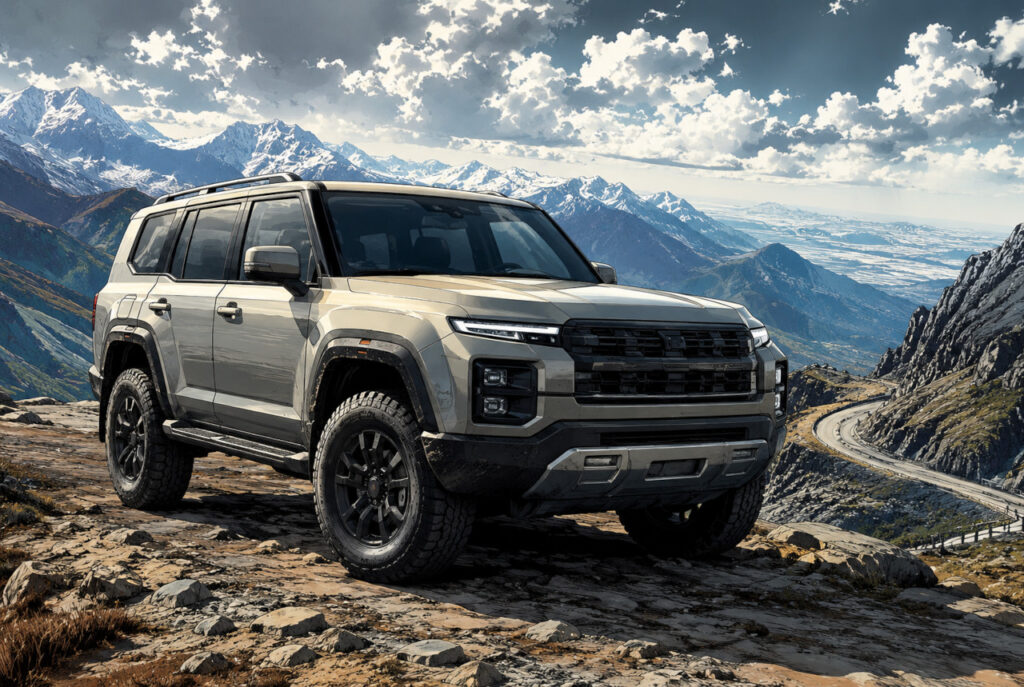 This AI-generated image was created in August 2026 before Mitsubishi officially revealed the new Pajero. It is a prediction and does not represent the actual production vehicle.
First, the answer: yes, the Pajero really is back
On May 29, 2026, Mitsubishi Motors officially announced that its upcoming cross-country SUV would carry the Pajero name.
Then, on September 2, Mitsubishi presented the completed all-new model at its world premiere.
This was not merely a concept car or a nostalgic design exercise.
Mitsubishi describes it as a new-generation flagship model for the brand.
Production is based in Thailand. Mitsubishi says the new Pajero will first launch there, followed by Japan and Australia during the company’s fiscal 2026.
For international readers, there is an important date detail here: Mitsubishi’s fiscal 2026 runs from April 2026 through March 2027. So this does not necessarily mean every market will receive the vehicle before December 31, 2026.
From fiscal 2027 onward, Mitsubishi plans to expand the Pajero to approximately 100 countries, including markets in ASEAN, Latin America and the Middle East.
In Japan, production of the Japanese-market Pajero ended in 2019, so the return of the nameplate represents a seven-year comeback.
Mitsubishi’s Japanese website also says reservation orders will begin on October 1, 2026.
As of September 10, 2026, however, the final Japanese manufacturer’s suggested retail price has not yet been published on the company’s official Pajero information pages.
The Pajero helped turn a serious 4×4 into an everyday adventure vehicle
The first Mitsubishi Pajero appeared in 1982.
At the time, four-wheel-drive vehicles were much more strongly associated with rough terrain, professional work and specialist users than today’s SUVs are.
Mitsubishi’s basic idea was deceptively simple:
combine genuine off-road ability with the comfort and usability of a passenger car.
Today, driving an SUV to the supermarket is completely ordinary.
In the early 1980s, however, the idea that a serious 4WD could also be a family vehicle, a weekend leisure vehicle and a comfortable road car was much less established.
The Pajero became one of the vehicles that helped normalize that idea in Japan.
This is also why Mitsubishi’s use of the old Japanese term RV can confuse English-speaking readers. In 1980s and 1990s Japan, “RV” was often used broadly for recreational lifestyle vehicles such as SUVs, 4WDs and minivans. It did not necessarily mean a large American-style motorhome.
Twelve Dakar victories gave the Pajero credibility that advertising alone could not buy
The Dakar Rally transformed the Pajero from a successful 4WD into a global Mitsubishi icon.
Mitsubishi began competing with the Pajero in 1983.
In 1985, it achieved the first overall Dakar victory for a Japanese manufacturer.
Over the following years, Pajero-based competition vehicles accumulated 12 overall victories, including seven consecutive wins.
That distinction matters.
The Pajero was not simply styled to look adventurous.
Mitsubishi actually took the name into one of the world’s toughest rally raids and built much of the vehicle’s reputation there.
Of course, a Dakar competition machine was not identical to the Pajero sitting in a dealership. Motorsport success should never be confused with proof that every production model could do the same thing.
But the repeated victories gave Mitsubishi something extremely valuable: credibility.
The Pajero’s image of durability and off-road ability was not created entirely in a television commercial.
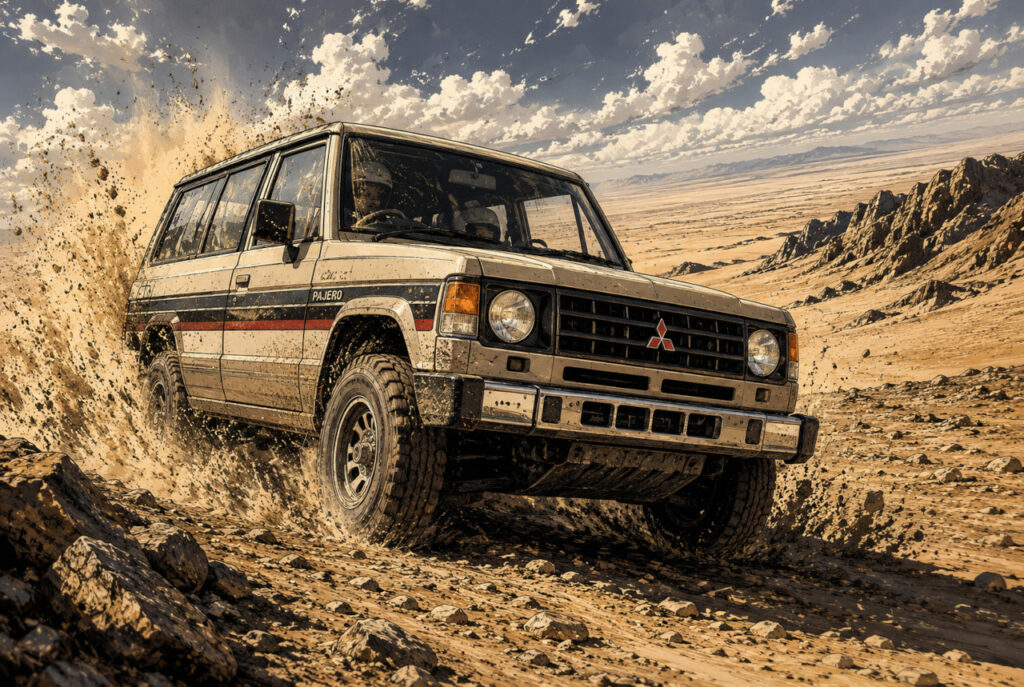 AI-generated illustration inspired by the Pajero’s historic association with the Dakar Rally. It is not a photograph of a specific competition vehicle or event.
The second-generation Pajero became a phenomenon in 1990s Japan
The Pajero stopped being merely a vehicle for serious 4WD enthusiasts when the second generation arrived in 1991.
Japan was entering an era in which leisure itself had become an important consumer culture.
Skiing.
Camping.
Marine sports.
Car-based outdoor trips.
Families loaded equipment into their vehicles and left the city for the mountains, ski resorts and campsites on weekends.
The Pajero fitted that lifestyle almost perfectly: large enough for people and gear, tall enough to feel adventurous, genuinely capable on poor roads, but civilized enough to use every day.
According to a 2026 Mitsubishi historical feature, Japanese sales reached an extraordinary 7,000 to 8,000 Pajeros per month during the early 1990s.
For a large body-on-frame 4WD, that is remarkable even by historical standards.
You saw Pajeros at ski resorts.
You saw them at highway rest areas.
You saw them parked outside ordinary suburban homes.
The buying logic had changed.
It was no longer simply:
“I need four-wheel drive, so I should buy a Pajero.”
It became:
“I want a Pajero because owning one makes me want to go somewhere.”
That may be one of the most important things the model ever achieved.
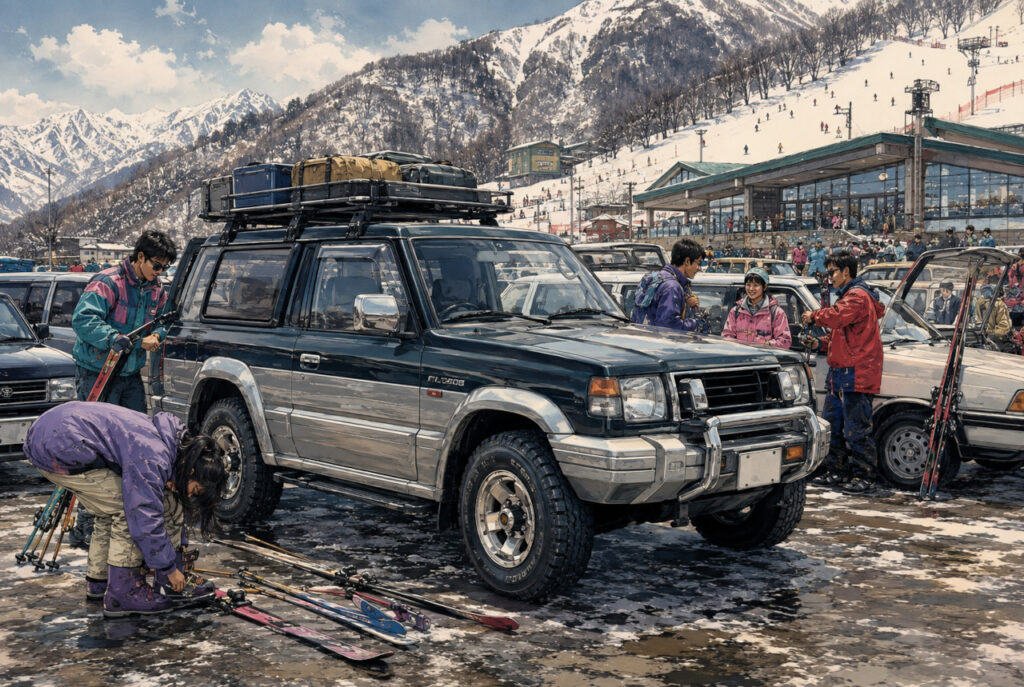 AI-generated conceptual scene representing the Pajero’s popularity during Japan’s 1990s ski, camping and outdoor leisure boom.
Then came the Pajero Mini, Pajero Junior and Pajero iO
The success became so large that “Pajero” expanded beyond a single model.
Mitsubishi introduced the Pajero Mini in 1994, the Pajero Junior in 1995 and the Pajero iO in 1998.
The Pajero Mini requires a little explanation for readers outside Japan.
It belonged to Japan’s kei-car category, a tightly regulated class of very small vehicles designed around limits on body size and engine displacement.
In other words, Mitsubishi took the image of its big desert-running flagship and compressed it into a tiny Japanese city car.
That sounds slightly absurd.
It was also extremely effective branding.
Customers who did not need a large serious off-roader could still buy into the Pajero identity.
At that point, Pajero had become more than a model name.
It had become a Mitsubishi sub-brand.
The world the Pajero helped create eventually made life harder for the Pajero
The third-generation Pajero arrived in 1999, followed by the fourth generation in 2006.
But the automotive market around it was changing.
Minivans became increasingly popular in Japan. Hybrids expanded rapidly. Fuel economy and ownership costs became more important to many consumers.
Then SUVs became fashionable again — but this time the growth increasingly came from crossover SUVs designed primarily around everyday road use rather than traditional body-on-frame off-road engineering.
There is some irony here.
By the time the Pajero’s original idea — making 4WD-style vehicles usable by ordinary families — had become mainstream, the Pajero itself looked increasingly large, heavy and specialized.
Production for the Japanese market ended in 2019.
Production for overseas markets ended in 2021.
For the first time since 1982, the continuous Pajero story had stopped.
According to Mitsubishi’s September 2026 announcement, total production across the first four generations exceeded 3.29 million vehicles, with the Pajero reaching customers in more than 170 countries and regions.
 AI-generated historical concept image representing the evolution of the Pajero. It is not an official Mitsubishi model-lineup photograph.
So is the new Pajero just a Triton with an SUV body?
This was one of the obvious questions when news of the revival first appeared.
The new Pajero is based on a version of the ladder frame used by Mitsubishi’s Triton pickup.
For readers in markets where the name is unfamiliar, the Triton is also sold as the Mitsubishi L200 in some countries.
That naturally creates a cynical interpretation:
“Did Mitsubishi simply put an enclosed SUV body on a pickup and attach the Pajero badge?”
But even before the world premiere, Mitsubishi had already indicated that the answer was more complicated.
In May, the company said the cabin and front and rear suspension would be specifically developed for the Pajero.
The September reveal gave us the details.
The front uses independent double-wishbone suspension.
The rear receives a newly developed five-link rigid axle.
The ladder frame itself uses more high-tensile steel and has been reworked for greater torsional and bending rigidity.
Mitsubishi even uses the phrase “off-road comfort” to describe one of the development targets.
That tells us what the engineering team was trying to avoid.
The new Pajero is not supposed to be merely a pickup that can climb a hill.
It is supposed to retain genuine off-road hardware while giving seven occupants the refinement expected from a modern flagship SUV.
Official specification: 2.4-liter diesel and a newly developed eight-speed automatic
When the first version of this article was written, Mitsubishi had not yet disclosed the complete production powertrain.
Now we have the answer.
The all-new Pajero uses a specially developed 2.4-liter clean-diesel engine with a wide-range single variable-geometry turbocharger.
Maximum torque is 480 Nm, although Mitsubishi notes that some specifications produce 470 Nm.
The transmission is also new: an eight-speed automatic with Sport mode.
This is not the old-school approach of solving every problem with huge displacement.
Instead, Mitsubishi is using strong diesel torque, a wide-ratio transmission and modern control systems to make the Pajero useful both at low speed off road and during normal road driving.
That is an important distinction.
This may be a heritage nameplate, but it is not being engineered as a nostalgia machine.
Super Select 4WD-II and S-AWC appear together
The new Pajero is equipped with Mitsubishi’s Super Select 4WD-II, or SS4-II.
Drivers can select four drivetrain modes:
- 2H — rear-wheel drive
- 4H — full-time four-wheel drive
- 4HLc — four-wheel drive with the center differential locked
- 4LLc — low-range gearing with the center differential locked
That last mode is particularly important.
Many modern SUVs offer a collection of electronic terrain programs but no genuine low-range transfer gearing.
The Pajero still does.
On top of that hardware, Mitsubishi adds S-AWC — Super-All Wheel Control, its integrated vehicle dynamics control system.
The vehicle offers seven selectable drive modes:
- Normal
- Eco
- Gravel
- Snow
- Mud
- Sand
- Rock
So underneath the modern electronic assistance sits a traditional piece of serious 4WD engineering.
It is trying to be both a comfortable SUV for the city and a genuine 4×4 for places where the pavement ends.
That combination is arguably more “Pajero” than any retro badge could be.
The new Pajero is large — but not absurdly large by modern SUV standards
The world premiere also confirmed the exterior dimensions.
- Length: 4,920 mm
- Width: 1,925 mm
- Height: 1,910 mm on 20-inch-tire models
- Wheelbase: 2,870 mm
- Ground clearance: 230 mm on 20-inch-tire models
- Seating: three rows, seven passengers
For Japanese roads, a width of 1,925 mm is unquestionably large.
Parking spaces, older residential streets and urban garages in Japan can make width more noticeable than it might be in Australia or parts of North America.
But by the standards of today’s full-size and premium off-road SUVs, the new Pajero has not expanded into something completely outrageous.
Mitsubishi specifically says maneuverability was part of the development target.
The three-row, seven-seat configuration is also significant.
The classic Pajero was not simply an off-road toy. It was often a family vehicle that happened to be able to go much farther off pavement than most family cars.
The new model appears determined to retain that dual identity.
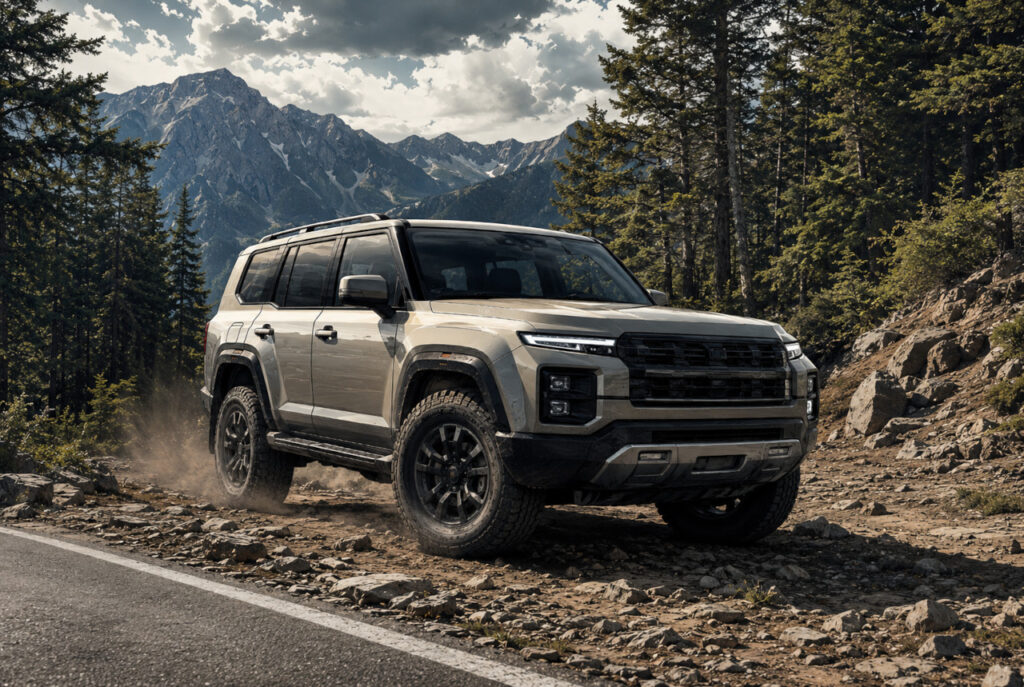 This image was generated before the official September 2026 world premiere. It is an AI prediction and should not be interpreted as showing the actual production design.
One prediction was surprisingly accurate: the triple-meter display really returned
Of all the features Mitsubishi teased before the premiere, the one that interested me most was the return of the Multi-Meter.
Earlier Pajeros became famous for the small cluster of additional instruments mounted prominently near the center of the dashboard.
Depending on generation and specification, these could display information such as direction and altitude.
Did the average owner really need to know their altitude while driving to a supermarket?
Probably not.
That was part of the charm.
The gauges existed partly to create the feeling that the Pajero was ready for somewhere more interesting than the supermarket parking lot.
They were functional instruments, but they were also little machines for manufacturing adventure.
The 2026 Pajero does not simply bolt three analog pods onto the dashboard.
Instead, Mitsubishi has reimagined the idea inside its large monolithic digital display, which integrates two screens measuring up to 14.3 inches.
The modern Multi-Meter can display altitude, compass heading, temperature, vehicle pitch and roll angles, and information related to Active Yaw Control.
A smartphone can already tell you your altitude.
A navigation system already knows which direction you are traveling.
That is not really the point.
Mitsubishi appears to have preserved the feature because it helps a Pajero feel like a Pajero.
For a heritage revival, that may matter more than another tenth of a second in an infotainment response test.
The exterior also borrows more from old Pajeros than expected
Before Mitsubishi showed the actual vehicle, all we could do was imagine what a modern Pajero might look like.
The production design turned out to contain numerous deliberate references to earlier generations.
The overall body uses a strong horizontal theme and upright proportions.
Mitsubishi says the C-pillar was inspired by the roll bar of the first-generation Pajero.
At the rear, a hexagonal design motif reinterprets the visual impression created by the externally mounted spare tire seen on earlier Pajeros.
The company did not attempt to recreate a 1982 SUV with LED headlights.
That would have been too easy.
Instead, it scattered recognizable Pajero cues throughout a completely new design.
People who know the older vehicles may notice them without the new Pajero becoming a caricature of its own history.
I think that is the better approach.
How accurate were the pre-reveal predictions?
The original article was published on August 27, before Mitsubishi revealed the complete production vehicle.
Now we can grade the information that was known at the time.
| What was known or expected before the premiere | What Mitsubishi confirmed on September 2 |
|---|---|
| Triton-based ladder frame | Confirmed, with modifications and development for the Pajero |
| Pajero-specific cabin and suspension | Confirmed; rear suspension uses a newly developed five-link rigid axle |
| S-AWC | Confirmed |
| Return of the triple-meter concept | Confirmed as a modern digital Multi-Meter |
| Serious off-road positioning | Confirmed through SS4-II, 4LLc, ladder frame and dedicated suspension |
| Powertrain | Confirmed as a 2.4-liter clean diesel with a newly developed 8AT |
Seen in retrospect, the pieces Mitsubishi released before the premiere revealed quite a lot about the vehicle’s basic philosophy.
The major unanswered questions were the detailed powertrain, dimensions, seven-seat layout, safety systems and full interior specification.
This also illustrates something useful about automotive prediction articles.
Normally, we assume a prediction becomes worthless the moment the real vehicle appears.
But if the original claims are preserved and checked afterward, the article gains a different kind of value.
It becomes a record of what manufacturers wanted us to know before the reveal — and what they deliberately kept secret.
Were people waiting for a vehicle, or for the 1990s?
Reading the specifications of the new Pajero inevitably leads to another question.
For many people now in their 50s and 60s, the second-generation Pajero is tied to a period when cars played a much larger role in leisure culture.
You went skiing.
You went camping.
You drove somewhere late at night simply because you could.
Buying a particular vehicle and imagining the places you would go in it were part of the same decision.
The Pajero name became deeply connected to those memories in Japan.
And that means older enthusiasts may not be waiting only for a technically impressive SUV.
They may also be waiting to see a name associated with their younger years printed in a new-car brochure again.
That kind of nostalgia is commercially powerful.
But it is also dangerous.
A vehicle cannot survive indefinitely by reminding customers of who they used to be.
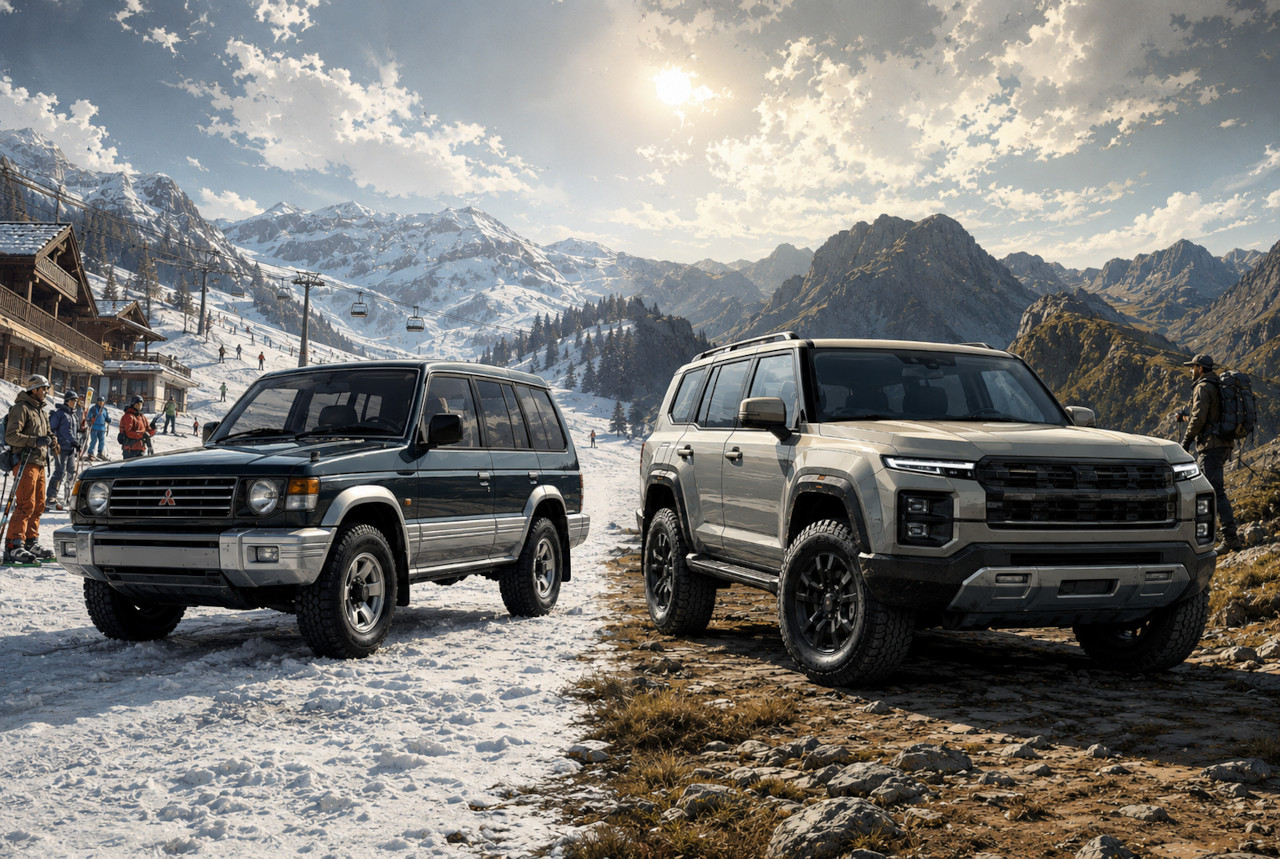
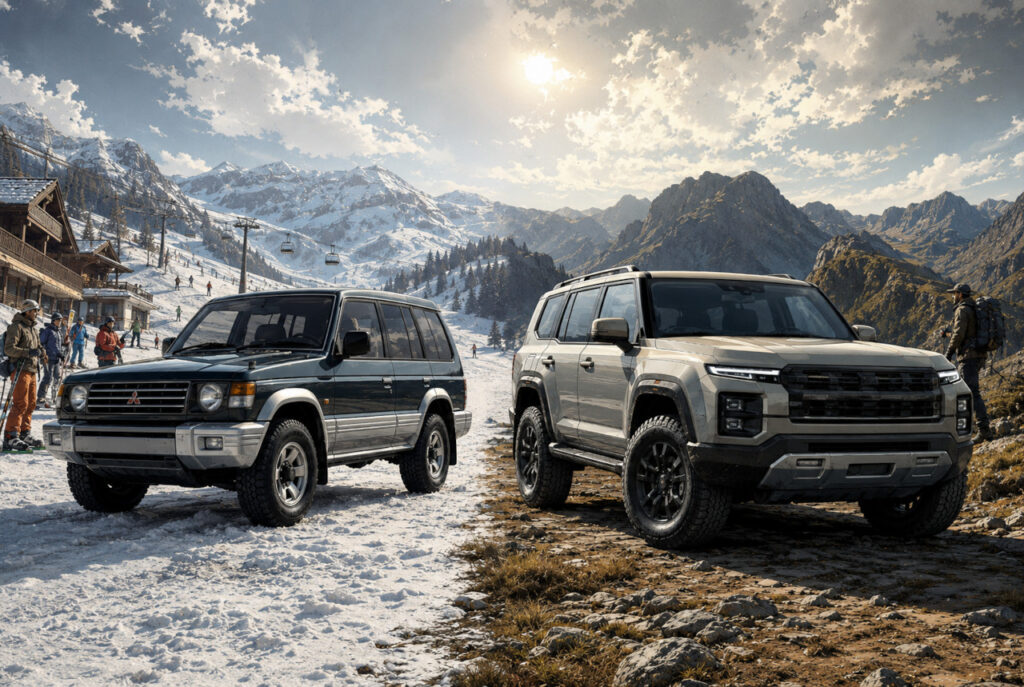 The modern vehicle in this image was generated before the official world premiere and is not the production 2026 Pajero. The illustration represents the contrast between the model’s 1990s legacy and its return.
Nostalgia alone will not make the new Pajero successful
Reviving a famous name does not guarantee success.
Vehicle prices have risen.
Fuel and ownership costs matter.
The Japanese market is no longer one in which a large 4WD can casually sell 7,000 or 8,000 units every month simply because an outdoor leisure boom is exploding.
And the Pajero is returning to a world full of extremely capable SUVs.
Toyota’s Land Cruiser family alone gives Mitsubishi a formidable benchmark, while global customers now have far more premium, mainstream and specialist off-road choices than they did in 1991.
The new Pajero will not truly succeed because buyers in their 50s or 60s look at it and say:
“I remember that name!”
The real victory will come if somebody who never experienced the Pajero boom sees the new one and thinks:
“I want to get in that thing and go somewhere.”
That was one of the old Pajero’s greatest talents.
The 2026 model now has to learn the same trick with a new generation.
This may be the beginning of a new Pajero series, not a one-model revival
There is another detail in Mitsubishi’s official statements that may turn out to be even more interesting than the new SUV itself.
Mitsubishi has made clear that the all-new Pajero is intended to lead a Pajero series to follow.
That wording deserves attention.
It suggests that Mitsubishi does not necessarily view Pajero as a single isolated heritage model.
However, this is exactly where speculation must stop.
As of September 2026, Mitsubishi has not officially announced the names, sizes or specifications of additional Pajero-series vehicles.
There is no official confirmation here that a new Pajero Mini, Pajero Junior or Pajero iO is coming.
Those would be predictions.
What we can say is that Mitsubishi itself has described the new flagship as the vehicle that will lead the Pajero series that follows.
That makes the revival potentially much larger than the return of one famous SUV.
As of September 2026, the next big questions are price and Japanese-market specification
The September 2 world premiere answered most of the engineering questions.
We now know the basic platform, engine, transmission, four-wheel-drive system, suspension, dimensions, seating layout and much of the equipment.
Mitsubishi’s Japanese website says reservation orders will begin on October 1, 2026.
So the next obvious question is simple:
How much will the new Pajero cost in Japan?
As of September 10, 2026, Mitsubishi has not yet published the final Japanese suggested retail price on the official information pages checked for this article.
Details of the Japanese trim structure and market-specific equipment also remain to be clarified.
That means this story is not finished.
Reservation orders.
Pricing.
Final Japanese-market grades.
Launch.
And eventually, actual customer reaction.
Each will give us another opportunity to compare Mitsubishi’s promise with reality.
Conclusion: Mitsubishi revived more than the badge
Before the full reveal, my biggest concern was obvious.
Would Mitsubishi revive the famous PAJERO name, attach it to a conventional SUV and expect nostalgia to do the rest?
After the September 2 premiere, that concern is much smaller.
Ladder frame.
Super Select 4WD-II.
S-AWC.
Low-range 4LLc.
A torque-rich diesel engine.
Pajero-specific suspension development.
And, gloriously, a modern version of those slightly unnecessary adventure gauges.
Mitsubishi did not simply ask, “How do we bring back a famous name?” It appears to have asked the more difficult question: “What actually made a Pajero feel like a Pajero?”
That is the right question.
The next one is harder.
Does that interpretation of Pajero still produce a vehicle people genuinely want in 2026?
A specification sheet cannot answer that.
The market will.
Editor’s Note
When I first wrote this article in late August, Mitsubishi still had not shown us the complete new Pajero. A few days later, the real thing appeared and I could finally compare the predictions with the finished vehicle.
The ladder frame matters. S-AWC matters. The diesel engine matters.
But the detail I like most may still be the Multi-Meter.
You can get altitude from a smartphone. Navigation already knows your direction. Most owners will probably never need half of the information while driving around town.
And that is precisely why I like it.
A car becomes more interesting when it contains at least a little hardware that cannot be justified entirely by efficiency and practicality.
I remember the era when even the tiny Pajero Mini seemed to be everywhere in Japan. For me, the bigger story is therefore not simply whether this one flagship SUV sells well.
It is whether Mitsubishi can make the words “Mitsubishi = Pajero” mean something again to people who did not grow up with the original boom.
References
- Mitsubishi Motors — “Mitsubishi Motors Unveils the All-New Pajero Cross-Country SUV” (September 2, 2026) — Official world-premiere announcement covering the new Pajero’s powertrain, dimensions, SS4-II, S-AWC, suspension, interior, safety technology and global rollout plans.
- Mitsubishi Motors — “Mitsubishi Motors to Debut the All-New Pajero Cross-Country SUV in Autumn 2026” (May 29, 2026) — Official pre-premiere announcement confirming the Pajero name, Triton-based ladder frame, dedicated cabin and suspension development, Dakar record and historical sales background.
- Mitsubishi Motors Japan — All-New Pajero Special Website — Official Japanese product information and updates for the new Pajero.
- Mitsubishi Motors — “Looking Back on the History of the Pajero with Hiroshi Masuoka” — Official Mitsubishi historical feature examining how the Pajero brought genuine 4WD capability into everyday and recreational use.
- Mitsubishi Motors — “Looking Back on the History of the Pajero with Hiroshi Masuoka Part 2” — Official historical feature covering the second-generation Pajero, the 1990s Japanese boom and domestic monthly sales of approximately 7,000 to 8,000 vehicles.