
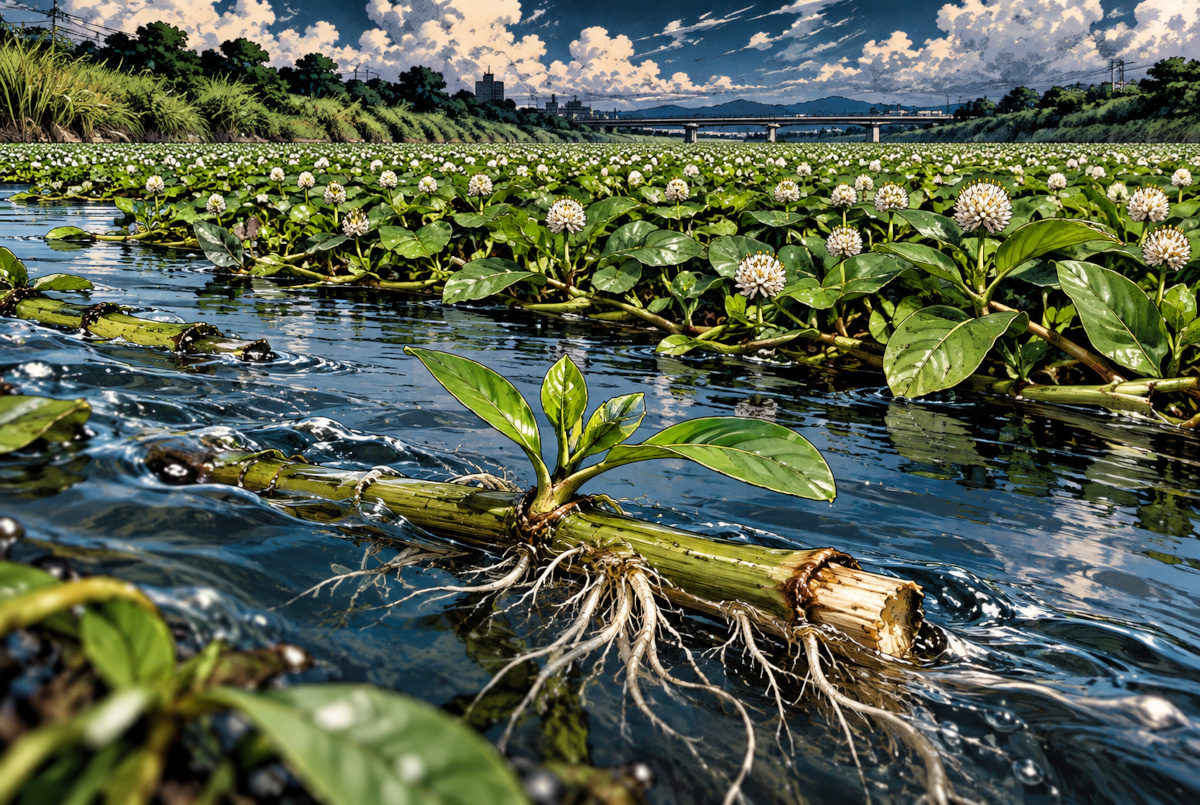
Imagine clearing an invasive weed from a riverbank, only to find fresh roots and shoots emerging from a stem left behind. Now imagine those broken stems floating into the next town.
That is the problem Japan faces with alligatorweed (Alternanthera philoxeroides), a South American plant known locally as nagae-tsurunogeitou.
On October 20, 2026, Japanese broadcaster TV Asahi reported that masses of the plant had washed ashore at Kasai Rinkai Park, a coastal park in Tokyo near the mouth of the Arakawa River.
Park staff had found and removed the weed in August and September. Yet on October 8, they discovered new shoots and roots growing from a stem that had escaped removal.
The trouble is not simply that alligatorweed grows quickly. A fragment can travel downstream, survive, and potentially establish an entirely new infestation.
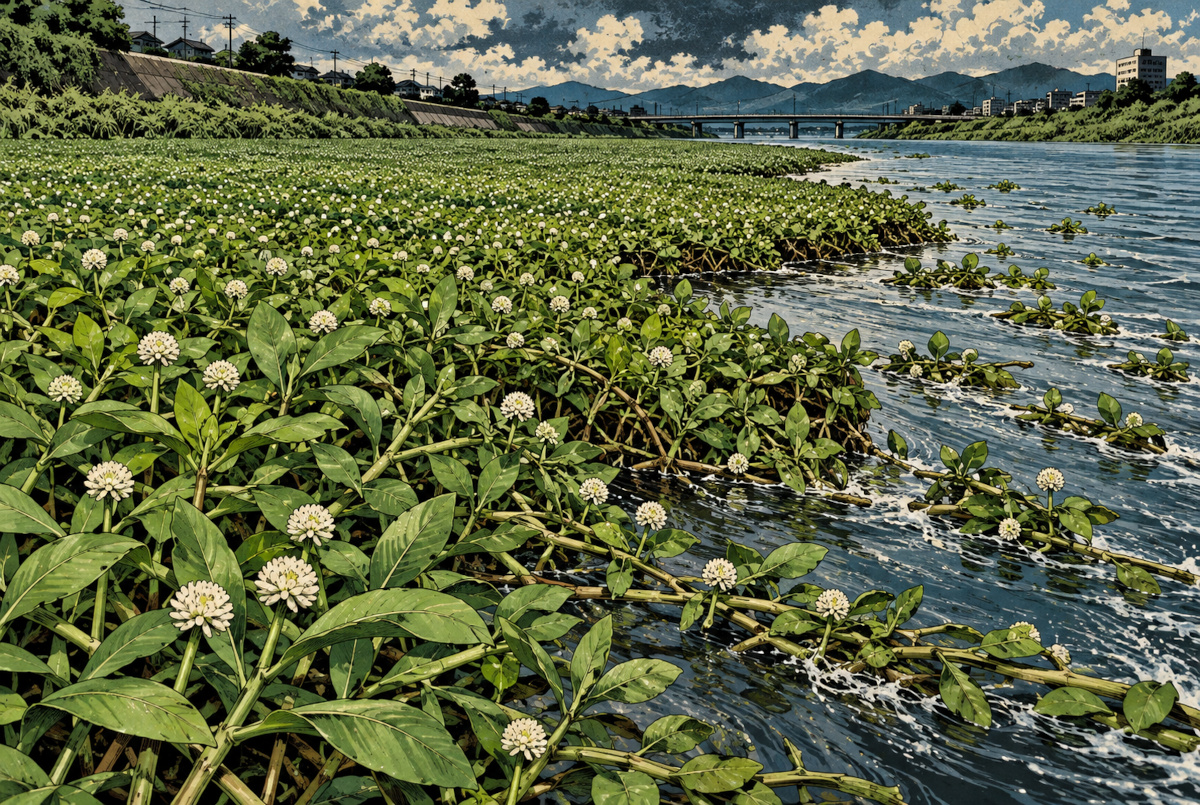
An imagined alligatorweed infestation spreading across a river. This AI-generated illustration does not depict a specific real location.
No Confirmed Seed Reproduction in Japan—Yet Found in 32 Prefectures
Japan’s first recorded established population of alligatorweed was discovered in Amagasaki, Hyogo Prefecture, in 1989.
The National Institute for Environmental Studies suggests that the species was deliberately introduced as an ornamental or aquarium plant before escaping into the wild. The precise date and route of its original introduction remain unknown.
Its subsequent spread is striking.
In a February 2025 research announcement, Japan’s National Agriculture and Food Research Organization (NARO) reported that alligatorweed had been confirmed in 26 prefectures as of December 2024.
Tokyo Metropolitan Government’s revised control guide, issued in February 2026, reported its presence in 32 prefectures.
That is a difference of six prefectures. Using the earlier figure as a baseline:
(32 – 26) / 26 × 100 = approximately 23.1%.
But this is where the numbers need careful handling. The figures come from different publications and reporting dates, not necessarily identical monitoring surveys.
The 23.1% figure describes the difference between two reported counts. It does not mean the area occupied by the plant increased by 23.1%, nor does it prove that all six additional prefectures were invaded during that period. Some populations may simply have been detected later.
There is another remarkable detail: seed reproduction has not been confirmed in Japanese populations.
Instead, alligatorweed spreads primarily through vegetative reproduction. Its creeping, hollow stems break relatively easily, and fragments only a few centimeters long can produce new roots and shoots.
A river can therefore become more than a place where the weed grows. It can serve as a transport network for living pieces of the plant.
Downstream Is Not the Only Direction
The TV Asahi report revealed another complication along Tokyo’s Arakawa River: tidal movement.
Floating alligatorweed can travel downstream with the river current. Near the estuary, however, incoming tides can reverse the direction of the water and carry plant fragments upstream again.
Tokyo’s February 2026 control guide also notes established populations in Saitama Prefecture, farther upstream in the Arakawa river system. Those populations may have contributed to the weed’s spread into Tokyo, although individual source populations have not been conclusively traced.
The guide raises an even more unusual possibility: fragments might travel along the coast on ocean currents and subsequently enter other river mouths during incoming tides.
That possibility should not be confused with a demonstrated dispersal route.
In the October 20 report, a researcher explained that alligatorweed fragments may survive for a time in water with salinity approaching that of seawater. However, evidence demonstrating successful establishment after actual marine drift was still lacking.
Movement through rivers and regeneration after dispersal are documented. Successful colonization of another river system via the open sea remains a possibility requiring further evidence.
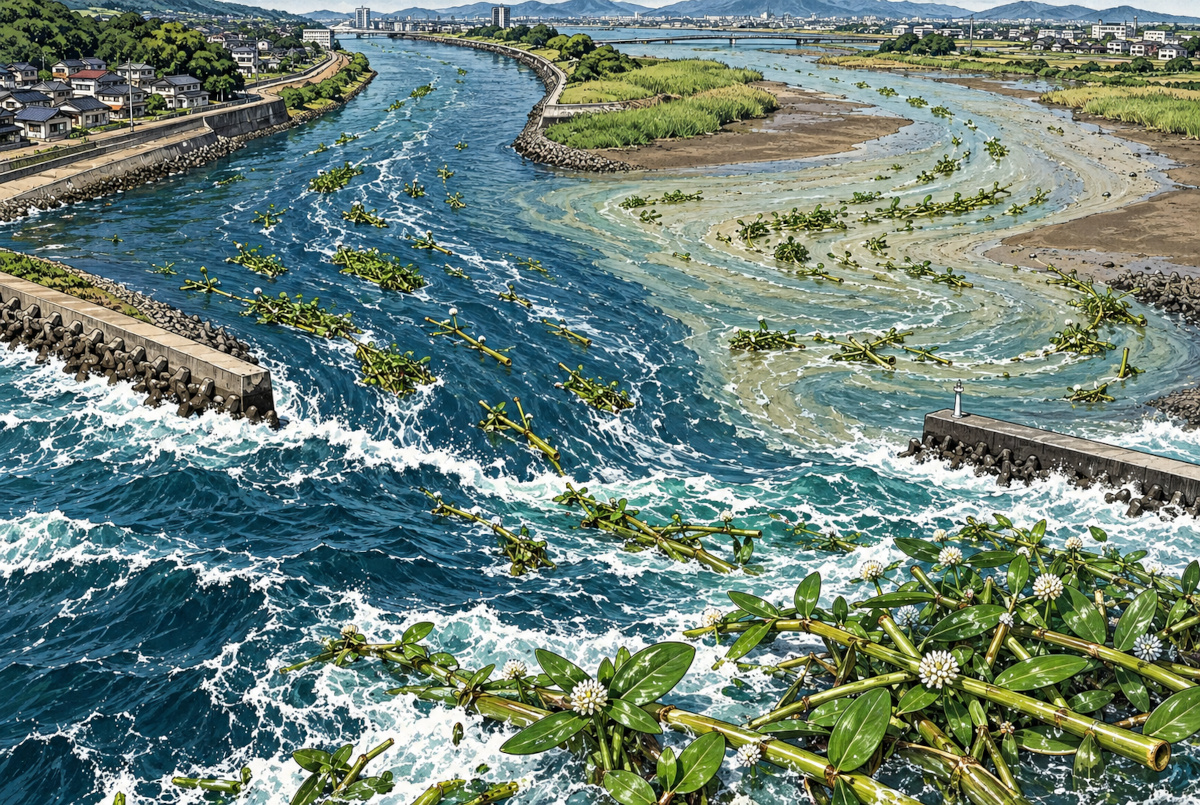
Illustrative representation of river flow and tidal reversal near an estuary. Different current conditions are combined in one scene; this is not an observation of simultaneous flows at a real location. AI-generated illustration.
Can Municipal Weed Removal Actually Make the Problem Worse?
Here is where a botanical problem becomes an administrative headache.
For ordinary roadside vegetation, mowing may be a routine maintenance task. With alligatorweed, simply cutting the visible stems can leave its underground parts intact while producing fragments capable of spreading elsewhere.
Tokyo’s official control guide warns that inappropriate cutting can worsen an infestation. That does not mean removal is a bad idea. It means the method matters: roots must be recovered as thoroughly as possible, and fragments must be prevented from escaping.
Japan’s national removal manual describes using nets or floating barriers downstream of a worksite to catch detached stems.
Then comes the part that caught my attention.
Tokyo’s guide recommends notifying downstream municipalities and facility managers before carrying out removal work.
It is a recommendation, not a blanket legal requirement. But its significance is hard to miss.
A city may complete a perfectly ordinary-looking maintenance operation within its own boundaries, only for escaped fragments to create trouble for another municipality downstream.
In other words, the weed crosses administrative boundaries that the organizations responsible for controlling it cannot simply ignore.
There is also a legal complication. Japan’s Invasive Alien Species Act regulates the keeping and transportation of living specimens of designated invasive species, including alligatorweed.
Removal projects must follow the applicable procedures. Certain small-scale community removal activities have specific conditions under which transportation for disposal is permitted. Work in rivers may also require approval from the responsible river administrator.
It is not merely a matter of pulling weeds and putting them in a truck.
Even the Mud From a Cleared Waterway Can Be a Problem
Another unexpected detail appears in the March 2025 revision of Japan’s national alligatorweed removal manual.
When an infested irrigation or drainage channel is excavated, the resulting dredged sediment can contain living stems and roots.
Moving that sediment elsewhere without effective treatment risks moving the weed with it.
Previously, some projects used prolonged light-exclusion treatment, keeping contaminated sediment covered for approximately two years. That created an obvious practical problem: finding somewhere to store and manage the material for so long.
The revised manual describes a different approach: solar heat treatment of contaminated dredged sediment.
Excavated mud is piled on an impermeable sheet, covered with transparent plastic, and sealed to retain heat. Under suitable summer conditions, the treatment can render the sediment suitable for reuse in approximately one to three months.
That shorter period is not automatic. The manual provides specific conditions:
- Regions with an average August temperature of roughly 29°C or higher are the main candidates for this method.
- Treatment should begin no later than early August.
- The plastic covering must be properly sealed and inspected.
- A cumulative total of at least 200 hours at 40°C or above inside the sediment mound is a benchmark for completing treatment.
- Remaining live plants must be checked before the sediment is reused.
Now compare the treatment periods.
Using the previously reported example of approximately 24 months and the newer range of one to three months:
24 / 3 = 8, while 24 / 1 = 24.
Under suitable conditions, the period for which a treatment site is occupied could theoretically fall to between one-eighth and one-twenty-fourth of the previous example.
This is a comparison of treatment durations, not a measured nationwide reduction in costs or land requirements. The method may be unsuitable for cooler locations, poorly sealed installations, or sites where viable plants remain after treatment.
Still, for a municipality that must reserve land for contaminated sediment, the difference between months and years is hardly trivial.
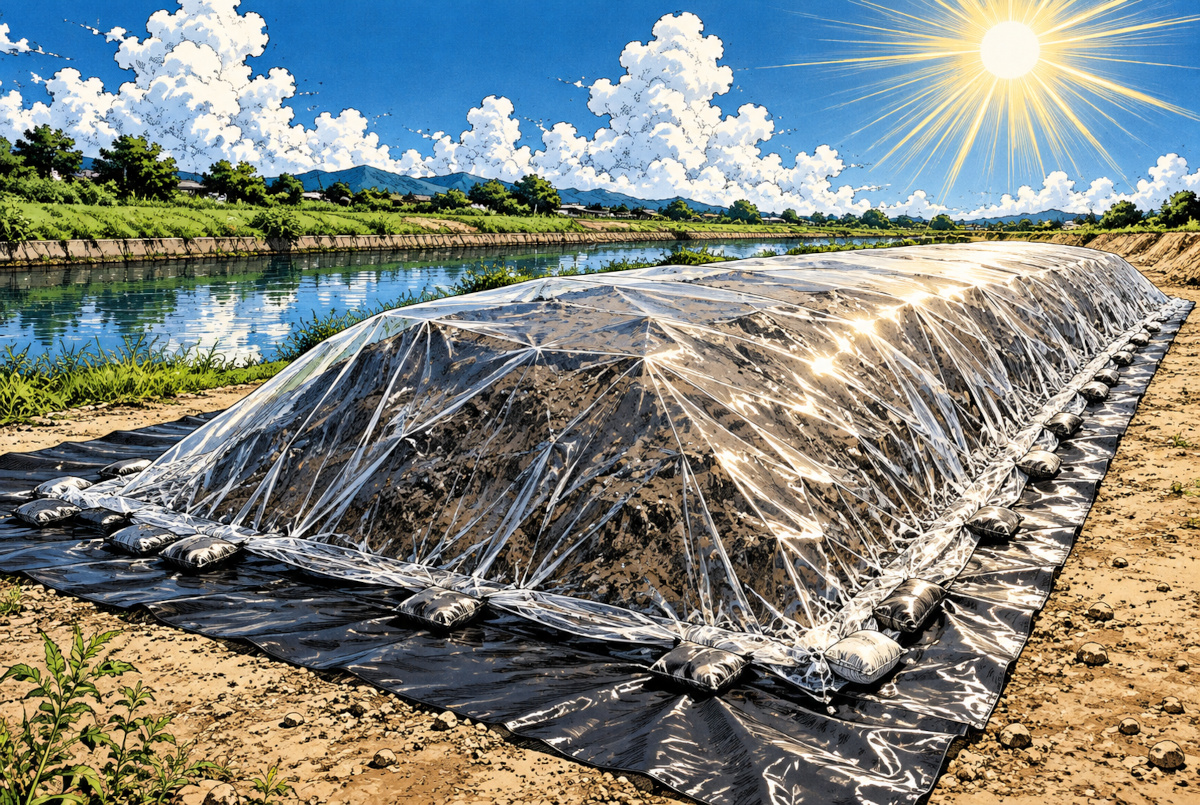
Illustration of solar heat treatment for contaminated dredged sediment. Actual installations require properly sealed sheet edges, temperature monitoring and checks for surviving plants. This is not a photograph or exact reconstruction of a government trial. AI-generated illustration.
Removing the Weed Is Not Enough if You Ignore the River System
Tokyo’s guide emphasizes that recording a newly discovered infestation requires more than noting a location and taking a photograph.
Investigators should also determine whether the plants are merely stranded or have rooted, how extensive the infestation is, and whether it threatens water flow or nearby facilities.
Even places where alligatorweed was not found are worth documenting. Such records help establish when a previously unaffected location may have become infested.
The consequences can extend well beyond the appearance of a riverbank. Alligatorweed can clog screens at pumping stations, invade rice paddies, interfere with boats, and cover muddy habitats used by aquatic organisms.
The real difficulty is not just the plant’s ability to regenerate. It is that rivers, farmland, parks and drainage infrastructure are managed by different organizations, while the weed moves between them.
That makes prevention, removal, disposal and long-term monitoring parts of the same problem.
Editor’s Note
When I first saw the footage, I thought it was simply another story about some troublesome weed floating down a river.
Then I started looking through the official manuals. What a nuisance this thing turns out to be.
It can arrive from upstream, regrow from fragments left behind, and turn an ordinary clearing job into a potential problem for the next town. Even the mud dug out of a drainage channel needs careful handling.
But the detail that really stopped me was Tokyo’s recommendation to notify downstream authorities before removal.
Think about that. You are clearing weeds in your own jurisdiction, yet the manual advises you to tell the people farther downriver first.
Not because the plant understands municipal boundaries, of course. Quite the opposite.
That is what makes this story more than a botanical curiosity. It’s a problem of how public agencies coordinate their work across a connected landscape.
All this trouble over a plant. You have to admire the sheer inconvenience of it.
References
- Tokyo Metropolitan Government, Bureau of Environment, Guide to the Control of Alligatorweed (February 2026, in Japanese) — Prefectural distribution, dispersal through river systems, monitoring, removal procedures and recommended advance notification of downstream authorities.
- Ministry of Agriculture, Forestry and Fisheries; Ministry of the Environment; and National Agriculture and Food Research Organization, Alligatorweed Removal Manual (revised March 2025, in Japanese) — Regeneration from fragments, containment, legal procedures and solar heat treatment of contaminated sediment.
- National Institute for Environmental Studies, Invasive Species Database: Alternanthera philoxeroides (in Japanese) — Native range, biological characteristics, first recorded establishment in Japan and possible introduction pathway.
- National Agriculture and Food Research Organization, Development of Herbicide-Based Control Methods for Alligatorweed in Transplanted Rice Cultivation (February 5, 2025, in Japanese) — Distribution count as of December 2024 and research on control of overwintering underground plant parts.
- TV Asahi, Invasive Plant Spreads in Tokyo Amid Heavy Rain Concerns (October 20, 2026, Japanese news report) — Reports from Kasai Rinkai Park and the Arakawa River, including stem regeneration, tidal movement and the uncertainty surrounding marine dispersal.