

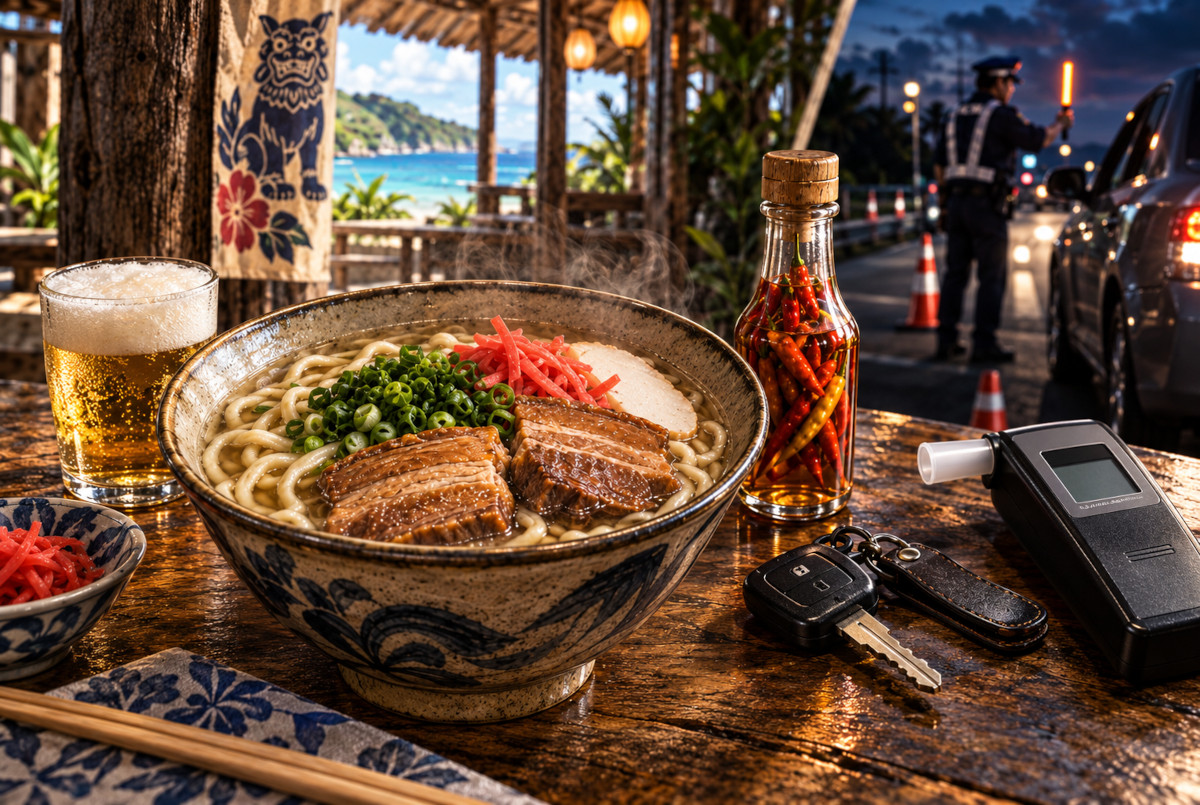
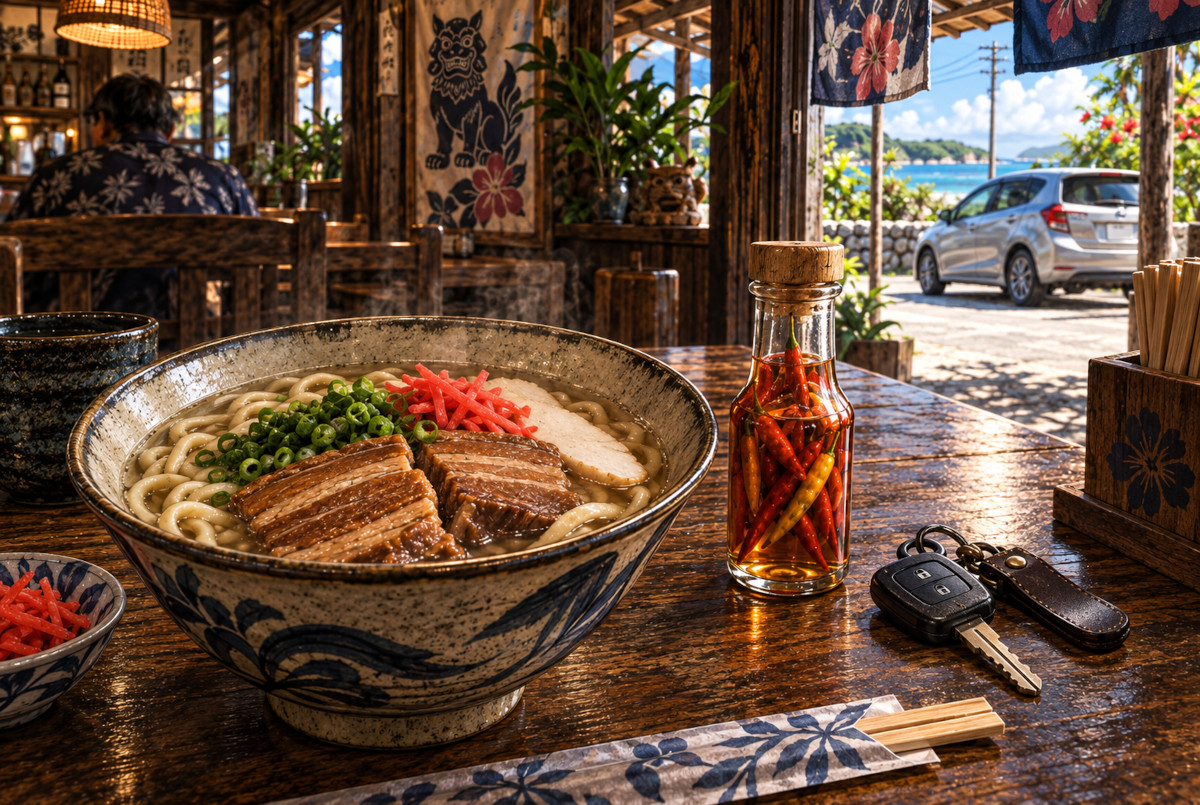
You drive to an Okinawa soba restaurant. Someone offers you a sip of beer, but you turn it down. You are driving, after all. Then you sit down in front of a bowl of Okinawa soba and find a small bottle of koregusu—a traditional condiment made by soaking Okinawan chili peppers in awamori, Okinawa’s distilled rice spirit.
A splash goes into the noodles. Maybe another. And then an awkward question appears: if even a sip of beer is something drivers are expected to avoid, what about pouring an awamori-based condiment over your lunch?
This is more than an odd piece of Okinawan food trivia. It is a small collision between traditional food culture and Japan’s modern, extremely strict approach to drinking and driving. Koregusu looks like a condiment, not a glass of liquor. The law and an alcohol detector, however, are not especially interested in appearances.
For readers unfamiliar with the dish, Okinawa soba is a local noodle soup made with wheat-based noodles rather than the buckwheat noodles usually associated with the word “soba” elsewhere in Japan. Koregusu is one of its classic table condiments, adding both chili heat and the distinctive aroma of awamori.
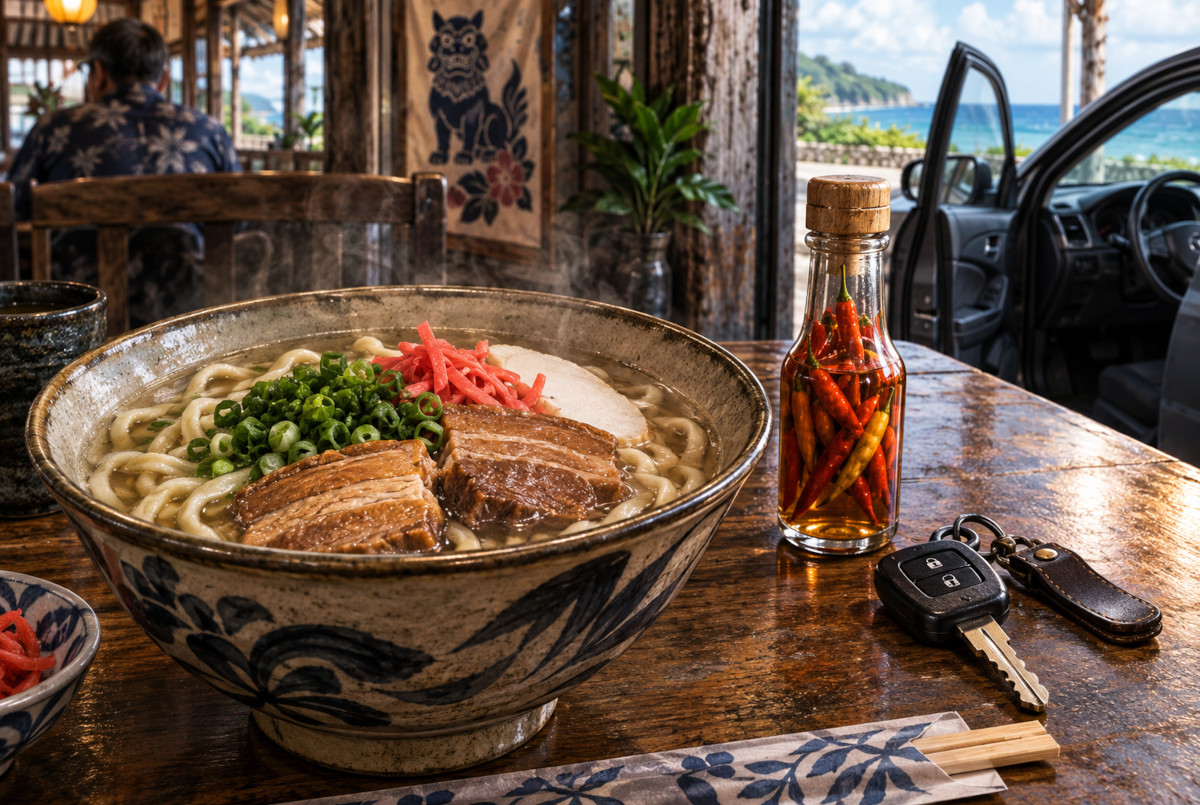 AI-generated illustration based on the subject of this article. It does not depict a specific restaurant or real incident.
Koregusu is more than just hot sauce
The first thing to understand is that traditional koregusu is not simply chili extract mixed with vinegar or water. It is made by steeping Okinawan chili peppers in awamori. Commercial products vary in recipe and alcohol content, but the traditional idea is straightforward: this is a spicy condiment made using an alcoholic spirit.
That distinction matters. Adding koregusu to a bowl of noodles can also mean consuming a food product that contains alcohol. Calling it a condiment does not somehow make the alcohol cease to exist.
Okinawa’s official tourism website, Okinawa Story, even mentions the issue when discussing how local Okinawa soba enthusiasts use koregusu. It describes roughly a capful as a common amount and cautions that using considerably more may lead to an alcohol reading.
That does not mean a few drops of koregusu will automatically put a driver over Japan’s legal enforcement threshold. The amount used is usually small, and any effect will vary with quantity, body size, individual metabolism, whether the person has eaten, and how soon they drive afterward.
But it does mean that the relevant question is not simply whether someone “drank alcohol.” The question becomes whether alcohol is present in the body when that person drives.
Japanese law looks at alcohol in the driver, not the label on the bottle
Japan’s Road Traffic Act states that no person may drive a vehicle while under the influence of alcohol. The National Police Agency goes further in its public explanation, describing drunk driving as driving after consuming not only beer, sake or other alcoholic beverages, but also food or drink containing alcohol while alcohol remains in the body.
In other words, the basic issue is not whether the ethanol came from beer, sake, awamori or a condiment. What matters is the driver’s condition.
Japan’s punishable breath-alcohol threshold for the offense commonly described as shuki-obi unten—driving with alcohol present—is 0.15 mg of alcohol per liter of breath. A reading from 0.15 mg/L to below 0.25 mg/L carries 13 administrative points, while 0.25 mg/L or more carries 25 points and, under standard circumstances, can result in license revocation.
The National Police Agency also notes that driving while alcohol is present remains prohibited even below the 0.15 mg/L punishment threshold.
There is one important distinction here. A single sip of beer does not automatically mean that every person will immediately produce a reading of 0.15 mg/L or more. The reason Japanese drivers are generally told to avoid even “just one sip” is much simpler: a driver cannot reliably calculate his or her own breath-alcohol concentration in advance.
That is where koregusu creates an unusual psychological blind spot. People instinctively treat a beer glass as alcohol. A bottle sitting among the seasonings on a restaurant table feels like food. Chemically, however, the body does not care which shelf the product came from.
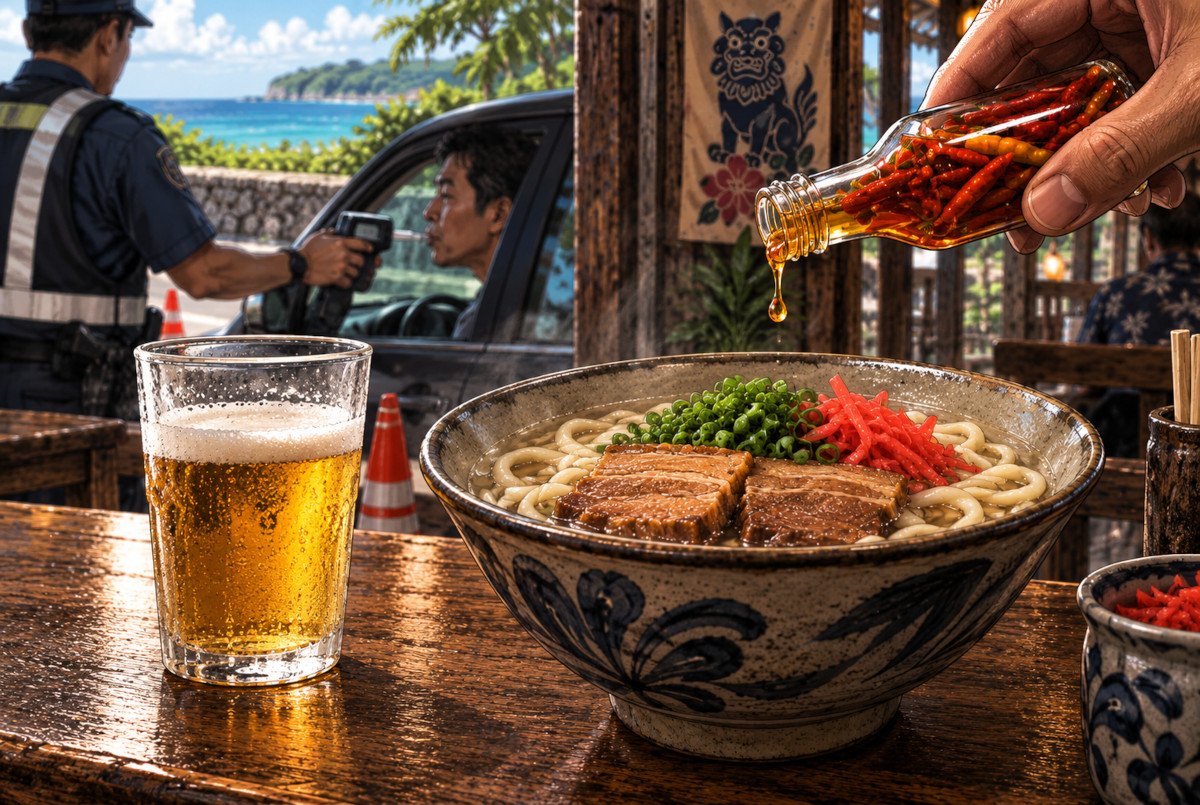 AI-generated conceptual illustration. The beer and koregusu shown here are not intended to represent equal amounts of alcohol.
Would Okinawa police make an exception for traditional food culture?
This is where the question becomes especially interesting. Koregusu is not some novelty created for tourists. It is part of everyday Okinawan food culture. So would the Okinawa Prefectural Police treat it more leniently because it is a traditional condiment?
There is no cultural exemption in the Road Traffic Act for regional dishes or traditional seasonings. Nothing in the rules suggests that alcohol stops counting because it arrived at the table as part of local food culture.
The Okinawa Prefectural Police also maintains dedicated drunk-driving prevention programs and publishes annual analyses of drunk-driving enforcement and incidents. Okinawa’s relationship with alcohol is not treated as a reason to relax enforcement; if anything, drinking and driving is a particularly visible road-safety issue in the prefecture.
So imagine a driver leaving an Okinawa soba restaurant and then being stopped after an accident or traffic violation. If a breath test shows alcohol above the relevant threshold, saying, “I didn’t drink awamori—I only put koregusu on my noodles,” would not by itself change the breath-test standard.
The important question for police would not be whether the source was culturally traditional. It would be what condition the person was actually in while driving.
The tricky part: food can temporarily affect an alcohol detector
There is another complication. A breath alcohol detector does not always tell a simple story immediately after someone has eaten.
Japan’s Ministry of Land, Infrastructure, Transport and Tourism explains in guidance for commercial vehicle operators that foods and other substances—including fermented foods and even some types of gum—can sometimes cause an alcohol detector to respond. Its guidance recommends rinsing the mouth and waiting for a short period before testing again when food is suspected of influencing the result.
This means a detector reacting immediately after a meal is not necessarily identical to alcohol that has already been absorbed into the bloodstream and is being expelled through the lungs. Residual alcohol or other substances in the mouth can matter, especially immediately after consumption.
But this should not be turned into a convenient loophole. The fact that “mouth alcohol” can affect a detector does not mean every positive result after koregusu is a false positive. Alcohol that is actually swallowed can be absorbed into the body, and the result will depend on the amount consumed, timing, metabolism and other factors.
“A food product may temporarily affect an alcohol detector” and “it is safe to drive” are two entirely different statements.
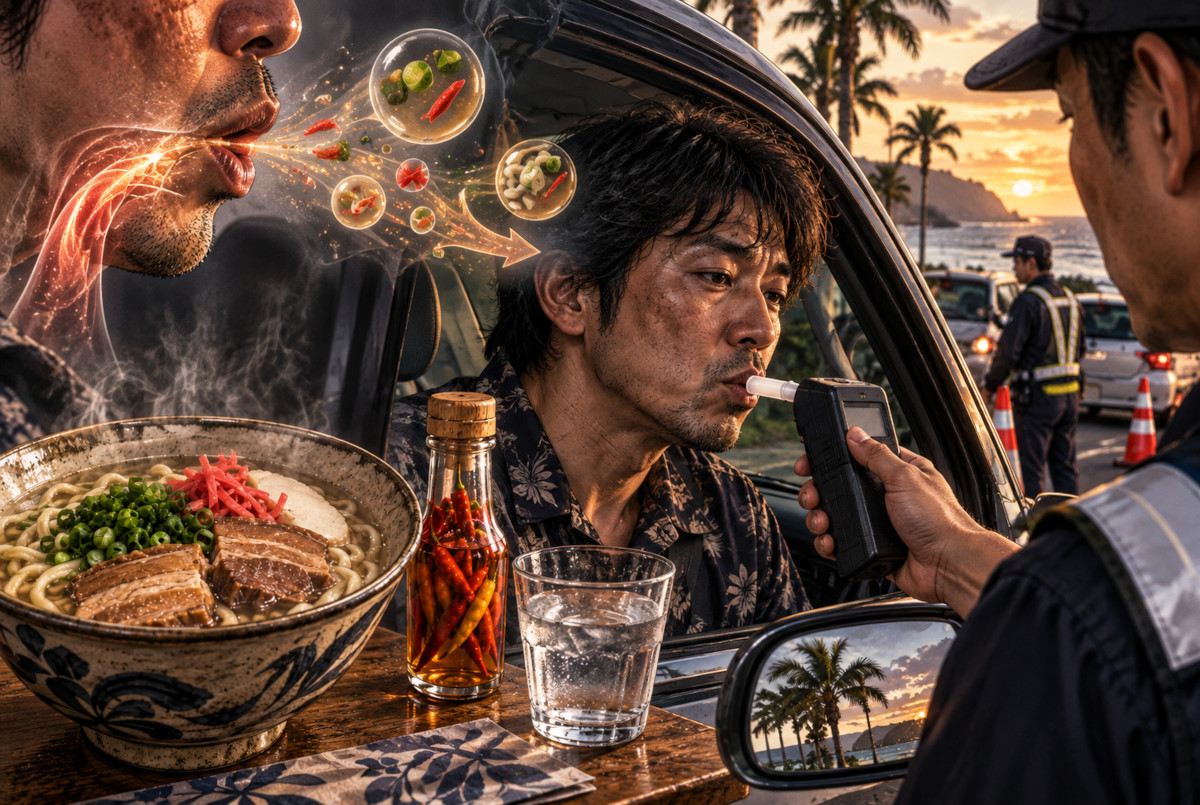 AI-generated conceptual illustration. The visible particles are symbolic and do not represent the literal physical movement of food through exhaled breath.
There has actually been an arrest where koregusu was offered as the explanation
This is not purely theoretical.
In a 2023 article, Okinawan newspaper Ryukyu Shimpo recalled a 2019 case in Okinawa City involving a then-17-year-old boy who was arrested on suspicion of riding a motorcycle while alcohol was present in his system.
According to the report, the boy denied the allegation and said that he had “used a large amount of koregusu when eating soba.” His breath alcohol reading was reportedly about twice the legal threshold.
There is an important limit to what can be concluded from that case. The report does not establish that koregusu alone caused the breath reading. What is confirmed is that the arrested rider cited heavy use of koregusu while denying that he had been drinking.
That distinction matters. Otherwise the story turns from an interesting documented case into an unsupported claim that eating heavily seasoned Okinawa soba will automatically produce an illegal breath-alcohol level.
Still, the case demonstrates that the strange boundary between “food” and “alcohol” has already appeared in a real drunk-driving investigation in Okinawa.
The bigger problem is assuming that “food doesn’t count”
Koregusu is not the only product sitting on this border. Japan has narazuke, vegetables preserved in sake lees; sweets and cakes made with rum or brandy; foods containing sake lees; and numerous desserts flavored with alcoholic spirits. Other countries have their own equivalents, from rum cake to liqueur-filled chocolates.
None of this means such foods are inherently dangerous or should be treated like bottles of liquor. That would be absurd. Their role is culinary, and in ordinary portions the amount of alcohol may be small.
The more interesting point is that traditional food cultures developed long before modern societies adopted extremely strict drink-driving rules and widespread breath testing. Put those two systems together, and odd gray areas appear.
Koregusu makes that conflict unusually visible. A driver may refuse even a taste of beer without hesitation, then casually reach for a condiment whose defining ingredient is awamori.
The sensible approach is not to panic about Okinawa soba. It is simply to stop assuming that something becomes irrelevant to driving rules merely because it is sold as food. If you are about to drive and you are unsure how much alcohol a condiment or dessert contains, the safest option is the boring one: skip it.
 AI-generated illustration based on the theme of this article. It does not depict a specific restaurant, rental-car company or real incident.
Editor’s Note
I spent about six months living in Okinawa, and koregusu was never some exotic tourist gimmick to me. Even casual family restaurants could put it on the table when you ordered Okinawa soba. I like spicy food, so my instinct was always to add a little more.
But when I had driven to the restaurant, my hand would sometimes stop. “If I keep pouring this stuff in, am I going to regret it when I get back in the car?” I would think. I would never have considered drinking a beer before driving, yet the same caution suddenly became fuzzy when the alcohol arrived disguised as seasoning.
I do not think traditional food culture is the problem, and I certainly do not want koregusu treated like some dangerous substance. What interests me is the awkward point where an old, perfectly ordinary habit meets a modern rule that leaves almost no room for casual judgment. It feels slightly restrictive—but it is exactly in those little collisions between old common sense and new rules that everyday life becomes surprisingly complicated.
References
- National Police Agency of Japan, “Everyone Together: Never Drink and Drive, Never Let Others Drink and Drive”
https://www.npa.go.jp/bureau/traffic/insyu/info.html - e-Gov Law Search, Road Traffic Act, Article 65: Prohibition of Driving Under the Influence of Alcohol
https://laws.e-gov.go.jp/law/335AC0000000105 - Ministry of Land, Infrastructure, Transport and Tourism, “Use of Alcohol Detectors in Commercial Motor Vehicle Operations”
https://www.mlit.go.jp/jidosha/anzen/03alcohol/ - Okinawa Prefectural Police, “Analysis Based on the 2025 Drunk-Driving Survey”
https://www.police.pref.okinawa.jp/docs/2026041000012/ - Okinawa Story, Official Okinawa Tourism Information, “Okinawa Soba Enthusiasts Share How They Enjoy Their Soba”
https://www.okinawastory.jp/news/tourism/4459 - Ryukyu Shimpo, report discussing a drunk-driving arrest and the earlier 2019 case in which a rider cited heavy use of koregusu
https://ryukyushimpo.jp/news/entry-2560391.html