

For 33 years, Jensen Huang and NVIDIA were practically inseparable. The black leather jacket, the GeForce GPUs, the spectacular keynote presentations—Huang was the face of one of the world’s most influential technology companies.
Then, on November 12, 2026, NVIDIA announced that its co-founder had resigned as CEO. An extramarital affair had become public, and reports had also raised concerns about a possible foreign intelligence operation.
What happens to GeForce when the man who built NVIDIA suddenly leaves? And just how dominant is the company in the first place? We checked the official records and GPU market data. The results were rather more peculiar than expected.
From an Apology to Resignation in Three Days
On November 8, Huang sent a message to NVIDIA employees acknowledging that he had been unfaithful to his wife and apologizing for his actions.
On the same day, NVIDIA’s board announced an independent investigation following reports that Huang had been targeted by a foreign intelligence effort.
The board stressed that it had no reason at that point to believe US national security or NVIDIA’s confidential information had been compromised. It also expressed confidence in Huang and his leadership team.
But the company’s filing with the US Securities and Exchange Commission (SEC) reveals an extraordinary timeline. The board accepted Huang’s resignation on November 11, effective immediately.
Just three days after publicly expressing confidence in its leadership, NVIDIA had lost the founder who had run the company since 1993.
The resignation was formally announced on November 12. Chief Financial Officer Colette Kress became interim CEO, and NVIDIA shares closed 4.3% lower that day, according to Reuters.
There is an important distinction here. Neither the SEC filing nor NVIDIA’s CEO transition announcement specifies the reason for Huang’s resignation. Nor has the reported foreign intelligence connection established that espionage occurred or confidential information was leaked. The admitted affair and the unresolved national security questions should not be treated as the same thing.

AI-generated editorial illustration. This is not a depiction of Huang’s actual departure, NVIDIA’s offices, or real historical stock-price movements.
NVIDIA Has 90% of the Graphics Card Market. So Why Is Intel No. 1?
According to Jon Peddie Research (JPR), NVIDIA accounted for approximately 90% of worldwide desktop graphics add-in board shipments in the second quarter of 2026. AMD held roughly 8%, while Intel managed just 2%.
If you’re a PC enthusiast shopping for a dedicated graphics card, that probably comes as no surprise. GeForce dominates this market.
But look at another JPR report, covering the broader PC GPU market—including integrated graphics built into processors and GPUs used in laptops—and the picture changes dramatically.
| Manufacturer | Desktop Graphics Cards | All PC GPUs |
|---|---|---|
| NVIDIA | 90% | 23% |
| AMD | 8% | 21% |
| Intel | 2% | 56% |
Source: Jon Peddie Research, Q2 2026. Approximate shares of units shipped, rounded to whole percentages. The two columns cover different market definitions.
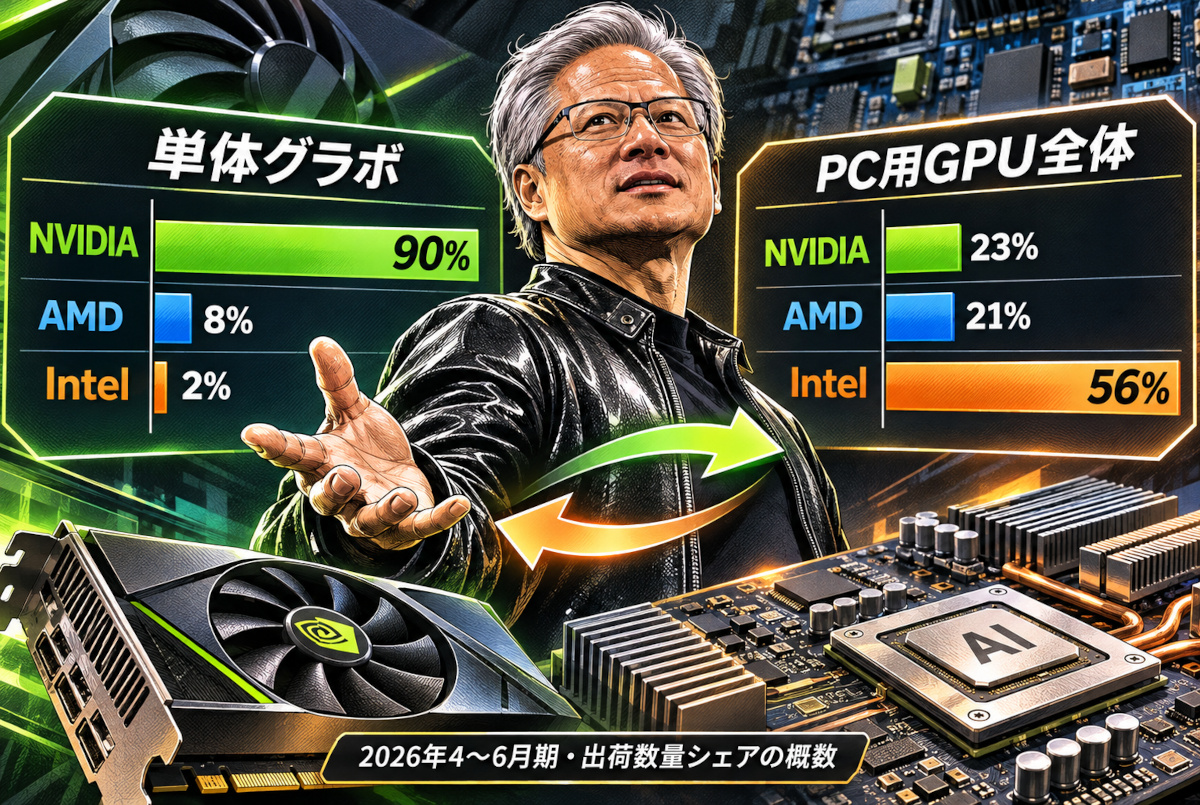
Independent comparison based on JPR’s Q2 2026 figures. The illustration retains Japanese chart headings: dedicated desktop graphics cards on the left and all PC GPUs on the right. Percentages are approximate, and bar lengths are schematic. The people and hardware are illustrative; this is not an official JPR chart.
Now for a little arithmetic.
In the desktop graphics card market, NVIDIA’s share was 45 times Intel’s, using the rounded figures: 90 ÷ 2 = 45.
But across the entire PC GPU market, Intel’s share was approximately 2.4 times NVIDIA’s: 56 ÷ 23 ≈ 2.43.
Same industry, same quarter, different definition—and suddenly a different company is in first place.
The explanation is integrated graphics. Intel supplies huge numbers of processors with built-in GPUs. These count in the broader market, but they are not separate graphics cards that someone can buy and install in a desktop PCIe slot.
How Many Graphics Cards Are We Actually Talking About?
JPR reported approximately 12.5 million desktop graphics add-in boards shipped worldwide in Q2 2026. Applying NVIDIA’s rounded 90% share gives:
12.5 million × 90% = approximately 11.25 million NVIDIA graphics cards.
The broader PC GPU market reached approximately 75.5 million units during the same quarter. Applying Intel’s rounded 56% share produces:
75.5 million × 56% = approximately 42.28 million Intel GPUs.
Both figures are our calculations using JPR’s published shipment totals and rounded market shares, not exact unit counts reported by NVIDIA or Intel.
There’s another trap here: these two numbers do not describe equivalent products or identical groups of PCs. A machine can have integrated graphics and a discrete GPU, while an integrated GPU is generally part of a larger processor package.
For browsing, office work and everyday video playback, integrated graphics are often enough. That doesn’t make them automatic replacements for high-end GeForce cards in demanding games or GPU-heavy workloads.
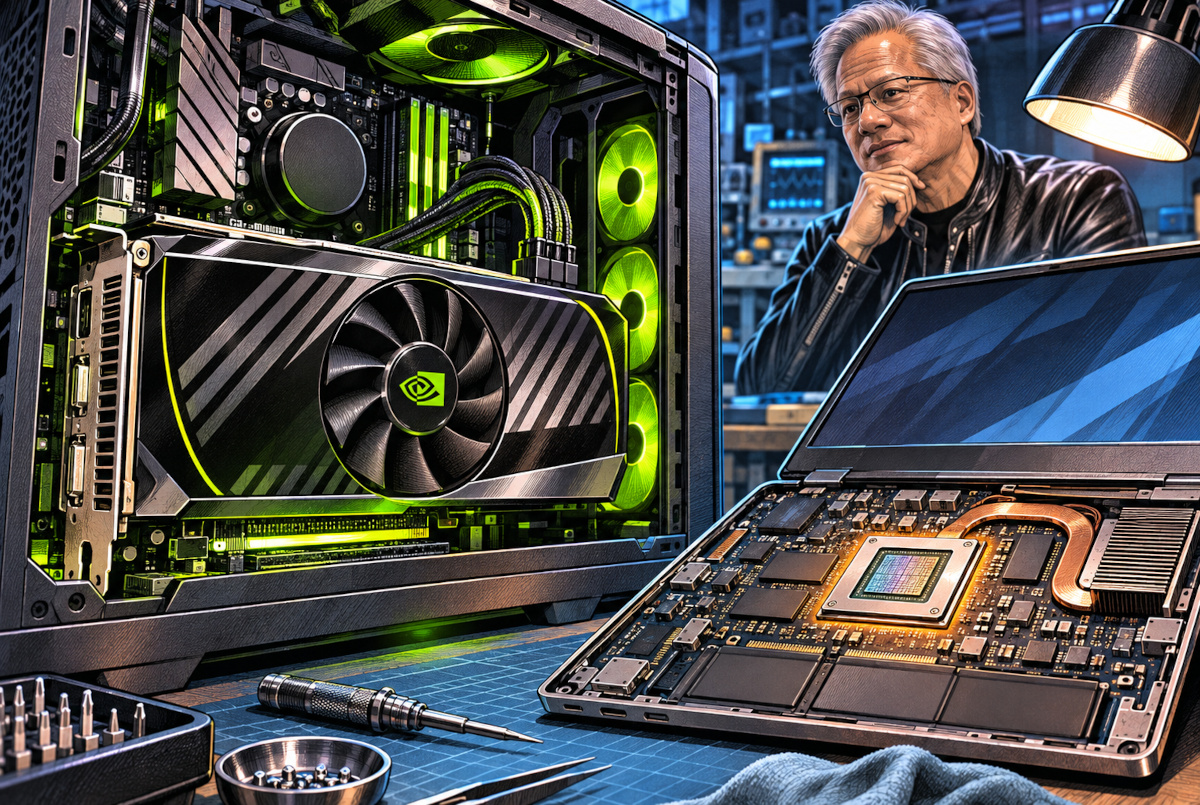
AI-generated hardware illustration. The components are schematic rather than an exact teardown of a specific commercial product. Some laptops also include discrete GPUs. The person and workshop are fictional.
Does Losing the Founder Mean Losing the Technology?
NVIDIA has said it expects business operations, customer commitments and its product roadmap to continue without interruption under the new leadership team.
And that makes sense. A CEO’s resignation doesn’t erase a company’s GPU architectures, engineering staff, CUDA software platform or years of accumulated driver development.
Still, replacing a founder’s judgment, relationships and strategic direction is another matter. Those qualities cannot simply be transferred along with the CEO title.
A company’s engineering strength and its leadership risk are not the same thing.
Editor’s Note
If an executive’s affair could reduce GPU performance, hardware reviewers would have one very strange new benchmark to add to their charts.
Of course, silicon doesn’t care about scandals. Investors certainly do. A company can have serious problems at the top without its graphics cards suddenly becoming rubbish.
What bothers me more is that NVIDIA can dominate 90% of one GPU market while Intel leads another. Both headlines are defensible, but only if you read the small print about what was counted.
So whenever someone says NVIDIA owns the GPU market, my first question is going to be: Which GPU market?
And if NVIDIA graphics cards really became unavailable, could AMD and Intel fill the gap? That’s the question we’ll put to the numbers in Part 2.
NVIDIA: Three-Part Series
From the resignation of NVIDIA's founder and CEO to the global GPU market, AMD and Intel competition, and the dependence of AI infrastructure on NVIDIA. Three articles examine the technology, market data, and the challenges of replacing NVIDIA hardware.
- Part 1: NVIDIA’s CEO Is Out. Why Does Intel Lead the PC GPU Market? (Part 1)
- Part 2: English edition Coming soon
- Final Part: English edition Coming soon
References
- NVIDIA, “A Message to Our Company” (November 8, 2026) — Jensen Huang’s apology to employees and statement concerning the investigation.
- NVIDIA, “Statement From NVIDIA Board of Directors” (November 8, 2026) — Announcement of the independent investigation and the board’s initial expression of confidence.
- US Securities and Exchange Commission, NVIDIA Form 8-K (filed November 12, 2026) — Official disclosure that the board accepted Huang’s resignation on November 11, effective immediately.
- NVIDIA, “NVIDIA Announces CEO Transition” (November 12, 2026) — Appointment of Colette Kress and plans to continue operations and product development.
- Jon Peddie Research, “Q2’26 PC Graphics AIB Shipments” (September 9, 2026) — Desktop add-in graphics board shipment totals and market shares.
- Jon Peddie Research, “PC GPU Shipments Increased 10.4% Q-Q, Up 1.1% Y-Y” (September 3, 2026) — Worldwide PC GPU shipments and market shares across integrated and discrete graphics.
- Reuters, “Nvidia CEO Jensen Huang Resigns in Blow to AI Boom He Helped Foster” (November 12, 2026) — Reporting on the resignation, surrounding allegations and stock market reaction.