

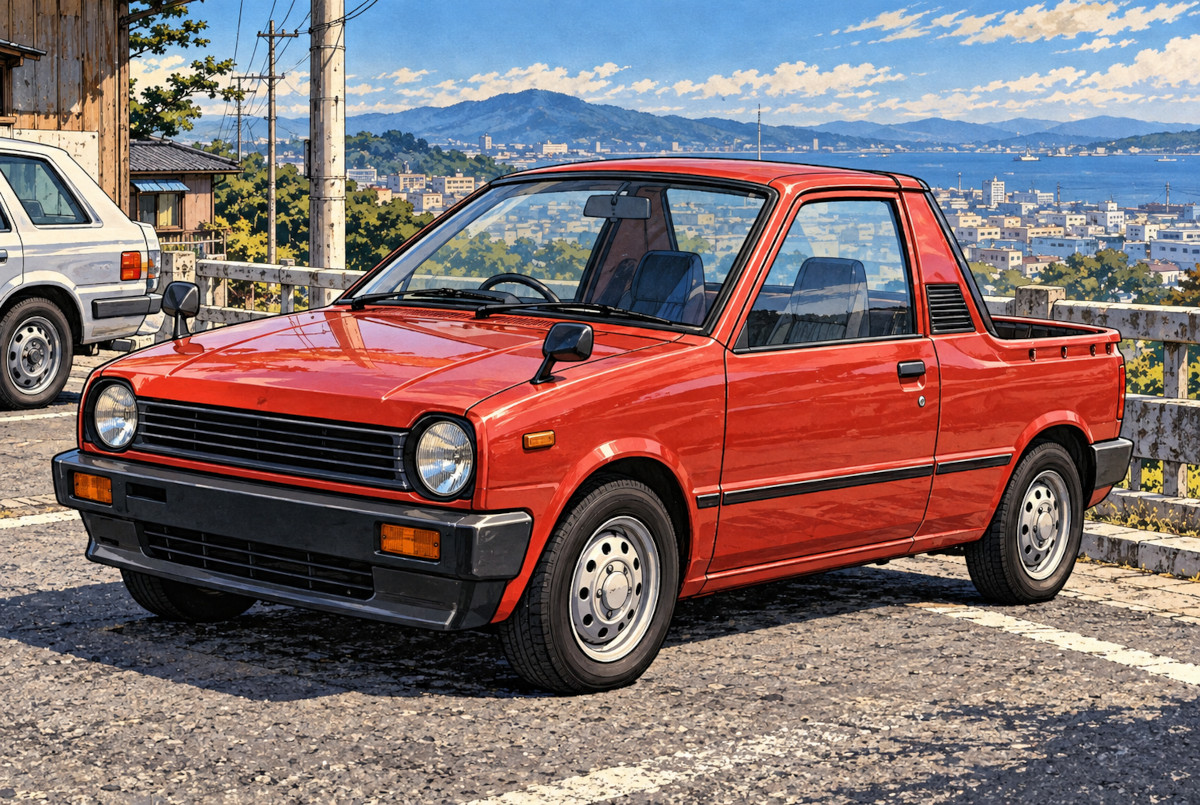
A cargo bed just 660 mm—about 26 inches—long. Two seats. A 543 cc engine making 28 PS. A maximum payload of 200 kg. And a starting price of just ¥450,000.
On paper, the Suzuki Mighty Boy is a difficult car to explain. Launched in Japan in February 1983, this tiny pickup—often affectionately nicknamed “Ma-bo” in Japan—was neither a proper kei truck nor a conventional coupe. Yet that awkward middle ground was exactly the point. The Mighty Boy was not a work truck made stylish. It was a coupe-like personal car turned into a commercial vehicle with just enough open cargo space for play.
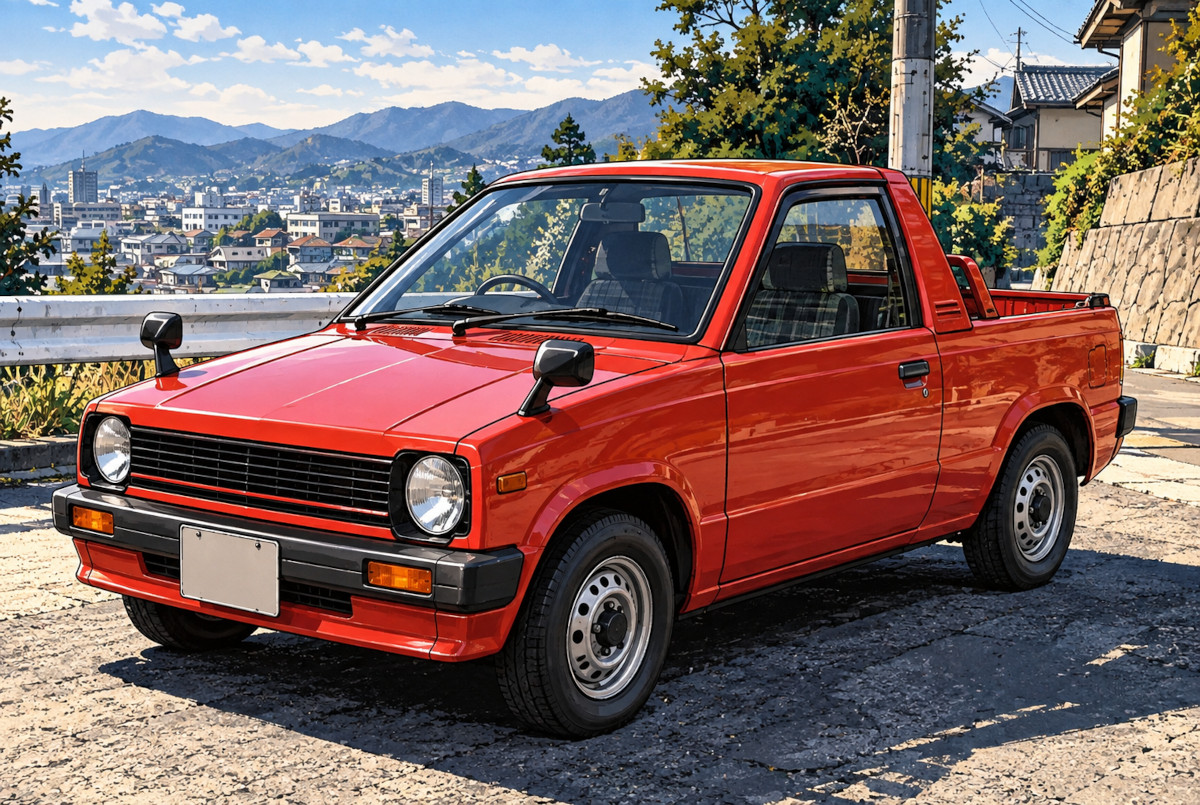 AI-generated illustration inspired by an early 1983 Suzuki Mighty Boy. Trim details and exterior features may differ from the actual production car.
¥450,000 Was Not Merely “Cheap”
The second-generation Suzuki Cervo, on which the Mighty Boy was based, started at ¥580,000. The Mighty Boy started at ¥450,000—a difference of ¥130,000, or roughly 22 percent.
For another comparison, Honda launched the Ballade Sports CR-X 1.3 in 1983 at a Tokyo price of ¥993,000. The two cars were in completely different performance classes, of course, but the price gap is still revealing: one CR-X cost about as much as 2.2 base Mighty Boys.
And Suzuki did not simply strip everything out and bolt on a box. Within Japan’s then-current kei-car dimensions—3,195 mm long and 1,395 mm wide—the Mighty Boy retained two reclining seats and useful storage behind them, with a short open bed at the rear. If cargo efficiency were the main goal, the design would make little sense. But that was not the goal.
The 660 mm bed makes more sense if you stop thinking of it as a truck bed and start thinking of it as the part of a personal car where dirty, awkward or recreational gear could live outside the cabin.
The ¥470,000 Alto Had Already Shown the Way
The Mighty Boy did not appear from nowhere. In 1979, Suzuki launched the original Alto at just ¥470,000.
The key idea behind the Alto was particularly Japanese: it looked and behaved much like a small passenger car, but it was officially classified as a kei commercial vehicle. At the time, Japan’s old commodity-tax system treated commercial vehicles more favorably than passenger cars, helping Suzuki keep the price remarkably low. The Alto became a major success and helped establish the kei “bonnet van” as a category of its own.
There is an important tax detail here. When the Alto debuted, kei commercial vehicles were exempt from commodity tax. After bonnet vans became popular, however, a 5.5 percent commodity tax was imposed on them from 1981. So it would be wrong to say that the Mighty Boy cost ¥450,000 simply because “commercial vehicles paid no tax.”
What survived was the product philosophy: use commercial-vehicle rules and proven components to build an inexpensive personal car. The Alto used that idea for practical transportation. The Mighty Boy pushed it toward recreation and style.
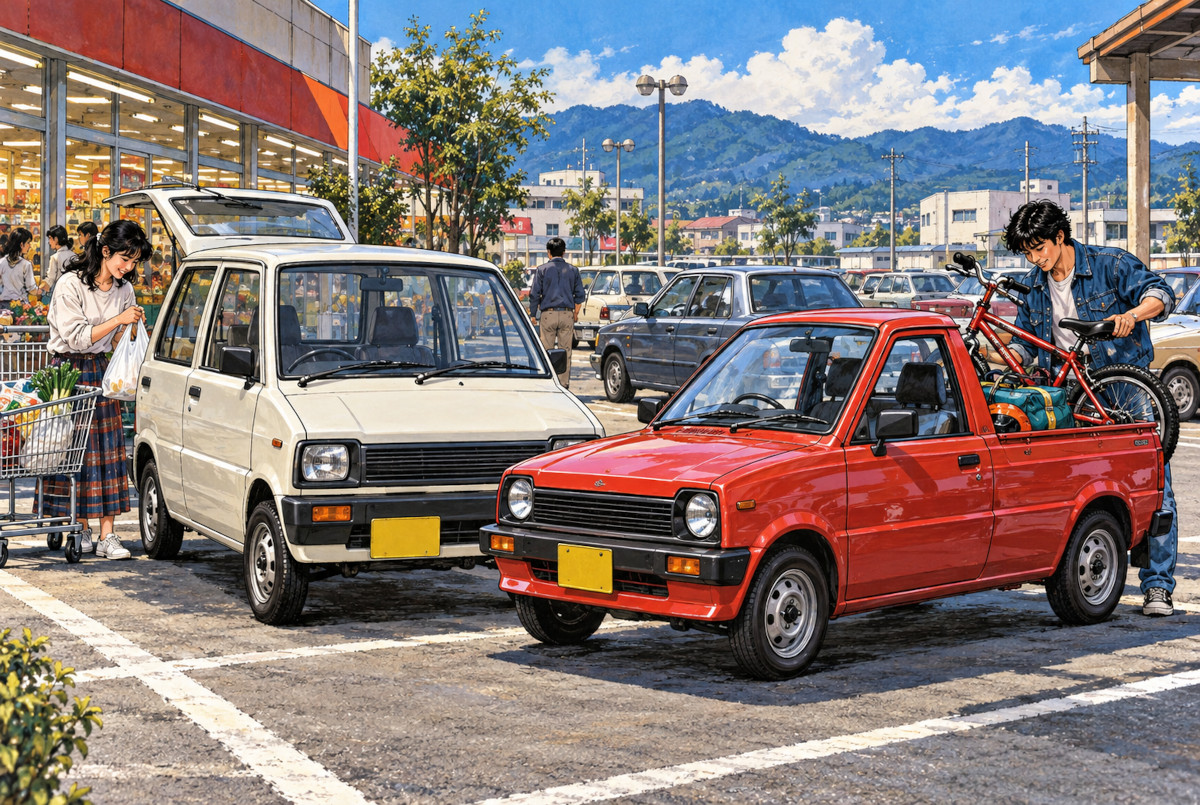 AI-generated illustration showing the different roles of early-1980s kei bonnet vans and the Mighty Boy. The vehicles, trim levels and exterior details are not exact reproductions of specific production models.
28 PS Sounds Slow—Until You Notice the Weight
The Mighty Boy used Suzuki’s 543 cc F5A three-cylinder engine, producing 28 PS. Read that figure from a modern perspective and the car sounds painfully slow.
But a representative early version weighed only about 520 kg. Divide that by 28 PS and you get roughly 18.6 kg per horsepower. The important number is not only “28 PS.” It is also “520 kg.”
A contemporary CAR and DRIVER road test praised its maneuverability and light feel in ordinary driving, and found that it was not unduly strained at typical highway speeds. The same test recorded fuel economy of 22.35 km/L.
No one should compare its safety, refinement or performance directly with a modern car. But judging the Mighty Boy only by its horsepower misses what lightweight cars of that era were like.
It Was Not a Product of the Bubble Economy
Looking back at Japanese cars from the 1980s, it is tempting to explain every strange model the same way: Japan was getting rich, manufacturers had money to experiment, and buyers were willing to try odd things.
That explanation does not fit the Mighty Boy very well.
It went on sale in February 1983. According to the Cabinet Office’s official business-cycle reference dates, February 1983 was actually the trough of Japan’s ninth postwar business cycle. The expansion associated with the later bubble-era boom did not begin until November 1986.
In other words, the Mighty Boy was not born because money was overflowing.
The early 1980s were instead a period when Japanese manufacturers were finding increasingly inventive ways to make modest cars interesting. Honda had launched the City. The CR-X arrived in 1983. Suzuki itself introduced a turbocharged Cervo. Against that background, the Mighty Boy took a different route: not more power, not luxury, but “cheap without being ordinary.”
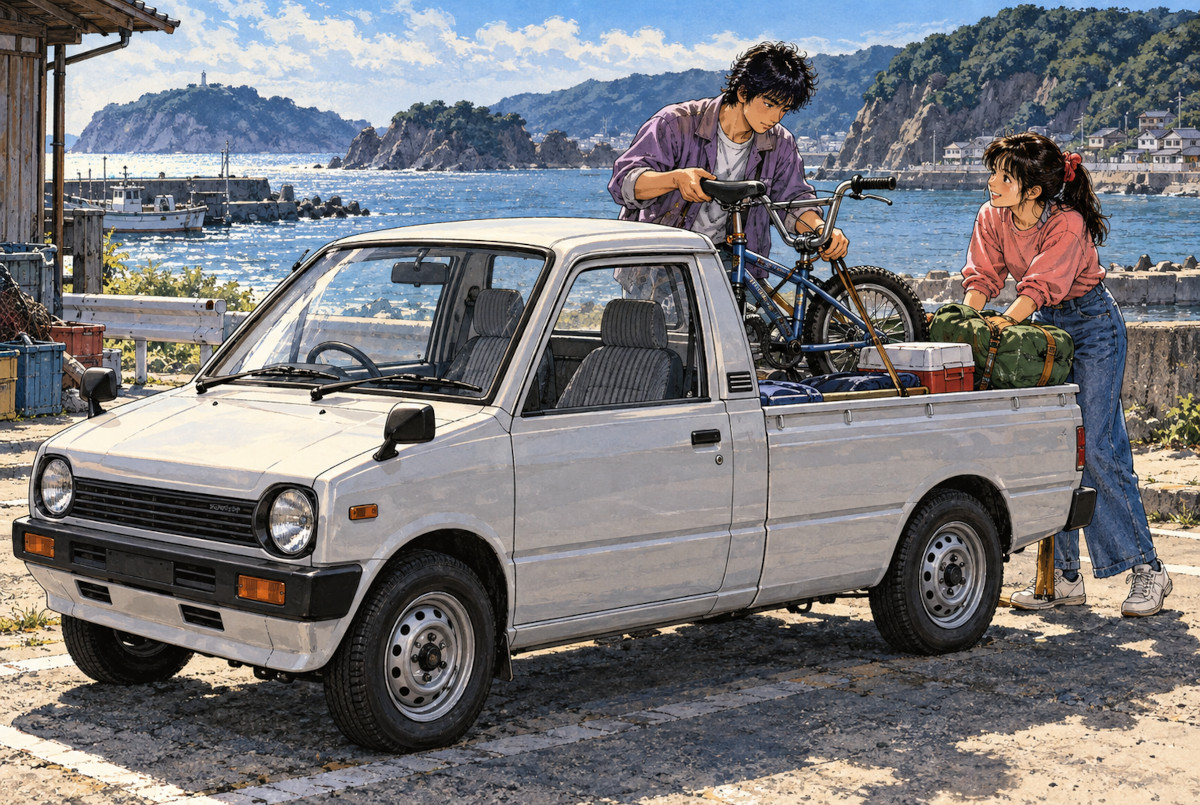 AI-generated illustration of young people using a Mighty Boy for recreation around 1983. The real Mighty Boy had a 660 mm cargo bed; the vehicle proportions and loading arrangement shown here are not exact reproductions.
Suzuki’s own historical material is unusually direct about the concept. It describes the Mighty Boy as an “American-style fun car” aimed at people who wanted to “stand out without spending much money.”
That may be the best explanation of the car. It did not need a large engine, turbocharging, rear seats or serious cargo capacity. It was for someone who did not have much money but still refused to drive something ordinary. Suzuki tried to satisfy that person for ¥450,000.
Editor’s Note
My first assumption was the obvious one: a car this strange could only have existed because Japan in the 1980s had enough money and optimism to let manufacturers fool around.
Then I checked the date. February 1983 was the bottom of a business cycle.
That changes the whole character of the Mighty Boy. It was not interesting because Suzuki had money to waste. It was interesting because Suzuki was trying to create personality without spending money. A familiar engine, a tiny body, two seats, a very short bed—and somehow the result became more memorable than many cars that were faster, more practical and far more expensive.
I do not think modern cars are simply “boring.” Safety, emissions and equipment expectations are completely different now, and a ¥450,000 new car is no longer a realistic comparison. What feels missing is something else: a product designed to let people with very little money still be a little silly with their car. That may be what people actually miss when they look at the Mighty Boy today.
References
- Suzuki Digital Library — Cervo / Mighty Boy
- Suzuki History — 1983 Mighty Boy historical material (Japanese)
- Suzuki Digital Library — Alto
- Suzuki 100-Year History, Part 2 (Japanese PDF)
- Economic and Social Research Institute, Cabinet Office — Business Cycle Reference Dates
- Honda — Launch of the Honda City and Motocompo, October 29, 1981
- Honda — Launch of the Ballade Sports CR-X, June 23, 1983
- CAR and DRIVER — 1983 Suzuki Mighty Boy (M-SS40T)