

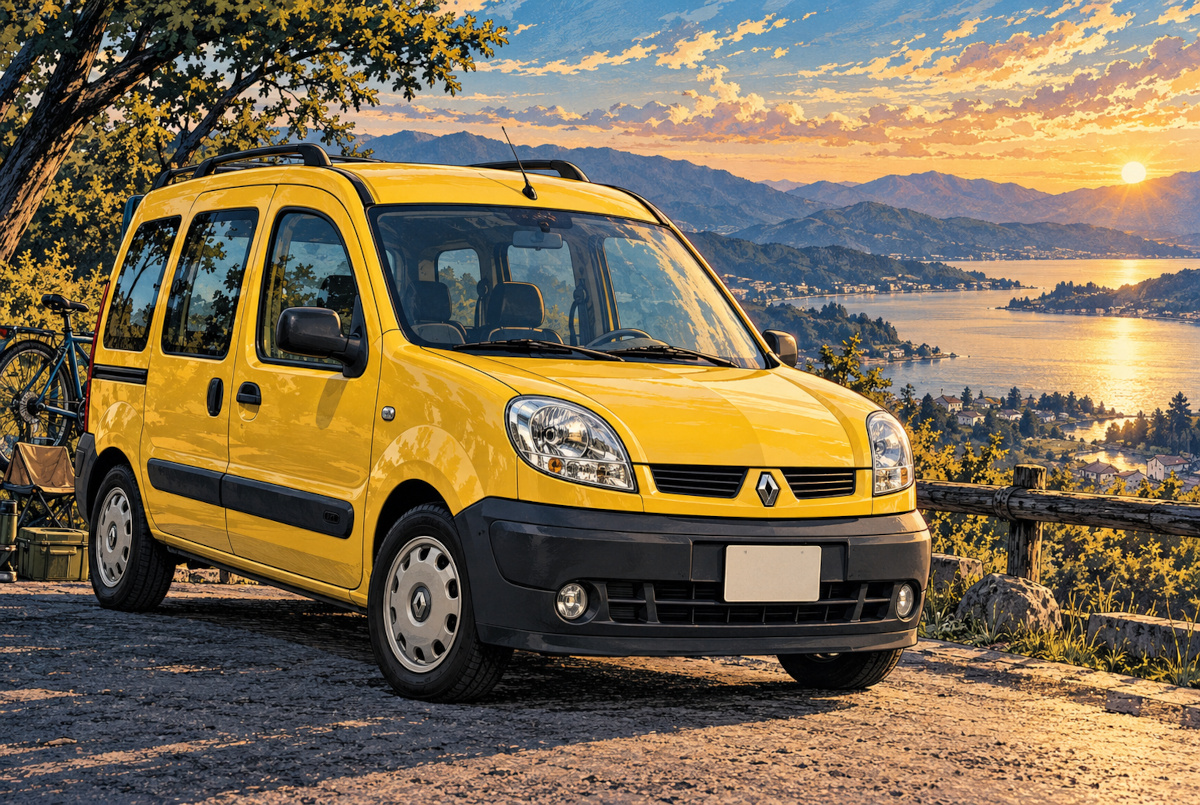
What exactly is so good about the Renault Kangoo?
It is not fast. It is not luxurious. And in Japan, the current model starts at ¥4.29 million, so calling it a cheap utility vehicle would be difficult. Yet Japan has an event where well over a thousand Kangoos can gather in one place—an event Renault itself has described as the world’s largest gathering of Renault Kangoo vehicles.
If carrying stuff were the whole story, Japan already has plenty of cheaper minivans and serious commercial vans. So why did this boxy French vehicle become such an object of affection in Japan?
It Was Never Simply “a Van with Seats Added”
The Kangoo debuted in Europe in 1997. Renault offered both a five-seat passenger version and the work-oriented Kangoo Express from the beginning, so describing it as a commercial van that was later converted into a family car is a little too simplistic.
Still, its thinking was unmistakably utilitarian: a tall, square body, plenty of cargo space, and sliding side doors. By 1999, Renault had added sliding doors on both sides. The same features that made sense for tools and deliveries also happened to work very well for families, hobbies and weekend gear.
The First Japanese Kangoo Was Surprisingly Small
The first Kangoo arrived in Japan in 2002. It measured 3,995mm long, 1,675mm wide and 1,810mm tall, with a list price of ¥1.75 million. It was tall, but under four meters long and narrow enough to fit Japan’s compact “5-number” passenger-car classification.
| Japanese-market model | Length | Width | Original list price |
|---|---|---|---|
| First generation (2002) | 3,995mm | 1,675mm | ¥1.75 million |
| Second generation (2009) | 4,215mm | 1,830mm | ¥2.298 million (4AT) |
| Current generation (2026) | 4,490mm | 1,860mm | From ¥4.29 million |
From the first Japanese model to the current one, the Kangoo has grown by 495mm in length and 185mm in width.
The price comparison needs a little more care. The 2002 ¥1.75 million figure came from an era when Japanese vehicle prices were not always displayed on the same tax-inclusive basis used today. Adding the then-5% consumption tax puts that old figure at roughly ¥1.84 million. Against today’s ¥4.29 million tax-inclusive price, that works out to roughly 2.3 times as much. Of course, nearly a quarter-century of inflation, added safety equipment and vastly different specifications make this anything but a simple “it got expensive” story.
The more interesting jump came with the second generation. Width increased by a huge 155mm in one go. If Japanese buyers had loved the Kangoo mainly because it was a small, easy-to-handle European import, that should have been the moment enthusiasm cooled.
Instead, Japan’s Kangoo culture really took off during the era of the 1,830mm-wide second-generation model.
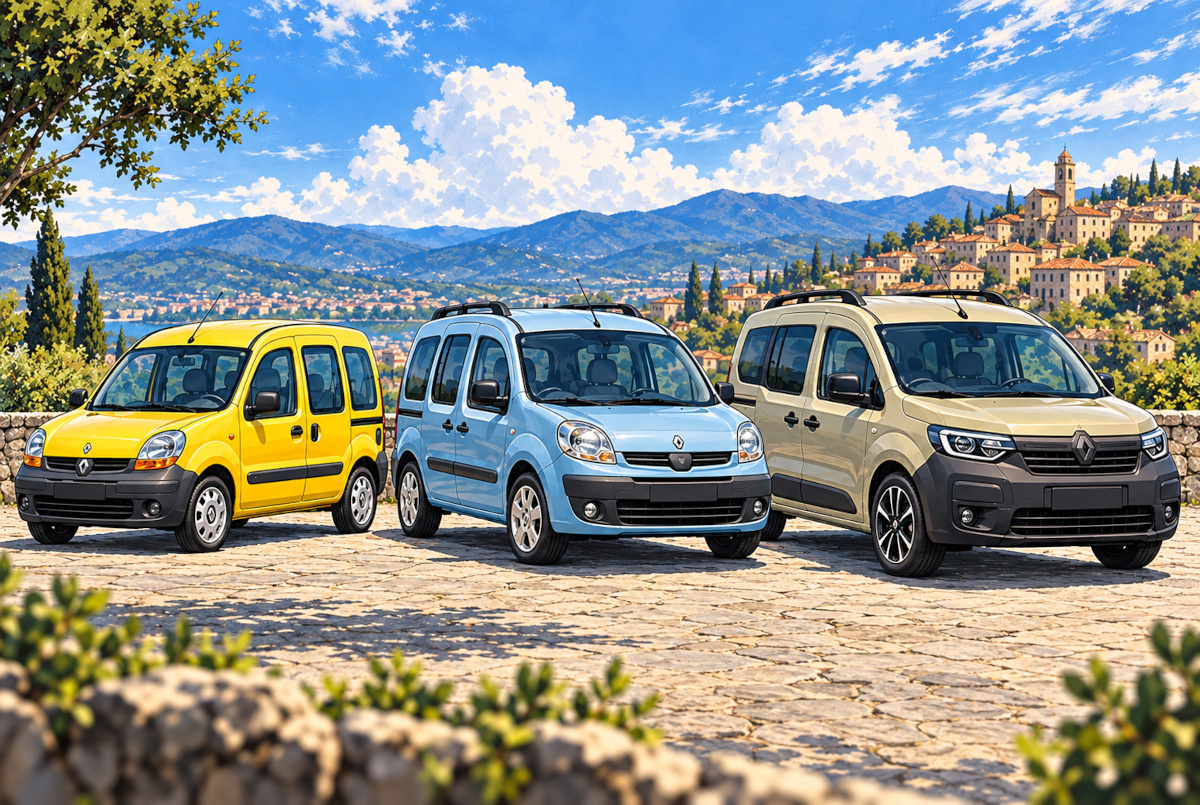
AI-generated comparison illustration inspired by the facelifted first-generation, second-generation and third-generation Kangoo. Vehicle details, equipment and relative scale are not intended as exact technical reproductions; see the table above for actual dimensions.
Yes, It Carries 775 Liters. But That Is Not the Whole Answer
The current Kangoo offers 775 liters of luggage capacity with five people aboard and up to 2,800 liters with the rear seats folded. It has twin sliding side doors, a tall and boxy cargo area, and the Kangoo’s familiar asymmetric double rear doors.
That practicality is real. But practicality alone does not explain why someone specifically chooses a Kangoo. Japan has cheaper minivans. If maximum load-carrying ability is the priority, proper commercial vans go even further. Add dealer coverage and ease of ownership, and a domestic Japanese vehicle can often be the more rational choice.
This is where the Kangoo gets slightly strange—in a good way.
Many Japanese minivans arrive almost completely “finished” by the manufacturer: clever storage, powered doors, elaborate seat mechanisms, tables, charging ports and other conveniences already designed into the vehicle.
The Kangoo has traditionally felt more like it is saying, “Here is the space. Now do whatever you want with it.”
Put bicycles in it. Carry a dog. Build shelves. Throw in camping gear. Leave the steel wheels alone. Cover it in stickers. Rather than admiring the car as a completed object, owners seem encouraged to finish the story themselves.
Then Japan Turned It Into a Festival
The clearest symbol of that phenomenon is the Renault Kangoo Jamboree, first held in 2009. Renault’s global media site has described the Japanese event as the world’s biggest gathering of Kangoo vehicles.
At the 2025 event near Lake Yamanaka, 1,289 vehicles attended in total. Of those, 1,149 were Kangoos, with 2,653 people taking part. As of October 2026, the next event is scheduled for November 1 at Yamanakako Community Plaza Kirara.
This is not a sports car. It is not a classic-car icon. It is a practical French box—and more than a thousand of them can turn up together.
At that point, you are no longer looking at a product alone. You are looking at a culture.
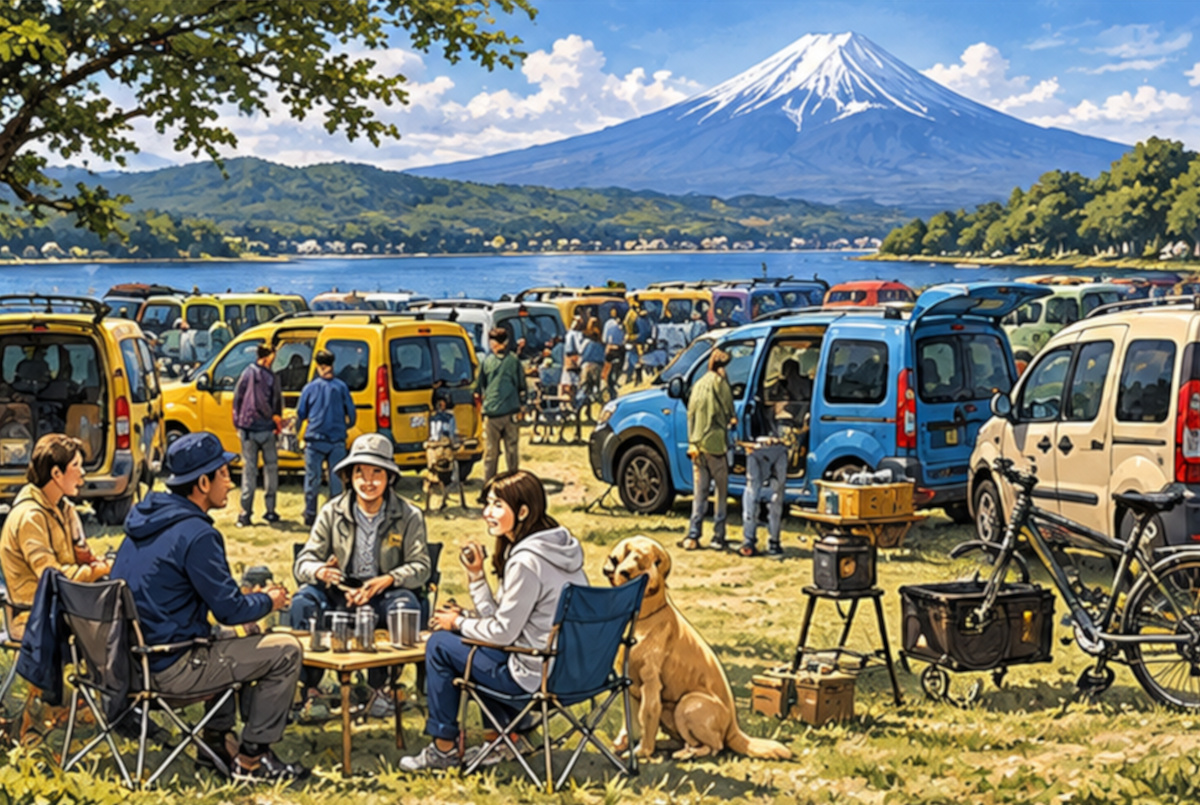
AI-generated illustration representing Japan’s Kangoo owner culture. It does not reproduce an actual Kangoo Jamboree scene, specific participating vehicles, weather conditions or event operations.
Eventually, Japan Started Changing the Kangoo Too
There is another detail that makes the Japanese story unusual.
When Renault introduced an EDC transmission to the second-generation Kangoo, a Renault product manager told Japanese automotive publication webCG that demand from Japan played a major role in the decision. Automatic transmission demand was relatively limited for the Kangoo in Europe, while Japan was overwhelmingly a two-pedal market.
In other words, Japanese buyers were not simply adapting themselves to a French vehicle. The vehicle itself began adapting to Japan.
Then there is Kangoo Couleur, a Japan-focused series of special-color editions launched in 2010. Renault Japan describes the idea with the phrase, “What Japanese streets were missing was color.” Yellow, green, beige and other distinctive shades became part of the appeal instead of something to be eliminated in favor of safe resale colors.
After years of Japanese buyers embracing the Kangoo on their own terms, Renault itself increasingly responded to the way Japan wanted to use—and enjoy—the car.
Maybe the Kangoo Is Selling Something Other Than Cargo Space
From here on, this is editorial interpretation rather than a manufacturer claim.
One of the Kangoo’s most interesting qualities is that, despite being an imported European vehicle, it rarely gives off the usual “look at my expensive foreign car” message.
A yellow Kangoo carrying bicycles or camping equipment does not naturally make the car itself the center of attention.
Instead, the interesting question becomes: what does the owner do with it?
With a sports car, the engine and chassis tend to be the stars. With a luxury car, the car itself is often the experience. With a Kangoo, the starring role can belong to the dog, the bicycles, fishing gear, camping equipment, family luggage—or even camera gear.
So if I had to answer the original question—“What is so good about the Kangoo?”—with one idea, “it has lots of cargo space” would not quite be enough.
The Kangoo steps out of the spotlight and lets whatever you actually enjoy doing become the main event.
That may be the real reason it became something more than just another French utility vehicle in Japan.
A Term That May Need Explaining
- EDC
- Renault’s name for its dual-clutch transmission. The clutch operation is handled automatically, so the driver uses two pedals, much like a conventional automatic.
Editor’s Note
At first, I thought the answer was obvious: the Kangoo is basically a big box for carrying stuff. And to be fair, that is not wrong.
But once I looked at the first Japanese model at ¥1.75 million, then looked at today’s ¥4.29 million Kangoo, the story stopped being quite so simple. It is no longer especially cheap. It is no longer especially small. And yet more than a thousand of them can still gather for what is effectively a festival devoted to a practical van-shaped car.
Pure rationality does not really explain that.
I think the Kangoo may be one of those rare cars where you do not use the car to show people who you are. You show who you are by what you put inside it. What you carry, where you go, and what you do when you get there matter more than the badge.
In that sense, there is something strangely old-school about it—almost like the old vans and light commercial vehicles people once turned into whatever they needed.
Calling a ¥4.29 million French import an “unpretentious tool” is admittedly a slightly ridiculous contradiction. But that contradiction may be exactly why the Kangoo remains interesting.
References
- Renault Group — “Saga Renault Kangoo: LCV and ludospace, the best of both worlds”
- Renault Global Media — “Renault Kangoo, a Japanese passion”
- Renault Japan — Renault Kangoo official model page [Japanese]
- Renault Japan — Kangoo Couleur history [Japanese]
- Renault Japan — Kangoo Jamboree 2025 results [Japanese]
- Renault Japan — Kangoo Jamboree 2026 event information [Japanese]
- GAZOO — 2002 Renault Kangoo 1.4 specifications and Japanese list price [Japanese]
- Car Watch — 2009 second-generation Renault Kangoo launch specifications [Japanese]
- webCG — Renault Kangoo Zen EDC and the influence of the Japanese market [Japanese]
- Ministry of Finance Japan — consumption tax rate history [Japanese]