
In 1989, the Nissan Skyline GT-R returned after an absence of roughly 16 years. Looking back today, it is easy to describe the R32 as the car that “revived the legendary GT-R.” But once you examine how the R32 was actually developed, the order of events looks slightly different.
The R32 was not created simply to celebrate the GT-R name. It was engineered with a clear mission: build a Skyline worthy of that badge by making it capable of winning in Group A racing. By succeeding so completely, the R32 ended up creating a new GT-R legend of its own.
Tracing the Skyline GT-R — 5-Part Series
The GT-R did not evolve in a straight line. Across five articles, we examine its birth, disappearance, revival, transformation into a legend, and eventual independence from the Skyline name.
- Part 1: Why the Nissan Skyline GT-R Became a Legend — Defeat, Disappearance and a 16-Year Comeback
- Part 2: How the R32 Skyline GT-R Was Engineered to Win Group A — and Became a Legend
- Part 3: Was the R33 GT-R Really the Weak Link? Why the R34 Became a Legend
- Final Part: Is the R35 Really a GT-R? Why Nissan Made It a Standalone Model
- Special: What Happened to the Skyline During the GT-R’s 16-Year Absence? From the Four-Cylinder R30 RS to the R32 Revival
Skyline kept fighting during the 16 years without a GT-R
When the Kenmeri GT-R disappeared in 1973, high-performance Skylines did not disappear with it. During the 1980s, Nissan introduced the DR30 Skyline 2000 Turbo RS, followed by the HR31 Skyline GTS-R in 1987, a model developed with Group A touring-car competition firmly in mind.
For readers outside Japan, Group A was an international production-based racing category governed by regulations that closely linked race cars to their road-going counterparts. Manufacturers therefore had to think about racing requirements while developing the production cars themselves.
The HR31 GTS-R achieved real success, including winning the 1989 Japanese Touring Car Championship. But one major obstacle remained: the Ford Sierra RS500.
The Sierra had become one of the most formidable Group A touring cars of the late 1980s. At Japan’s international touring-car races, including the InterTEC event at Fuji Speedway, it represented exactly the kind of European competition Nissan wanted to beat.
Nissan was not simply looking for another nostalgic version of the old GT-R. It needed a new Skyline capable of defeating the strongest international Group A machinery.
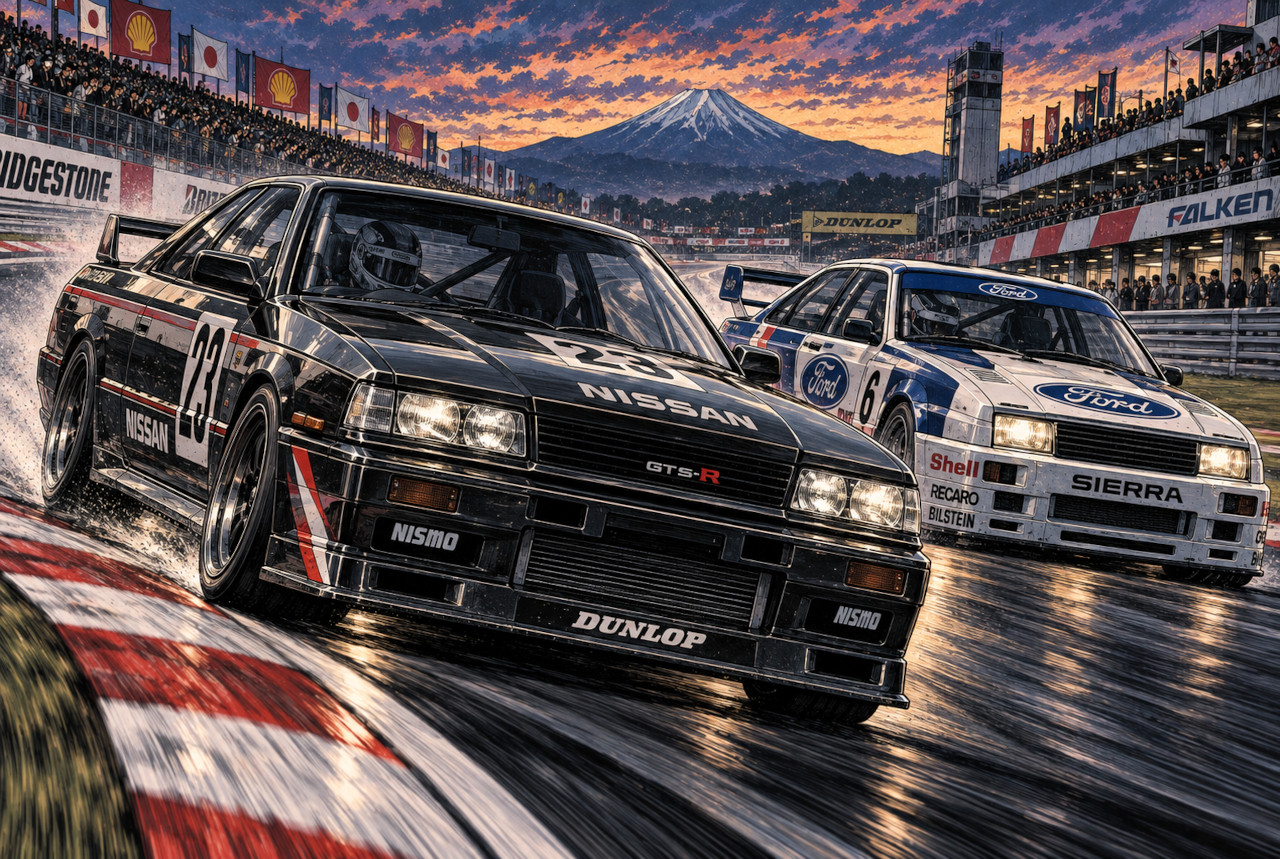 AI-generated illustration inspired by late-1980s Group A battles between the HR31 Skyline GTS-R and Ford Sierra RS500. It is not an exact recreation of a specific race, car or livery.
Group A was already present on the R32 drawing board
NISMO — Nissan’s motorsport division — has described two major objectives behind development of the R32 GT-R: creating an ultimate road-going performance car and producing a machine capable of winning overall in Group A competition.
That distinction is important.
Nissan did not finish an ordinary production Skyline and then ask its racing department how to make it competitive. The production car itself was developed while engineers were already considering the requirements of Group A.
One of the clearest examples is the displacement of the RB26DETT engine.
Under Group A regulations of the period, turbocharged engines were classified using a displacement multiplication factor. The resulting equivalent displacement affected which class the car entered, as well as regulations governing items such as minimum weight and allowable tire width.
Nissan also had to account for the additional weight of an all-wheel-drive system. Engineers therefore worked backward from the regulations and selected a turbocharged engine displacement of approximately 2.6 liters, placing the car within the desired regulatory category.
The production result was the 2,568cc RB26DETT, a twin-turbocharged inline-six that would eventually become one of Nissan’s most famous engines.
The RB26 was not 2.6 liters simply because Nissan happened to like that number. Its displacement was closely connected to the mathematics of Group A racing regulations.
Once you know that, the R32’s specification sheet begins to look less like a collection of impressive engineering features and more like the visible result of a racing rulebook.
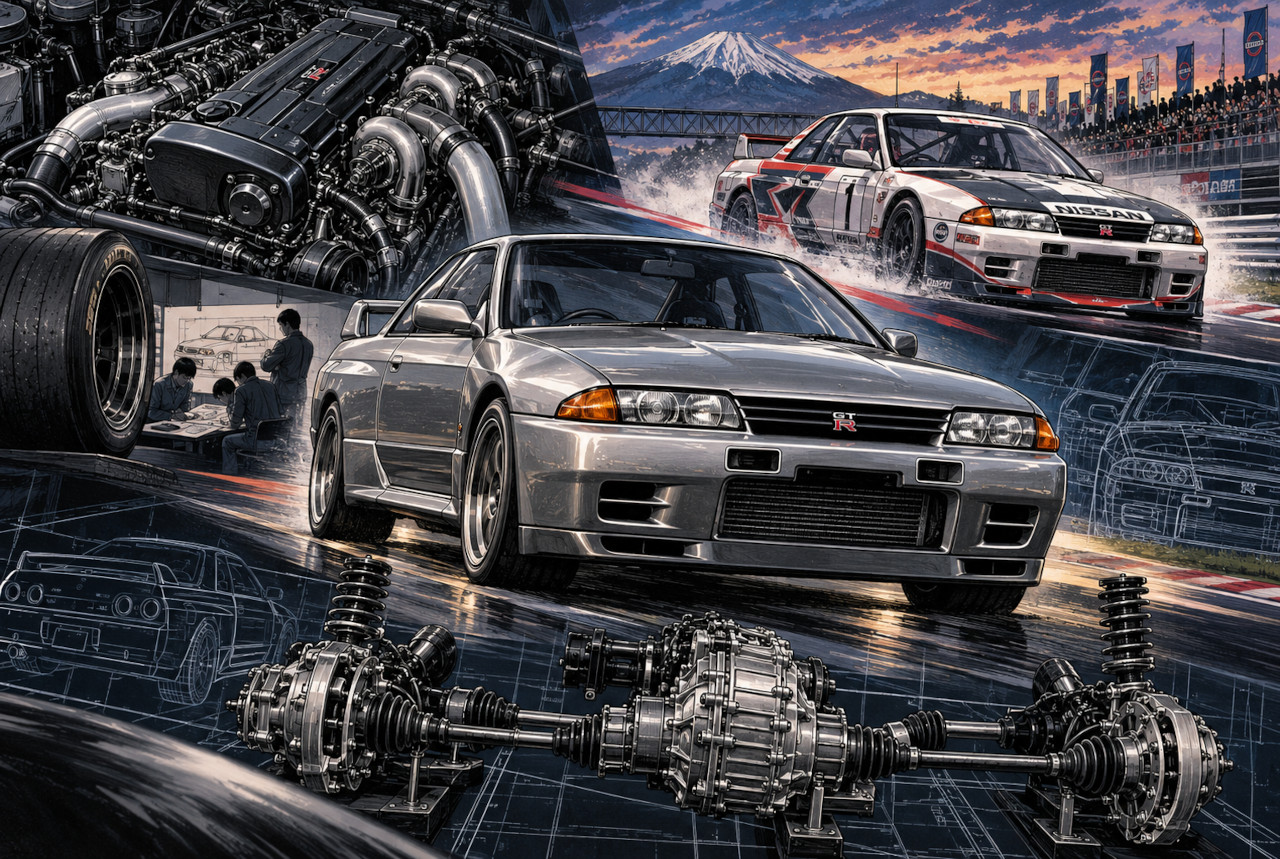 AI-generated conceptual illustration of the R32 GT-R development philosophy, combining the RB26DETT, all-wheel-drive system and Group A competition. It is not a technical engineering diagram.
The R32 was originally considered as a rear-wheel-drive car
One of the most interesting parts of the R32 development story is that Nissan did not simply decide from day one that the new GT-R had to be all-wheel drive.
According to NISMO’s historical account, an early concept involved a relatively lightweight rear-wheel-drive car producing more than 500 PS in racing form.
There was an obvious problem.
Group A regulations also limited tire width. NISMO engineers concluded that controlling still greater power through only the rear wheels would be extremely difficult with the tires available under the rules.
The development direction therefore changed.
Nissan prepared an engine capable of producing more than 600 PS in racing specification and combined it with an electronically controlled torque-split all-wheel-drive system. That system became ATTESA E-TS.
The road-going R32 GT-R was officially rated at 280 PS in Japan, so the often-mentioned 500- and 600-PS figures belong to the competition-development story rather than the showroom specification.
ATTESA E-TS was therefore more than a piece of high-tech equipment added to make the road car impressive. It was also Nissan’s answer to a very practical racing problem: how do you put enormous power onto the track when the regulations limit how much tire you can use?
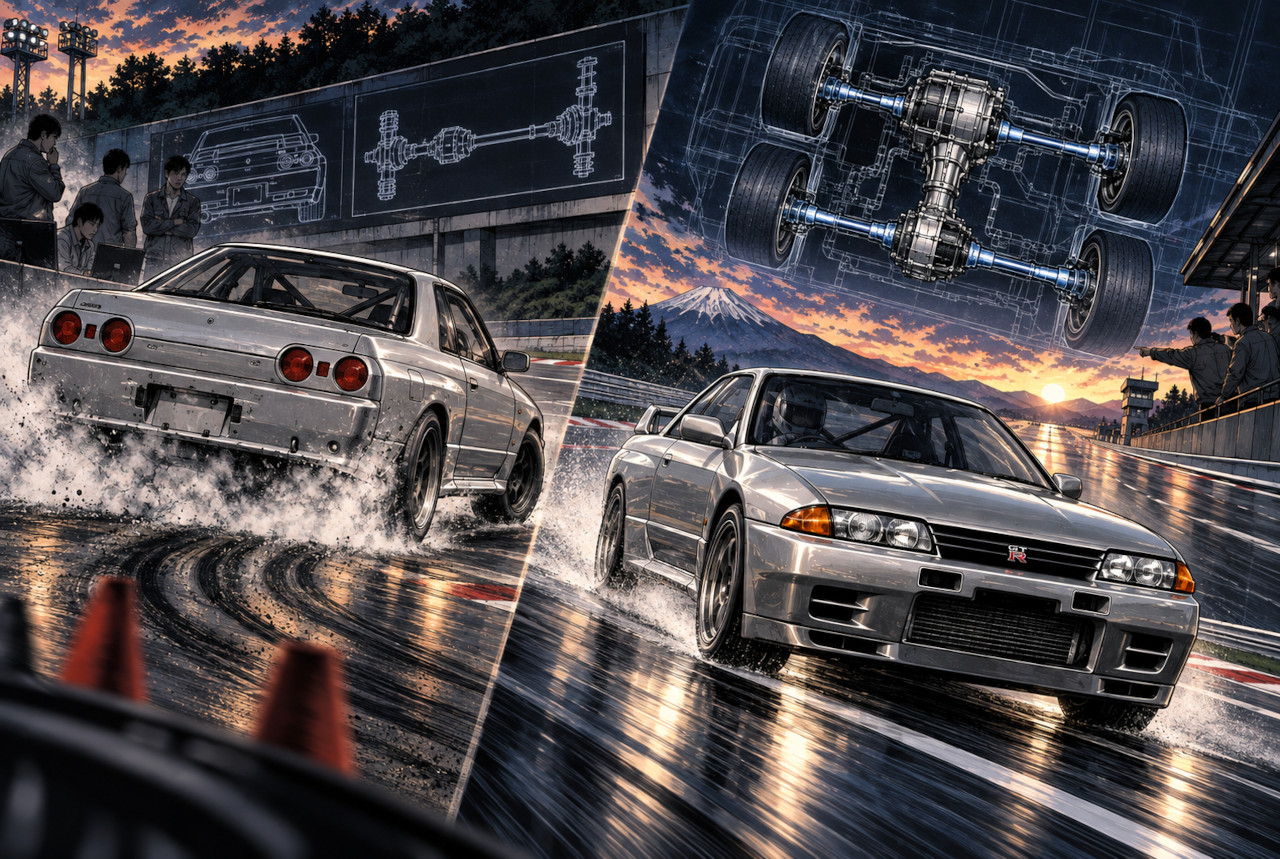 AI-generated illustration representing the development shift from a high-powered rear-wheel-drive concept to the ATTESA E-TS all-wheel-drive solution. It does not depict an actual Nissan prototype or historical test session.
The R32 finished 1-2 on debut — then its rivals started becoming GT-Rs
In March 1990, the Group A R32 Skyline GT-R made its Japanese Touring Car Championship debut at Nishi-Nihon Circuit.
The two GT-Rs, represented by the well-known Calsonic and Reebok entries, qualified first and second. They then finished the race in the same order.
The Ford Sierra RS500, which had been one of the benchmarks Nissan wanted to beat, had immediately been overtaken by the new GT-R.
Later that year, the GT-R also finished first and second at the international InterTEC race at Fuji Speedway. European manufacturers such as Volvo and Ford had dominated the event during much of the previous era, making the victory particularly significant for Nissan.
Then came the statistic most commonly associated with the R32’s domestic racing career.
From 1990 through 1993, R32 Skyline GT-Rs won all 29 Japanese Touring Car Championship races in which the model competed.
That statement needs one important clarification.
It does not mean that a single GT-R won 29 races in a row. Multiple teams competed with R32 GT-Rs, and as the car’s competitiveness became undeniable, more teams moved to the same platform.
By 1992, the highest class of the championship had effectively become a battle between GT-Rs.
The R32 kept defeating its rivals until, in a sense, the rivals started becoming R32 GT-Rs themselves.
That may explain the car’s dominance better than the number “29” alone.
A racing car can prove it is fast by beating another model. A truly dominant platform can reach the point where competitors decide that the easiest way to beat it is to use the same car.
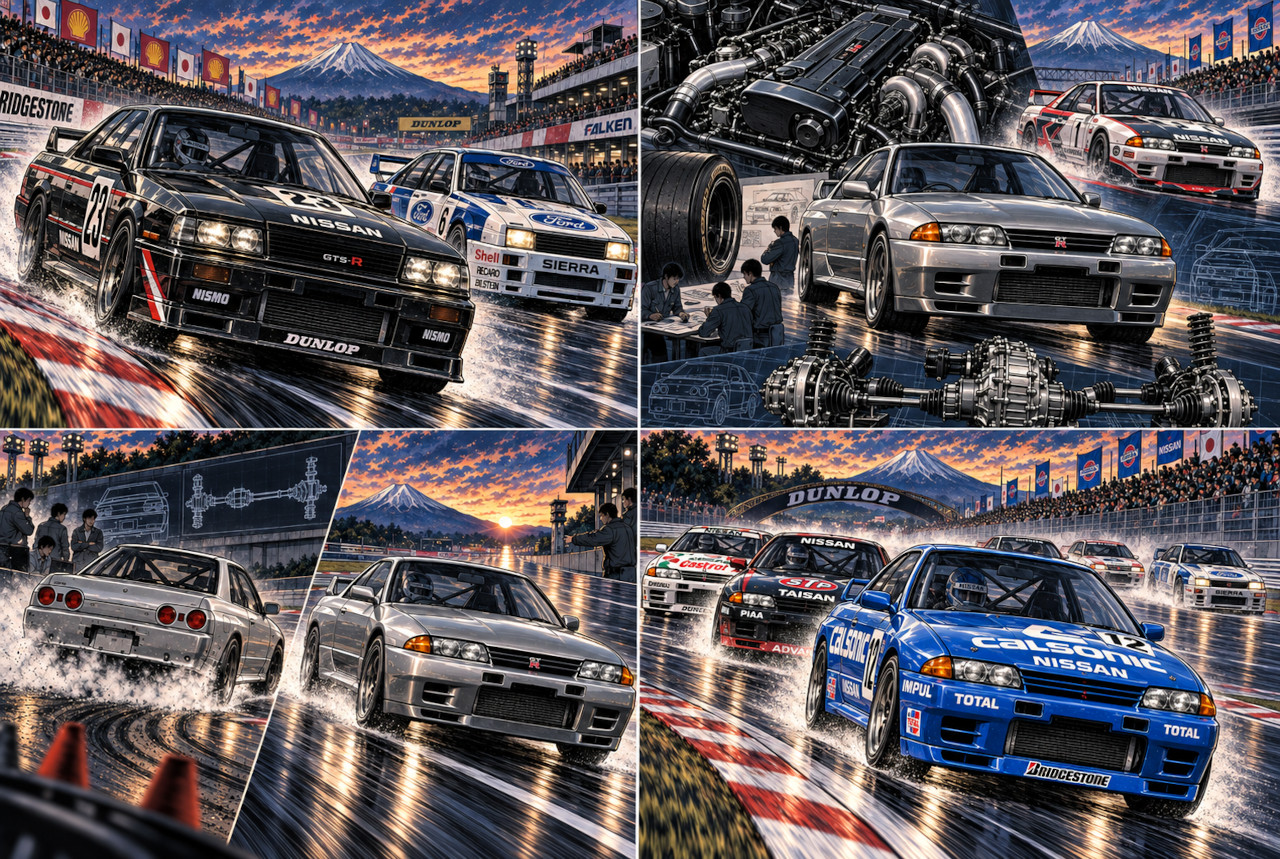
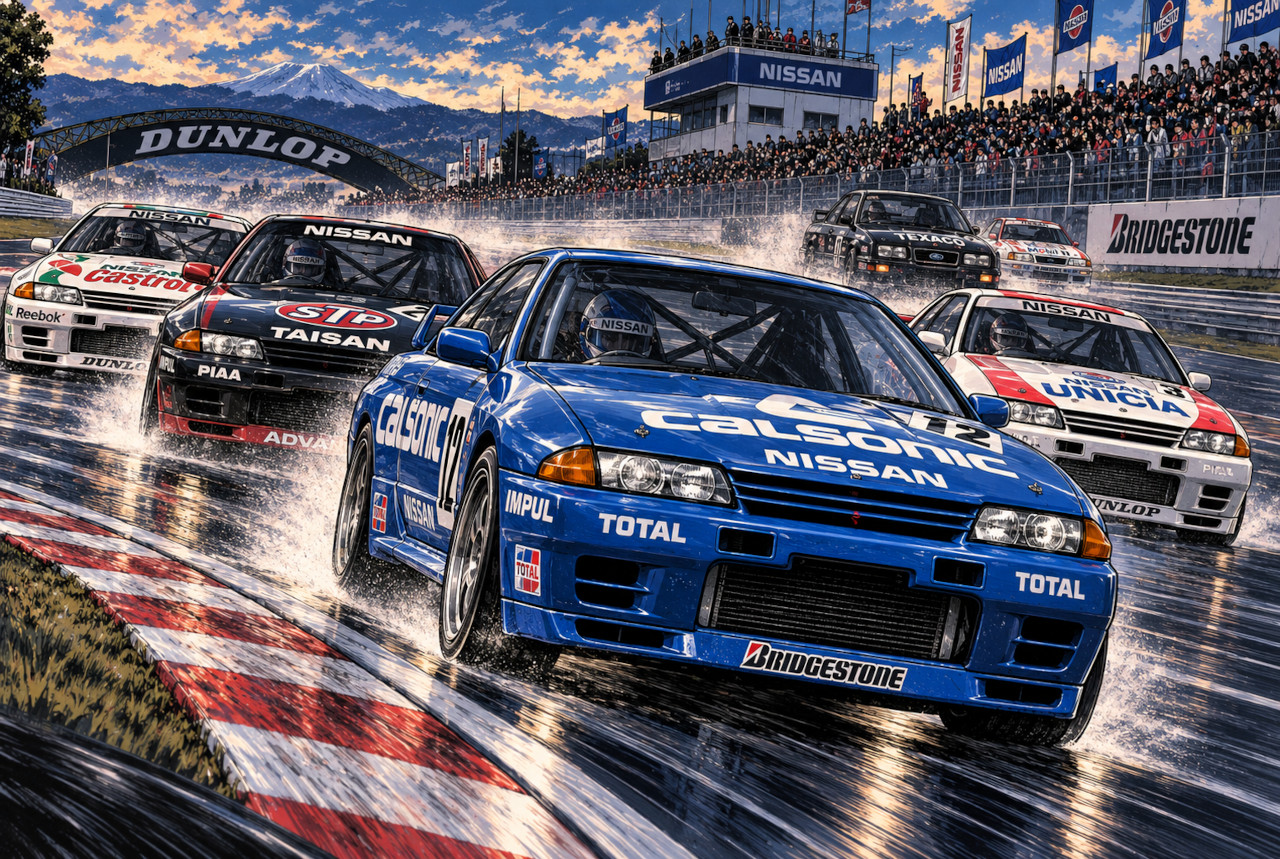 AI-generated illustration inspired by the period when R32 GT-Rs became dominant in Japanese Group A racing. Car numbers, liveries and race details are not intended as exact historical reproductions.
The R32 did not inherit the GT-R legend — it rebuilt it
The R32 was not a retro revival created simply to remind enthusiasts of the racing success of the Hakosuka GT-R.
It was the result of lessons learned through the DR30 and HR31 generations, combined with the experience of trying to defeat cars such as the Ford Sierra RS500.
Nissan worked backward from a competitive objective.
What engine displacement best fitted the Group A rules? How much power would be necessary? Could rear-wheel drive transmit that power through the permitted tires? How much weight would an all-wheel-drive system add? What combination would allow a production Skyline to become the basis of a championship-winning race car?
The answers eventually produced the RB26DETT, ATTESA E-TS and the BNR32 Skyline GT-R.
The R32 was not built primarily to revive a legend. It was built to bring victory back to Skyline racing. By winning again and again, it became a new legend almost as a consequence.
This may be the most important difference between nostalgia and engineering.
Nissan did not appear to begin with the idea that simply attaching the letters “GT-R” would make the new car special. If the car was going to carry the GT-R badge again, its engineering had to justify the name.
That way of looking at the R32 makes its history even more interesting. Today we remember it as an icon. During development, however, the problem was much less romantic: build a Skyline that could win.
Editor’s Note
I used to think the R32 was special mainly because Nissan revived the GT-R name after 16 years. The deeper I looked into its development, the more I realized that the story was almost the reverse. Nissan did not seem to begin with the badge and then invent a car to justify it. Engineers were asking practical questions: What displacement works best under Group A rules? Can rear-wheel drive handle this much power with restricted tire widths? If not, should the car use all-wheel drive? The answers eventually became the R32. That makes me think truly great cars are rarely created by deciding, “Let’s make a legend.” They are created when engineers become almost obsessively serious about solving a specific problem — and people later decide that the result deserves to be called legendary.
References
- NISMO — Group A Part 3: The Arrival of the BNR32 Skyline GT-R, the Ultimate Group A Machine
- NISMO — Group A Part 4: 29 Consecutive Victories and Complete Group A Domination
- Nissan Heritage Collection — Nissan Skyline GT-R (1989)
- Japan Automobile Federation — 1990 All Japan Touring Car 300 km Race Results
- Japan Automobile Federation — 1990 International Touring Car Endurance Race InterTEC Results
- NISMO — Racing GT-R History Vol. 5: Group A Legend I — The Road to the GT-R’s Revival