
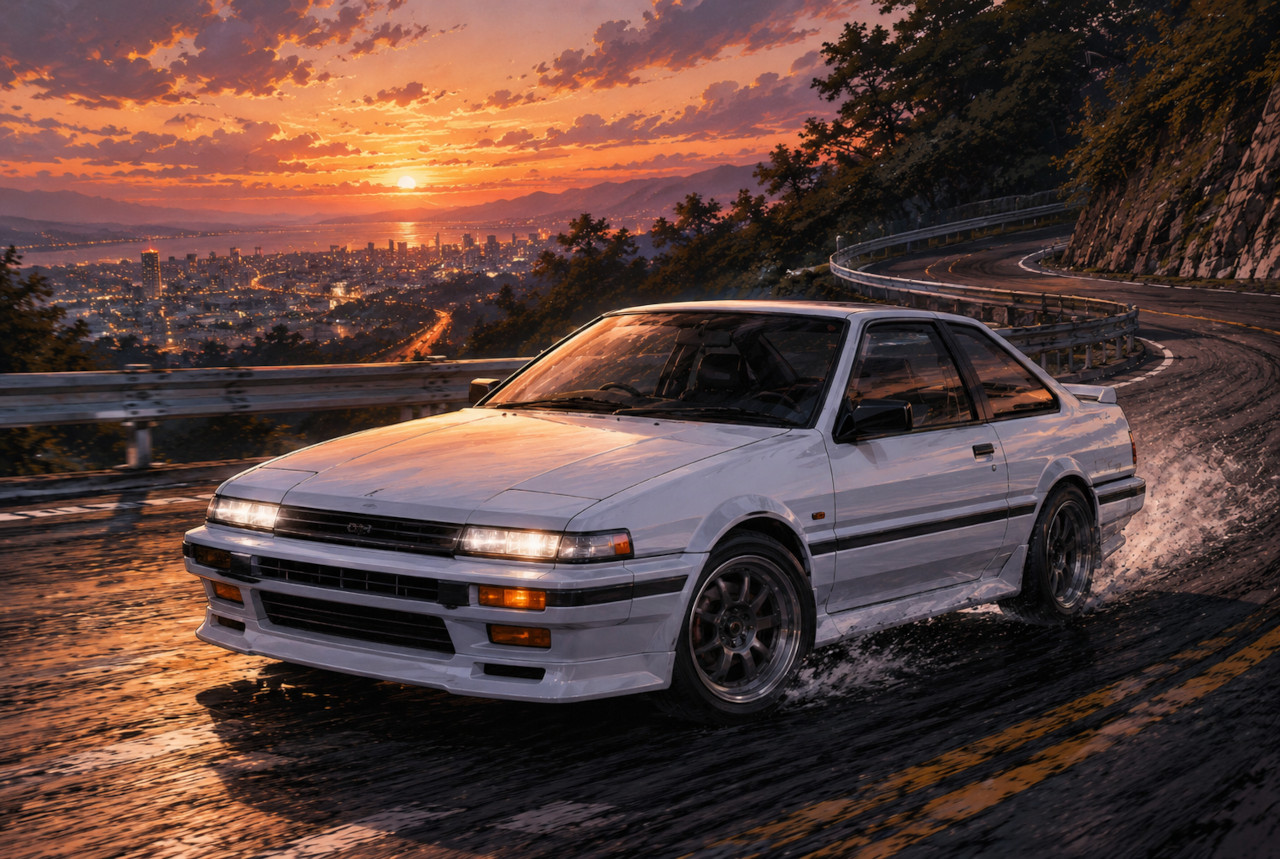
When Toyota replaced the AE86 Corolla Levin with the AE92 in 1987, many enthusiasts had one immediate question:
“Why did Toyota make it front-wheel drive?”
The AE86 was rear-wheel drive. It was light, simple and easy to play with at the limit, and decades later its chassis code became famous enough that enthusiasts around the world simply call it the Hachiroku — Japanese for “eight-six.”
Then came the AE92, and even the Corolla Levin and Sprinter Trueno switched to front-wheel drive.
Seen only from today’s perspective, it can look as though Toyota abandoned the sporting character it had created with the AE86 and replaced it with a more practical, efficiency-focused car.
But look at the history in reverse and the picture changes.
The surprising part was not that the AE92 became front-wheel drive. The surprising part was that Toyota had kept the AE86 rear-wheel drive for one more generation.
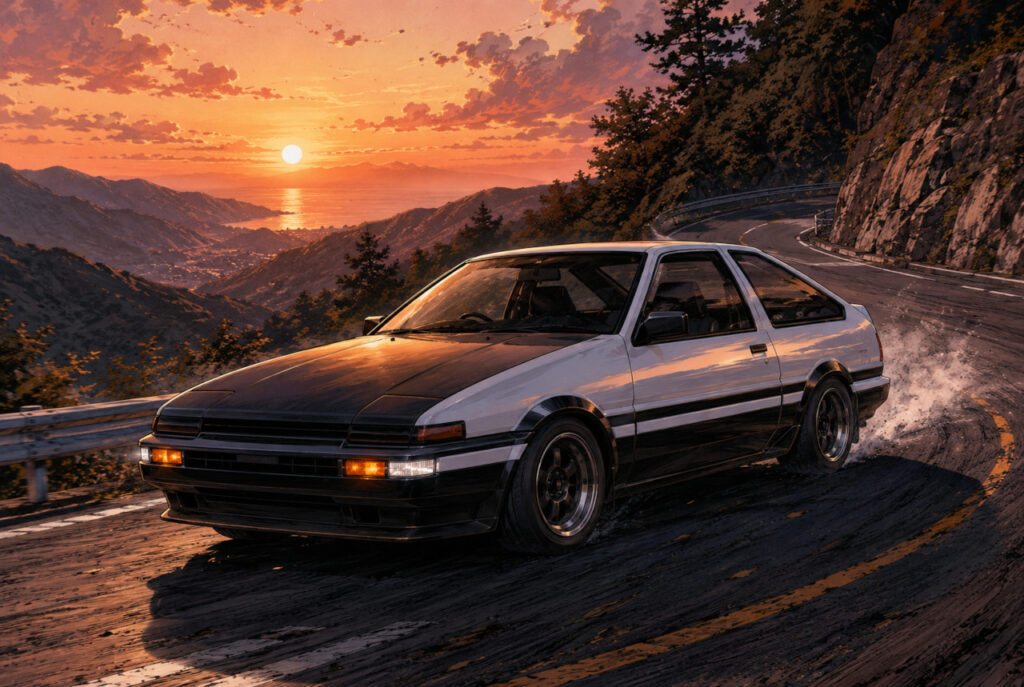 This is an AI-generated illustration based on the general characteristics of the real vehicles. Body shapes, lighting details and other design elements may differ from the production cars.
The Corolla had already gone front-wheel drive during the AE86 era
This is the part of the story that makes the AE92 much easier to understand.
When the fifth-generation Corolla and Sprinter families appeared in 1983, the mainstream sedan models had already moved from rear-wheel drive to front-wheel drive.
In other words, the Corolla family of the AE86 era was not uniformly rear-wheel drive.
The mainstream family cars were front-wheel drive, while sporty coupe models such as the Levin and Trueno remained rear-wheel drive.
That created an unusual situation: cars belonging to the same broader Corolla family used completely different drivetrain layouts depending on their role.
Toyota moved the family-oriented sedans to front-wheel drive for packaging and everyday usability, while keeping rear-wheel drive for the sporty Levin and Trueno.
So the AE86 was not simply the normal next step in an uninterrupted line of rear-wheel-drive Corollas.
It was effectively the sporty branch of the Corolla family being allowed to remain rear-wheel drive for one extra generation while the rest of the range moved on.
Looking backward from today, the AE92’s switch to front-wheel drive can seem radical. Seen from Toyota’s position in 1983, however, the AE86 itself was becoming the exception.
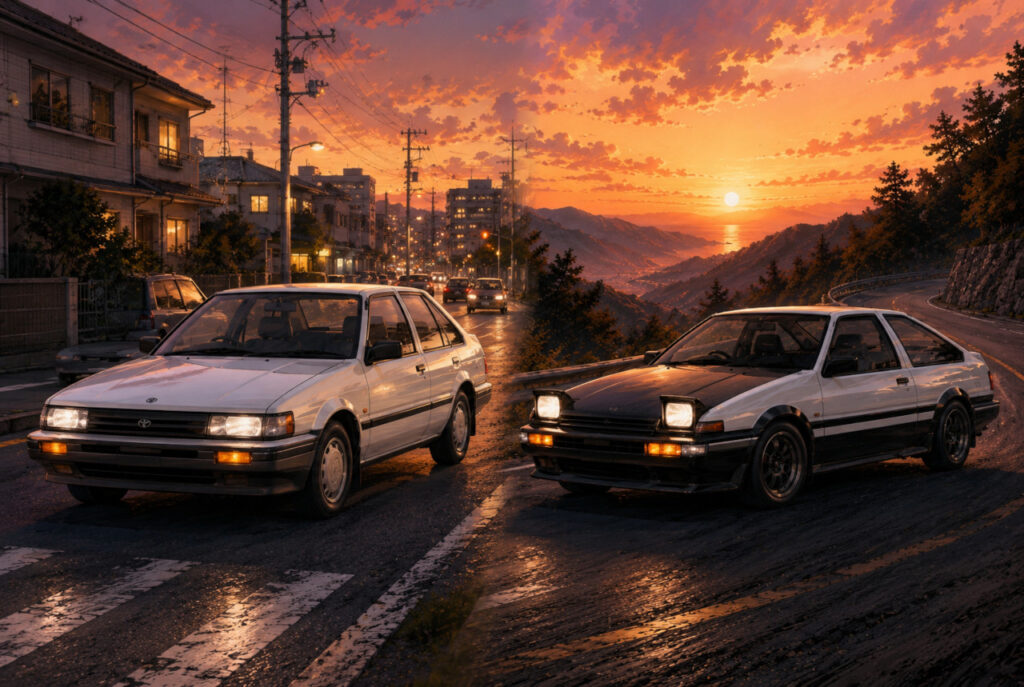 AI-generated conceptual illustration showing the split between front-wheel-drive mainstream Corollas and rear-wheel-drive sporty Levin and Trueno models during the AE86 generation. It is not an exact model-by-model comparison.
Why did Toyota move the Corolla to front-wheel drive?
The reason was not simply cost cutting.
During the 1980s, front-wheel drive was rapidly becoming the standard layout for compact family cars around the world.
For a small car, the advantages were obvious.
With a conventional front-engine, rear-wheel-drive layout, power has to travel from the engine to the rear axle through a driveshaft. That requires space beneath the passenger compartment and usually creates a transmission and driveshaft tunnel through the center of the floor.
With front-wheel drive, the engine, transmission and driven wheels can all be packaged at the front of the vehicle.
The result is simple: more usable interior space can be created within the same overall body size.
Removing rear-drive components can also reduce complexity and, depending on the design, help with weight and fuel efficiency.
For a mass-market compact car such as the Corolla, these were powerful advantages.
By the 1980s, there were increasingly more reasons to adopt front-wheel drive than there were reasons to keep rear-wheel drive in an ordinary small family car.
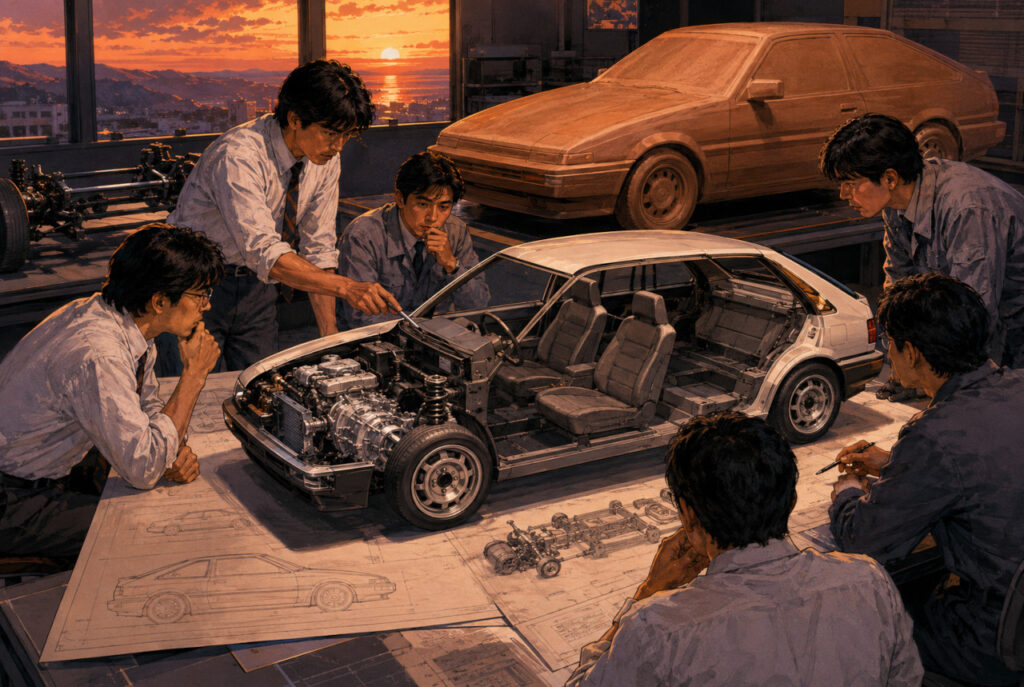 AI-generated conceptual illustration comparing general FR and FWD vehicle packaging. It is intended to explain layout differences rather than reproduce a specific Toyota engineering diagram.
Yet Toyota kept the AE86 rear-wheel drive
If front-wheel drive made so much sense, Toyota could have converted the Levin and Trueno at the same time as the rest of the Corolla lineup in 1983.
It did not.
At the time, rear-wheel drive was still strongly associated with serious sporting performance, especially among drivers who valued throttle-adjustable handling and traditional sports-car dynamics.
Toyota therefore moved the mainstream sedans to front-wheel drive while allowing the Levin and Trueno to retain rear-wheel drive.
From a manufacturing perspective, this was hardly the simplest solution. Toyota was supporting different drivetrain architectures within the same broader model family.
Yet the company chose to preserve rear-wheel drive for the sporting variants for one more generation.
That changes the way the AE86 can be interpreted.
Rather than being the natural future of the rear-wheel-drive Corolla, the AE86 was more like the final extension of an older formula while the rest of the Corolla family was already moving into the front-wheel-drive era.
And, ironically, that final extension later became the most famous Corolla of them all.
1987: the AE92 finally brought the Levin into the FWD mainstream
In May 1987, Toyota introduced the sixth-generation Corolla family.
This time, the Levin and Trueno switched to front-wheel drive as well.
The sporting model commonly identified by enthusiasts as the AE92 had arrived.
If you begin with the assumption that “the successor to the AE86 should obviously be rear-wheel drive,” this looks like a dramatic break with tradition.
From Toyota’s perspective, though, another interpretation makes more sense:
The Levin and Trueno were finally being integrated into the same front-wheel-drive architecture already used by the mainstream Corolla family.
And Toyota did not abandon sporting performance.
The AE92 continued to offer the 1.6-liter twin-cam 4A-GE engine. Toyota also created the higher-performance GT-Z, powered by the supercharged 4A-GZE.
The supercharged version initially produced 145 PS, with later versions reaching 165 PS.
The philosophy had changed.
Instead of saying “a sports car must be rear-wheel drive,” Toyota was trying to prove that a front-wheel-drive coupe could still be fast and entertaining.
The AE92 stood right at that turning point.
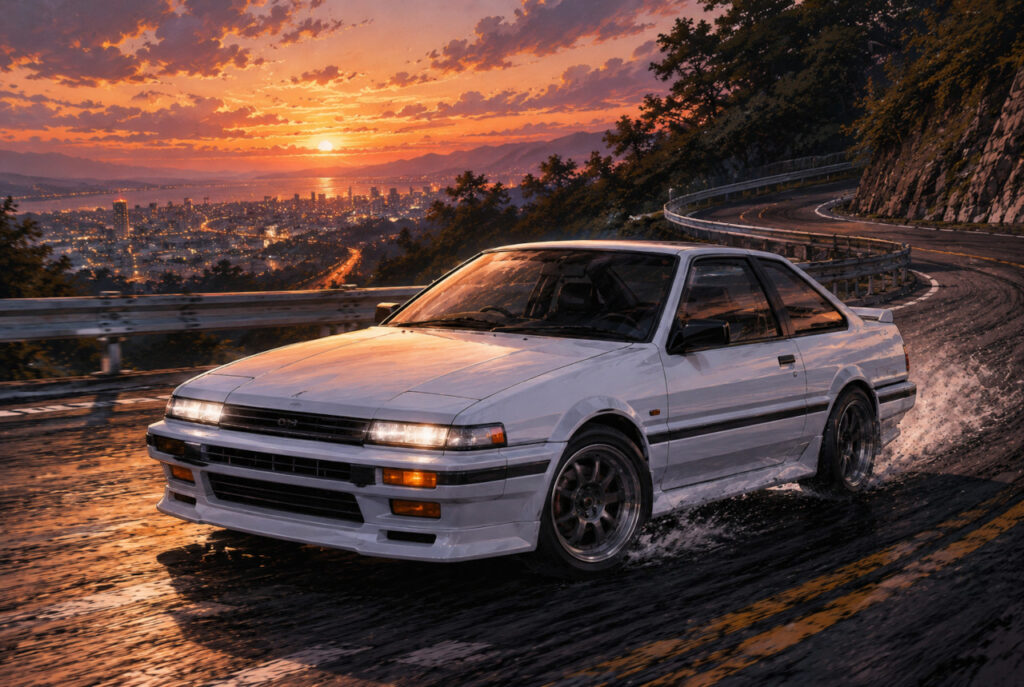 AI-generated illustration inspired by the AE92 Corolla Levin era. It may differ from the actual production car in body shape, lamps, trim and other details.
AE101: when the Levin became very 1990s Japan
In 1991, the Levin moved into the AE101 generation.
By then, its character had moved even further away from the lightweight simplicity associated with the AE86.
The body became larger, equipment levels increased, and the car moved closer to what Japan called a specialty coupe — a stylish two-door car sold as much on image, comfort and equipment as on pure performance.
That description makes particular sense in the context of Japan’s late-1980s and early-1990s Bubble Economy, when domestic manufacturers were enthusiastically adding technology, equipment and increasingly sophisticated chassis systems to relatively affordable cars.
The engines were anything but dull.
The naturally aspirated 4A-GE gained a 20-valve cylinder head and produced 160 PS, while the supercharged 4A-GZE reached 170 PS.
Higher-grade versions could even be equipped with Toyota’s sophisticated Super Strut suspension system, technology also associated with some performance-oriented Celica models.
It was no longer the same kind of car as the light, playful AE86.
But it was extremely representative of early-1990s Japanese automotive thinking.
More power. More equipment. More chassis technology. More of almost everything.
In that sense, the AE101 may have been the most “Bubble-era” Levin of them all.
AE111: the Levin tried to rediscover lightness
When the AE111 arrived in 1995, Toyota changed direction again.
Although it inherited many components from its predecessor, weight was reduced by as much as approximately 70 kg depending on specification.
The supercharged engine disappeared, but the naturally aspirated 1.6-liter 4A-GE now produced 165 PS.
Performance versions were available with features such as Super Strut suspension and a helical limited-slip differential.
A six-speed manual transmission was added with the 1997 facelift.
A high-revving naturally aspirated engine, lighter body, six-speed manual gearbox and LSD.
It was not rear-wheel drive.
But judged as a front-wheel-drive sports coupe, Toyota was clearly still taking the formula seriously.
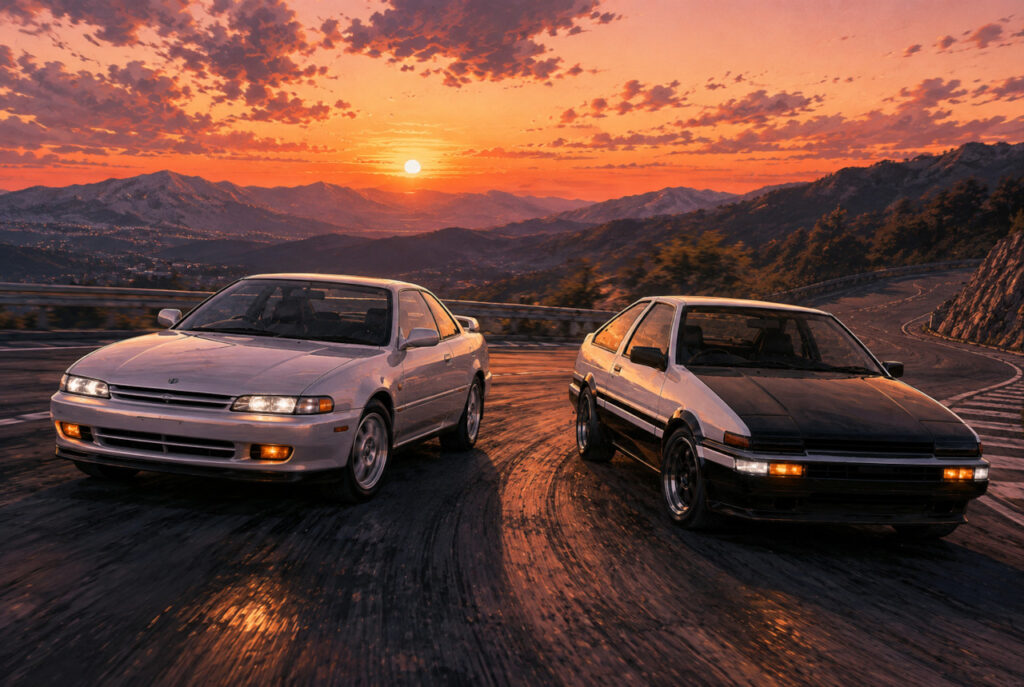 AI-generated illustration inspired by the AE111 Corolla Levin. Exterior details may differ from the actual production model.
Front-wheel drive did not kill the Levin
The Corolla Levin disappeared after the AE111 generation in 2000.
That has encouraged a simple explanation among some enthusiasts: Toyota ruined the Levin when it converted the car to front-wheel drive with the AE92.
But that explanation ignores what happened to the entire market around it.
During the 1980s, Japan had a large market for affordable two-door coupes aimed at younger buyers.
By the late 1990s, that market was shrinking rapidly.
Consumers were moving toward sedans, minivans, recreational vehicles and later SUVs. Stylish two-door coupes were becoming much harder to sell in meaningful numbers.
Toyota could give the Levin a high-revving 4A-GE, sophisticated suspension, an LSD and even a six-speed manual gearbox.
But engineering could not solve one fundamental problem: fewer people wanted to buy compact two-door coupes at all.
The biggest reason the Levin disappeared was probably not front-wheel drive. It was the collapse of the affordable youth-oriented coupe market that had supported cars like the Levin in the first place.
Was the AE86-to-AE92 transition really a mistake?
From an enthusiast’s point of view, wanting the Levin to remain rear-wheel drive is completely understandable.
History certainly gave the AE86 a level of fame that the AE92 never achieved.
But from Toyota’s point of view, converting the Levin to front-wheel drive in 1987 was highly rational.
The mainstream Corolla had already switched to front-wheel drive four years earlier.
Compact cars around the world were moving in the same direction.
Front-wheel drive offered packaging advantages.
It suited the basic mission of the Corolla.
And maintaining a completely separate rear-wheel-drive architecture for one relatively small sporting branch of the range became increasingly difficult to justify.
That is why the AE92 becomes more interesting when it is not described simply as “the car in which Toyota abandoned the rear-wheel-drive sports Corolla.”
A better description may be:
The AE92 was the car that finally brought the Levin back into the technological mainstream of the Corolla family.
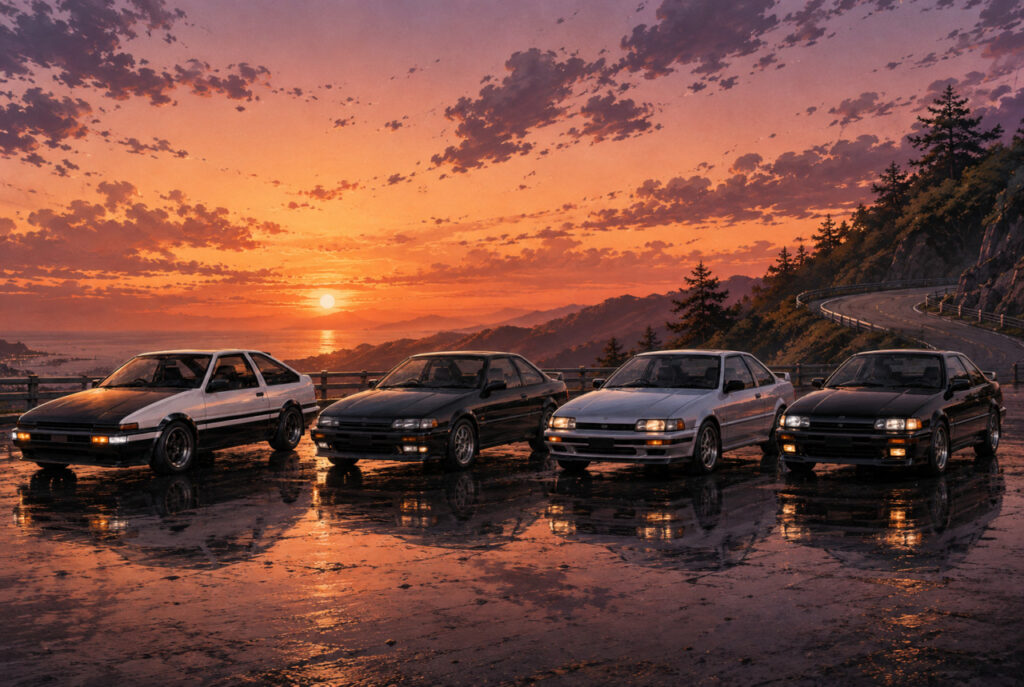 AI-generated conceptual illustration showing the generational transition from the AE86 to later front-wheel-drive Levin models. It is not intended as an exact photographic comparison of each production generation.
Seen that way, it also becomes easier to understand why the AE86 shines so brightly today.
The AE86 was not the beginning of a new era.
It was an exceptionally good outsider left behind at the very end of the rear-wheel-drive mass-market Corolla era.
And that is the irony.
The car that was technically becoming an exception within Toyota’s own lineup became the one people around the world would still call simply “Hachiroku” more than four decades later.
Editor’s Note
If I were choosing a car purely for fun, I would still want a gasoline engine, rear-wheel drive and a manual gearbox. Modern cars are faster, safer and more efficient, but for me, part of the pleasure is pressing a clutch pedal, choosing the gear myself and feeling the rear wheels influence the way the car turns.
That is also why I understand people who look at the AE92 and ask why Toyota abandoned rear-wheel drive. But after looking at the history, I think the more interesting question is the opposite: why did Toyota keep the AE86 rear-wheel drive for as long as it did? By 1983 the Corolla family was already moving toward front-wheel drive. The AE86 was not the future. It was one remarkably entertaining survivor from the old world — and perhaps that is exactly why it became legendary.
References
- Toyota Motor Corporation — 75 Years of Toyota: Vehicle Lineage and Corolla History
- Toyota Motor Corporation — Corolla 50th Anniversary Official Historical Materials