

Why do American TV characters seem to go to therapy so quickly?
Watch enough American television from Japan, and one thing starts to stand out: everybody seems to have a therapist.
A detective loses a partner and is sent to counseling. A soldier returns from combat and talks to a therapist. A marriage begins to fall apart and the couple books a session. A protagonist starts having nightmares, and before long someone is sitting across from them asking, “How does that make you feel?”
To many Japanese viewers, the reaction is almost automatic:
“Do Americans really go to therapy that often?”
The answer is more complicated than television makes it look.
American dramas exaggerate reality, and therapy sessions are extremely convenient for screenwriters. But the scenes also reveal a genuine cultural difference in how professional psychological help is imagined, discussed and used.
For an English-speaking reader, the interesting question may therefore be the reverse one:
Why can talking to a therapist look relatively ordinary on American television, while in Japan the same decision can still feel unusually serious or private?
First, “therapy” does not mean the same thing as being hospitalized
This distinction is important because Japanese discussions of mental health have traditionally blurred several very different forms of care.
A psychiatrist, psychologist, counselor and psychotherapist do not necessarily perform the same role. Seeing someone for outpatient counseling is also very different from being admitted to a psychiatric hospital.
Yet in everyday Japanese conversation, seeking professional psychological help can still carry the feeling of “going to a mental health clinic because something is seriously wrong.”
That makes ordinary counseling sound more dramatic than it necessarily is.
In the United States, professional mental health care is certainly not universal, but it is far from a rare or marginal activity.
According to the U.S. Substance Abuse and Mental Health Services Administration’s 2024 National Survey on Drug Use and Health, 22.9% of adults aged 18 or older — about 60.1 million people — received some form of mental health treatment during the previous year.
That figure needs an important qualification: it does not mean that 22.9% of American adults regularly sat on a therapist’s couch. The definition includes outpatient and inpatient treatment, prescription medication and telehealth.
The same survey reported that 9.9% of U.S. adults received care in the office of a therapist, psychologist, psychiatrist or other mental health professional.
So American television is not documenting everyday life with statistical precision. But neither is therapy something confined to a tiny and unusual group.
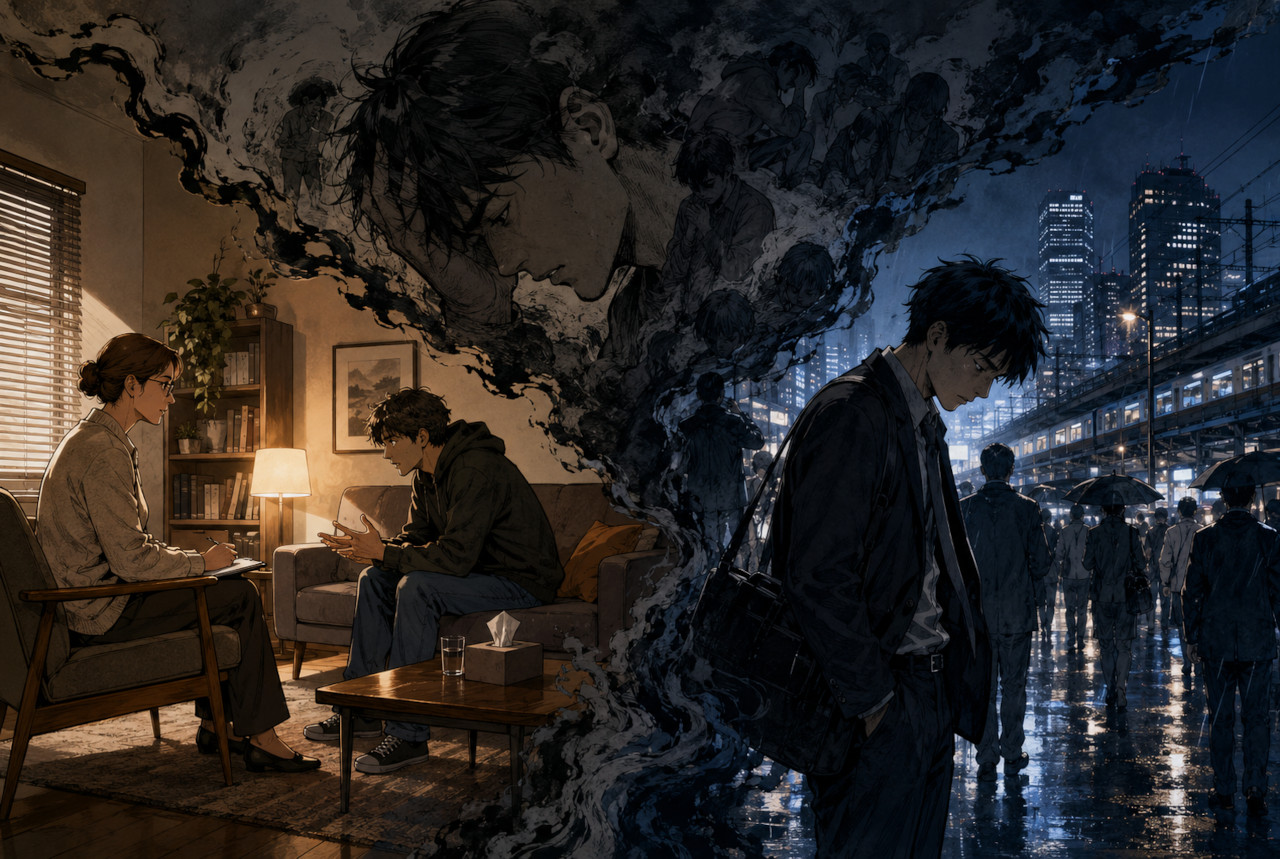
 AI-generated conceptual illustration. The scene represents the familiar television image of outpatient counseling and does not depict a specific patient, therapist or television program.
Japan has a stronger tradition of trying to handle problems alone
This is where the comparison becomes more interesting.
Research into mental health help-seeking in Japan has repeatedly found barriers between experiencing psychological distress and asking a professional for help.
One study using data from the World Mental Health Japan Survey found that among people who delayed seeking care, the most frequently reported reason was:
“I wanted to handle the problem on my own.”
That response was reported by 68.8% of those in the study who had delayed accessing care.
The same research found other barriers, including uncertainty about where to seek help, inconvenience, doubts about treatment and concern about what other people might think.
The data were collected between 2002 and 2006, so they should not be treated as a perfect description of Japan today. But the pattern is revealing.
A separate Japan-U.S. comparison of university students also found that the Japanese participants reported greater reluctance to seek professional psychological help than the American participants.
Again, university students cannot represent two entire nations. Culture is never that simple.
But the studies support something many Japanese people recognize from everyday conversation: there is considerable social value placed on endurance, self-control and not burdening other people with personal problems.
The result can be a mindset that says:
“I should deal with this myself.”
“Maybe it will pass.”
“I can talk to a friend.”
“Going to a psychiatrist sounds too serious.”
“I don’t want people at work to know.”
None of these reactions is uniquely Japanese. Americans have them too.
The difference is one of tendency and social expectation, not a rule dividing two completely different kinds of people.
A newer Japanese study still suggests a help-seeking gap
More recent research suggests that the issue has not simply disappeared.
A study published in 2025 analyzed data from Japan’s nationally representative 2019 Comprehensive Survey of Living Conditions. Among adults aged 20 to 64 included in the analysis, 6.4% reported consulting a physician about mental distress.
That figure should not be directly compared with the U.S. figure of 22.9%, because the two surveys measure different things. The American definition includes several forms of mental health treatment, while the Japanese study specifically examined physician consultation for worries or psychological distress.
Still, the Japanese study identified a potential care gap, particularly among people experiencing moderate levels of distress.
That matters because professional help is often most useful before someone’s life has completely fallen apart — not only after reaching a crisis point.
In an American drama, there is a therapist. In a Japanese drama, there may be an izakaya
Popular entertainment makes the cultural contrast especially visible.
In an American crime drama, a detective may sit in a therapist’s office and say:
“I keep thinking about the person I couldn’t save.”
In a Japanese television drama, a surprisingly similar conversation may happen somewhere else.
An izakaya.
For readers unfamiliar with the term, an izakaya is a casual Japanese pub where people drink, eat small dishes and often talk after work.
The exhausted employee sits beside a coworker, orders another beer and eventually says something like:
“You know… things have been pretty rough lately.”
 AI-generated conceptual illustration. The izakaya is used here as a cultural metaphor for informal conversations with friends or coworkers, not as a substitute for professional mental health care.
The two scenes can perform surprisingly similar emotional functions.
Someone stops pretending that everything is fine. Someone listens. The character finally says aloud what has been bothering them.
But there is one obvious difference.
The coworker is not a mental health professional.
This does not mean Japanese people literally use bars instead of therapists. Nor does it mean Americans do not talk to friends over drinks.
The comparison is useful because it reveals where each culture’s fiction tends to place emotionally vulnerable conversations.
Therapists are also incredibly useful to screenwriters
There is another explanation that has nothing to do with national psychology.
A therapy scene is a brilliant storytelling device.
A screenwriter has a basic problem: viewers cannot hear a character’s thoughts unless the story gives that character a reason to say them aloud.
A protagonist may never tell coworkers:
“I am terrified because this case reminds me of my father.”
They may never admit to their spouse:
“I blame myself for what happened.”
But put that character in a therapist’s office and suddenly those lines become believable dialogue.
The therapist can ask about childhood, guilt, fear, relationships, dreams or traumatic memories without the conversation feeling completely artificial.
That makes therapy especially useful in police dramas, medical dramas, military stories and psychological thrillers — genres in which characters regularly experience events that would be extraordinarily stressful in real life.
The therapist is therefore two things at once: a professional helping the character, and a narrative doorway into the character’s private thoughts.
This is one reason television can make therapy appear even more common than it is outside the screen.
American television is not proof that America has eliminated mental health stigma
It would be equally misleading to conclude that the United States has solved the problem.
It has not.
Cost, insurance coverage, availability of providers, waiting times, social stigma and personal reluctance can all affect whether someone receives treatment.
Even the 2024 U.S. statistics show this.
Among American adults identified as having any mental illness during the previous year, only about half received mental health treatment.
So the familiar television scene — the troubled protagonist calling a therapist and immediately getting an appointment — should not be confused with universal access to care.
American society may be more comfortable discussing therapy in some settings, but that does not mean every American can easily afford it, obtain it or talk openly about it.
Japan is changing too
The Japanese side should not be frozen in a stereotype either.
The phrase mental health has become common in Japanese workplaces and media. Online counseling and remote consultations have become more visible. Employers increasingly discuss employee stress, burnout and psychological wellbeing.
Younger generations also encounter far more public discussion of depression, anxiety, trauma and neurodiversity than previous generations did.
There is therefore no clean line where “America accepts therapy” and “Japan rejects therapy.”
What remains interesting is the threshold at which seeking professional help feels socially justified.
In one culture, talking to a therapist may more readily be interpreted as:
“I’m taking care of a problem.”
In another environment, the same action may still be interpreted as:
“My problem must have become serious if I need professional help.”
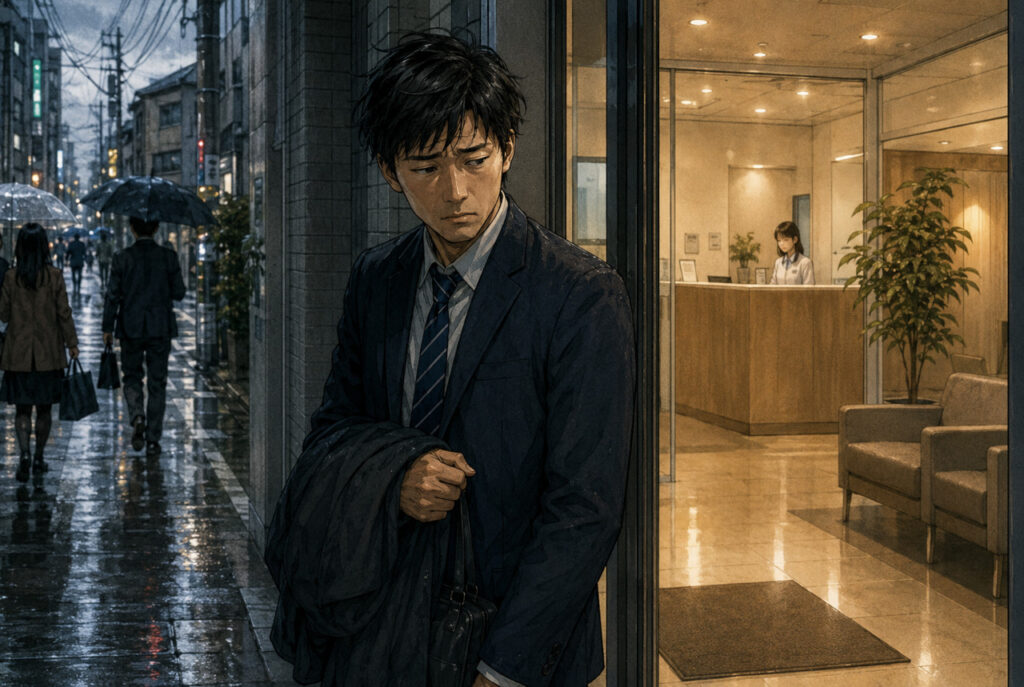 AI-generated conceptual illustration. Individual attitudes vary widely in both Japan and the United States; the image represents a cultural tendency discussed in research, not a rule about nationality.
Perhaps the real difference is when professional help begins to feel “necessary”
This may be the most revealing part of the comparison.
Many Japanese people are perfectly willing to accept professional care once a problem is clearly recognized as an illness.
The harder step can come earlier:
When does ordinary stress become something worth discussing with a professional?
If the mental image of counseling begins only at severe illness, then people may naturally wait.
If counseling is also imagined as a way to understand stress, relationships, grief or recurring emotional problems before reaching that point, the threshold becomes lower.
That is why the apparently trivial therapy scene in an American television show can reveal something larger.
The character is not necessarily portrayed as “broken.”
They may simply have experienced something difficult and now have an appointment with someone trained to talk about it.
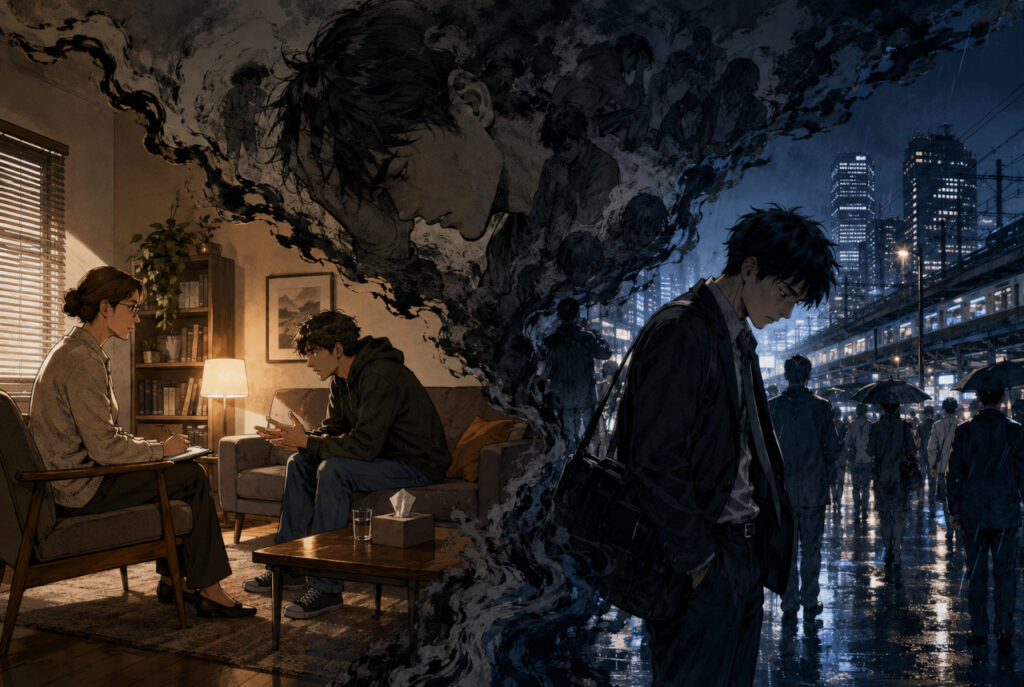 AI-generated conceptual illustration. Informal support and professional care are not mutually exclusive; they serve different purposes depending on the person and situation.
The couch in an American drama tells us something about Japan too
So why do American TV characters seem to go to therapy all the time?
Partly because professional mental health treatment is common enough in the United States that audiences recognize the setting.
Partly because American popular culture has made talking about therapy relatively familiar.
And partly because screenwriters love a room where even the toughest detective can finally explain what is happening inside their head.
But for a Japanese viewer, those scenes also act like a mirror.
They expose the assumptions hidden inside our own reaction:
“Surely you wouldn’t see a professional unless things were really bad.”
That assumption is worth questioning.
Talking to friends, family or coworkers can be enormously valuable. Informal human support is not inferior simply because nobody has a professional title.
But there are situations where knowledge, confidentiality and professional training matter.
The interesting cultural difference may not be that Americans have problems and Japanese people do not. People everywhere struggle. The difference may be how long we believe we are supposed to struggle alone before asking someone trained to help.
Editor’s Note
Watching American dramas from Japan, I used to find therapy scenes almost comically frequent. A detective has a bad week and suddenly there is a therapist. A marriage hits trouble and there is another therapist. To a Japanese viewer, it can feel as if every character already has someone’s number saved in their phone.
But the more I thought about it, the stranger habit may be the opposite one: enduring a problem, drinking it away, complaining to friends, saying “I’ll deal with it myself,” and waiting until things become unbearable before considering professional help.
I still like the Japanese izakaya scene. There is something very human about telling a friend what you could not say at work.
But sometimes a good drinking companion is exactly that — a good drinking companion. Expecting them to become your therapist may be asking rather a lot.
References
- Substance Abuse and Mental Health Services Administration — 2024 National Survey on Drug Use and Health Annual National Report — U.S. national data on mental health treatment. In 2024, 22.9% of adults received some form of mental health treatment, while 9.9% received treatment in the office of a therapist, psychologist, psychiatrist or other mental health professional.
- Kanehara et al. — “Barriers to Mental Health Care in Japan: Results from the World Mental Health Japan Survey” — Japanese population study examining reasons for not seeking, delaying or discontinuing mental health care. Wanting to handle the problem independently was the most frequently reported reason for delayed access.
- Mojaverian, Hashimoto & Kim — “Cultural Differences in Professional Help Seeking: A Comparison of Japan and the U.S.” — Cross-cultural study of university students that found greater reluctance toward professional psychological help among the Japanese participants than among the American participants.
- “Determinants of Consulting a Physician for Mental Distress in Japan: Analyses of the General Population With a Particular Focus on the Moderate Distress Group” — Recent analysis using Japan’s 2019 Comprehensive Survey of Living Conditions, examining professional help-seeking among adults experiencing psychological distress.