

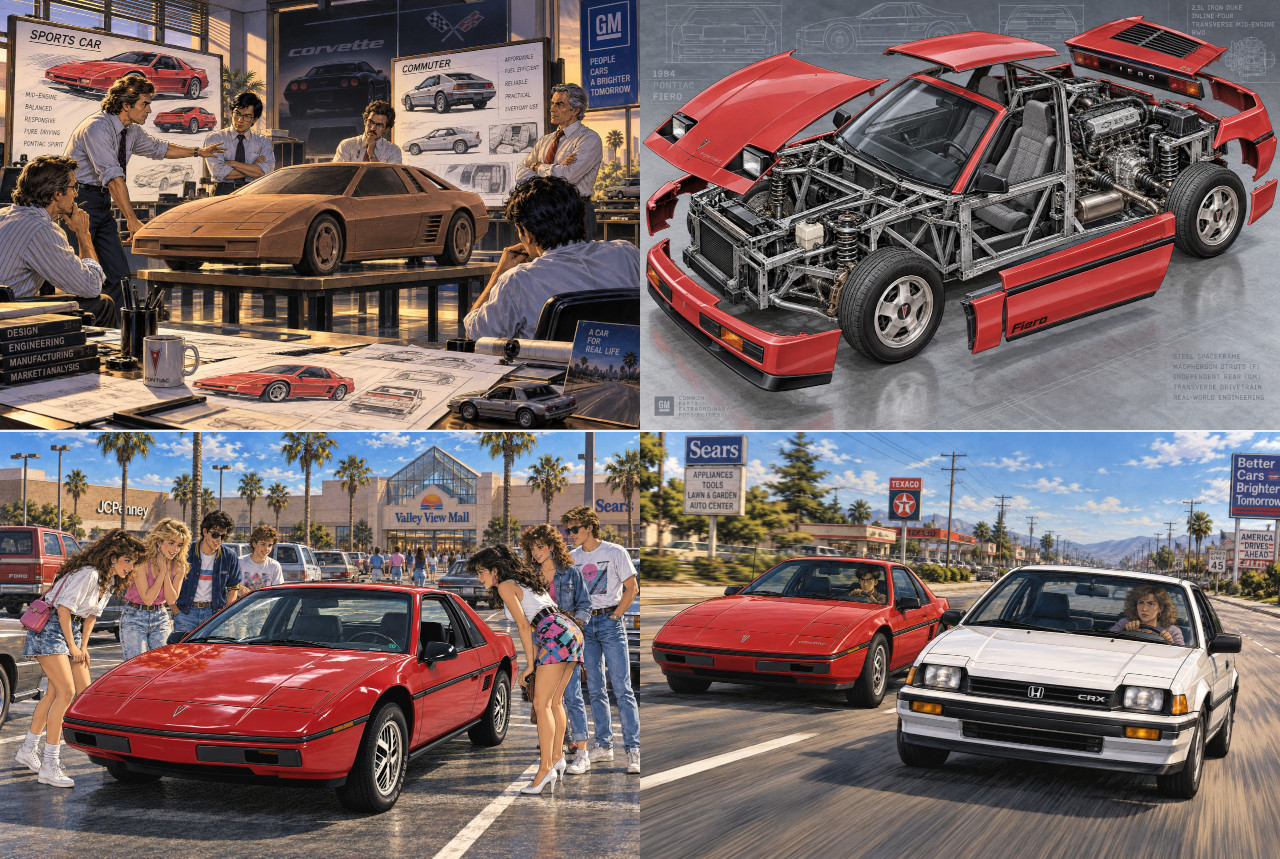
In 1984, America got one of its strangest new two-seaters: the Pontiac Fiero. The engine sat behind the occupants, power went to the rear wheels, the body was low and dramatic, and pop-up headlights completed the miniature-exotic look. At first glance, it seemed as if General Motors had finally decided to build a serious, affordable mid-engine sports car.
Then you looked at the engine. The original Fiero used GM’s 2.5-liter inline-four “Iron Duke,” producing just 92 hp. In Car and Driver testing, the 1984 car needed 11.3 seconds to reach 60 mph. Mid-engine, yes. Fast, no. So why did GM build such an unusual car with such ordinary performance? The answer begins with the fact that the Fiero had to live two different lives before it even reached production.
The Strange Life of the Pontiac Fiero — 3-Part Series
From its underpowered commuter-car origins to its final 1988 transformation and its strange second life as a replica-car platform, this three-part series follows the Pontiac Fiero from birth to afterlife.
- Part 1: Why Was the Pontiac Fiero So Slow? — The Mid-Engine Sports Car That Had to Pretend It Was a Commuter
- Part 2: Why Did the Pontiac Fiero Disappear Just as It Got Good? — Fires, the MR2, and the 1988 Overhaul Coming soon
- Final Part: Why Did the Pontiac Fiero Become a Ferrari? — How America’s Mid-Engine Oddball Became the King of Replicas Coming soon
To Build a Sports Car, Pontiac Had to Call It a Commuter
The Fiero program was led by Pontiac engineer Hulki Aldikacti and his team in the late 1970s. What they wanted was an affordable, two-seat, mid-engine car. The problem was that selling another sports-car program inside GM was politically difficult. Chevrolet already had the Corvette, and fuel economy had become a major corporate concern in the post-oil-crisis era.
So the Fiero was pushed through the system not simply as another sports car, but as a fuel-efficient two-seat commuter. Early planning reportedly envisioned fuel economy approaching the 50-mpg range under favorable conditions. That was a planning goal, not the eventual production car’s normal EPA rating.
In other words, Pontiac did not merely take a commuter and make it look sporty. It wanted to build a sports car, but helped get the project approved by saying, in effect, “This is a commuter.” That corporate compromise would shape almost everything that followed.
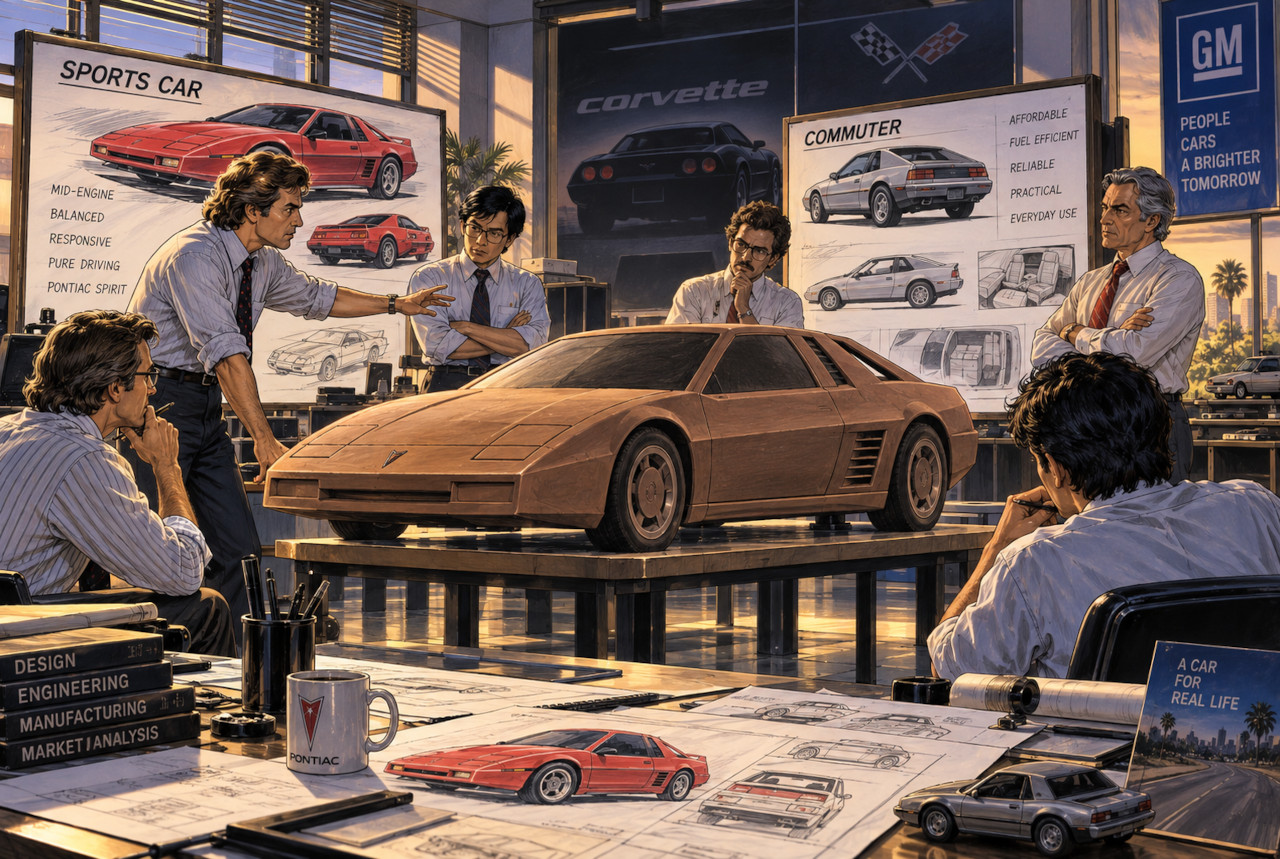 AI-generated illustration representing the tension between the Fiero’s sports-car ambitions and its commuter-car business case. It does not reproduce an actual GM meeting.
The “Commuter” Story Started Shaping the Hardware
Once the project had been approved as an inexpensive, efficient two-seater, Pontiac also had to live with a tightly controlled development budget. That encouraged extensive use of existing GM components. The front suspension drew heavily from GM’s T-car family, including the Chevrolet Chevette, while the rear suspension adapted hardware originally designed for the front of GM’s front-wheel-drive X-cars.
This was not the engineering approach of a clean-sheet exotic car. Yet the Fiero’s basic structure was genuinely innovative. It used a steel space frame covered by non-structural composite body panels. The outer skin did not provide the vehicle’s primary structural strength, which made panel replacement and restyling relatively easy.
That construction would later give the Fiero a completely different second career as one of America’s favorite platforms for replica and custom bodies — but that is another part of the story.
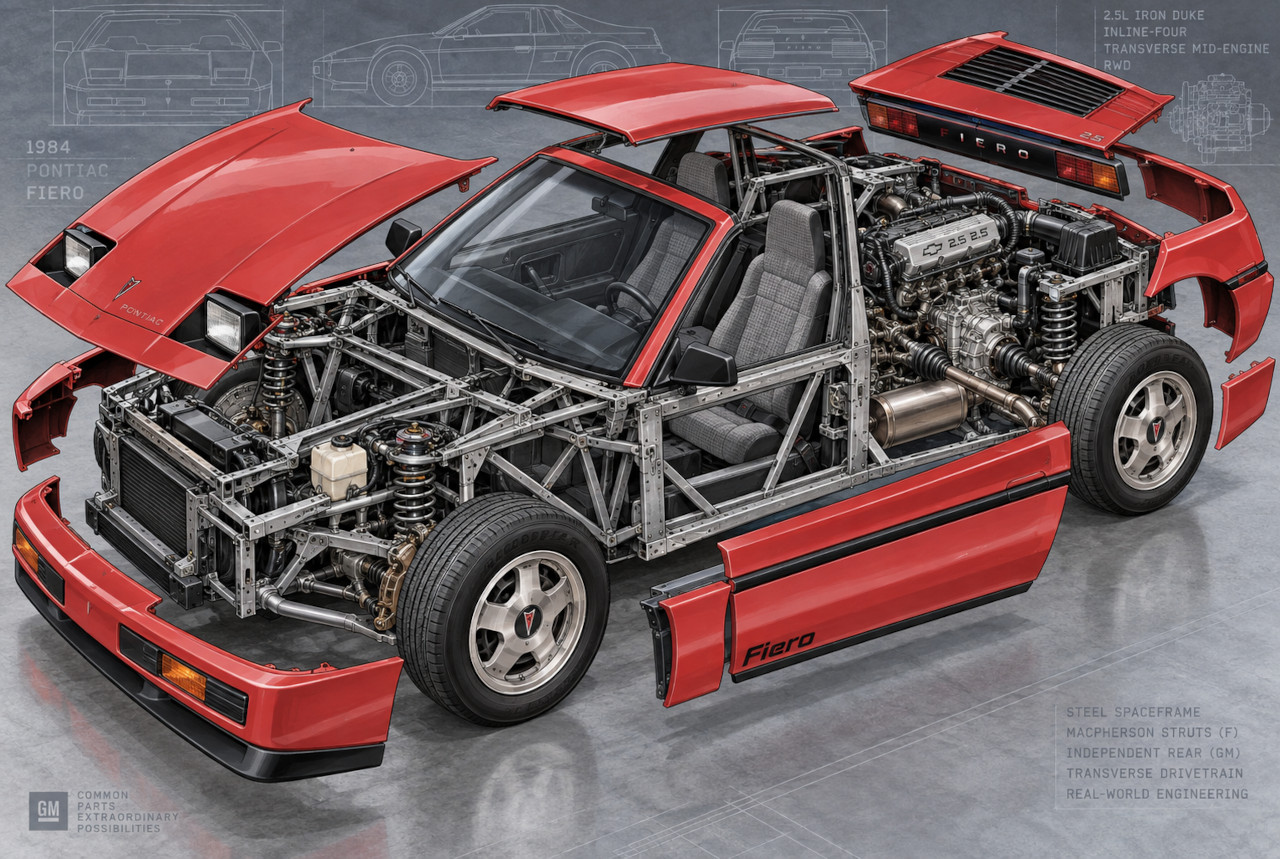 AI-generated technical illustration of the 1984 Pontiac Fiero’s space frame, composite panels, and mid-engine layout. Component shapes and locations are not an exact reproduction of a factory engineering diagram.
It Looked Exotic, but the Engine Made 92 Horsepower
The 1984 Fiero’s 2.5-liter OHV four-cylinder Iron Duke produced 92 hp. It was a durable, practical mass-production GM engine, not a high-revving performance unit developed specifically for the Fiero. The Car and Driver test car weighed 2,580 pounds — about 1,170 kg — and reached 60 mph in 11.3 seconds.
But calling the original Fiero a sales failure would be completely wrong. Pontiac produced 136,840 Fieros for the 1984 model year, far beyond the company’s original expectations. Buyers were attracted by the exotic shape, the novelty of a mid-engine American car, and a base price of just $7,999.
Performance enthusiasts may have wanted more power, but the public clearly wanted the car.
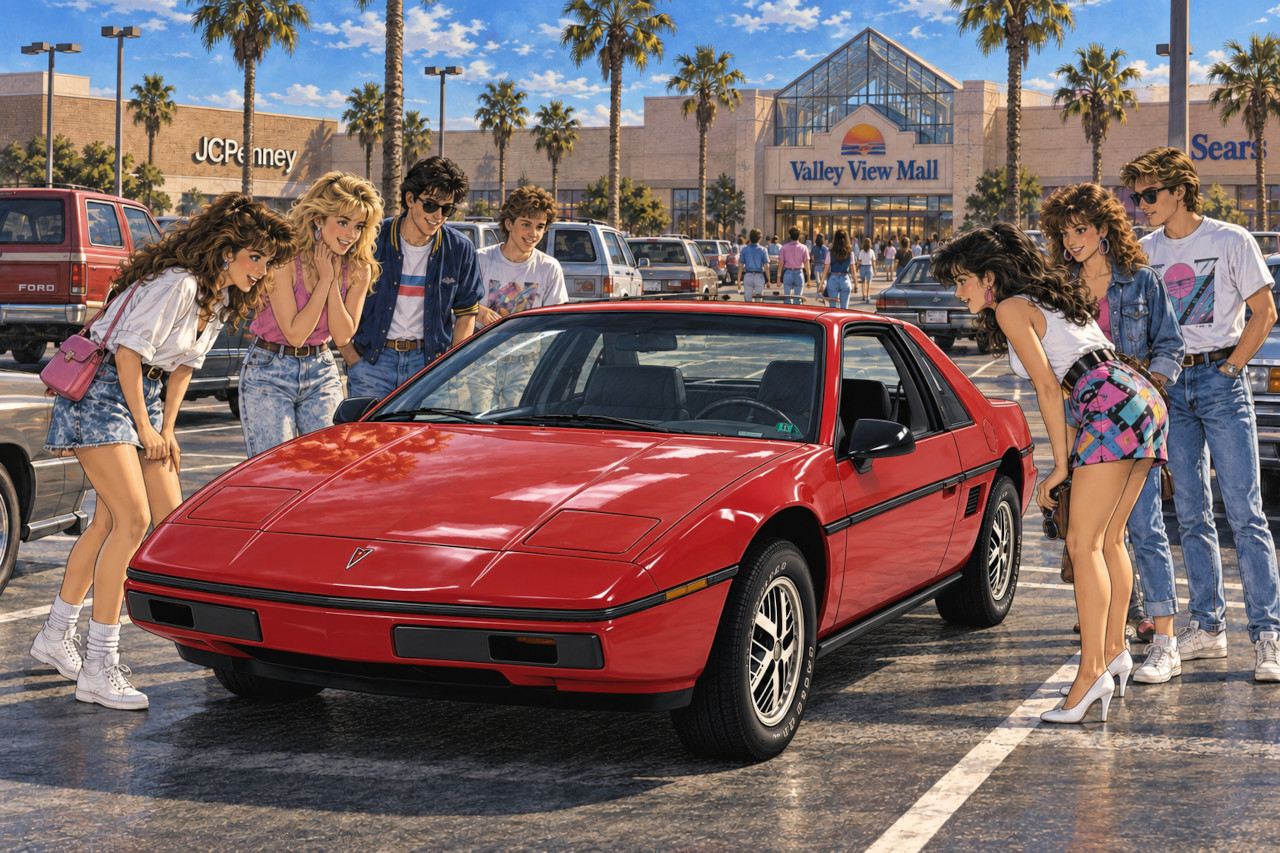 AI-generated illustration representing the strong public attention and early popularity of the 1984 Fiero.
Then a Front-Wheel-Drive Honda CRX Made the Fiero Look Awkward
At almost the same time, Honda introduced a very different kind of two-seat economy coupe to the American market: the CRX. It was based on the Civic, used front-wheel drive, and had none of the Fiero’s exotic mid-engine architecture. But it was dramatically lighter.
Contemporary MotorTrend testing made the contrast uncomfortable for Pontiac. The 1.5-liter CRX was lighter and quicker than the four-cylinder Fiero while also offering strong fuel economy at a lower price. The Fiero had the larger engine and the supposedly superior sports-car layout, yet the humble Civic-based Honda was better at much of the job Pontiac had originally used to justify the Fiero.
A 2.5-liter American mid-engine car was being beaten at the “light, quick and economical” game by a 1.5-liter front-wheel-drive Honda derived from the Civic. Few comparisons better illustrate the original Fiero’s strange identity crisis.
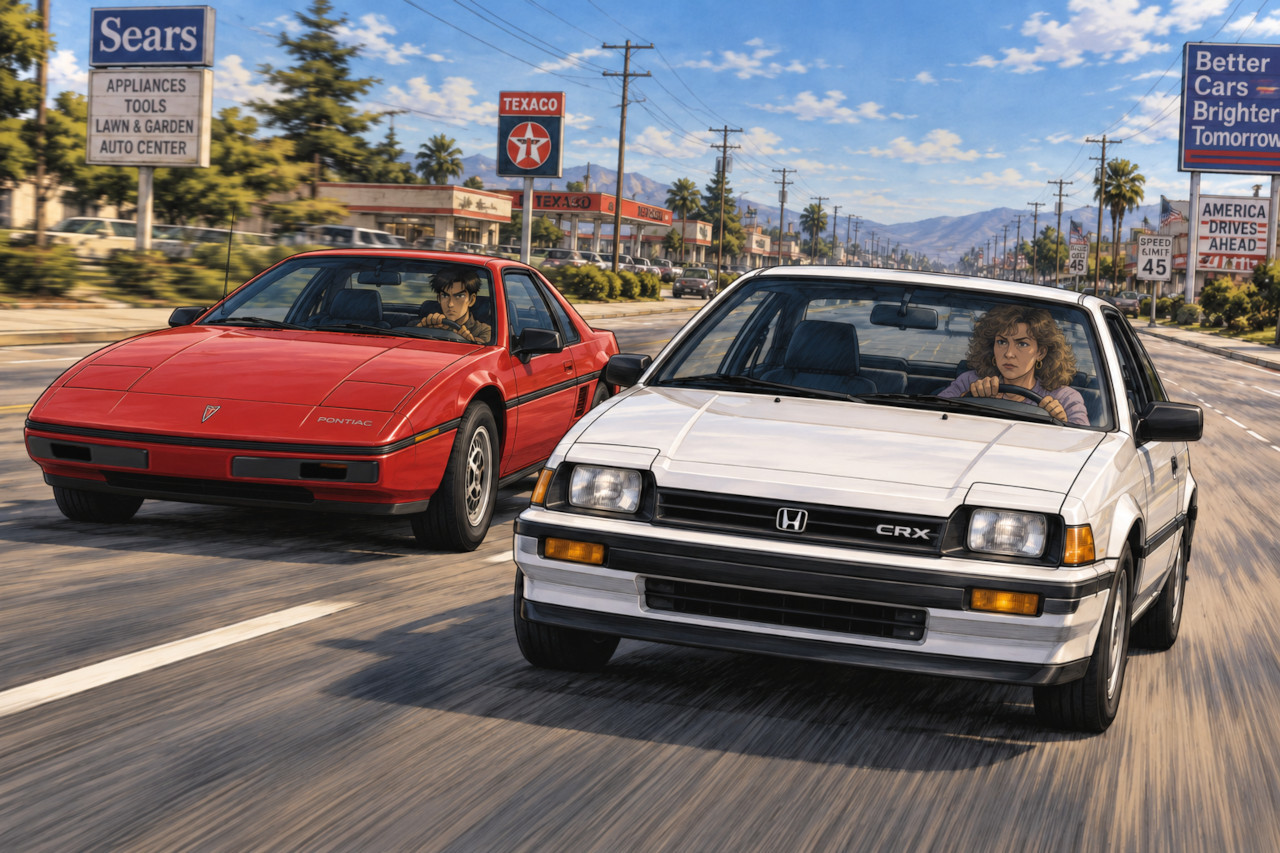 AI-generated illustration representing the performance contrast between the early four-cylinder Fiero and the first-generation Honda CRX.
Women Bought It — but Pontiac Had Left Out Power Steering
Another surprise was who actually bought the Fiero. In a later investigation, The Washington Post reported that women accounted for more than half of Fiero sales in 1984. The combination of distinctive styling, an attainable price, and compact two-seat dimensions clearly appealed to buyers beyond the traditional male sports-car audience.
Yet the Fiero did not have power steering. According to the same report, GM officials later acknowledged that the pre-production test clinics had not included enough women to expose how difficult the steering could feel at low speeds. People inside the Fiero plant were reportedly hearing the same complaint at home: their wives liked the car’s appearance but found it difficult to park.
The remarkable part is what happened next. The Fiero sold so well that GM had little immediate incentive to spend more money correcting the issue. If customers were already buying the car without power steering, why add the cost?
The Fiero’s greatest early misfortune may not have been that it failed. It may have been that an unfinished car succeeded too quickly.
A V6 would soon arrive, followed by better transmissions, new styling, and eventually a dramatically improved chassis. But by then the Toyota MR2 had entered the American market, and reports of engine fires were beginning to damage the Fiero’s reputation. The truly strange part of the Fiero story was only beginning.
Editor’s Note
What fascinates me about the Fiero is that the story is much stranger than “old American cars were slow.” Pontiac wanted a sports car, but getting a sports car approved was difficult. So it sold management on a commuter — and then ended up with commuter-car money, commuter-car parts, and an engine that behaved like one. The styling was good enough that people bought it anyway, while a front-drive Honda CRX embarrassed it on performance and economy. What kind of car does that? I have always been more interested in machines that are slightly wrong in several different directions than in cars everyone already agrees are great. The Fiero is almost perfect at being imperfect.
References
- Car and Driver, “1984 10Best Cars” — Original 1984 Pontiac Fiero 2M4 specifications, $7,999 base price, and contemporary evaluation
- Car and Driver, “Remember the Fiero” — 92-hp Iron Duke performance, 11.3-second 0–60 mph time, early production success, and development compromises
- Car and Driver, “The Design Rejects: Second-Generation Pontiac Fiero” — Fiero development history, design philosophy, and the program’s eventual evolution
- The Washington Post, “Crash Course at GM” — GM corporate politics, development compromises, female buyers, and the Fiero’s lack of power steering
- MotorTrend, “The Ringer: 1985 Honda Civic CRX Si” — Period Honda CRX performance and comparison with the four-cylinder and V6 Fieros
- Ate Up With Motor, “Kill Your Darlings: The Birth and Death of the Pontiac Fiero” — Detailed history of the Fiero program, its commuter-car business case, engineering compromises, and later development
- Gary Witzenburg, Fiero: Pontiac’s Potent Mid-Engine Sports Car — Development history and interviews with people involved in the Fiero program