
In Japan, the phrase “a moped is cheap transportation” used to make perfect sense. Small 50cc scooters were inexpensive, easy to own, and could be ridden with either a basic moped license or an ordinary car license.
That logic is becoming harder to defend. Today, a new scooter that can still be ridden under Japan’s basic moped rules can cost surprisingly close to a regular 110–125cc scooter. Yet the legal restrictions remain severe: a 30 km/h speed limit, two-stage right turns at certain intersections, and no passenger.
Japan also changed its moped regulations in April 2025. In addition to traditional models of 50cc or less, motorcycles with engines above 50cc and up to 125cc can now qualify as a new type of Class 1 moped if their maximum output is restricted to 4.0 kW or less.
This does not mean Japan suddenly allowed anyone with a car license to ride a normal 125cc motorcycle. What it created instead is something much stranger: a 110–125cc-class machine whose performance is deliberately reduced so that it remains inside the old 30 km/h moped world.
The Replacement for the 50cc Moped Is Now a Restricted 125cc-Class Machine
Since April 2025, Japan’s Class 1 moped category has included not only conventional motorcycles of 50cc or less, but also motorcycles above 50cc and up to 125cc whose maximum output is limited to 4.0 kW or less.
These new-standard mopeds can be ridden with a Japanese moped license or an ordinary automobile license. But there is an important catch: they are still legally treated as Class 1 mopeds.
That means the familiar restrictions have not disappeared. Their legal maximum speed remains 30 km/h, carrying a passenger is prohibited, and at certain larger intersections riders must perform Japan’s unusual “two-stage right turn.” Instead of entering the right-turn lane with normal traffic, a Class 1 moped proceeds across the intersection first, stops on the far side, changes direction, and then continues when the signal permits.
For readers outside Japan, this distinction matters. A new-standard moped may have an engine physically closer to a 110cc or 125cc scooter, but legally it still behaves much more like the old Japanese 50cc moped.
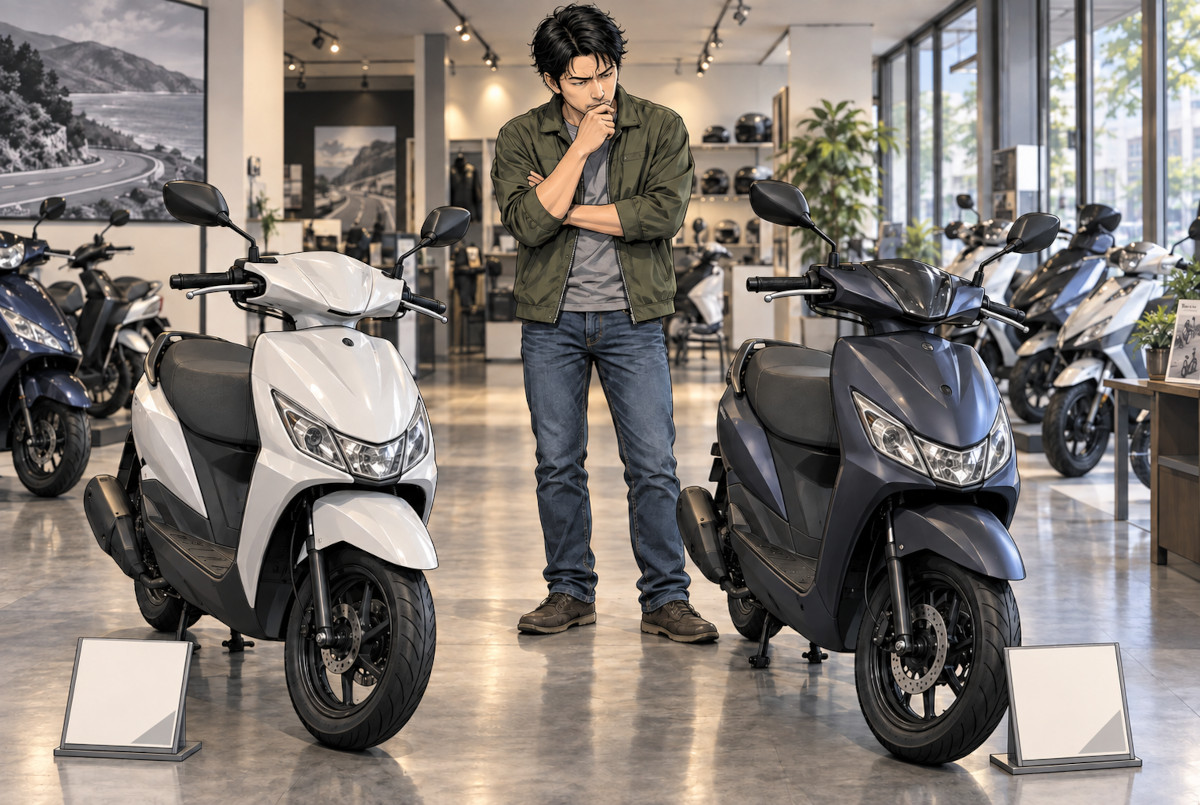 Concept illustration comparing a new-standard moped with a Class 2 scooter. Actual prices and specifications should be checked on the manufacturers’ official websites.
JOG ONE vs. JOG125 Shows Just How Strange the System Has Become
Yamaha’s JOG ONE and JOG125 make the difference unusually easy to see.
Both use 124cc engines. Their overall dimensions are also effectively the same: 1,740 mm long, 675 mm wide and 1,090 mm high, with a 735 mm seat height. Both weigh 95 kg and carry 4.0 liters of fuel.
Yet their legal identities are very different.
The JOG ONE is a new-standard Class 1 moped with maximum output restricted to 3.5 kW (4.8 PS). The JOG125 is a Class 2 scooter producing 6.1 kW (8.3 PS).
The price difference is the part that makes this comparison especially interesting. The JOG ONE is priced at ¥259,600, while the JOG125 is ¥270,600. The difference is only ¥11,000.
They are both 124cc, both weigh 95 kg, and are almost the same physical size—yet one is restricted to 30 km/h while the other is treated as a normal Class 2 scooter.
That ¥11,000 gap makes the old idea that “a moped is the cheap option and a 125cc scooter is a completely different class of vehicle” increasingly difficult to maintain.
There is one more important point for overseas readers. The JOG125 has far more freedom on ordinary Japanese roads, but it still cannot use Japan’s expressways or motor-vehicle-only roads where motorcycles of 125cc or less are prohibited. The advantage here is primarily about normal road use: no special 30 km/h moped limit and no Class 1 two-stage right-turn requirement.
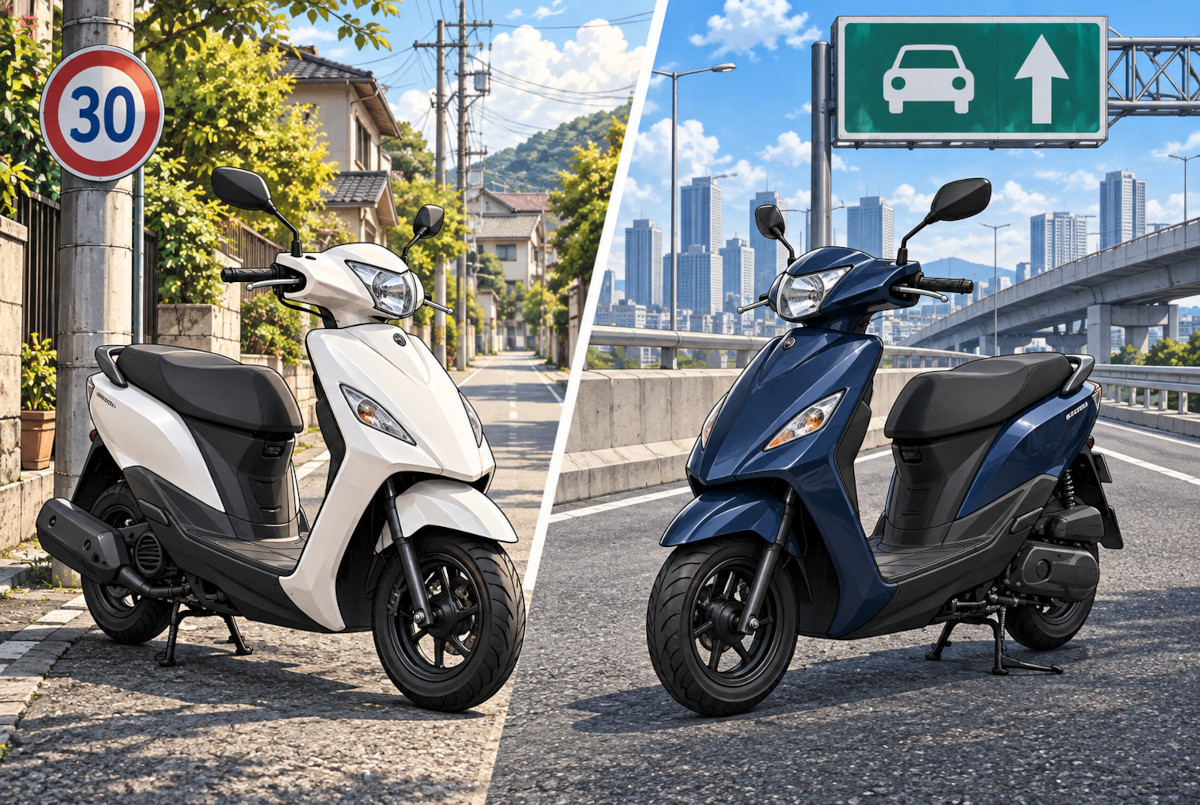 Concept illustration showing the difference in road rules. A 125cc-or-smaller Class 2 motorcycle is still not permitted on Japanese expressways and applicable motor-vehicle-only roads.
The 30 km/h Limit Feels More Restrictive Than the Number Suggests
The biggest weakness of Japan’s Class 1 moped system may not be the purchase price at all. It is the road rules.
A 30 km/h limit is not necessarily a major problem on a quiet residential street or for a very short trip to a supermarket. But the situation changes quickly on an urban arterial road where surrounding traffic may be moving at 50 or 60 km/h.
The moped rider is required to remain within the 30 km/h limit while faster vehicles repeatedly pass. The issue is not simply that the rider wants to go faster. There are situations in which obeying the moped speed limit creates a large speed difference between the rider and surrounding traffic.
That difference can make everyday riding feel surprisingly stressful.
The two-stage right-turn rule adds another layer. Cars and Class 2 scooters can normally move into the appropriate lane and turn right, while a Class 1 moped may be required to follow a completely different procedure at the same intersection.
 Concept illustration of the speed difference created by Japan’s 30 km/h Class 1 moped limit. Actual traffic conditions and regulations vary by road.
Honda’s Dio110 Lite Shows That Yamaha Is Not an Isolated Case
This is not just a Yamaha phenomenon.
Honda follows a very similar approach with the Dio110 Lite and the regular Dio110 Basic.
Both use 109cc engines, and their overall body dimensions are the same: 1,870 mm long, 685 mm wide and 1,100 mm high. The Lite version is designed for the new-standard moped category and produces 3.7 kW (5.0 PS). The Dio110 Basic is a Class 2 scooter producing 6.4 kW (8.7 PS).
The Dio110 Lite costs ¥239,800, while the Dio110 Basic costs ¥250,800.
Once again, the difference is exactly ¥11,000.
The models are not literally identical motorcycles with a software limiter added. Honda gives the Lite model its own tuning and equipment details, including a lower seat. But the broader pattern is obvious.
Manufacturers are no longer simply building an ultra-cheap 50cc scooter from scratch. They can use 110–125cc-class engines and platforms, then adapt their output and specifications to fit Japan’s Class 1 moped regulations.
In other words, the moped itself has changed. The old 50cc formula is giving way to something physically closer to the next class up, while the legal restrictions remain largely unchanged.
A New-Standard Moped Is Not Simply a Worse 125cc Scooter
It would be unfair to conclude that these new-standard mopeds are merely crippled versions of better motorcycles.
The JOG ONE demonstrates why.
The former 50cc JOG produced a maximum torque of 4.1 N·m at 6,000 rpm. The JOG ONE produces 7.7 N·m at only 3,000 rpm. Although its maximum power is restricted to stay within the new Class 1 standard, the larger engine gives it considerably stronger torque at lower engine speeds.
Yamaha specifically highlights smoother takeoff, easier acceleration and stronger climbing performance compared with the old 50cc model.
So while the legal 30 km/h limit remains, the experience of getting away from a traffic light, climbing a hill or carrying out ordinary low-speed riding can be noticeably easier than on an old 50cc scooter.
For someone who does not want to obtain another motorcycle license and only needs a machine for short local trips, that has real value.
The difficult question is whether that advantage justifies the price.
The JOG ONE and JOG125 differ by only ¥11,000. The Dio110 Lite and Dio110 Basic also differ by only ¥11,000.
Even the annual vehicle tax difference is small. Using Machida City, Tokyo as one current example, a Class 1 moped including the new-standard category is taxed at ¥2,000 per year, while a Class 2 motorcycle above 90cc and up to 125cc is ¥2,400.
That is a difference of just ¥400 per year.
At that point, the biggest financial barrier is no longer the scooter itself. It is the cost and effort required to obtain the appropriate small-motorcycle license.
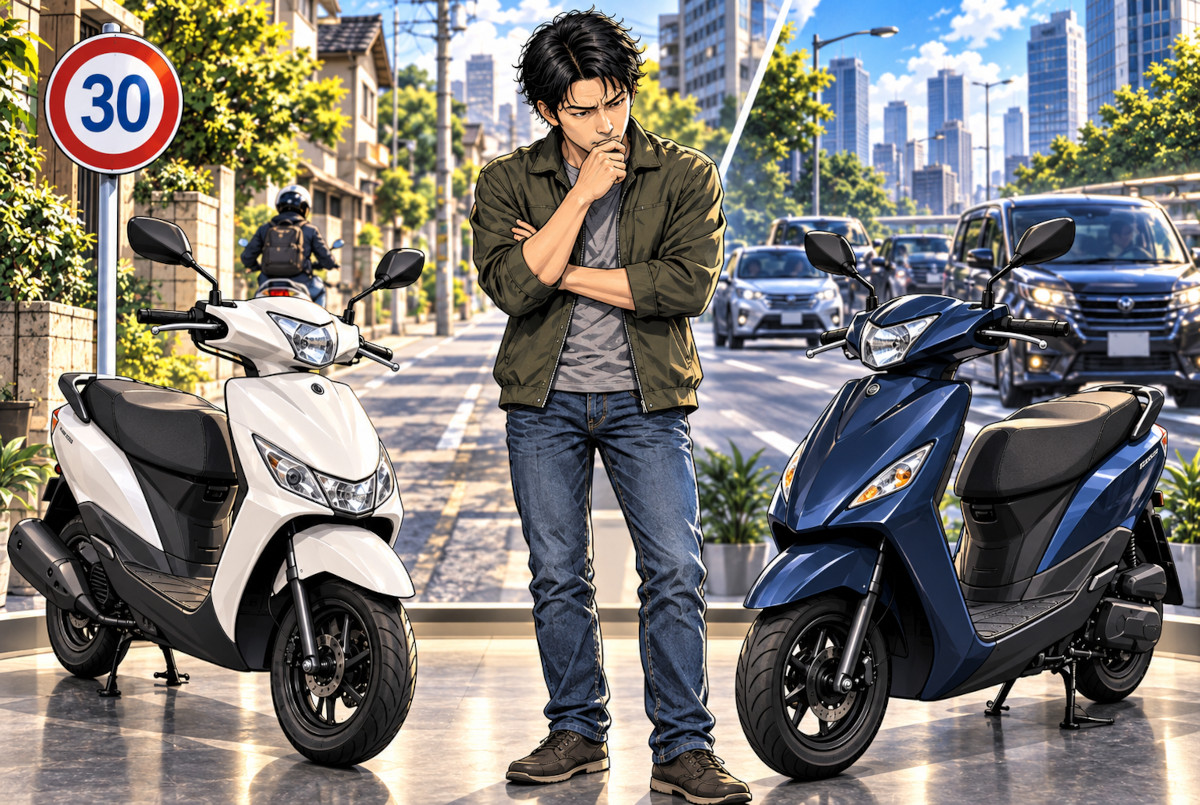
 Concept illustration of a buyer comparing commuting, shopping, licensing and ownership costs. Documents and license-like items shown are fictional visual props.
The Real Choice Is No Longer “50cc or 125cc”
Japan’s moped debate is no longer simply about engine displacement.
A buyer can now stand in front of two machines built around essentially the same 110–125cc-class hardware and make a very different kind of decision: remain inside the Class 1 moped system, or pay for the license needed to move beyond it.
The new-standard moped has one enormous advantage. A person who already has an ordinary Japanese car license does not need to obtain an additional motorcycle license to ride one.
But the vehicle itself is no longer dramatically cheaper than the Class 2 alternative.
That changes the calculation. Buyers need to consider not only the sticker price, but also where they intend to ride, whether the 30 km/h restriction will matter, how often they will encounter intersections requiring a two-stage right turn, and whether paying for motorcycle training would be worthwhile over several years of ownership.
Japan is moving away from the old question of “Is a moped cheap?” toward a more interesting one: “How much is it worth paying to escape the moped rules?”
The new-standard moped did not eliminate the old moped system. It exposed just how much of that system was never really about engine size in the first place.
Editor’s Note
Before looking into this, I assumed the answer would be simple: if mopeds have become expensive, just buy a 125cc scooter instead. But once I put the JOG ONE and JOG125 side by side, the whole thing looked different. The machines themselves are only ¥11,000 apart. So the expensive part is not really the 125cc scooter—it is getting the license that lets you leave the 30 km/h moped rules behind.
That does not make the JOG ONE pointless. If you already have a Japanese car license, do not want another license, and only ride short local distances, it makes perfect sense. But if you already hold a small-motorcycle license—or are willing to get one—I struggle to see much reason to deliberately stay on the 30 km/h side of the line. At this point, choosing a moped in Japan is becoming less about the price of the machine and more about how much you are willing to pay to escape the rules attached to it.
References
- Yamaha Motor — JOG ONE
Official product information for the JOG ONE, including price, specifications and its classification under Japan’s new-standard moped rules. - Yamaha Motor — JOG125 Specifications and Price
Official specifications, pricing and licensing information for the JOG125 Class 2 scooter. - Yamaha Motor — Riding the New-Standard JOG ONE
Yamaha’s comparison of the JOG ONE with the previous 50cc JOG, including torque, acceleration and hill-climbing characteristics. - Honda — Dio110 Lite
Official Honda product page for the new-standard Dio110 Lite. - Honda — Launch of the Dio110 Lite for Japan’s New-Standard Moped Category
Honda’s official release covering the Dio110 Lite’s price, output, engine and major specifications. - Honda — Dio110 Basic
Official price, engine, output and dimensional specifications for the Dio110 Basic. - National Police Agency of Japan — Revision of the Class 1 Moped Vehicle Category
Official explanation of the April 2025 regulatory change allowing certain motorcycles up to 125cc and 4.0 kW to be ridden under the Class 1 moped license category. - Machida City — Light Vehicle Tax Rates
Current municipal tax rates used to compare Class 1 mopeds with 90–125cc Class 2 motorcycles. - NEXCO East Japan — Vehicles Prohibited from Expressways
Official guidance confirming that Class 1 mopeds and motorcycles of 125cc or less are prohibited from expressways and applicable motor-vehicle-only roads.