

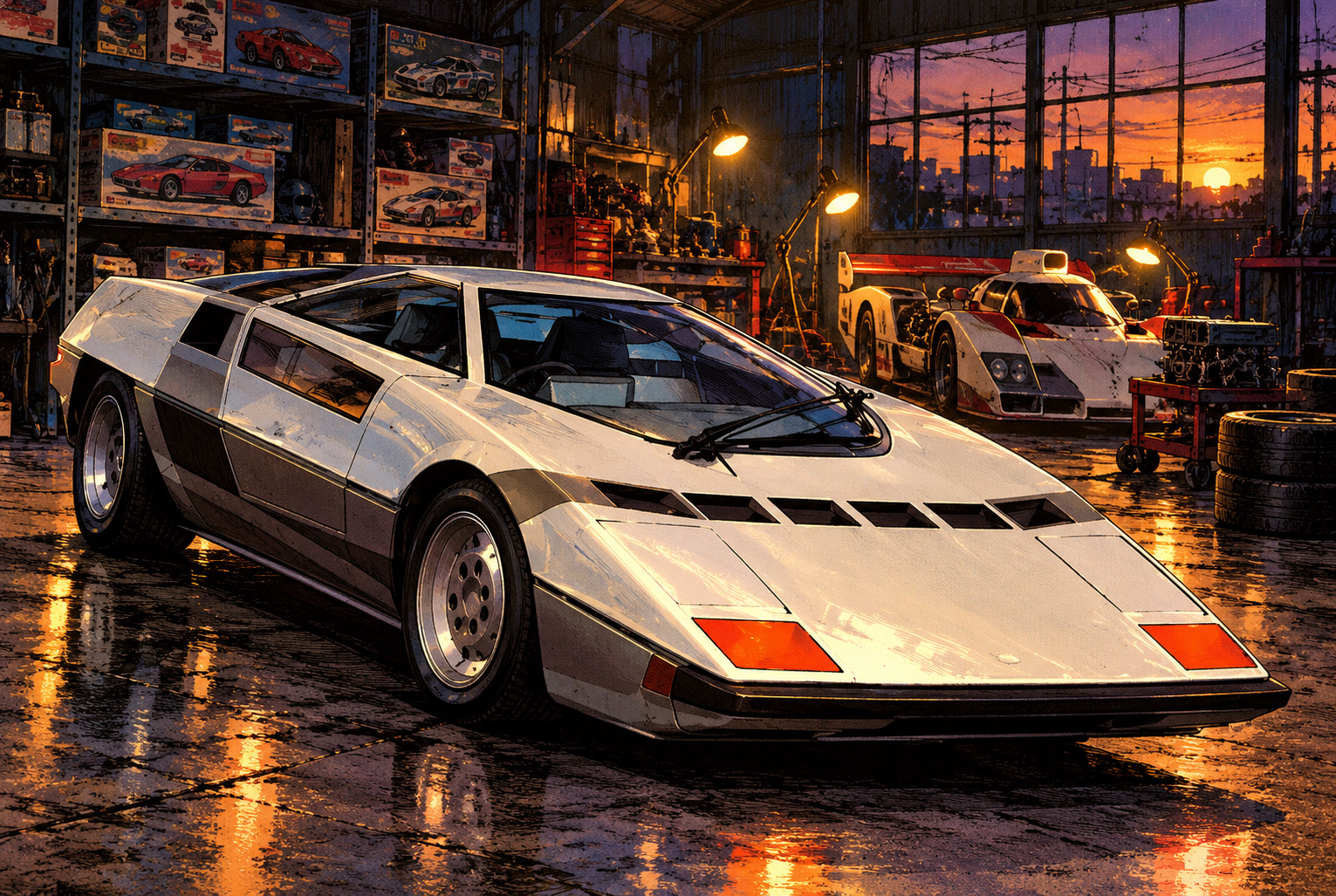
For Japanese car fans who grew up during the late-1970s supercar boom, the DOME Zero is one of those shapes that never quite leaves the memory. Even if you did not grow up in Japan, one glance explains the fascination: just 980 mm tall, brutally wedge-shaped, with doors that swing upward and proportions that look more like a show car than something meant for ordinary roads.
DOME unveiled the Zero at the 1978 Geneva Motor Show as a homegrown Japanese supercar contender. And yet, for all its fame, almost nobody has ever seen one passing them in traffic. There is a simple reason for that: not a single DOME Zero was ever sold to the public.
So what exactly was it? A failed production car? A publicity stunt? A race-car builder’s fantasy that got out of hand? Once you follow what happened next, the answer becomes much stranger.
It looked like a supercar. It had 145 PS.
The DOME project began in 1975, and the Zero was its first major creation. It was not conceived merely as a motor-show prop. DOME intended it to become a genuine road-going sports car.
Power came from Nissan’s L28-series 2.8-liter inline-six, producing 145 PS — roughly 143 hp — while the car weighed only 920 kg. That works out to a power-to-weight figure of about 6.3 kg per PS.
In other words, it looked as though it had arrived from the same wedge-shaped future as a Lamborghini Countach, but there was no huge V12 hiding behind the cabin. On paper, 145 PS does not sound especially exotic today.
But that misses half the point. The Zero weighed barely over 900 kg, stood less than one meter high and used a mid-engine layout. This was not simply a fiberglass fantasy shell. It was a serious attempt by people steeped in racing machinery to build a road car of their own.
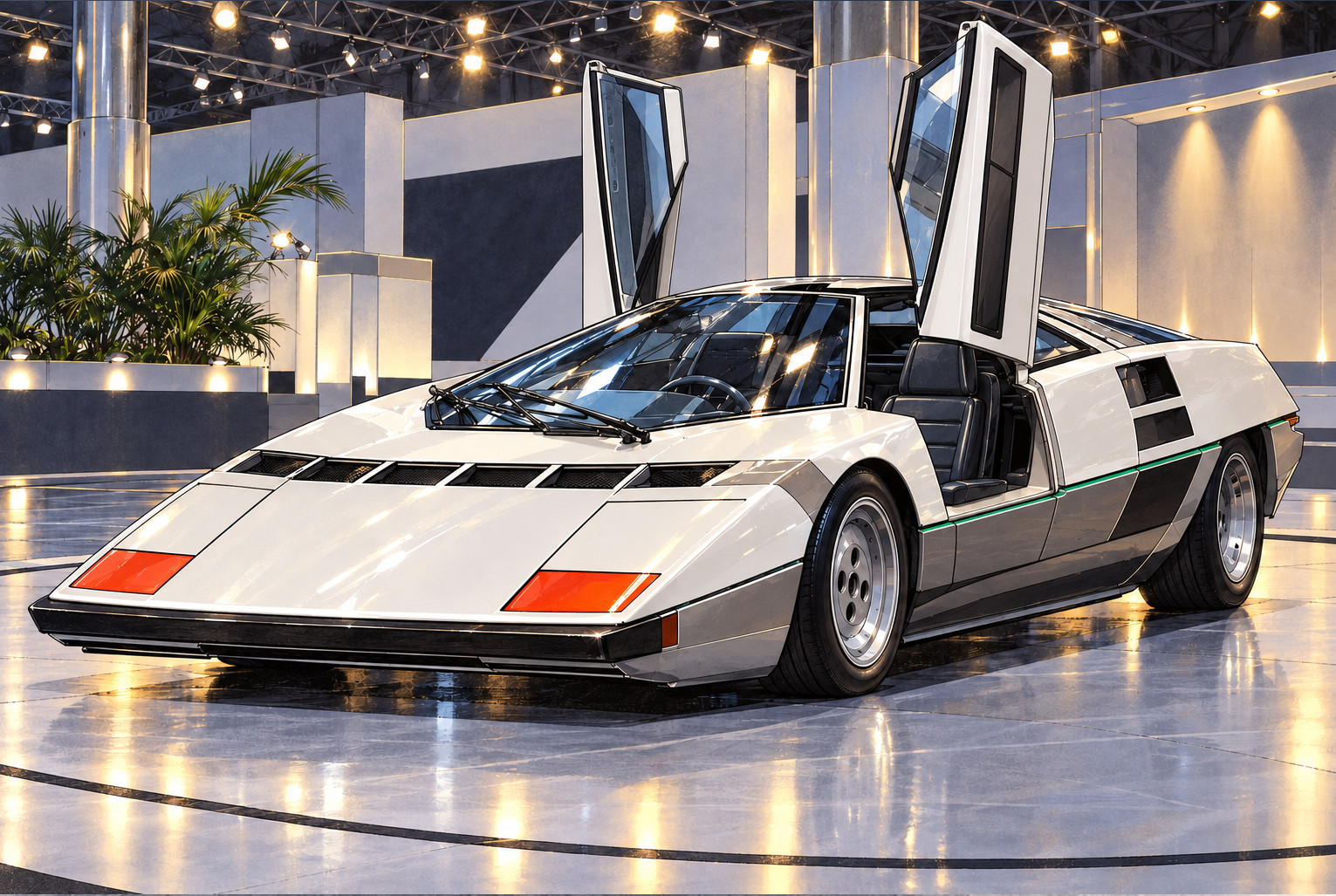
AI-generated explanatory illustration. It does not reproduce the actual Geneva Motor Show display or exhibition setting.
The story that it simply “failed approval” is too neat
A common explanation says the DOME Zero could not be sold because it “failed Japanese government approval.” That version is convenient, but DOME’s own account is more complicated.
The company says it spent more than a year trying to obtain domestic road-registration approval while dealing with Japan’s then-Ministry of Transport. Eventually, DOME gave up on the Japanese approval process and turned its attention overseas.
What the available material does not establish is a simple sequence in which DOME formally submitted the Zero to a definitive certification test and received an official rejection notice. At least from the sources reviewed here, “it failed the test” is more definite than the evidence allows.
So in 1979, DOME developed two cars called the DOME P-2, reworked around U.S. regulations. The P-2 stood 990 mm tall and weighed 950 kg. It was a substantially revised machine rather than a lightly modified Zero.
At this point, you would expect the story to become: “small Japanese company tries to sell its supercar in America.”
Instead, Le Mans happened.
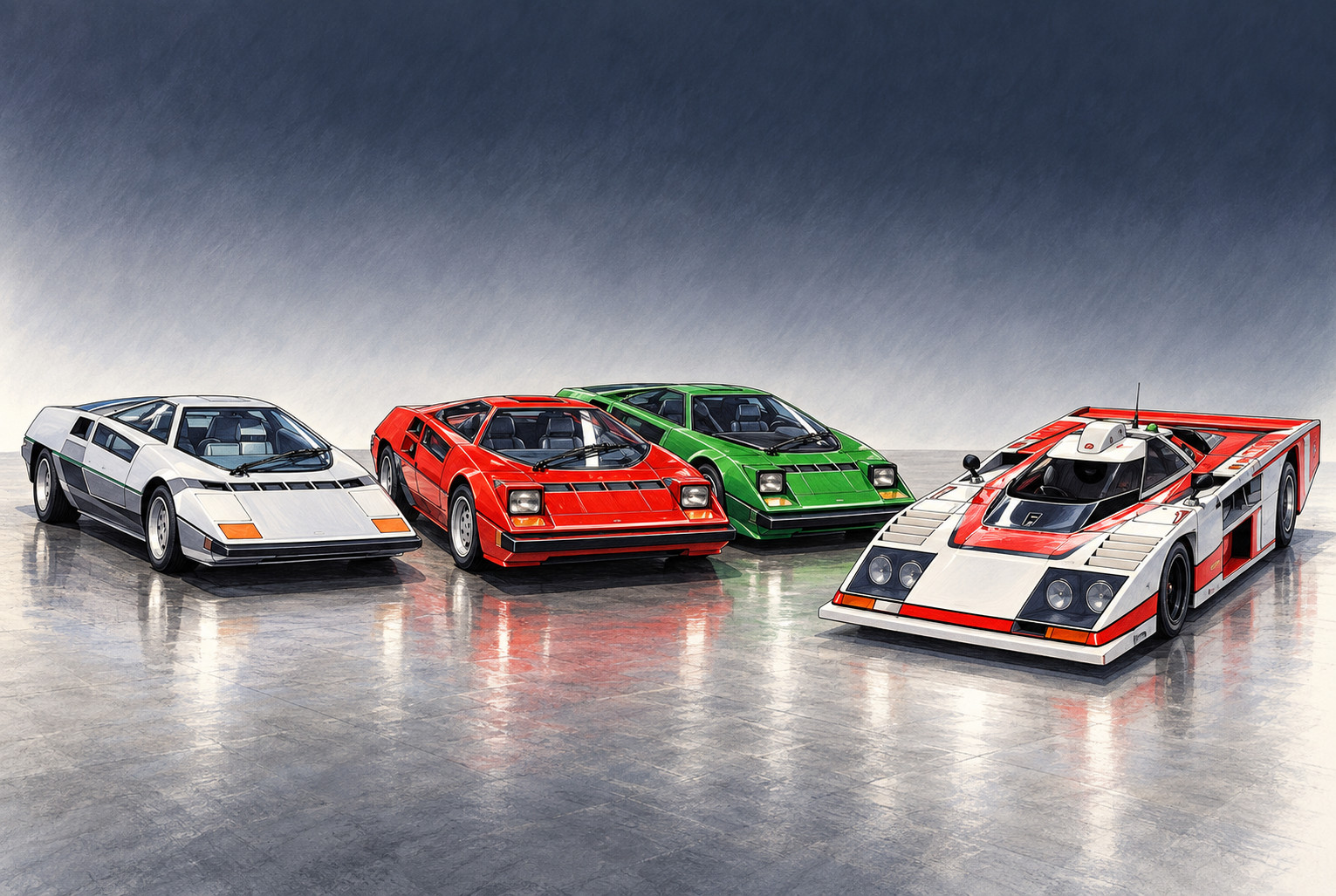
AI-generated comparison illustration showing the development path of the cars. It does not depict an actual four-car exhibition.
They were developing a road car. Then they went to Le Mans.
DOME’s own description of the P-2 is almost comically blunt. While the company was testing the cars in America, an opportunity to challenge Le Mans appeared, and the P-2 was effectively pushed aside.
That sounds like terrible corporate discipline if you imagine DOME as a conventional automaker. But that is exactly the problem with looking at it like a conventional automaker. These were racing-car people.
In 1979, DOME entered two DOME Zero RL cars in the 24 Hours of Le Mans. Despite the name, the Zero RL was not a road-going Zero with racing bodywork bolted onto it. It was a purpose-built prototype with an aluminum-alloy monocoque and a 2,993 cc Ford-Cosworth DFV producing around 480 hp.
The following year’s RL-80 completed the 1980 Le Mans 24 Hours. DOME would go on to work on Group C machinery, Formula 3000 cars, GT racers and later Le Mans prototypes. The road-car dream had not exactly evolved according to plan; it had veered back toward racing.
The real car did not sell. The toys did.
If no customer ever bought a DOME Zero, it would be tempting to call the project a commercial failure and move on.
But this is where the story becomes wonderfully backwards.
After the Zero caused a sensation in Geneva, DOME received numerous licensing offers for toys, radio-controlled cars and other merchandise. Founder Minoru Hayashi later recalled that the royalties became substantial enough to help finance DOME’s facility in Kyoto.
The road car sold zero units, but its image sold extremely well.
And the loop became even stranger. Hayashi recalled that a toy company making money from DOME Zero radio-controlled cars wanted another product and offered advance funding for a racing version of the Zero. Hayashi’s response was essentially: if they were going to build a racing car anyway, why not go to Le Mans?
That helped set the Zero RL project in motion.
So the sequence was not the normal one in which racing success sells road cars. It was almost the reverse: a road car that never reached customers became a popular toy, the toy business generated money, and that money helped propel the company toward real racing cars.
You will not find many supercar stories with a business model quite like that.
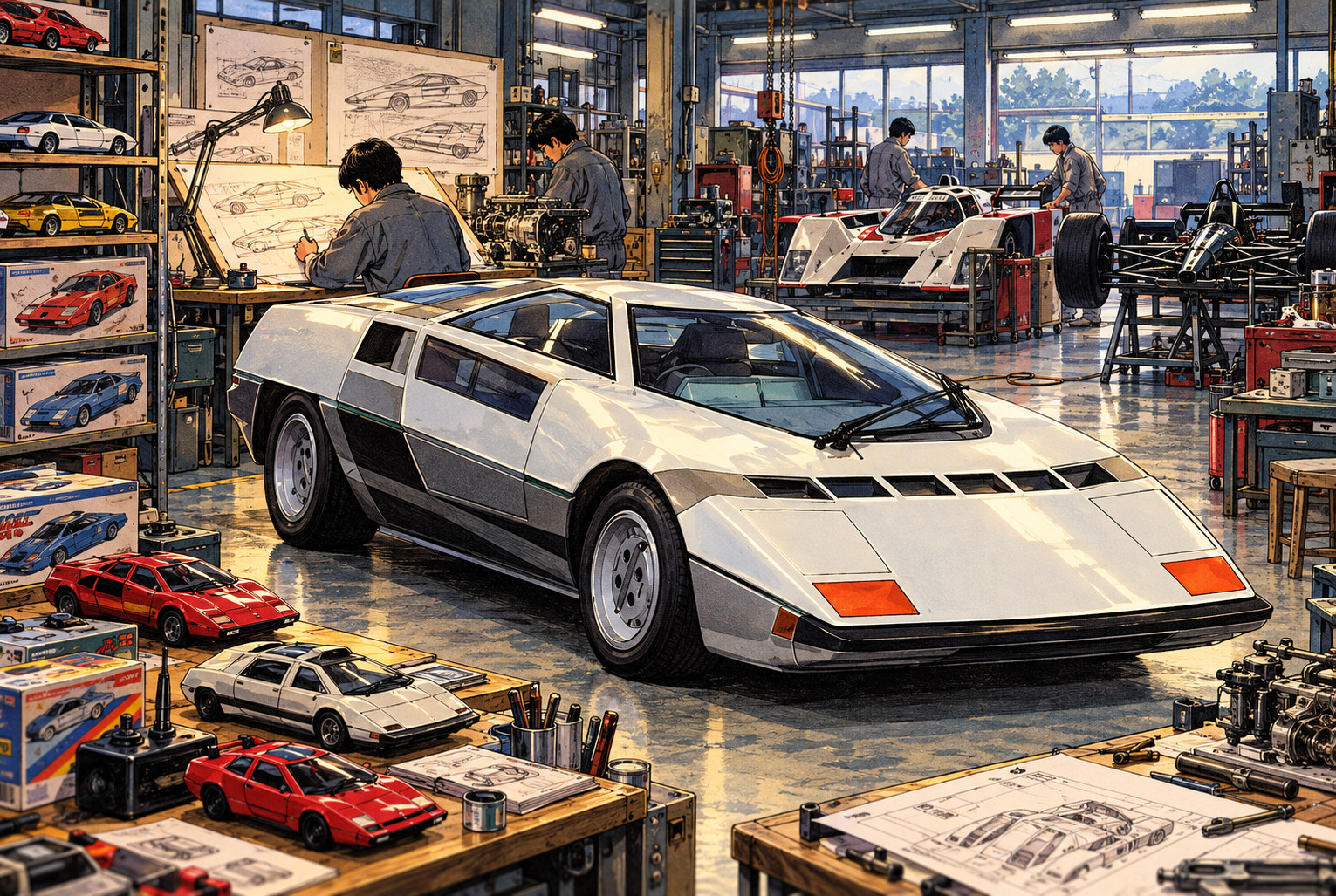
AI-generated symbolic illustration of the link between toy popularity and later racing development. It does not reproduce an actual DOME workshop.
The DOME Zero still exists — and so does DOME
The original Zero itself has survived.
When the Toyota Automobile Museum exhibited a DOME Zero in 2000, its official exhibition material identified the car as being on loan from DOME. More recently, an actual DOME Zero was displayed at the Fuji Motorsports Museum from December 25, 2025 through March 31, 2026.
The two P-2 prototypes were built in red and green. A 2019 Pen Online feature reported that both were still preserved at DOME at that time. Publicly available information does not establish the exact location or operating condition of both cars as of 2026, so it is safer not to describe them as currently roadworthy or permanently displayed.
DOME itself has not disappeared either.
In September 2026, DOME announced that it would serve as the lead company for rolling-chassis development of the JMIA-DOME F113, a next-generation Japanese top-formula development project. DOME is responsible for coordinating the chassis design, evaluation and improvement work within the wider JMIA collaboration.
That is a remarkable piece of continuity. Forty-eight years after the Zero appeared in Geneva, the company carrying the DOME name is still engineering racing cars.
Calling the Zero a “failed Japanese supercar” misses the interesting part
As a production road car, the DOME Zero was not a success. No production run followed, no customers took delivery, and the P-2 plan also failed to become a commercial road-car program.
There is no need to rewrite that as a triumph just because the car became legendary.
But look at the company rather than the sales chart and another pattern appears:
the Zero created attention → licensing generated income → facilities grew → Le Mans followed → engineering work expanded.
That is why the DOME Zero is difficult to classify simply as a failure. It did not succeed at the job a normal car is supposed to do — being manufactured and sold — but it succeeded spectacularly at making people notice DOME.
Perhaps the best way to describe it is this: the DOME Zero was a car DOME failed to sell, but a car that successfully sold DOME itself.
That also explains why it is hardly a buried embarrassment. DOME’s own official history still begins with the Zero.
Editor’s Note
The part I keep coming back to is how gloriously backwards the whole thing was. They built a supercar and sold none of them. Then the toys sold well enough to help fund the company. Then a toy maker asked for another model, money appeared on the table, and these guys somehow ended up heading for Le Mans.
A normal car company would probably have had a meeting, made a spreadsheet and killed the idea before lunch. DOME did the opposite.
Maybe that is exactly why the Zero still matters. For kids in Japan who once looked at it and thought, “We have a supercar too,” the fact that it never reached mass production almost makes it more fitting. It stayed what it had always looked like: a slightly unreasonable machine built by people who were more interested in making the next interesting car than behaving like a sensible automaker.
References
- DOME Co., Ltd. — “HISTORY / WHAT’S DOME”
- DOME MUSEUM — “DOME-ZERO 1978”
- DOME MUSEUM — “DOME P-2 1979”
- DOME MUSEUM — “DOME-ZERO RL 1979”
- DOME MUSEUM — “DOME RL-80 1980”
- Minoru Hayashi — “What’s Minoru Hayashi & DOME”
- Pen Online — “Three Supercars Born from a Dream of the Future: DOME P-2”
- Toyota Motor Corporation — Toyota Automobile Museum 20th Special Exhibition
- Fuji Motorsports Museum — DOME Zero Special Exhibition Announcement
- DOME Co., Ltd. — “NEXT-FORMULA-PROJECT Enters Full Development Phase,” September 16, 2026