

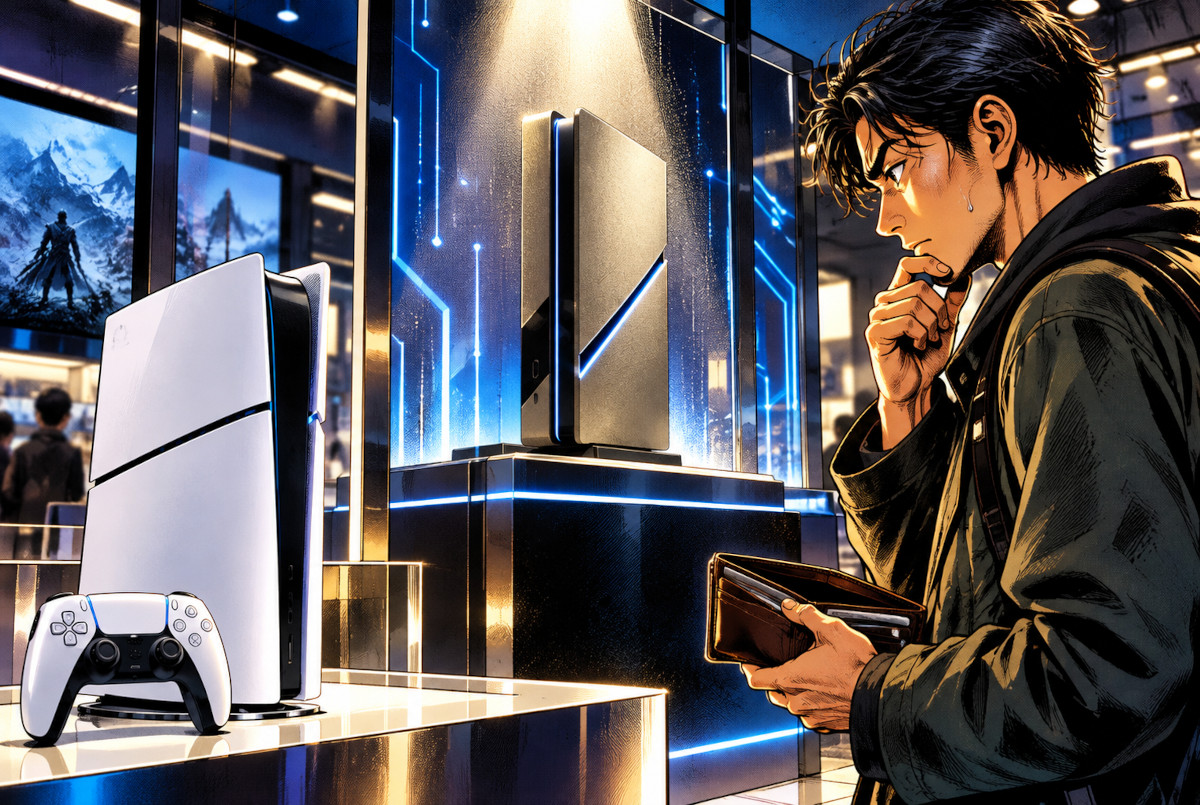
On September 23, 2026, a strangely specific number began circulating around Sony’s next-generation PlayStation—the machine everyone is already calling the “PS6.” Hardware leaker KeplerL2 claimed that the chip intended for the system had already reached tape-out and that its GPU could deliver roughly 40 TFLOPS of theoretical compute performance.
Before getting carried away, there is one important detail. As of September 28, 2026, Sony has not formally announced a product called PlayStation 6. There is no official PS6 specification sheet, release date, price, or confirmed 40-TFLOPS figure. Sony has publicly discussed its “next-generation platform,” but the hard numbers discussed here remain leaks and rumors.
So rather than treating the latest leak as a specification sheet, I wanted to do something slightly more useful: put the rumors next to what Sony has actually told us about PS5, PS5 Pro, image reconstruction, hardware costs, and its current PlayStation business. Once you do that, the interesting part of PS6 may not be how fast it is. It may be how much Sony can realistically charge for it.
40 TFLOPS does not mean “four times faster than PS5”
The original PS5 uses an eight-core Zen 2 CPU, an RDNA 2-based GPU rated at 10.3 TFLOPS, 16GB of GDDR6 memory, and 448GB/s of memory bandwidth. Those are official Sony specifications.
Separate PS6 rumors reported since 2025 have pointed to Zen 6-class CPU cores, next-generation RDNA graphics, and GDDR7 memory. Another leaked claim suggested roughly three times the rasterization performance of the standard PS5. Then, in September 2026, the newer 40-TFLOPS claim appeared.
The easy calculation is obvious: 40 divided by 10.3 is about 3.9. On paper, that looks like nearly four times the number.
But writing “PS6 is four times faster than PS5” would be asking for trouble from anyone who follows GPU architecture. TFLOPS measures peak floating-point throughput; it is not a clean cross-generation measure of game performance. Architecture, instructions per clock, memory behavior, ray-tracing hardware, scheduling, and workload all matter.
That is why the older leak claiming roughly 2.5 to 3 times PS5-class rasterization performance is a more useful way to think about the rumored jump than simply dividing one TFLOPS figure by another. And even that remains a rumor, not a benchmark.
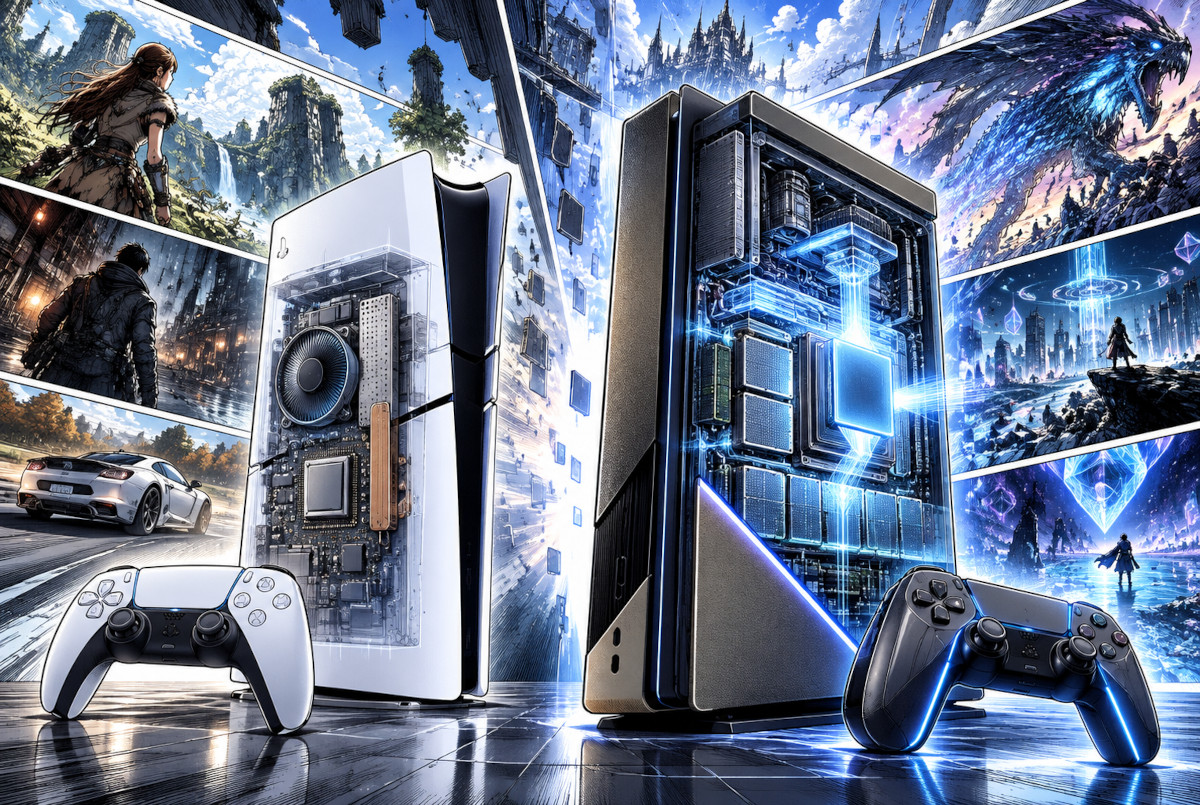 AI-generated conceptual illustration. The device on the right is fictional and does not depict an actual PS6 console or its internal hardware.
The bigger change may be what happens while a game is running
The CPU side may be more interesting than another jump in GPU numbers.
PS5 is built around Zen 2 CPU technology. The recurring PS6 leaks point to Zen 6-class cores. If that proves accurate, the CPU side would span several architectural generations.
A faster GPU can give developers more resolution, better reflections, denser effects, and heavier ray tracing. A much stronger CPU can affect things that are harder to sell in a screenshot: more NPCs, smarter AI behavior, heavier physics, busier traffic, more complicated simulation, and larger amounts of game-world data being processed at once.
That creates an odd possibility. Put a PS5 screenshot next to a PS6 screenshot and some people may initially say, “That’s it?” Then play the two versions and the difference could be far more obvious.
In other words, PS6 may end up being a generation whose biggest improvements are easier to feel than to freeze into a promotional image.
PS5 Pro may already be showing us the direction
The other clue is image reconstruction.
PS5 Pro introduced PlayStation Spectral Super Resolution, or PSSR. In March 2026, Sony rolled out an upgraded version and confirmed that its new algorithm and neural network came from Project Amethyst, its technology partnership with AMD.
PSSR is an AI-based image reconstruction system. Instead of forcing the GPU to render every final pixel at full output resolution, a game can render internally at a lower resolution and reconstruct a sharper image for the display.
That matters because the future of console graphics may be less about brute-forcing native 4K at all costs and more about using the available processing budget intelligently.
For PS6, the important question may not simply be “How much more GPU power does it have?” but “How convincingly can it create a high-resolution final image without paying the full computational cost of one?”
I would not literally call PS5 Pro a PS6 prototype. That goes too far. But it does look like a very public test bed for the kind of reconstruction technology Sony clearly intends to keep developing.
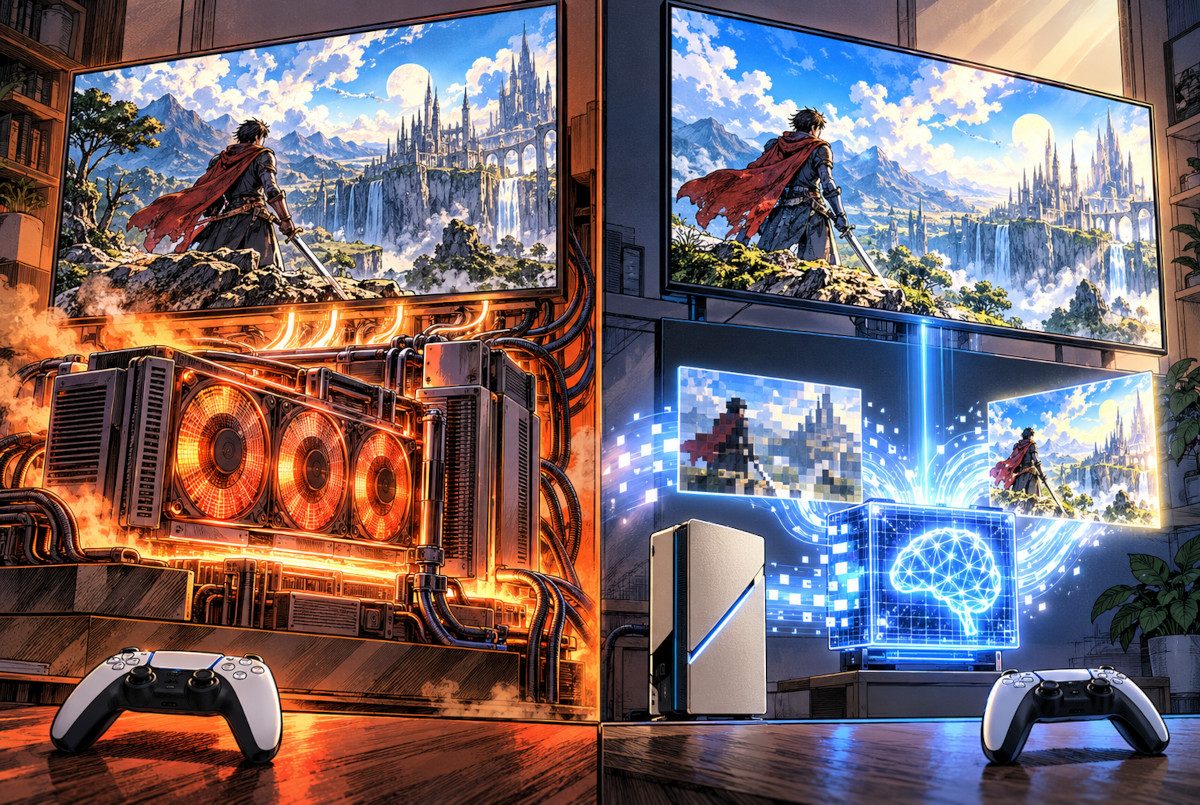 AI-generated concept illustration. It is intended to explain the general idea of image reconstruction and does not reproduce the actual PSSR processing pipeline or hardware.
That also means we should be careful with the usual next-generation fantasy of “4K, 120fps, full ray tracing, everything switched on.” Give developers more performance and they tend to spend it. More lights appear. Crowds get denser. Physics becomes heavier. Worlds become more complicated.
Game hardware gets faster, and game software immediately finds new ways to become slower. It is one of the industry’s oldest traditions.
The scarier number may be the price
This is where the story became more interesting to me.
When PS5 launched in Japan in November 2020, the standard disc model cost ¥49,980 before tax, or ¥54,978 including Japan’s 10% consumption tax. Following Sony’s April 2026 price revision, the standard PS5 now carries a Japanese suggested retail price of ¥97,980. PS5 Pro is ¥137,980.
That means the Japanese price of the standard PS5 is now roughly 78% higher than its launch price.
So when trying to guess the price of PS6, the old assumption that “a game console costs around ¥50,000” is already obsolete.
Sony itself has acknowledged the problem. In May 2026, the company said no decision had yet been made on the timing or pricing of its next-generation platform. It also said the prevailing view was that memory prices would remain elevated and supply-demand conditions tight through 2027.
Then, at a June 2026 Game & Network Services meeting, Sony said it was not realistic for the company to absorb every increase in component costs and that, as a principle, it did not intend to sell hardware at significant losses.
Put those facts beside today’s Japanese PS5 pricing and I would personally keep roughly ¥110,000 to ¥150,000 in mind as a plausible territory for a standard next-generation machine if current conditions persist.
That is not a leak. It is not Sony guidance. It is simply my estimate based on where PS5 and PS5 Pro prices already sit. Exchange rates, memory costs, storage capacity, model segmentation, and Sony’s eventual launch strategy could move the real figure substantially.
 AI-generated illustration. It does not depict a real retail store, an actual PS6 console, or an actual PS6 sales display.
But Japan already shows Sony has another option
There is one particularly strange clue in Sony’s current Japanese lineup.
Sony sells a Japan-specific PlayStation 5 Digital Edition—Console Language: Japanese only for ¥55,000. The globally compatible Japanese-market Digital Edition is ¥89,980.
The cheaper model keeps the basic PS5 performance but limits the console language to Japanese and requires a PlayStation account whose country or region is set to Japan. It ships without a disc drive, although Sony’s optional drive can be attached later.
That makes the model interesting beyond Japan itself. Sony has already demonstrated that it is willing to create a heavily localized SKU to preserve a lower entry price in a difficult market.
So a similar strategy for the next generation is not impossible: a more expensive globally standardized PS6 alongside a lower-priced, restricted digital model for Japan.
To be clear, no such PS6 model has been announced. This is simply one possible strategy suggested by what Sony is already doing with PS5.
PS6’s biggest competitor may be PS5
If PS6 really delivers something close to three times the raster performance of PS5, combined with a much newer CPU and improved reconstruction technology, it could be a formidable machine.
But that leads to a less glamorous question: how many PS5 owners will want to spend well into premium-electronics territory just to move to the next box?
By March 2026, Sony said the PS5 installed base had passed 93 million units, while the wider PlayStation platform had 125 million monthly active user accounts.
That is an enormous audience. Sony cannot simply pretend those machines disappear when the next generation arrives.
And that creates the strange possibility that the PS6’s toughest rival will not be Xbox or a gaming PC.
It may be the perfectly usable PS5 already sitting under the television.
Editor’s Note
The number that made me sit up was not 40 TFLOPS. It was ¥54,978 becoming ¥97,980.
I still have the old mental image of a game console as an expensive toy—something you grumble about, save up for, and eventually buy. Once the price starts wandering toward ¥150,000, it stops feeling like a toy and starts feeling like a serious home-electronics purchase.
Even if PS6 really is three times faster than PS5 in some meaningful sense, my first question would still be: “Fine. How much?” And if AI reconstruction really can reduce the amount of brute-force rendering needed, I would rather see some of that cleverness spent on keeping the machine affordable instead of merely producing prettier reflections.
Maybe the most important specification the next PlayStation needs to improve is performance per yen.
References
- Sony Group Corporation, “Corporate Strategy and Earnings Announcement Presentation Q&A (Summary),” May 8, 2026.
- Sony Group Corporation, “Game & Network Services (G&NS) Segment Small Meeting Q&A (Summary),” June 5, 2026.
- PlayStation.Blog, “Unveiling New Details of PlayStation 5: Hardware Technical Specs.”
- PlayStation.Blog, “Upgraded PSSR rolling out to Silent Hill f, Monster Hunter Wilds, Final Fantasy VII Rebirth, Crimson Desert, and more,” March 16, 2026.
- PlayStation.Blog Japan, “PS5, PS5 Pro and PlayStation Portal Suggested Retail Price Revision,” March 27, 2026. Japanese-language official source.
- PlayStation, “PlayStation 5 Digital Edition — Console Language: Japanese only.” Japanese-market official product information.
- Sony Group Corporation, FY2025 Q4 earnings materials, covering PS5 cumulative sales and PlayStation monthly active users.
- TechSpot, “PlayStation 6 leaks suggest AMD Orion APU with RDNA 5 and Zen 6 cores,” August 1, 2025. Used only as a secondary source for unconfirmed leaked specifications.
- VideoCardz, “PS6 and next-gen Xbox chips reportedly taped out, Kepler claims 40 TFLOPS for PS6 and 56 for Helix,” September 23, 2026. Used only as a rumor source.