

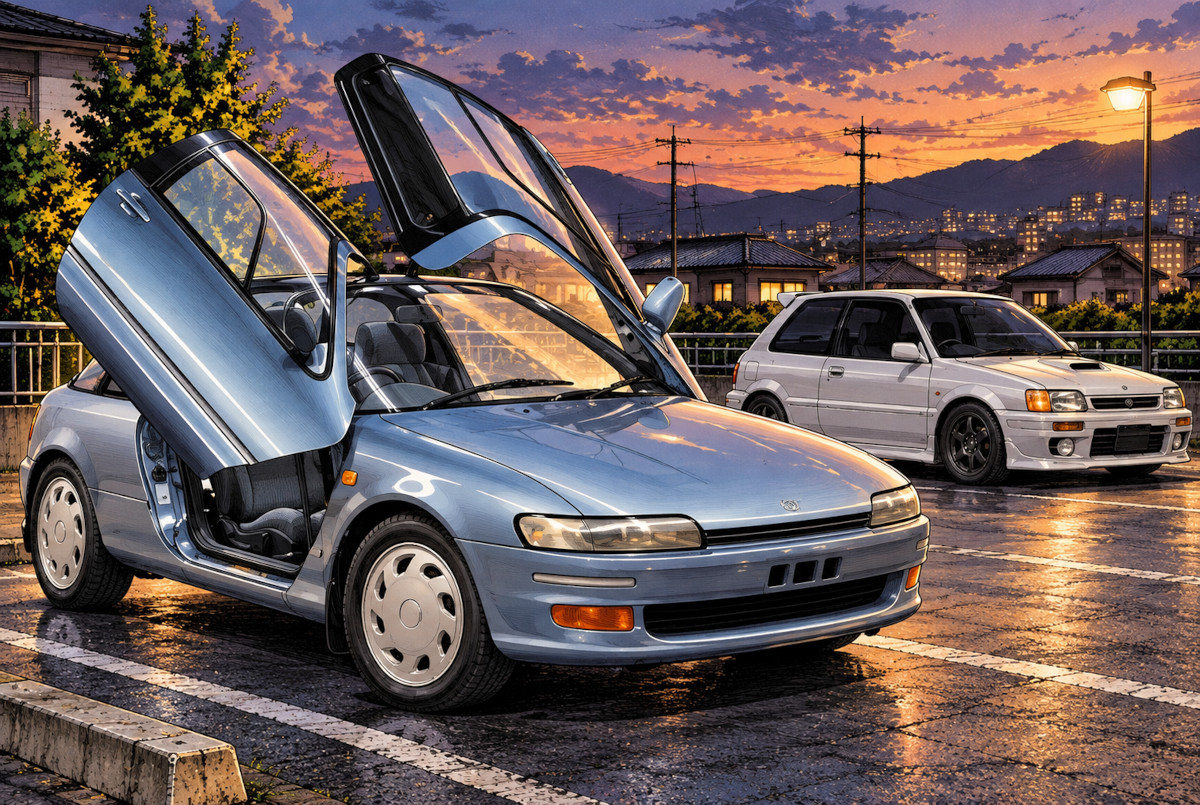
In 1990, Toyota launched one of those cars that seemed to make no sense at first glance. The Sera had a rounded body, a cabin wrapped in glass, and doors that swung dramatically upward. Parked on a Japanese street, it looked like somebody had shrunk a supercar.
Mechanically, however, this was no baby Supra or MR2. The Toyota Sera was a 1.5-liter, front-wheel-drive coupe producing 110 PS, and Toyota’s own vehicle history states that it used a Starlet platform. So the more interesting question is not why the Sera looked so strange. It is this: how did Toyota turn small-car underpinnings into something this exotic and sell the five-speed model for just ¥1.6 million?
The Sera did not come out of nowhere
The Sera’s direct ancestor was the AXV-II concept shown at the 1987 Tokyo Motor Show. Its basic idea was already remarkably close to the production car: a compact body, a glass-heavy “glassy cabin,” and large doors that opened upward and forward.
Toyota then displayed a near-production SERA at the 1989 Tokyo Motor Show before putting the car on sale on March 8, 1990. In other words, this was not the result of someone at Toyota suddenly deciding, at the height of Japan’s bubble economy, that a small coupe needed ridiculous doors.
The Sera had been developed through a proper concept-to-production process. That matters, because it changes the car from a bubble-era novelty into something closer to a deliberate engineering exercise.
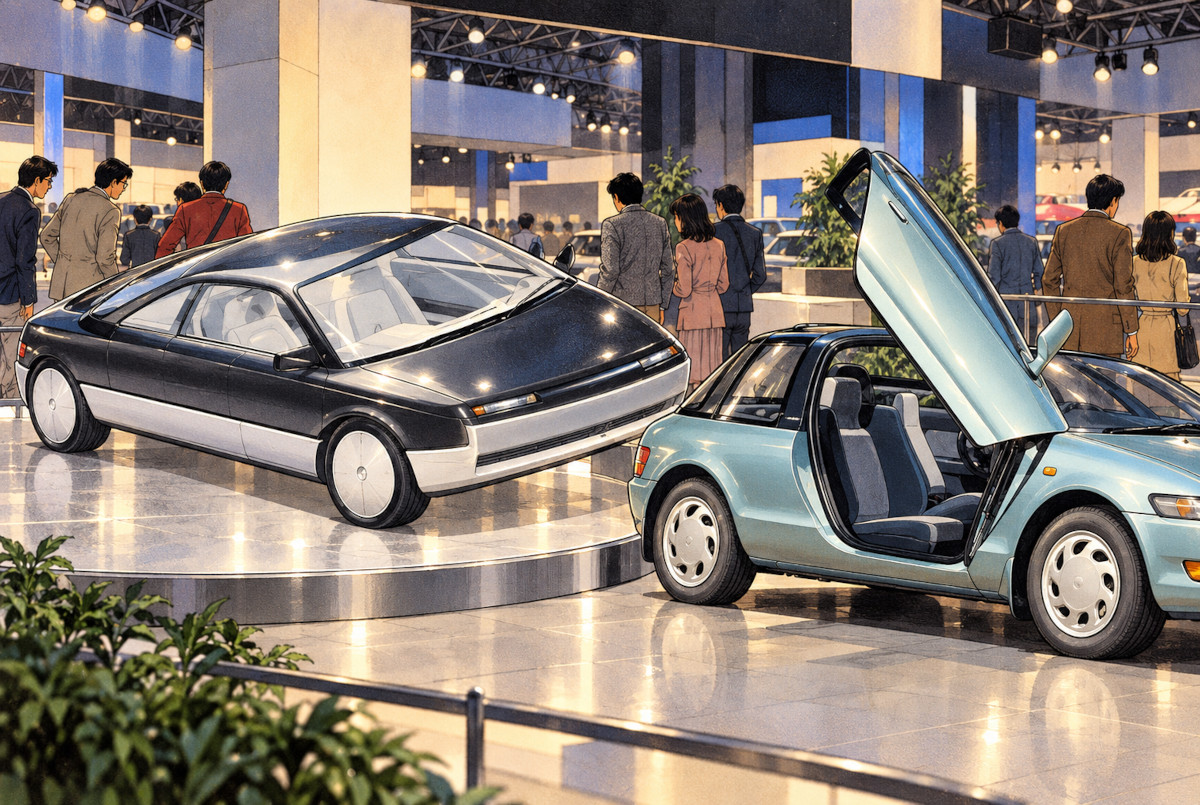 AI-generated comparison illustration. It does not precisely reproduce the actual Tokyo Motor Show display, AXV-II concept, or every detail of the production Sera.
“It’s basically a Starlet underneath” — true, but only halfway
The Sera had a 2,300mm wheelbase. So did the contemporary EP82-generation Starlet, and Toyota officially identifies the Starlet platform as the Sera’s foundation.
But calling the Sera nothing more than a Starlet wearing a weird body is too simple. Toyota gave it the 1,496cc 5E-FHE DOHC 16-valve engine producing 110 PS, as well as newly designed suspension and a 1,405mm front and rear track.
The comparison becomes more revealing when the Sera is placed next to the contemporary turbocharged Starlet GT.
| Model | Sera 5MT | Starlet GT 5MT |
|---|---|---|
| Price in Japan | ¥1.60 million | ¥1.24 million |
| Maximum output | 110 PS | 135 PS |
| Vehicle weight | 890kg | 830kg |
| Weight / power | Approx. 8.1kg/PS | Approx. 6.1kg/PS |
On maximum output and power-to-weight ratio alone, the Starlet GT has the advantage. Yet the Sera cost ¥360,000 more—roughly 29 percent extra.
That tells us something important about what Toyota was actually selling. The Sera was not asking buyers to pay more for horsepower. They were paying for the experience of driving something that looked and felt as though it had arrived from the future.
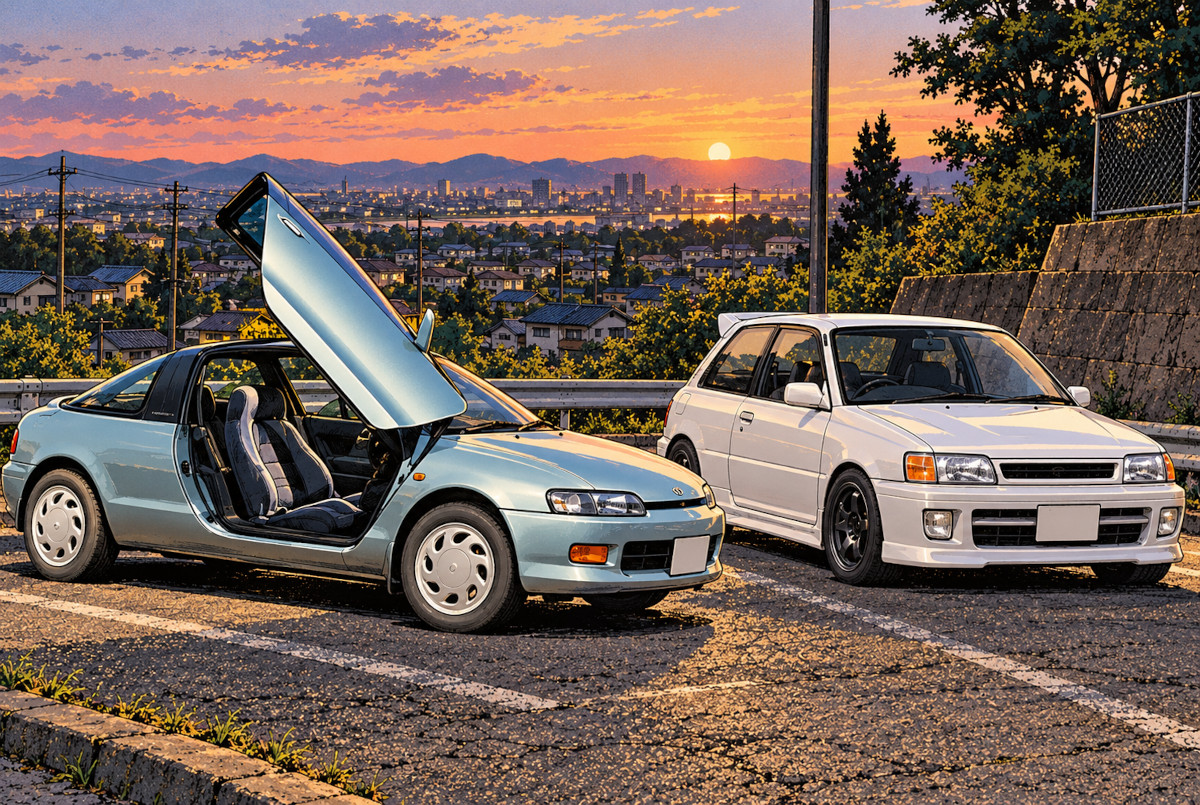 AI-generated comparison illustration. It is not a photograph of actual vehicles, and some exterior details of the Sera and EP82 Starlet GT have been simplified.
The really strange part was not the doors. It was how Toyota built the car
This is where the Sera becomes more interesting than the usual “weird Japanese car” story.
Despite its highly distinctive bodywork, the five-speed Sera was only about 29 percent more expensive than the Starlet GT used for our comparison. Behind that price was a manufacturing technology Toyota had specifically developed for small-lot production: the Toyota Flexible Press System, or FPS.
In a March 26, 1990 announcement, Toyota explained that FPS combined liquid-pressure press forming, high-speed three-dimensional CO₂ laser cutting, and multi-directional press forming. On the Sera’s front fender, Toyota said a panel that would normally have required five forming processes could be produced in three.
The Sera was therefore more than an odd-looking coupe. It was a production car in which Toyota actually deployed a new system intended to make complex, low-volume body panels more practical to manufacture.
Toyota was equally serious about the doors. Their gas-strut system included a mechanism designed to keep operating effort consistent as temperatures changed. Automatic climate control was also standard in a cabin surrounded by an unusually large area of glass.
The styling may have looked almost frivolous. The engineering behind it was anything but.
And are they really “gull-wing” doors?
Toyota itself called them “gull-wing doors” when the Sera was launched, so using that term in a period context is perfectly defensible.
Technically, however, they are not the same arrangement as the classic roof-hinged doors of a Mercedes-Benz 300SL or DeLorean. The Sera’s doors pivot from two points around the roof edge and the base of the A-pillar, moving both upward and forward.
Even Toyota’s historical description notes that the motion is closer to the wings of a butterfly. In modern enthusiast terminology, butterfly or dihedral-style doors is usually the more precise description.
Classic-car people will eventually bring this up anyway, so we may as well get there first.
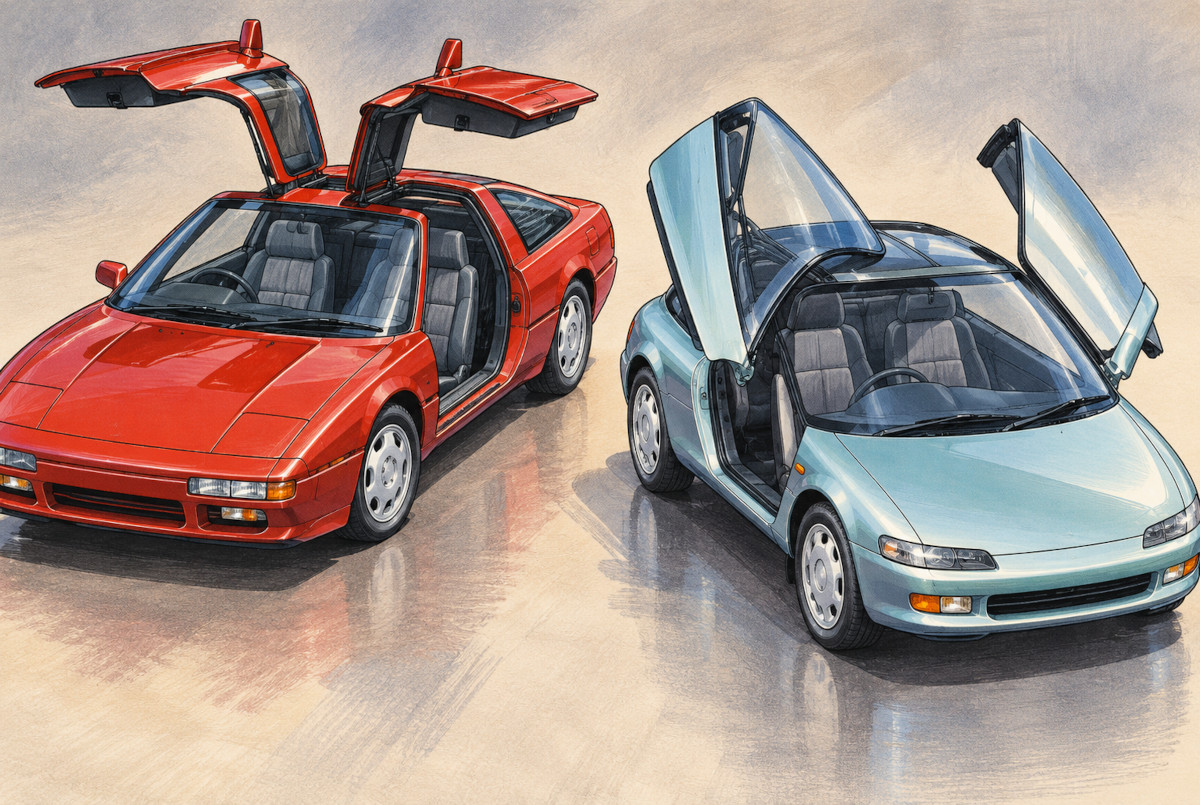 AI-generated conceptual comparison. This is not an engineering drawing and does not reproduce the exact hinge mechanisms of any specific vehicle.
Was the Sera simply killed by Japan’s bubble bursting?
The Sera was produced from February 1990 until December 1995, with total production reaching 15,941 cars. Nearly six years is not actually an exceptionally short production life.
What did change dramatically was the economic environment around it. Toyota’s domestic production fell from approximately 4.21 million vehicles in 1990 to 3.17 million in 1995, during the prolonged downturn that followed the collapse of Japan’s asset-price bubble.
That makes the familiar explanation—“the bubble burst, so cars like the Sera disappeared”—tempting. But it is too neat. We have not found a Toyota primary source stating that the bubble collapse alone was the reason the Sera was discontinued.
There is another plausible factor. A highly unusual design can generate a rush of early buyers, then exhaust that audience quickly. Toyota UK notes that roughly three-quarters of Sera production came during the first phase of its life.
With no direct successor, the Sera looks less like a model Toyota intended to nurture through multiple generations and more like a one-off specialty coupe that packaged a particular moment in design, manufacturing technology, and Japanese consumer optimism.
Then the strange Toyota left a mark on a real supercar
The story gets better after the Sera disappears.
Gordon Murray, designer of the McLaren F1, later credited the Toyota Sera as an influence on the F1’s door development. Toyota UK also acknowledges the connection, and Murray’s comments to CAR magazine have been widely quoted: after repeatedly seeing a Sera near his home in Britain, his team eventually borrowed one while developing the McLaren’s door arrangement.
That does not mean the McLaren F1 simply copied the Toyota. The F1’s three-seat layout and central driving position created very different access requirements, and its final dihedral doors became a distinct solution.
Still, there is something wonderfully backwards about the chain of events. A 110 PS, front-wheel-drive Toyota coupe—built from small-car underpinnings—ended up giving one of the world’s most famous supercars a useful idea.
That is why dismissing the Sera as a “fake supercar” misses the best part of the story.
Editor’s Note
I started with roughly the same memory many Japanese car fans probably have: the Sera was that strange bubble-era Toyota with fake-supercar doors. Then the numbers ruined that simple explanation.
Its maximum output was lower than the Starlet GT’s, yet the Sera cost ¥360,000 more. And Toyota was not spending that difference trying to win a horsepower contest. It was spending engineering effort on glass, doors, unusual body panels, and a production system that made a low-volume shape possible.
Open the doors next to a Starlet and the Sera wins the parking-lot drama immediately. That sounds trivial, but perhaps that is exactly the point. A car does not have to justify itself entirely through horsepower. Part of me would still like to see what would happen if modern Toyota tried the same kind of nonsense again—and what the price tag would look like today.
References
- Toyota Motor Corporation 75-Year History: Toyota Sera vehicle profile (Japanese)
- Toyota Motor Corporation, “TOYOTA SERA MAKES DEBUT: NEW CHALLENGE FOR 1990S” — March 8, 1990
- Toyota Motor Corporation, “TOYOTA DEVELOPS NEW FLEXIBLE PRESS SYSTEM” — March 26, 1990
- Toyota Motor Corporation: Toyota vehicles exhibited at the Tokyo Motor Show, 1975–1993 (Japanese)
- Toyota Motor Corporation 75-Year History: fourth-generation Starlet vehicle profile (Japanese)
- Toyota Certified Used Vehicles: March 1990 Sera specifications and original price (Japanese)
- Toyota Certified Used Vehicles: December 1989 Starlet GT specifications and original price (Japanese)
- Toyota Motor Corporation 75-Year History: production records for former Central Motor (Japanese)
- Toyota Motor Corporation 75-Year History: domestic production volume (Japanese)
- Toyota UK, “History of the Toyota Sera”
- Autostrada Magazine, “The Strange And Wonderful Toyota Sera Inspired A Generation Of Supercars” — citing Gordon Murray’s 2012 CAR interview