

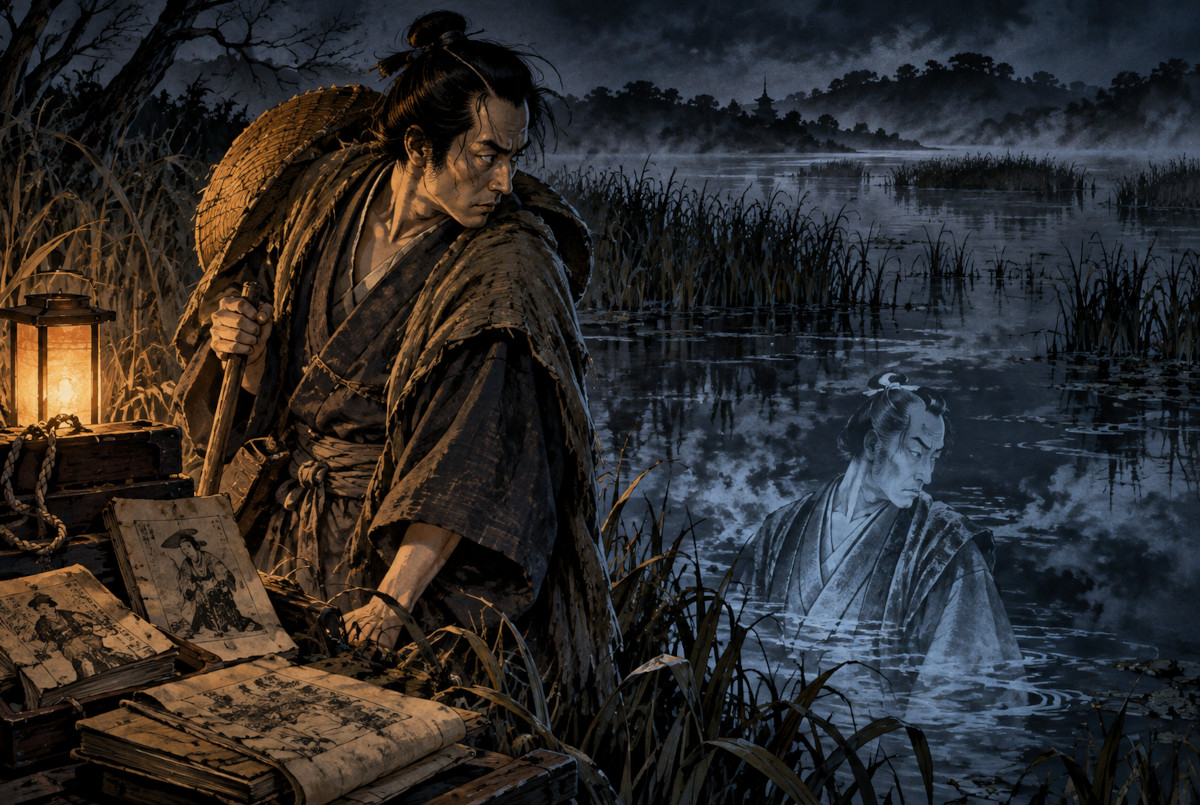
There was once a traveling actor who was murdered at Inbanuma and dumped beneath its dark waters—or so the story goes. His name was Kohada Koheiji. The dead man supposedly returned to Edo, the city now known as Tokyo, and eventually became a ghost who appeared again and again in fiction, kabuki, and ukiyo-e.
Because even Katsushika Hokusai painted him, I assumed there had to be a real murder somewhere underneath the folklore. Then I started checking the older records. The deeper I went, the stranger the story became. The murder itself cannot be confirmed—and neither can the existence of Kohada Koheiji as a real actor.
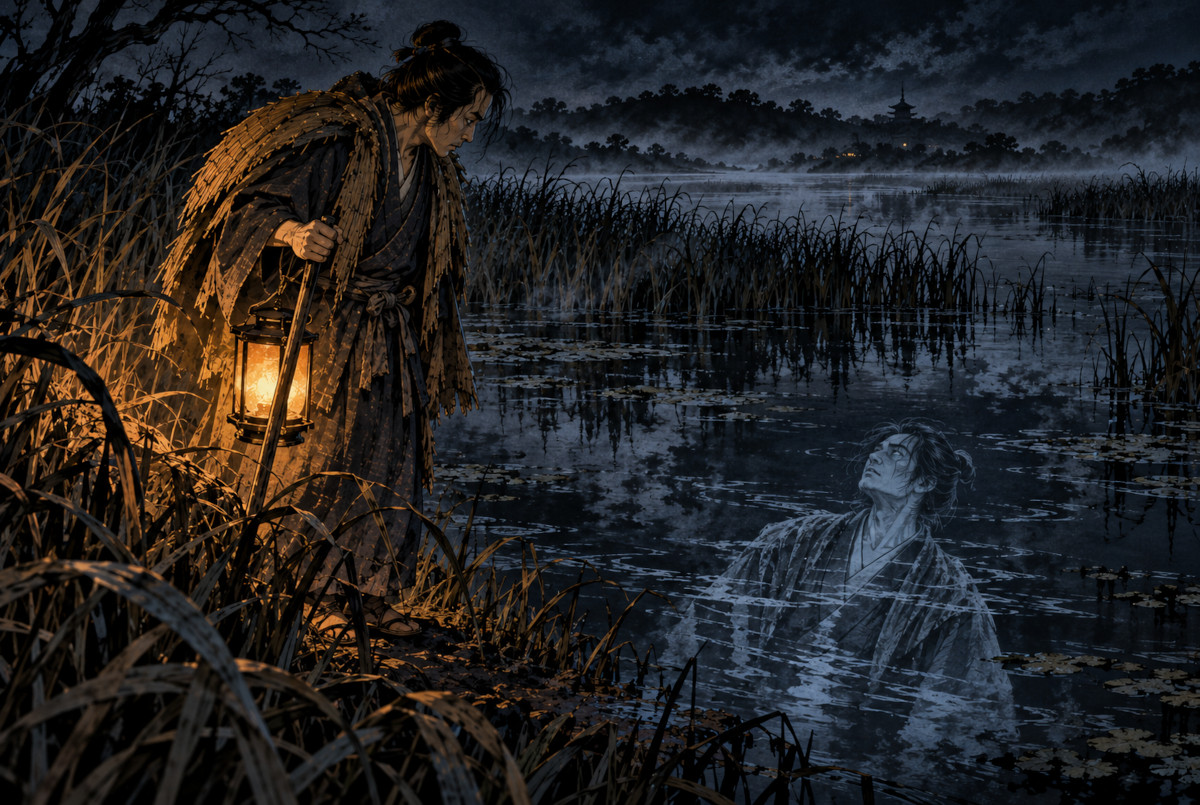 AI-generated illustration inspired by the legend. There is no historical confirmation that Kohada Koheiji was murdered at Inbanuma.
The Inbanuma murder story splits in two when you check the record
One of the most useful sources is Gaidan Bunbun Shūyō, a collection compiled by Ishizuka Hōkaishi from stories, rumors, and incidents circulating in Edo. It preserves more than one explanation for what supposedly happened to Koheiji.
In one version, Koheiji earns money while traveling with a theater troupe. A friend murders him for the cash and returns to Edo. But when the killer visits Koheiji’s wife, she casually tells him that Koheiji came home the previous night and is asleep behind the mosquito net.
Another version says that Koheiji was killed at Inbanuma in Shimōsa Province by a man named Ichikawa Sōzaburō and buried in the marsh. Yet the same source marks the matter as uncertain.
That creates an odd problem. Modern retellings often present a neat story in which “a friend murdered Koheiji for money at Inbanuma.” But in Gaidan Bunbun Shūyō, the money-murder story and the Inbanuma murder story are separate versions. Somewhere along the way, different legends may have fused into one cleaner, easier-to-repeat tale.
Then the actor himself disappears from the records
Hōkaishi seems to have been bothered by Koheiji’s identity too. He checked older yakusha hyōbanki—published books that rated and discussed kabuki actors—from the Kanbun, Enpō, Jōkyō, and Genroku eras. He reported that he could not find an actor named Kohada Koheiji.
That does not prove Koheiji never existed. A minor performer traveling with provincial troupes could easily have escaped the surviving record. But the reverse is also true: there is no solid documentary basis for treating this as the well-recorded murder of a known actor.
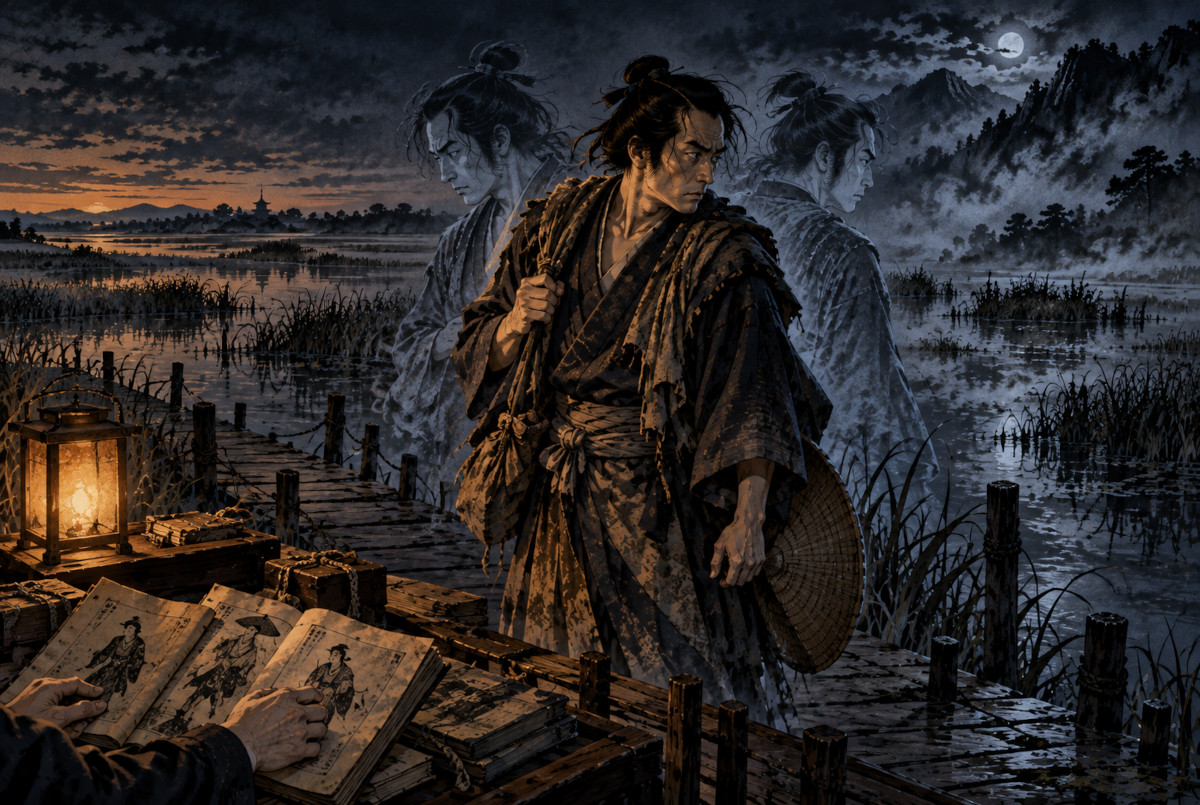 AI-generated conceptual illustration. The two landscapes are not intended as literal reconstructions of Inbanuma or Asaka Marsh; they visualize the contradictions among different versions of the legend.
Before Koheiji, there was already a Koheiji-shaped ghost story
So did Santo Kyoden simply invent the whole thing? Not quite.
In 1801, two years before Kyoden’s famous version appeared, a book called Tōyū Kidan by Ichimu Sanjin included a story titled “The Ghost of Nakamura Kichijūrō.” The name is different, but the structure is strikingly familiar: a traveling actor dies; someone who knows of his death visits his family; the family says the actor has already returned home; and when they look for him, nobody is there.
Researcher Kazuaki Yamamoto has pointed out the connection while stopping short of claiming that this story was necessarily Kyoden’s direct source. What matters here is that by 1801, a “dead traveling actor returns home” type of story was already circulating strongly enough to appear in print.
Then, in 1803, Santo Kyoden published Fukushū Kidan Asaka no Numa, also known as the story of Kohada Koheiji. In Kyoden’s version, Koheiji is killed by Adachi Sakurō, the lover of his wife Otsuka, and returns as a vengeful ghost. But the location is no longer Inbanuma near Edo. It is Asaka Marsh in Ōshū, northeastern Japan.
The victim’s identity, the killer, the motive, and even the place of death shift depending on which version you read. Rather than one historical murder being faithfully preserved, it makes more sense to see the “dead traveling actor who comes home” motif gradually attaching itself to the figure called Koheiji.
A man of uncertain existence received a real memorial service in Edo
This may be the strangest part of the whole story.
In 1808, Kohada Koheiji appeared on the kabuki stage in Tsuruya Nanboku IV’s Iroeiri Otogizōshi, with Onoe Matsusuke I playing Koheiji. The production became a major talking point, and contemporary records even preserve rumors that when Matsusuke fell ill, Koheiji’s ghost appeared night after night.
That same year, a large segaki memorial rite was held for Koheiji at Ekō-in temple in Ryōgoku. A segaki is a Buddhist rite associated with pacifying and making offerings to restless spirits. Records describe crowds gathering for the occasion.
Think about that for a moment. Nobody could agree on when this man died, exactly where he died, or even whether the actor himself had existed. Yet people in Edo had reached the point of performing a real religious memorial rite for him.
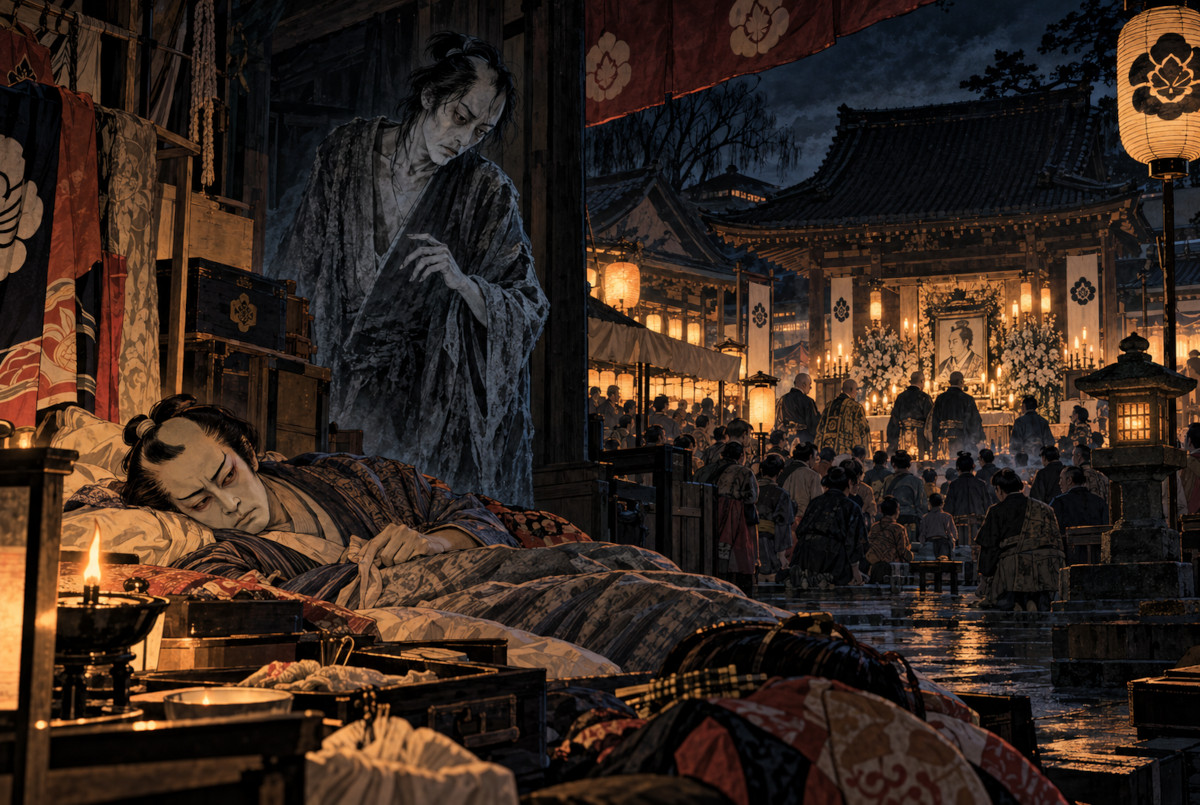 AI-generated composite illustration. It combines the 1808 theater ghost rumors and the separate memorial rite at Ekō-in into one visual concept; they did not take place at the same location or moment. The people and altar are not historical reconstructions.
Then Hokusai gave the ghost a face that was hard to forget
Around 1831–32, Katsushika Hokusai created Kohada Koheiji for his One Hundred Ghost Stories series. Koheiji peers through a mosquito net with a horribly decayed, partly skeletal head. The Sumida Hokusai Museum notes that the remarkably anatomical treatment may reflect knowledge from Dutch anatomical and scientific books circulating in Japan at the time.
By then, Koheiji had long since escaped the limits of a whispered rumor. Hokusai gave him an especially powerful visual identity as a ghost.
Based on the surviving evidence, we cannot state as historical fact that a traveling actor named Kohada Koheiji existed, or that he was murdered at Inbanuma. What we can document is the legend itself: it circulated, changed shape, became literature and kabuki, received a real memorial service, and was eventually given one of its most memorable images by Hokusai.
Perhaps that is what makes Koheiji genuinely unsettling. The deeper you investigate, the less solid the man becomes—while the ghost becomes increasingly real. The person fades out of the record, but the legend keeps acquiring a body. More than two centuries later, that reversal is still rather creepy.
Editor’s Note
I started with a very simple question: “Was the guy who was supposedly murdered at Inbanuma actually real?” I expected to find either a historical actor behind the ghost story or a straightforward piece of fiction. Instead, the location changes, the killer changes, the circumstances of the death change, and eventually even the actor himself becomes difficult to pin down.
Yet Edo audiences turned him into a hit on stage and even held a religious rite to pacify his spirit. That bothers me more than the ghost itself. Once enough people repeat a story, perform it, and treat its subject as real, even someone who may never have existed can begin to acquire a kind of reality. Maybe Koheiji was never waiting at the bottom of a marsh. Maybe he survived somewhere more durable: inside the rumor itself.
References
- Gaidan Bunbun Shūyō, compiled by Ishizuka Hōkaishi; revised edition by Tōzō Suzuki — National Diet Library
- Tōyū Kidan (1801) — Ibaraki University Digital Collection
- Santo Kyoden, Kohada Koheiji Shiryō Monogatari: Fukushū Asaka no Numa (1803) — CiNii Books
- Kazuaki Yamamoto, “Ichimu Sanjin’s Shokoku Kidan Tōyū Kidan: Transcription and Commentary” — Database of Research Theses in Japanese Literature and Archival Science
- “Kabuki and Tsuruya Nanboku” — Japan Arts Council, Cultural Digital Library
- Tsuruya Nanboku and the large memorial rite for Koheiji — Japan Arts Council, Cultural Digital Library
- Katsushika Hokusai, One Hundred Ghost Stories: Kohada Koheiji — The Sumida Hokusai Museum