
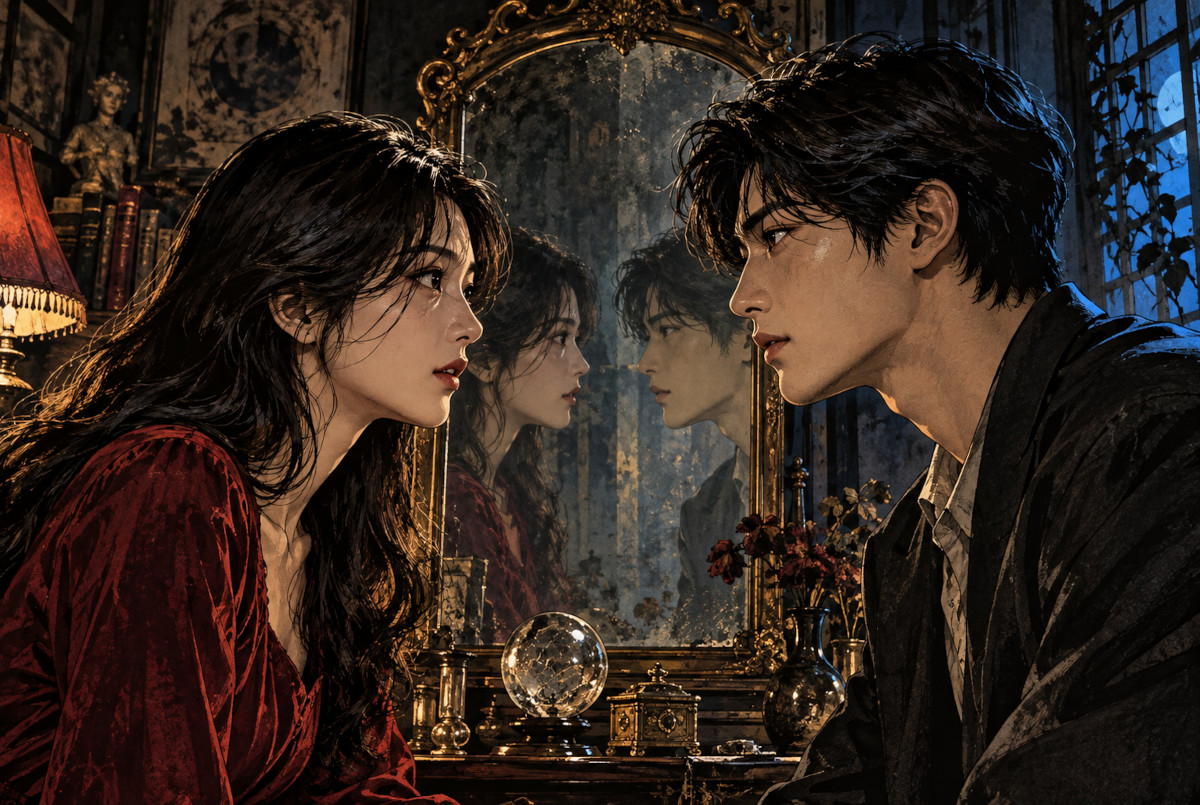
“If you ever meet your doppelganger, one of you will die.” It is exactly the kind of line that could have filled a two-page spread in an old Japanese occult magazine.
Then, in 2024, something happened in South Korea that sounded almost too convenient for the legend. Actress Han Ga-in finally met singer and actor Kim Dong-jun, a man whose face had been compared with hers for years. Before the meeting, Han herself mentioned the old idea that meeting your doppelganger could be dangerous and admitted that the thought made her a little nervous.
According to Han, she began feeling seriously unwell later that same day and was eventually hospitalized.
The unsettling part is not simply that she ended up in hospital. It is that she had mentioned the doppelganger superstition before anything happened. Even if you have no interest in the paranormal, that timing is enough to make you stop for a second.
So did an urban legend actually come true? Or did an ordinary medical problem happen to land on the worst possible date?
First, the “two people hospitalized” version does not check out
The version of the story that originally led me down this rabbit hole was even more dramatic: a Japanese person and a Korean person who looked alike supposedly met, and two days later both were hospitalized.
I could not verify that version.
What can be verified is different. On November 27, 2024, Han Ga-in released a video featuring her first meeting with Kim Dong-jun, who had long been described in Korean media and entertainment programs as looking remarkably similar to her. Both are Korean, they are not related, and when they finally stood next to each other, even they commented on the strange resemblance. Kim described the experience as feeling almost like looking into a mirror.
Then came the part that gave the story its afterlife.
In a video released on December 5, while hospitalized, Han explained that she had started feeling extremely ill on the evening of the day she met Kim Dong-jun. She said she became too weak to remain standing comfortably and had difficulty eating before eventually entering hospital.
As far as the available reporting shows, Han Ga-in was the one who was hospitalized. There is no reliable evidence that both of them were admitted to hospital.
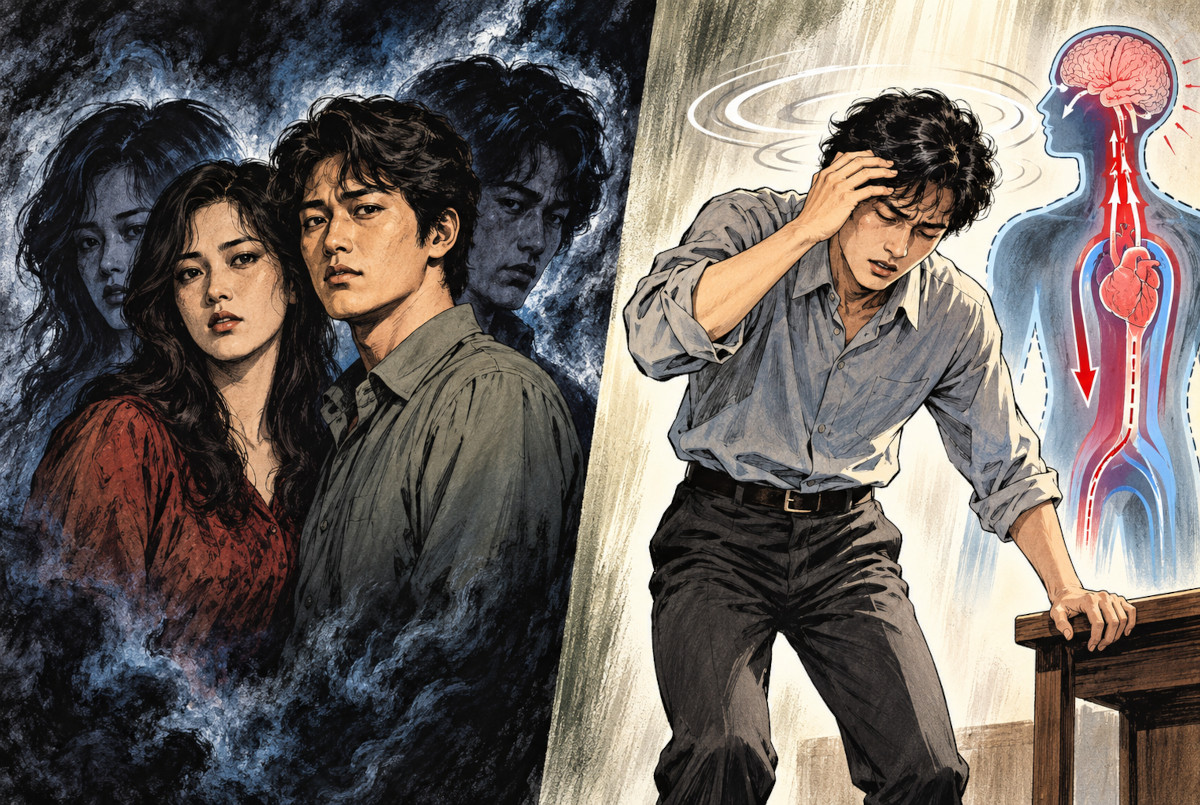 AI-generated illustration. It does not depict Han Ga-in, Kim Dong-jun, or the actual location where they met.
And within two years, the story had already shifted slightly
This is where things become more interesting than the ghost story itself.
Han’s own 2024 account was that she became ill later on the same day.
But on August 31, 2026, when Kim Dong-jun told the story again on a television-related YouTube program, his version was that Han became sick the following day and spent about a week in hospital.
That is not a huge contradiction. “That evening” becoming “the next day” changes very little about the basic event.
But this is also how legends grow.
A same-day illness becomes a next-day illness. One hospitalized person becomes two. Add a few rounds of retelling, remove the boring details, and suddenly you have a perfect supernatural anecdote.
The funny thing is that the confirmed version is already strange enough. It does not need embellishment.
But next to the “curse,” there was also a medical explanation
So what was actually wrong with Han Ga-in?
After being hospitalized, Han said she learned that she had orthostatic hypotension. More importantly, this was not a completely new history of symptoms.
She said she had experienced unexplained dizziness for roughly five years following the birth of her second child and had previously assumed it was related to an earlier case of benign positional vertigo.
Orthostatic hypotension is a drop in blood pressure that occurs after standing up from sitting or lying down. It can cause dizziness, weakness and, in some cases, fainting. Dehydration, medication effects, autonomic dysfunction and several other conditions can contribute to it.
That does not prove that orthostatic hypotension was the sole direct cause of every symptom she experienced that particular evening. Public reporting does not provide enough medical detail to make that claim.
What it does mean is that there is no medical evidence that meeting a look-alike caused her illness. Han already had a multi-year history of dizziness for which a conventional medical explanation had now been identified.
 AI-generated explanatory illustration. The medical imagery is conceptual and does not reproduce an actual diagnostic image or clinical diagram.
There is another problem: are these two even “doppelgangers” in the old sense?
Here is where the whole story turns sideways.
The modern word doppelganger is generally traced to German writer Jean Paul, who used the form Doppeltgänger in his 1796 novel Siebenkäs. His own explanatory note described the idea, roughly, as people who “see themselves.”
That is not quite the same thing as finding a stranger on social media who happens to have your nose, eyes and jawline.
The older literary and folkloric idea is much closer to encountering a second version of yourself: a double, apparition or duplicate self. Related European traditions involving doubles, fetches and wraiths sometimes treated such appearances as omens of death or misfortune.
But there is an important distinction.
I could not find good evidence that the old tradition specifically said that two unrelated, flesh-and-blood people with similar faces would die simply because they met each other.
That modern rule seems to be a much cleaner piece of folklore than the older material actually was.
So strictly speaking, calling Han Ga-in and Kim Dong-jun “doppelgangers” in the supernatural sense is already a bit of a category error. They are two unrelated real people who happen to look remarkably alike.
Unrelated people really can look disturbingly similar
That raises the obvious question: how can two strangers look so similar in the first place?
A 2022 study published in Cell Reports examined unrelated human look-alikes selected using facial-recognition algorithms. The researchers found that the strongest look-alike pairs shared more genetic similarities than might be expected, including genetic variants associated with aspects of facial appearance.
In other words, two people do not need to be close relatives in order to end up looking uncannily alike. No supernatural photocopier is required.
Han and Kim even pushed the joke further in 2025 by taking part in a program that tested whether they might somehow be related. Reports said that 19 of 23 tested items did not match.
That is about 82.6 percent if you simply divide 19 by 23.
But that number should not be misread as “82.6 percent unrelated.” Genetic relatedness is not calculated by turning a television program’s matching categories into a percentage. It is a neat number, not a biological conclusion.
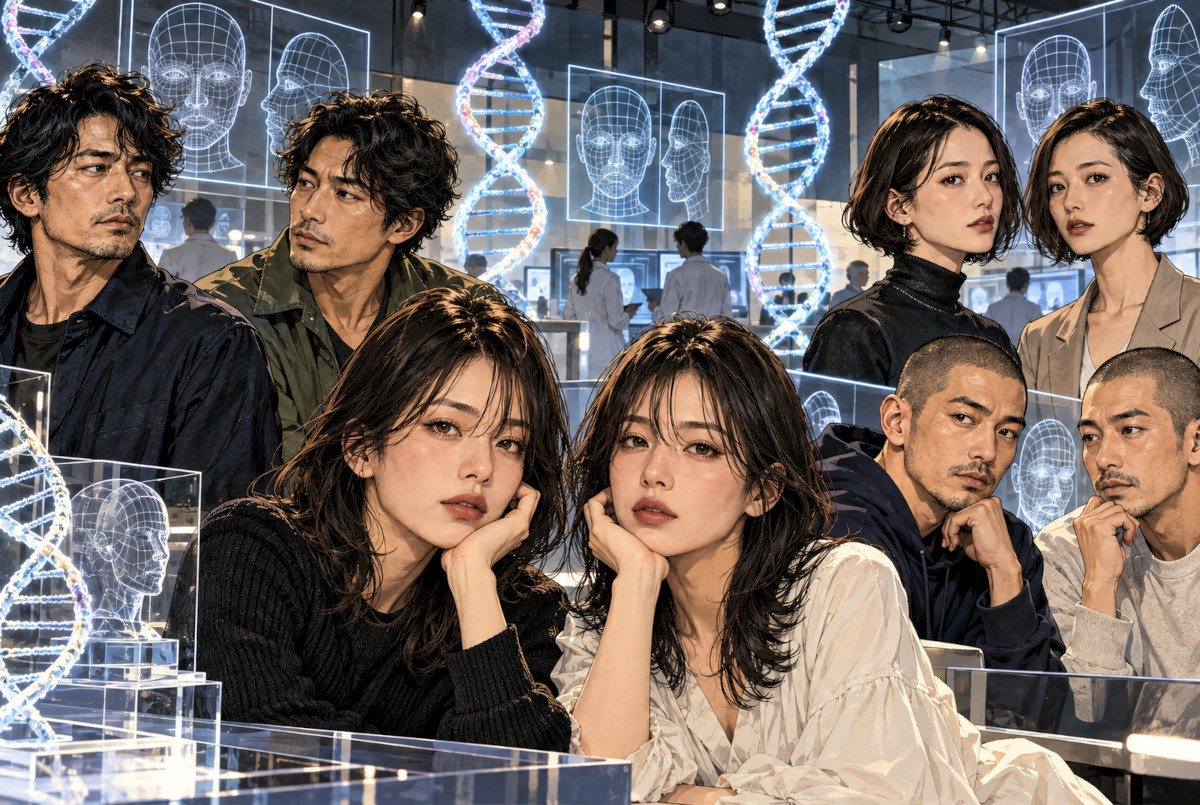
 AI-generated research concept image. It does not depict participants, laboratories, or analysis screens from the actual Cell Reports study.
Humans hate leaving coincidences unexplained
Now line up the events.
Two celebrities are repeatedly told they look alike → they finally meet → one of them mentions the old doppelganger superstition beforehand → she becomes ill that evening → she is hospitalized.
That sequence is almost offensively well designed for an urban legend.
Psychologists have long studied what is often called an illusion of causality: our tendency to perceive a causal link between events that may merely have occurred close together.
But there is a twist. Suspecting that an unusual coincidence might have an unknown cause is not automatically irrational. Looking for hidden causal relationships is one of the basic ways human beings learn how the world works.
The problem comes when we stop investigating too early.
“She met her doppelganger and then became ill, therefore the doppelganger caused it” is an excellent line for an old occult magazine.
As an explanation, though, it still needs evidence.
Editor’s Note
Before digging into this, I assumed it would collapse immediately into the usual internet ghost story: dramatic headline, vague source, nothing underneath.
It did not.
Han really had talked about the doppelganger superstition before meeting Kim. She really did say she became seriously unwell that same evening. She really was hospitalized afterward. Taken in isolation, that sequence is almost annoyingly perfect.
Then the ordinary world pushes its way back in. She also had a five-year history of dizziness, and a medical explanation emerged during the hospitalization.
What interests me most, though, is what happened to the story itself.
The version that first reached me involved a Japanese person and a Korean person, followed by both of them being hospitalized two days later. I could not confirm that version, or even prove that it grew directly from the Han Ga-in story. But in the verified accounts alone, “that evening” had already become “the next day” within two years.
That is how these things acquire extra parts.
Urban legends do not always begin with something completely invented. Sometimes they begin with something real, strange and badly timed—and then collect better details as they travel.
That, to me, is the part worth being suspicious of.
References
- iMBC Entertainment, “Han Ga-in Meets Her ‘Doppelganger’ Kim Dong-jun: ‘It Feels Like Looking in a Mirror’” (Korean, November 27, 2024)
- iMBC Entertainment, “Han Ga-in Hospitalized After Meeting ‘Doppelganger’ Kim Dong-jun; Says She Learned Why She Had Been Feeling Ill” (Korean, December 5, 2024)
- iMBC Entertainment, Kim Dong-jun recalls Han Ga-in’s hospitalization after their first meeting (Korean, August 31, 2026)
- ChosunBiz / OSEN, report on Han Ga-in and Kim Dong-jun’s relationship-testing segment (Korean, June 6, 2025)
- Andrew J. Webber, The Doppelgänger: Double Visions in German Literature, Oxford University Press
- Femi Oyebode, “Autoscopy and Related Syndromes,” Cambridge University Press
- Joshi RS et al., “Look-alike humans identified by facial recognition algorithms show genetic similarities,” Cell Reports, 2022
- Mayo Clinic, “Orthostatic hypotension (postural hypotension) — Symptoms & causes”
- Matute H et al., “Illusions of causality: how they bias our everyday thinking and how they could be reduced,” Frontiers in Psychology, 2015
- Johansen MK, Osman M, “Coincidence judgment in causal reasoning: How coincidental is this?”, Cognitive Psychology, 2020