

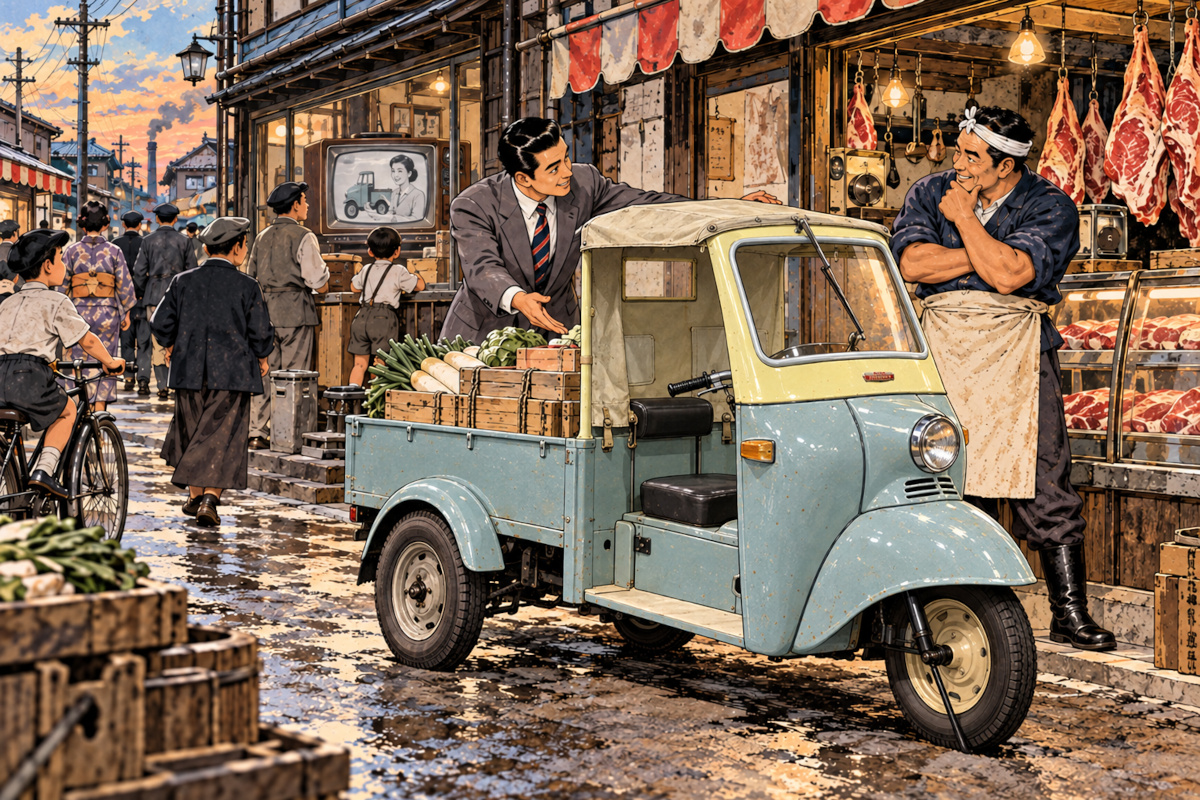
For many Japanese classic-car enthusiasts, the Daihatsu Midget is inseparable from comedian Kon Omura and his lively television commercials. The familiar story goes something like this: a funny TV ad caught the public’s imagination, and a tiny three-wheeled truck became a national sensation.
But there is a problem with that version of the story.
A look at Daihatsu’s official company history, alongside an interview with a former salesman published in June 2026, reveals a rather different sequence of events.
By October 1957, demand for the Midget was already exceeding production capacity. Yet the famous television commercials featuring Kon Omura and Juro Sasa did not begin until 1958.
So who was selling the Midget before those commercials made it famous? And what persuaded customers to buy such an unusual little machine?
A Tiny Three-Wheeler That Even Its Salesman Doubted
The original Daihatsu Midget DKA went on sale in August 1957. It was a kei-class commercial vehicle, belonging to Japan’s category of exceptionally small motor vehicles. Its single-cylinder engine displaced just 249cc, and its maximum payload was 300kg (approximately 661 pounds).
With motorcycle-style handlebars, an open-sided cab and a single seat, the DKA was a remarkably basic piece of transport. It looked more like a cargo-carrying motorcycle with an extra wheel than a conventional truck.
Even some of the people responsible for selling it were skeptical.
On June 26, 2026, Daihatsu published an interview with a former employee, Mr. Ueda (上田陽道), who had joined the company in April 1957. When he first saw the Midget, he wondered whether anyone would actually buy something that looked so much like a toy.
Then came a sales visit in the summer of 1957 that he would remember for decades.
Ueda approached a butcher shop without an appointment. The owner initially turned him away. Instead of selling the Midget as an exciting new vehicle, however, Ueda focused on something much more practical: the shop was already using motorcycles to make deliveries, and the Midget could make that work easier.
The pitch eventually paid off. According to Ueda’s recollection, the butcher business purchased Midgets for all 20 of its shops.
That detail matters. The attraction was not necessarily the novelty of a three-wheeled truck. It was the possibility of solving an everyday delivery problem.
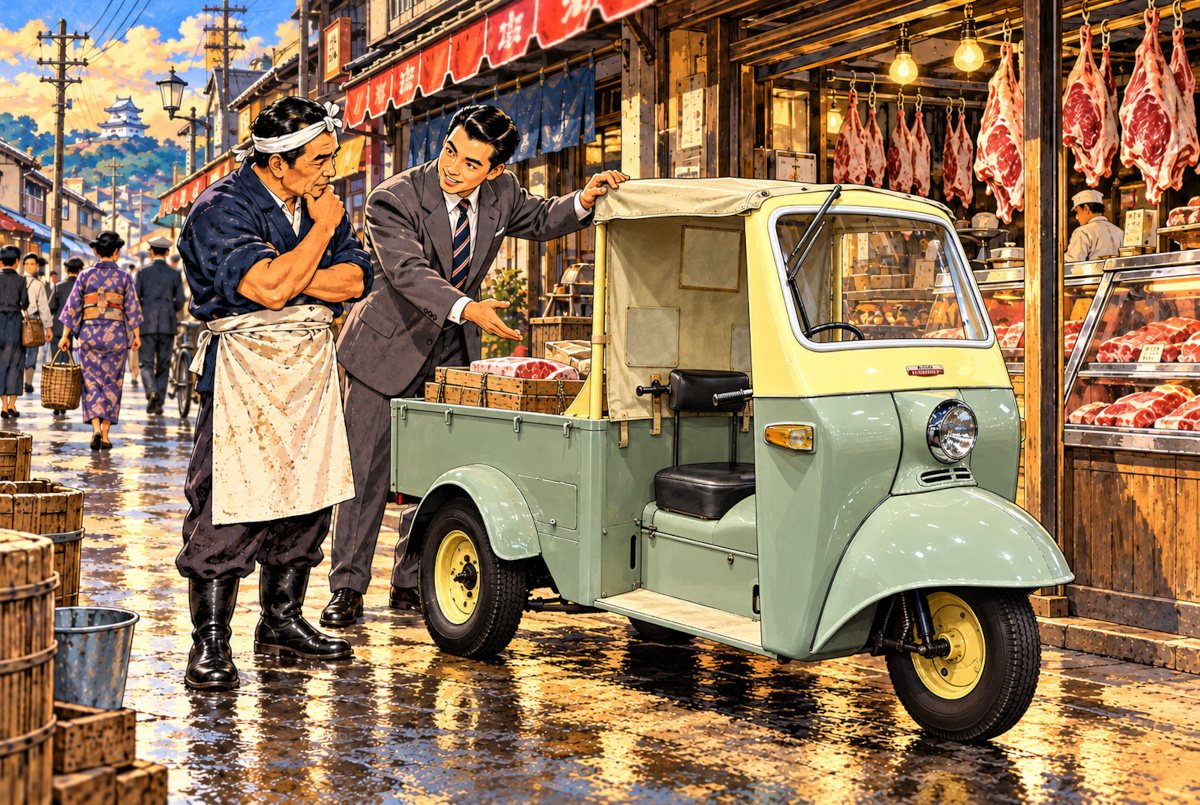
AI-generated historical illustration based on the sales account. It does not depict the actual salesman, butcher shop or location involved.
How Significant Was an Order Covering 20 Shops?
Daihatsu’s official company history states that the original DKA had an initial monthly production capacity of 500 vehicles.
Now consider the butcher business mentioned in Ueda’s interview. If each of its 20 shops had ordered one Midget, the resulting 20 vehicles would have represented the equivalent of 4% of that initial monthly capacity.
20 vehicles ÷ 500 vehicles × 100 = 4%
This is a hypothetical comparison, not a documented production or sales share. The available interview does not establish the exact number of vehicles delivered, their delivery dates or whether every shop received precisely one Midget. The 500-vehicle figure also refers to production capacity, not actual monthly sales.
Still, the calculation helps put the scale into perspective. For a small commercial vehicle that had only just entered the market, a single customer with 20 business locations represented a potentially meaningful sales opportunity.
And the demand did not stop there.
According to Ueda’s recollection, by October 1957 customers were traveling from across Japan to Daihatsu’s office in Kitahama, Osaka, to collect their Midgets. Some drove their newly purchased trucks home, turning the vehicles themselves into moving advertisements.
Demand had grown beyond what the company could comfortably produce. Ueda recalled that sales employees even went to the factory early in the morning to help with shipping procedures.
Sales Took Off in 1957. The Famous TV Ads Came in 1958.
Putting the manufacturer’s records and Ueda’s recollections into chronological order reveals the point that tends to disappear from the familiar advertising story.
| When | What the Sources Tell Us |
|---|---|
| April 1957 | Ueda joined Daihatsu. |
| Summer 1957 | Ueda’s sales visit led to an order covering 20 butcher shops. |
| August 1957 | The original Daihatsu Midget DKA went on sale. |
| October 1957 | According to Ueda, demand surged and production struggled to keep up. |
| 1958 | The television commercials featuring Kon Omura and Juro Sasa began. |
| September 1960 | Cumulative Midget registrations passed 100,000 vehicles. |
There is an important limitation here. The account of the October 1957 sales rush comes from a participant recalling events nearly seven decades later. We have not verified contemporary monthly order books or original transaction records.
However, Daihatsu’s own historical account independently places the Omura and Sasa commercials in 1958.
That makes one thing clear: the idea that television advertising created demand for the Midget entirely from scratch does not fit the chronology.
This does not establish how many vehicles were sold before the campaign, nor does it diminish the later importance of television. It establishes that the Midget had already found interested customers before its most famous promotional campaign began.
Daihatsu Had to Build a Sales System, Not Just a Truck
There is another revealing detail in Daihatsu’s company history, and it receives far less attention than the commercials.
In 1957, the company established a dedicated light three-wheeler sales department. It prepared agreements for dealers, developed sales manuals and worked to modernize sales and after-sales service arrangements.
Daihatsu also supported its sales network with product training, promotional materials and vehicle-related news distributed to salespeople.
Why was this necessary?
The Midget was aimed at a market that differed from the traditional customers for larger three-wheeled trucks. It was intended to appeal to small shops and local delivery operators, including businesses that had previously relied on motorcycles.
These buyers did not necessarily need another impressive piece of machinery. They needed an affordable, practical way to move merchandise through narrow streets and between nearby locations.
Daihatsu had identified that gap through market research. But finding an underserved market and persuading individual shopkeepers to spend money on an unfamiliar vehicle were two different tasks.
Ueda’s butcher-shop story shows what that second task looked like on the ground.
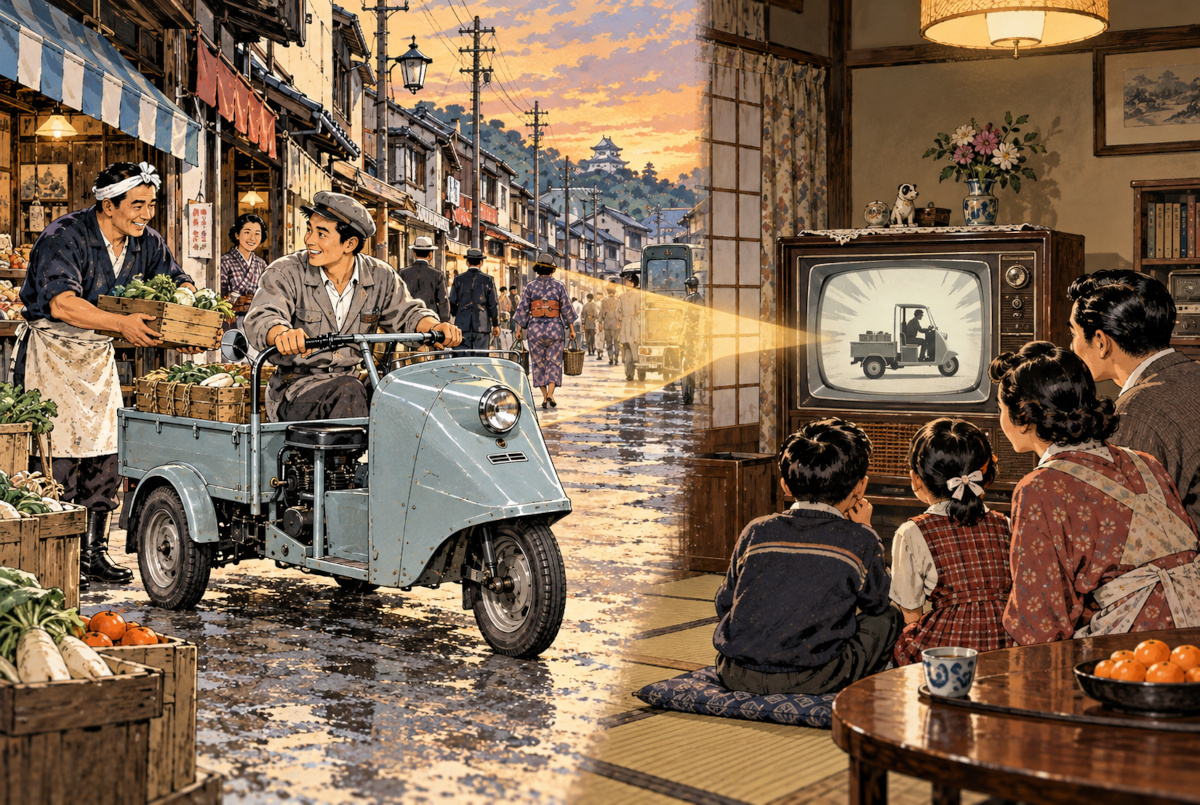
AI-generated conceptual illustration contrasting street-level sales in 1957 with television advertising from 1958 onward. It does not reproduce an actual commercial broadcast or historical scene.
So What Did Kon Omura’s Commercials Actually Change?
In 1958, a Daihatsu-sponsored television comedy called Yarikuri Apartment began airing. Its live Midget commercials, featuring comedians Kon Omura and Juro Sasa, became a memorable part of Japan’s early television advertising culture.
There is even an unexpected story behind their involvement.
In Daihatsu’s 2026 interview, Omura recalled that a female performer originally scheduled to appear in the commercial became unable to perform just before the live broadcast. Omura and Sasa were suddenly asked to take her place.
The improvised opportunity eventually became one of the best-known associations between a Japanese comedian and a small commercial vehicle.
Daihatsu’s official history credits television advertising with greatly expanding awareness of the Midget across Japan. That claim is consistent with the vehicle’s growing public recognition.
But awareness and additional sales are not the same measurement.
We could not verify a sufficiently detailed, comparable set of monthly sales figures from immediately before and after the campaign. As a result, there is no sound basis here for calculating exactly how many extra Midgets the commercials sold, or for claiming that direct sales were more important than television by any measurable factor.
The evidence supports a more careful interpretation.
Direct sales had already demonstrated demand for a practical delivery vehicle. Television advertising then helped turn that working vehicle into a name recognized far beyond its original customers.
One helped establish the market. The other helped enlarge the audience. Both belong in the Midget’s history.
Editor’s Note
For years, I had the simple version of this story in my head: funny comedian, memorable commercial, tiny truck becomes a hit. That’s the kind of neat explanation that looks great in an old car magazine.
Then I came across that order involving 20 butcher shops.
What bothered me was not really the number. It was what the salesman had said to get the owner’s attention. He wasn’t trying to convince a shopkeeper that three wheels were exciting or that the Midget was an adorable little machine. He was effectively saying, “I can make your deliveries easier.”
That’s a rather less glamorous sales pitch than a television commercial. But for someone trying to run a business, it may have been the more persuasive one.
Of course, one recollection from nearly 70 years ago cannot tell us the entire sales history. And the 4% comparison is a way of illustrating scale, not proof that one customer transformed Daihatsu’s fortunes.
Still, I rather like the idea that the Midget was earning its keep before it became a celebrity.
Sometimes the real story behind a famous vehicle starts not in front of a television camera, but at a shopkeeper’s delivery counter.
Daihatsu Midget — Four-Part Series
From the sales efforts that preceded its famous TV commercials to the evolution of the DK, DS, and MP models, competition with rival three-wheelers, and the shift to four-wheel kei trucks, we trace the history of the original Daihatsu Midget in four parts.
- Part 1: Before the Famous TV Ad: How a Butcher’s 20 Shops Helped Sell the Daihatsu Midget
- Part 2: English edition Coming soon
- Part 3: English edition Coming soon
- Final Part: English edition Coming soon
References
- Daihatsu Motor Co., “Big Dreams in a Small Vehicle: The Midget’s Past, Present and Future” (June 26, 2026; Japanese) — Interviews with former Daihatsu salesman Ueda and comedian Kon Omura, including the 20-shop order and the live-commercial story.
- Daihatsu Motor Co., “DAIHATSU 111th HISTORY,” Vol. 3: 1957 (Japanese) — Original DKA specifications, initial monthly production capacity, the 1958 advertising campaign, dealer development and cumulative registration figures.
- Daihatsu Motor Co., “Major Products: 1907 Onward” (Japanese) — Official product chronology confirming the August 1957 launch of the Midget.
- Daihatsu Motor Co., “Daihatsu’s Origins” (Japanese) — Background on market research, customer requirements and the development concept behind the original Midget.