

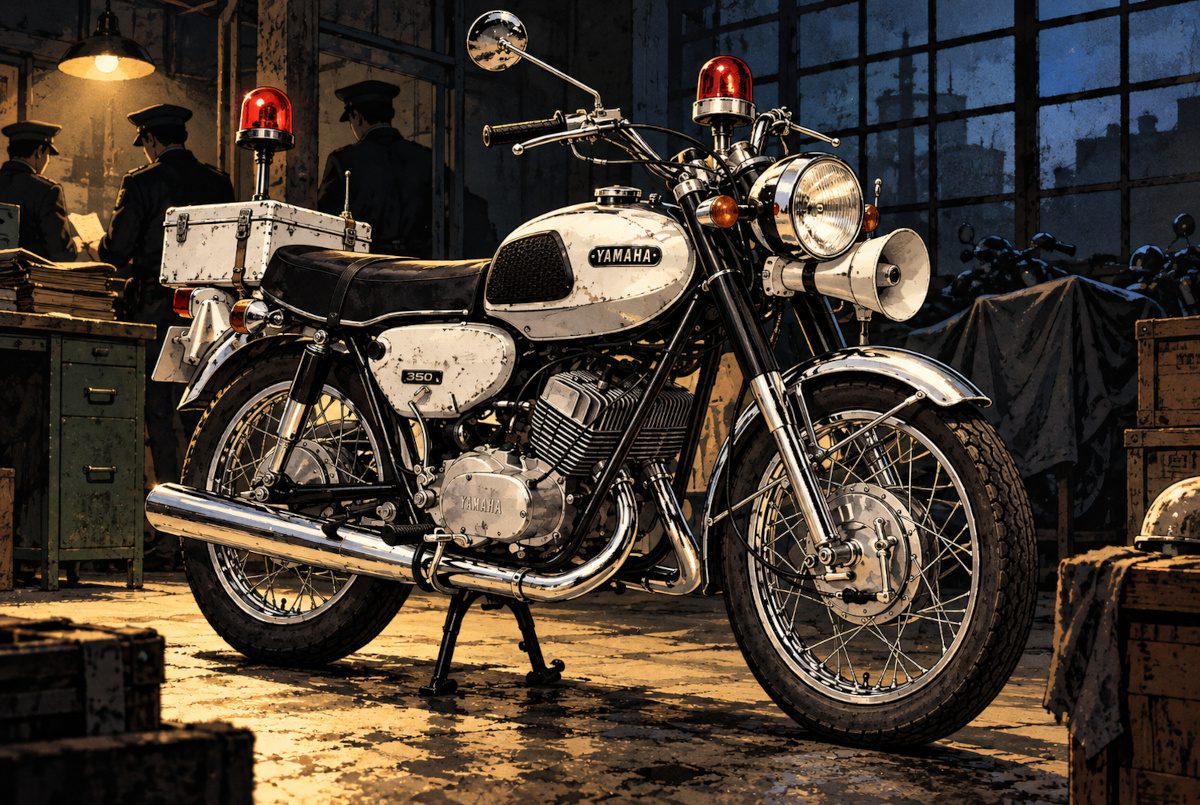
The fake police motorcycle used in Japan’s notorious ¥300 million robbery was actually a Yamaha 350cc sports bike.
On December 10, 1968, a man posing as a motorcycle police officer stole nearly ¥300 million in cash in Fuchu, western Tokyo. He left behind a Yamaha Sports 350 R1 that had been painted white and fitted with improvised police-style equipment, including a makeshift red warning light and a white-painted cookie tin.
But here is what surprised me when I started looking into the motorcycle itself.
The Yamaha 350 R1, introduced in 1967, had a 348cc air-cooled two-stroke twin producing 36 PS. Yamaha claimed a top speed of 173 km/h. This was a genuinely quick sports bike for its time.
Why turn a high-performance motorcycle into such a crude imitation of a police bike? And just how convincing was the finished machine?
For this special feature, I am putting the endless theories about the robber’s identity aside and examining the motorcycle, its improvised equipment and the evidence it left behind. Think of it as a vintage-bike investigation with a rather unfortunate criminal connection.
Underneath the White Paint Was a 36 PS Sports Bike
Yamaha Motor’s official historical collection describes the R1 as the company’s largest-displacement sports model when it was introduced in 1967.
It was no modest commuter motorcycle. Its engine, chassis and performance figures belonged to a machine designed to go seriously fast by the standards of the day.
| Specification | Yamaha Sports 350 R1 |
|---|---|
| Year introduced | 1967 |
| Engine | Air-cooled, two-stroke, parallel twin |
| Displacement | 348cc |
| Maximum power | 36 PS at 7,000 rpm |
| Maximum torque | 3.8 kgf·m at 6,500 rpm |
| Transmission | 5-speed |
| Weight | 170 kg |
| Top speed | 173 km/h (manufacturer’s figure) |
| Original price | ¥228,000 |
Here’s a calculation worth making.
Divide the R1’s stated output by its published weight:
36 PS ÷ 0.170 metric tons = approximately 212 PS per metric ton.
That is a power-to-weight calculation using Yamaha’s original stock-model specifications. It does not include a rider, additional equipment or any changes made to the stolen motorcycle.
Nor does it tell us how the fake police bike actually performed after modification.
Yamaha also claimed that the R1 could complete the standing-start 400-meter sprint in 13.8 seconds.
So the motorcycle underneath all that white paint was not some sluggish old utility bike. It was a respectable performance machine.
And someone took that machine, covered it in white paint and attempted to turn it into a police motorcycle.
From a vintage-bike enthusiast’s perspective, that is a painful thought.
The Real Police Used Hondas. The Fake Was a Two-Stroke Yamaha.
What would a genuine Japanese police motorcycle have looked like around 1968?
In Japan, police motorcycles are commonly called shirobai, literally “white bikes.” They were familiar symbols of police authority long before the robbery.
The Nagano Prefectural Police’s official history records the use of Honda 305 motorcycles from around 1963 and Honda CB350 motorcycles from 1968. The Niigata Prefectural Police identify their Honda 305 model as the CP77.
These are records from individual prefectural police departments, not a complete inventory of the Tokyo Metropolitan Police Department’s fleet in 1968.
However, the Japanese motorcycle-history organization Nirin Bunka wo Tsutaeru Kai also discusses the difference between the Honda four-stroke motorcycles used by Tokyo police at the time and the two-stroke Yamaha R1 used in the robbery.
That difference matters to motorcycle enthusiasts.
The Yamaha was a two-stroke sports twin. The Honda 305 and CB350 used as contemporary comparisons had four-stroke engines, with different mechanical layouts and styling.
Someone familiar with motorcycles might have noticed discrepancies in the engine note, exhaust layout or fuel-tank design.
But there’s an important qualification.
Not every Japanese police motorcycle throughout history was a four-stroke.
Japan had used some two-stroke police motorcycles before the robbery, and the Nagano police records include the two-stroke Suzuki GT750 from 1972 onward.
So a two-stroke engine alone did not automatically make a motorcycle an impossible police vehicle.
The more relevant point is that the fake Yamaha did not match the makes and mechanical characteristics associated with the Metropolitan Police Department’s contemporary patrol motorcycles.
AI-generated illustration inspired by the Yamaha Sports 350 R1 introduced in 1967 and a typical Japanese motorcycle workshop of the period. The paint scheme, engine details and equipment are not exact reproductions of a particular surviving motorcycle.
A Cookie Tin and a Megaphone? This Was No Museum-Quality Replica
Looking at reports about the fake motorcycle, one thing quickly becomes apparent: the conversion was hardly a faithful replica of a professionally equipped police machine.
Accounts describe the originally blue motorcycle being painted white and fitted with a lamp intended to resemble a police warning light, a transistor-powered megaphone and a white-painted cookie tin.
Instead of meticulously reproducing official police equipment, the builder appears to have relied on ordinary objects and readily available components to create the right impression.
Which raises another question: where did those parts come from?
According to retrospective accounts, the Yamaha 350 R1 had been stolen from the Hirayama housing complex area in Hino, western Tokyo, sometime between the night of November 19 and around November 20, 1968.
That left approximately 20 to 21 days before the robbery on December 10.
Some later accounts describe the megaphone itself as stolen, and report that investigators looked into the distribution channels for such equipment.
But the original theft reports and a complete, independently verifiable chain of acquisition for every part have not been established in the public sources examined here.
There is no reliable basis for naming a particular shop as the supplier of the entire conversion.
And this is where the motorcycle becomes more interesting than its appearance suggests.
The builder may not have needed the machine to withstand a knowledgeable inspection. It only needed to make someone believe that a police officer had arrived.
That is an interpretation based on the motorcycle’s construction and how the robbery unfolded, not a documented statement of the robber’s intentions.
It was less about producing a faithful replica and more about creating a convincing impression at the critical moment.
Newspaper Scraps and Fingerprints: The Crude Conversion Left Valuable Clues
The paintwork is what really caught my attention.
A 2022 Bunshun Online article describes a fragment of newspaper found attached to the fake motorcycle’s transistor megaphone. Investigators identified it as part of the December 6, 1968 edition of the Sankei Shimbun newspaper.
According to Fuji Television’s published timeline of the investigation, the newspaper fragment was discovered in December 1970, approximately two years after the robbery.
Unfortunately, the newspaper distributors’ delivery-route records that might have helped trace the fragment to a subscriber had already been discarded.
Here was a scrap of paper carrying a specific publication date, but the records potentially needed to connect it to a person were no longer available.
Then there were the fingerprints.
In a December 17, 2018 report, Kyodo News interviewed a former investigator who had worked primarily on forensic examination during the case.
He recalled a fingerprint believed to have been left when someone touched the freshly painted motorcycle to check whether the paint had dried.
According to his account, he argued that investigators should focus on that print, but his proposal was not accepted.
The missed opportunity still troubled him decades later.
Of course, the fingerprint was not conclusively established as belonging to the robber. Nor can we assume that the person who modified the motorcycle and the person who stole the money were necessarily the same individual.
Nevertheless, the conversion had potentially left behind traces of human activity and clues about the equipment’s origin.
The workmanship might have been crude, but that did not make the motorcycle worthless as forensic evidence.
In fact, it makes me wonder whether some of its most amateurish details were also among its most useful investigative features.
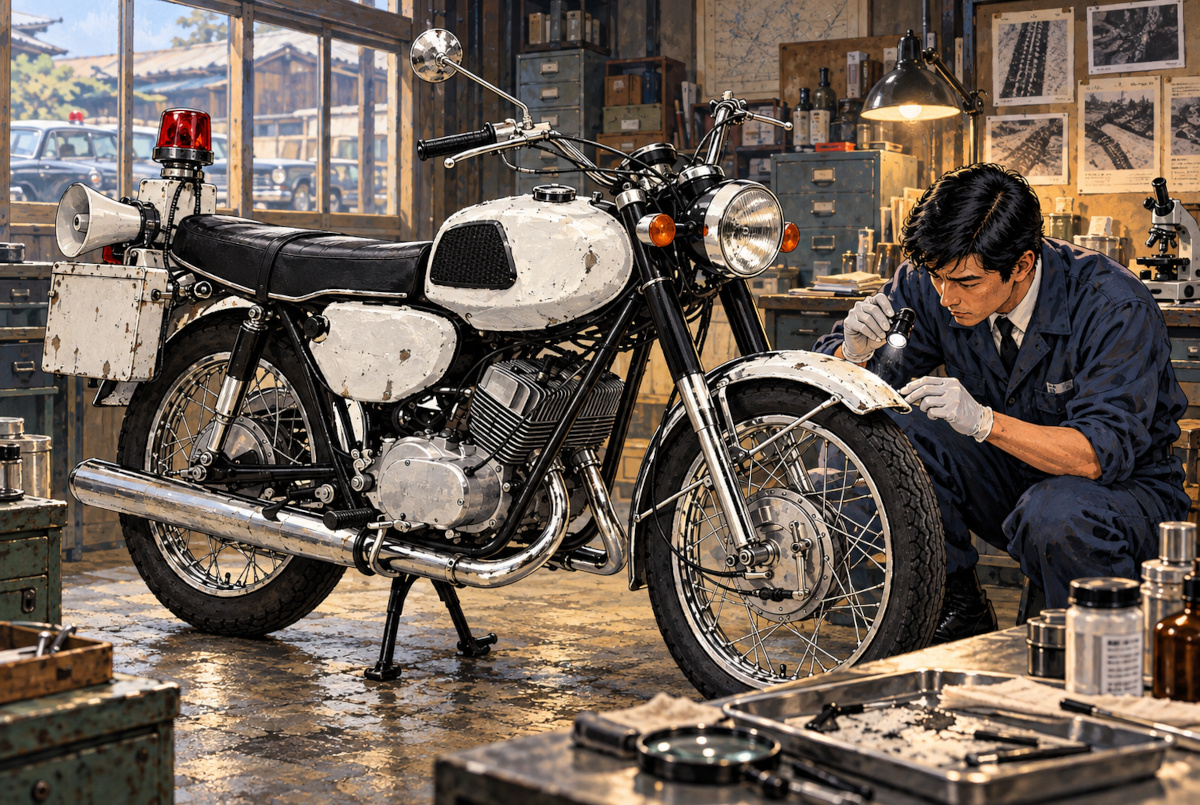
AI-generated illustration imagining a forensic examination in 1968. The motorcycle equipment, paintwork, technician and room are partly fictional and do not faithfully reproduce the seized motorcycle or actual forensic records. This image does not imply that a fingerprint was recovered from the specific front fender shown.
What If the Robber Had Used a Honda Instead?
There is another curious story surrounding the motorcycle.
According to a theory discussed in Japanese motorcycle-history writing, the person or people behind the robbery may originally have obtained a Honda motorcycle, only to abandon it because of mechanical problems and switch to the Yamaha 350 R1.
The motorcycle-history source itself treats this account cautiously.
For this article, I could not verify an original investigative record establishing exactly why the switch was made.
So we cannot simply declare that the original plan was to use a Honda because it looked more like an authentic police motorcycle.
Still, the possibility raises an interesting mechanical question.
If the fake had been based on a Honda model more closely resembling a contemporary police machine, would its engine sound and overall appearance have attracted less attention?
Possibly.
But that does not mean the robbery’s outcome would necessarily have changed. The motorcycle’s appearance was only one part of the deception.
The people in the cash transport vehicle did not identify a mismatch in motorcycle specifications. They accepted the supposed officer’s authority and followed his instructions during a very short encounter.
The result was extraordinary.
A fast Yamaha sports bike, hastily made to resemble a police machine with improvised equipment, was convincing enough for the encounter to succeed.
The fake motorcycle was not a masterpiece of replica engineering. Its effectiveness depended on how people interpreted what they saw.
And that, rather than the motorcycle’s top speed, may have been the most important factor in its role in the robbery.
Editor’s Note
Before researching this particular part of the ¥300 million robbery, I had always imagined the fake police bike as some tired old utility motorcycle sprayed white.
Then I discovered that the base machine was a Yamaha 350 R1.
Thirty-six horsepower. A claimed top speed of 173 km/h. In 1967, that was a properly quick motorcycle.
And someone decided to turn it into a fake police machine using a cookie tin and a megaphone.
As someone who likes old motorcycles, I have mixed feelings about that.
What bothers me even more is what was left behind. There was a fingerprint associated with the paintwork, and even a newspaper fragment that could be dated.
Yet the robbery remained unsolved.
That feels like a terrible waste of potential evidence.
I’m curious whether the person who put the motorcycle together was mechanically experienced or just handy with a paint can. But what I really want to know is how thoroughly investigators followed the physical clues that this clumsy conversion left behind.
A capable little Yamaha became a badly disguised police motorcycle and ended up as one of the enduring images of Japan’s most famous unsolved robberies.
Classic motorcycles collect some extraordinary stories over the years. This one is particularly hard to feel good about.
The 300 Million Yen Robbery $2014 Four-Part Series
The police officer's son, the missing money, the fake police motorcycle, and questions about the investigation. Four articles examine the evidence, competing theories, and what remains unproven.
- Part 1: Did the Robber Die Five Days Later? Japan’s ¥300 Million Mystery and a Police Officer’s Son
- Part 2: Did the Suspect’s Father Burn ¥300 Million? The Chimney Smoke Mystery
- Final Part: Did Police Already Know the Culprit? Japan’s ¥300 Million Robbery, 57 Years On
- Special: A Yamaha 350 R1 Disguised as a Police Bike? Japan’s ¥300 Million Heist
References
- Yamaha Motor — 1967 R1, Official Historical Collection (English) — Original specifications, including the 348cc engine, 36 PS output, 170 kg weight, claimed 173 km/h top speed, 400-meter acceleration time and ¥228,000 list price.
- Yamaha Motor — Yamaha News, September–October 1967 (Japanese, Official Archive) — Contemporary manufacturer material from the R1’s introductory period.
- Nagano Prefectural Police — A History of Japanese Police Motorcycles (Japanese) — Historical records of Honda 305, Honda CB350 and Suzuki GT750 police motorcycles and their periods of service.
- Niigata Prefectural Police — History of Police Motorcycles, Part 1 (Japanese) — Identifies the Honda 305 police motorcycle as the CP77 and provides historical deployment details.
- Netorabo — Report on a ¥300 Million Robbery Historical Tour (Japanese) — Discusses the Yamaha motorcycle, the white paint, the cookie tin and the transistor megaphone, alongside a modern tour recreation. The recreation itself is not original evidence.
- Bunshun Online — Unsolved Crimes Depicted in Japanese Manga (May 8, 2022; Japanese) — Describes the December 6, 1968 Sankei Shimbun fragment found on the megaphone and the discarded newspaper-delivery records.
- Fuji Television — New Testimony: The ¥300 Million Robbery, Official Timeline (Japanese) — Records the December 1970 discovery of the newspaper fragment and other major investigative milestones.
- Kyodo News — Fifty Years After the ¥300 Million Robbery: Investigators’ Lingering Regrets (December 17, 2018; Japanese) — A former forensic investigator discusses a fingerprint believed to be associated with checking the painted motorcycle and his unsuccessful request to focus the investigation on it.
- Nirin Bunka wo Tsutaeru Kai — The ¥300 Million Robbery and Two-Stroke Police Motorcycles (2018; Japanese) — Motorcycle-history discussion of Yamaha versus Honda, the unconfirmed motorcycle-switching theory and historical two-stroke police motorcycles.