

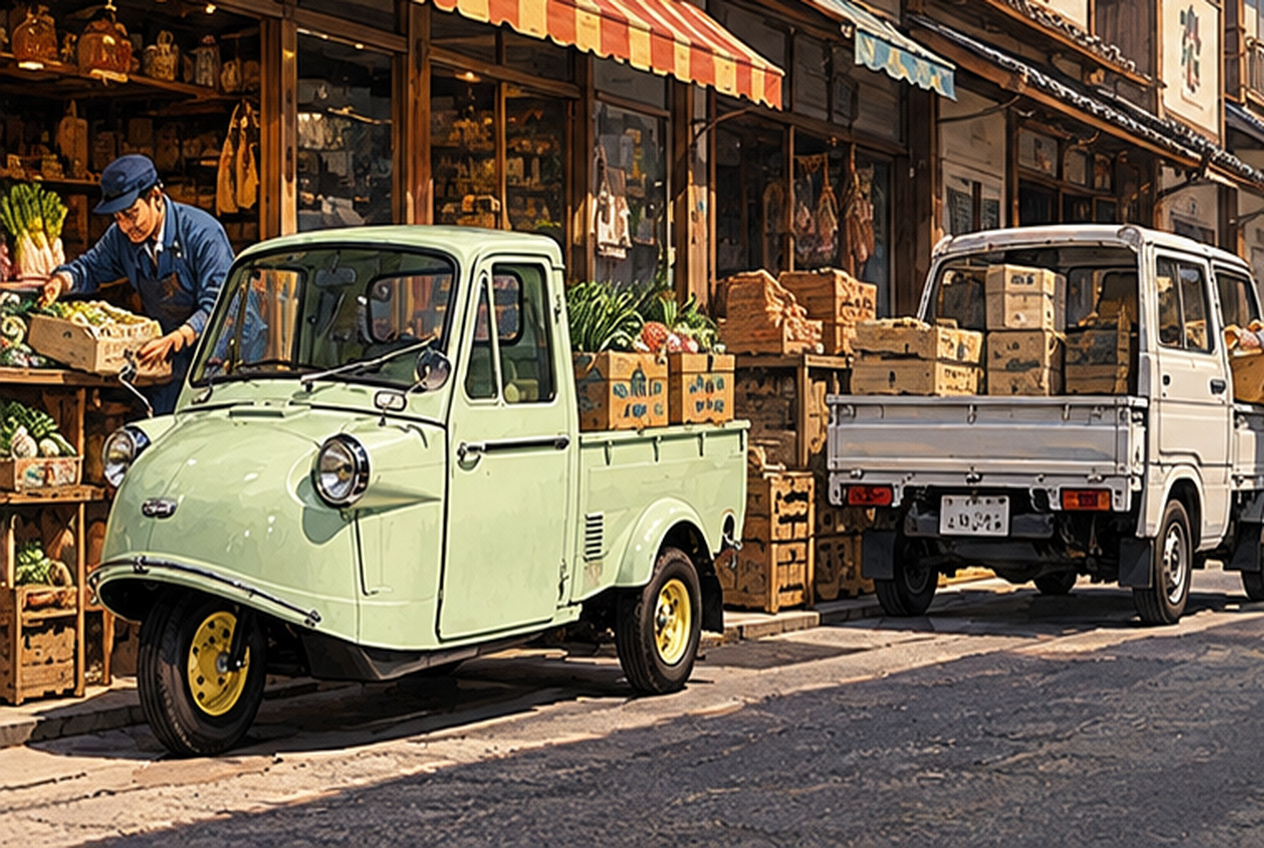
In 1960, approximately 86,000 Daihatsu Midgets were registered in Japan. Just three years after its introduction, the tiny three-wheeled truck had become one of the defining workhorses of Japan’s postwar shopping streets.
Yet in November of that very same year, Daihatsu introduced the Hijet, its first four-wheeled kei commercial vehicle. The company was launching a potential successor while its three-wheeler was still selling remarkably well.
Then I came across a particularly strange number.
The 1964 Daihatsu Midget MP5 and the second-generation Hijet introduced that same year were both 1,295 mm wide. Despite having one fewer wheel, the Midget was no narrower than its four-wheeled counterpart.
And yet Midget production ended in December 1971, according to Japanese classic-car reference material.
What happened to a vehicle that had helped transform small-business transportation? Was the three-wheeler defeated by superior machinery, or had the businesses buying these trucks begun demanding something different?
In 1960, Daihatsu Launched a Four-Wheeler While the Midget Was Booming
Introduced in 1957, the original Midget was built around a straightforward idea: give small shopkeepers an affordable, maneuverable way to carry loads that were awkward or impractical to transport by motorcycle.
Daihatsu’s own historical account describes the original concept in terms of maneuverability, ease of use and economy. This was not a miniature truck designed merely to look amusing. It was a practical answer to a very specific delivery problem.
But the first Hijet, launched in November 1960, also targeted customers who were ready to move beyond the Midget’s basic equipment and capabilities.
Its 356cc air-cooled, two-stroke twin-cylinder engine produced 17 PS, or metric horsepower. The front wheels used independent suspension, and the transmission incorporated synchromesh. For Daihatsu’s first four-wheeled kei vehicle, these were relatively sophisticated features that brought it closer to conventional automobile engineering.
Compared with the Midget MP series’ 305cc engine and 12 PS, the Hijet offered approximately 41.7% more maximum power.
So this was more than a three-wheeler with an extra wheel attached.
There was a catch, however. The original Hijet used a bonneted, or hooded, layout, with the engine ahead of the cab. A period comparison reproduced by Motor-Fan gives its cargo-bed length as 1,075 mm, against 1,160 mm for a short-bed Midget.
That made the Hijet’s bed 85 mm shorter in this particular comparison.
Switching to four wheels did not automatically mean gaining a larger cargo bed. The first Hijet was offering a different kind of value: better accommodation and a driving experience closer to that of a conventional automobile.
The Price Gap: Four Wheels Cost Roughly 30% More
With more power and more car-like features, surely the Hijet should have immediately replaced the Midget?
Not so fast. There was the question of price.
According to Motor-Fan’s historical comparison, around 1961 the Midget cost approximately ¥230,000, while the Hijet was priced at around ¥300,000.
¥300,000 − ¥230,000 = approximately ¥70,000
¥70,000 ÷ ¥230,000 × 100 = approximately 30.4%
In other words, choosing the four-wheeled Hijet required roughly 30% more money than buying the Midget.
These are approximate representative prices, not a controlled comparison of every trim level or specification. Even so, the difference was substantial for a small business investing in a delivery vehicle.
If a shopkeeper’s daily work consisted mainly of short neighborhood deliveries, and the Midget could carry everything required, spending significantly more on a Hijet was not necessarily an easy decision to justify.
The arrival of the four-wheeler therefore did not make the Midget economically pointless overnight. The three-wheeler still offered a convincing combination of affordability and maneuverability.
By 1964, the Three-Wheeler and Four-Wheeler Were Exactly the Same Width
The situation became more interesting in April 1964, when Daihatsu introduced the second-generation Hijet.
This time, the truck adopted a cab-over-engine layout, placing the engine beneath the seating area. The change allowed the available vehicle length to be used more effectively for the cab and cargo bed.
To understand what this meant for the Midget, I compared the published specifications of a 1964 Midget MP5 with Daihatsu’s official figures for the second-generation Hijet.
| Specification | Midget MP5 | Second-generation Hijet |
|---|---|---|
| Number of wheels | 3 | 4 |
| Overall length | 2,970 mm | 2,990 mm |
| Overall width | 1,295 mm | 1,295 mm |
| Engine displacement | 305cc | 356cc |
| Maximum power | 12 PS | 17 PS |
| Seating capacity | 2 | 2 |
Note: The MP5 figures come from a 1964 vehicle featured in Nostalgic Hero. The Hijet figures are representative specifications published in Daihatsu’s official 60th-anniversary history. This comparison does not imply that every version or production year shared identical specifications.
There was just 20 mm between them in overall length. In width, there was no difference at all.
Meanwhile, the Hijet produced 5 PS more power.
By this point, having three wheels no longer guaranteed a smaller vehicle in terms of overall dimensions.
This matters because both vehicles belonged to Japan’s kei vehicle category, where strict limits on exterior dimensions and engine capacity encouraged manufacturers to make efficient use of every millimeter.
Equal width did not necessarily mean equal maneuverability, of course. The 1964 Midget MP5 featured in Nostalgic Hero had a reported minimum turning radius of just 2.7 meters. It had certainly not forgotten how to negotiate tight streets.
But once manufacturers could fit four wheels, a more conventional cab and a useful load bed into virtually the same exterior dimensions, the argument for choosing three wheels became less straightforward.
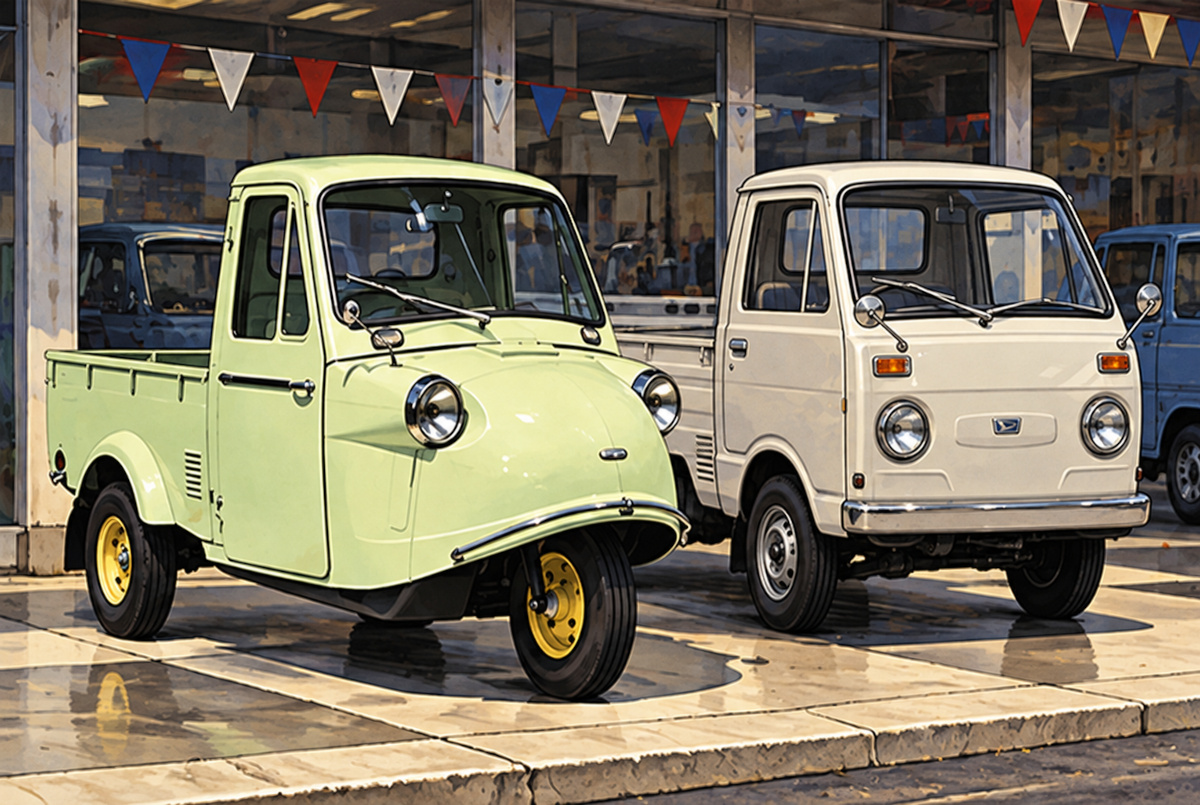
AI-generated illustration inspired by the Daihatsu Midget MP5 and second-generation Hijet of the mid-1960s. The showroom scene is fictional, and some vehicle details are artistically interpreted.
Did Four Wheels Solve Every Problem of a Three-Wheeler?
A three-wheeled vehicle rests on three tire contact points, forming a triangular support area. A conventional four-wheeled vehicle has four contact points arranged in a roughly rectangular pattern.
Those different layouts affect how a vehicle responds to lateral forces during cornering. Center-of-gravity height, track width, load distribution and road conditions all play a part.
Stack the cargo high, make a sudden steering input, or drive across a sloping surface, and the relationship between the load and the vehicle’s geometry becomes especially important.
That does not mean every three-wheeler is inherently unsafe, or that a four-wheeler cannot roll over. A meaningful comparison would require controlled measurements of weight distribution, center of gravity, speed, braking performance and loading conditions.
The Midget still had advantages: excellent maneuverability, a relatively low purchase price and simple mechanical construction.
The difficulty was that four-wheeled kei trucks were becoming better at delivering similar practical benefits while offering more conventional accommodation and greater versatility.
The Hijet’s transition from the first generation’s bonneted design to the second generation’s cab-over-engine layout illustrates that change particularly well.
Did Japan’s 1973 Vehicle Inspection Rules Kill the Midget?
There is another piece of the Midget’s disappearance worth checking: Japan’s vehicle inspection system, commonly known as shaken.
According to Japan’s Light Motor Vehicle Inspection Organization and the Japan Automobile Manufacturers Association, light vehicles had been removed from the regular inspection requirement in 1952. Legislative changes in 1972 subsequently established a renewed inspection system, with inspection operations beginning on October 1, 1973.
Japanese classic-car reference material, however, places the end of Midget production in December 1971. A handful of sales were still recorded in 1972.
Putting the developments in chronological order is revealing.
| Date | Development |
|---|---|
| 1960 | Japanese light three-wheeler production reaches approximately 190,000 units. The original Hijet is introduced in November. |
| April 1964 | The second-generation cab-over-engine Hijet is launched. |
| 1969 | Mazda ends K360 production. The Midget MP5 receives later-series revisions. |
| September 1971 | The fourth-generation Hijet truck is introduced. |
| December 1971 | Midget production ends, according to Japanese specialist historical records. |
| 1972 | A small number of Midget sales are recorded. Legislation concerning kei vehicle inspections is amended. |
| October 1973 | The Light Motor Vehicle Inspection Organization begins inspection operations. |
The Midget had already ceased production before the new kei vehicle inspection system began operating.
Therefore, the claim that the Midget disappeared because mandatory inspections had already started does not fit the historical sequence.
That does not establish that future regulatory requirements or evolving safety standards played no part in Daihatsu’s long-term planning. They may have influenced decisions about future products.
What I could not verify was any contemporary internal Daihatsu decision document identifying the inspection system as the direct reason for ending Midget production.
Separating a documented sequence of events from a plausible explanation is essential here.
Was the Midget Defeated, or Had Its Job Changed?
In 1957, the Daihatsu Midget offered shopkeepers a practical step up from motorcycles and other basic delivery equipment. It was inexpensive, compact and capable of carrying useful loads through narrow streets.
During the 1960s, however, Daihatsu itself expanded the available choices with the Hijet. By 1964, the cab-over-engine layout was making more effective use of the same tightly regulated vehicle dimensions.
Mazda’s competing K360 ended production in 1969. Specialist histories date the Midget’s production ending to December 1971.
Yet the work these vehicles performed did not disappear. Grocers, retailers and small businesses still needed to move goods between suppliers, shops and customers.
Increasingly, four-wheeled kei trucks took over those duties. Daihatsu’s own historical presentation even identifies the Midget as an important forerunner of the Hijet.
Perhaps the Midget’s fate was not simply a matter of losing a contest on horsepower or handling. The market it had helped create was developing a broader set of requirements.
The original breakthrough had been affordable transportation, tight turning ability and a 300 kg payload. Later, buyers could also consider more comfortable two-person accommodation and vehicles adaptable to a wider range of jobs.
The Midget’s original advantages did not suddenly become worthless. They simply stopped being sufficient reasons for everyone to choose three wheels.
And that may be the more revealing story behind the disappearance of Japan’s little three-wheeled workhorse.
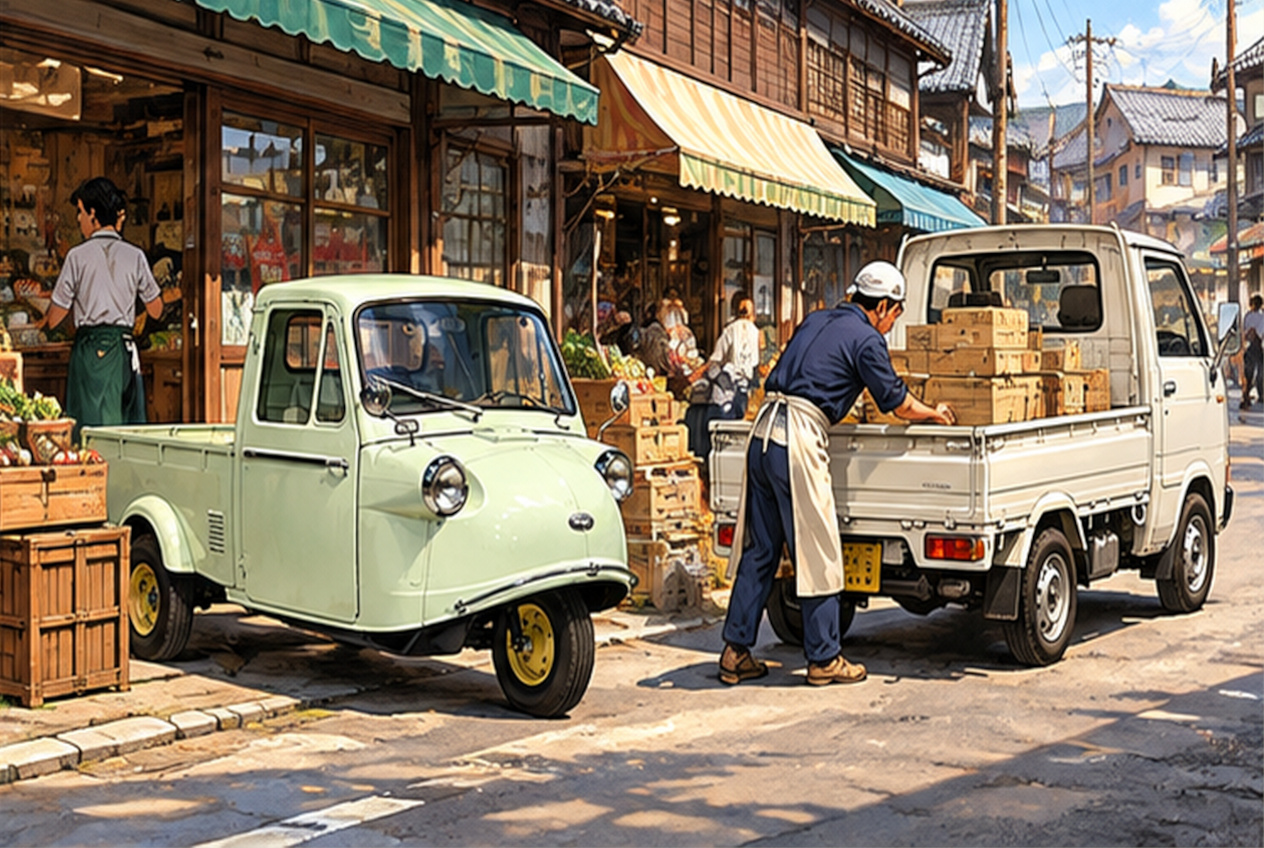
AI-generated illustration representing changes in Japanese local delivery work around 1971. It does not depict an actual street, business or historical event. Some vehicle details are artistic interpretations.
Editor’s Note
When I first started looking into the Midget’s disappearance, I thought the answer would be pretty obvious. Four wheels offer a different kind of stability, and Daihatsu had already introduced the Hijet. Surely the three-wheeler had simply outlived its usefulness.
Then I found out that the original Hijet actually had a shorter cargo bed than the smaller Midget in one contemporary comparison. It also cost roughly 30% more. And people still bought it.
That’s the part I couldn’t leave alone.
Then came the 1964 figures: identical overall width for the Midget and the Hijet. I had always associated three wheels with a genuinely narrower vehicle. The specifications made that assumption look rather questionable.
The Midget was not some primitive contraption that everyone had foolishly put up with. For its original customers, it was an entirely sensible machine. But as businesses developed, they began asking for more than a useful load bed. The driver’s comfort and the ability to handle different kinds of work mattered too.
Maybe the story isn’t just about why the Midget stopped selling. Maybe it also tells us something about how the Japan that once needed it was changing.
In 1957, even one of Daihatsu’s own salesmen reportedly wondered whether this toy-like little truck would sell. Yet the Midget went on to help establish a market that four-wheeled kei trucks would eventually dominate.
There is something wonderfully ironic about that. And something unmistakably Japanese about the engineering determination behind it.
Terms That May Need a Quick Explanation
- Kei vehicle
- A Japanese category of small motor vehicles governed by limits on dimensions and engine displacement. In the Midget’s era, the requirements were much more restrictive than today’s kei vehicle regulations.
- Cab-over-engine layout
- A vehicle design in which the cab is positioned above or close to the engine and front axle, rather than behind a long bonnet. This arrangement makes it easier to provide a longer cargo bed within a limited overall vehicle length.
Daihatsu Midget — Four-Part Series
From the sales efforts that preceded its famous TV commercials to the evolution of the DK, DS, and MP models, competition with rival three-wheelers, and the shift to four-wheel kei trucks, we trace the history of the original Daihatsu Midget in four parts.
- Part 1: Before the Famous TV Ad: How a Butcher’s 20 Shops Helped Sell the Daihatsu Midget
- Part 2: From 8 to 12 HP—and Just 5 mm to Spare: The Daihatsu Midget’s Evolution
- Part 3: The Daihatsu Midget Was Booming. So Why Was Mazda K360 Catching Up?
- Final Part: 86,000 Registrations in a Year—Why Did the Daihatsu Midget Disappear?
References
- Daihatsu Motor Co., Ltd., “Hijet 60th Anniversary” (Japanese): Official history of the transition from the Midget to the Hijet, including the first-generation 1960 model, the second-generation 1964 model, specifications and body-layout changes.
- Daihatsu Motor Co., Ltd., “Hijet Series Celebrates 60 Years Since Its Original Launch,” November 2, 2020 (Japanese): The development philosophy and evolution of Daihatsu’s four-wheeled light commercial vehicles.
- Daihatsu Motor Co., Ltd., “DAIHATSU 111th HISTORY,” Vol. 3 (Japanese): Original Midget development philosophy and registration figures for 1960.
- Motor-Fan, “Daihatsu Hijet (1960): The Original Bonnet-Type Compact Utility Vehicle” (Japanese): Historical prices, mechanical features, cargo-bed dimensions and comparisons with the Midget.
- Nostalgic Hero, “1964 Daihatsu Midget MP5, Vol. 2” (Japanese): Published vehicle specifications, including length, width, engine output and minimum turning radius.
- Meisha Bunka Kenkyujo (Classic Car Culture Research Institute), “Daihatsu Midget” (Japanese): Later MP5 modifications, the end of Mazda K360 production, the reported December 1971 Midget production ending and the small number of sales recorded in 1972.
- Light Motor Vehicle Inspection Organization, “History of Kei Vehicles” (Japanese): The peak of light three-wheeler production, the transition to four-wheeled vehicles, the 1972 legal amendments and the beginning of inspection operations in 1973.
- Japan Automobile Manufacturers Association, JAMAGAZINE, October 2014, “History of Vehicle Inspection and Its Purpose” (PDF, Japanese): Historical background to the 1952 exemption and the 1973 reintroduction of inspections for kei vehicles.