

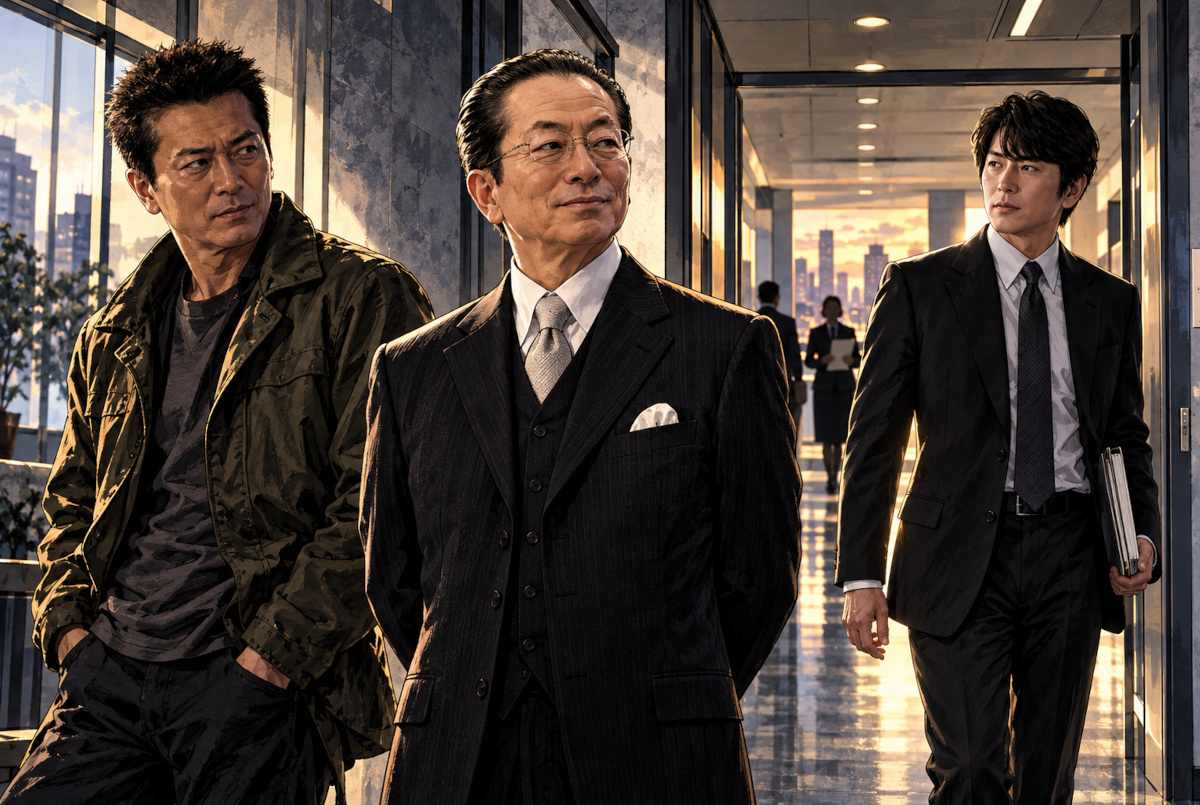
Was AIBOU supposed to begin and end with the same detective?
For years, one particularly appealing theory has circulated among fans of AIBOU: Tokyo Detective Duo: the long-running Japanese crime drama would eventually conclude by reuniting its central detective, Ukyo Sugishita, with his original partner, Kaoru Kameyama.
It wasn’t an entirely fanciful idea. In 2022, lead actor Yutaka Mizutani acknowledged that he had long imagined bringing Kameyama back whenever the series began to feel as though it was approaching its end.
That same year, Yasufumi Terawaki returned as Kameyama after fourteen years away.
Then came October 13, 2026. TV Asahi announced that Kameyama would hand the partner role back to Takeru Kanbe, played by Mitsuhiro Oikawa, during Season 25.
The show had been running for 26 years since its debut as a television special in 2000. Mizutani was now 74. Just when the original partnership looked like a natural way to close the book, the series was bringing back its second partner instead.
So what happened to the idea that AIBOU would end with Kameyama? Did Mizutani change his mind, or was that supposed ending never actually decided?
I went back to Mizutani’s interviews from 2022 and 2023, checked the television ratings, and compared his words with TV Asahi’s 2026 announcement.
What emerged was more interesting than a simple story about a finale that never happened.
Did Mizutani Ever Actually Say AIBOU Would End with Kameyama?
The best place to begin is an interview published by MANTANWEB on October 12, 2022, featuring Mizutani and Terawaki.
They were promoting Season 21, which reunited Sugishita and Kameyama after fourteen years apart.
When asked whether he had always hoped to work with Terawaki again, Mizutani explained that he had long carried an image in his mind: if AIBOU began to feel as though it was approaching its conclusion, he wanted Kameyama to return.
But the series kept going. The reunion he had imagined took fourteen years to happen, rather longer than he had expected.
That certainly sounds like the groundwork for a final chapter with the original partner.
Here is the part that makes the interview worth rereading.
The interviewer followed up by asking whether Mizutani was suggesting that AIBOU would soon be ending.
Mizutani’s response was that every story is inevitably moving toward an ending, but he himself couldn’t see when that ending would come. He answered with a laugh.
The two ideas appeared in the same interview.
In February 2023, during a special interview marking the drama’s 400th broadcast, Mizutani again recalled wanting Kameyama to return when he began thinking about the show’s eventual ending.
Wanting Kameyama back when the end approached is not the same as deciding that the series must end once Kameyama returns.
That small distinction matters enormously.
The interviews establish Mizutani’s personal image of how an ending might take shape. They do not establish that TV Asahi had approved a final season, fixed a concluding episode, or committed to finishing the drama with Kameyama.
In other words, the supposedly abandoned finale may never have been a finalized plan in the first place.
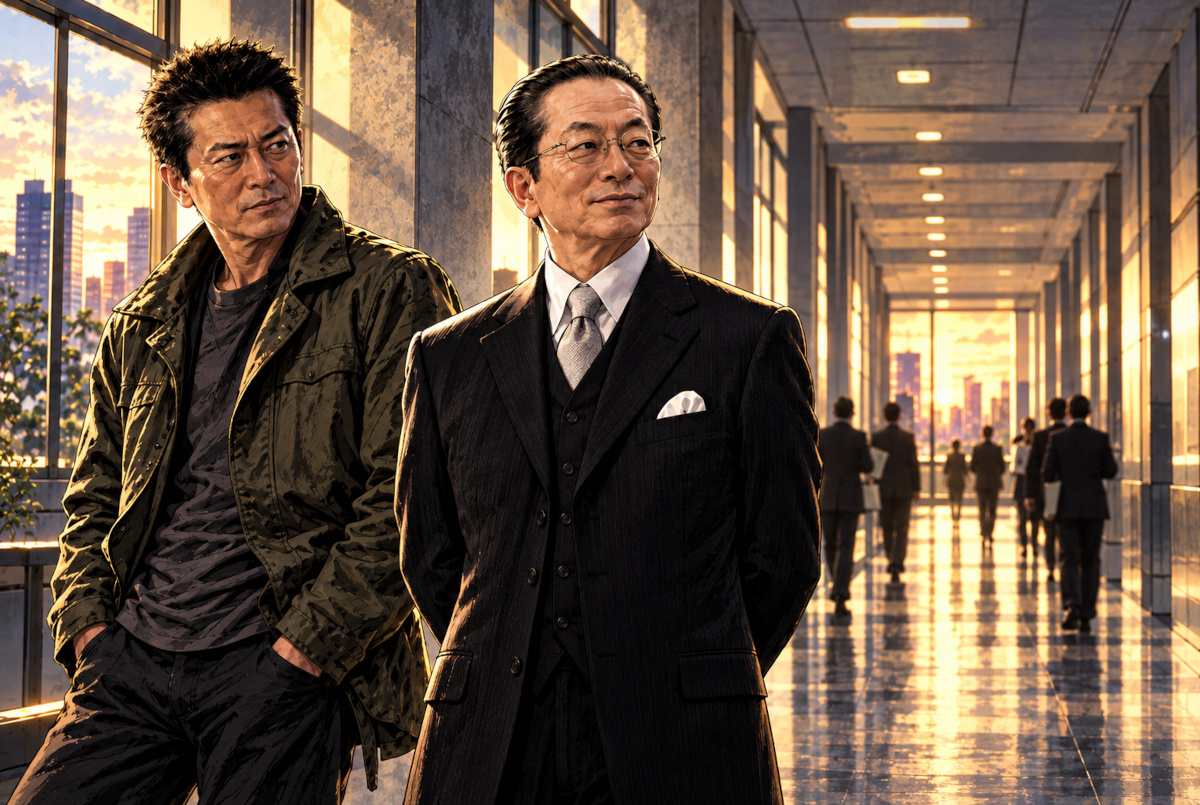
AI-generated illustration symbolizing Kaoru Kameyama’s return in 2022. It does not recreate an actual scene or filming location from AIBOU Season 21.
In Mizutani’s Own Words, Kameyama Was Orange and Kanbe Was Blue
There is another revealing piece of evidence in an interview published by TV Asahi’s entertainment outlet, TeleAsa POST, on March 8, 2023.
Asked to describe his various partners as colors, Mizutani associated Kameyama with orange and Kanbe with shades of blue.
It is a surprisingly useful way to understand how the two characters function.
Kameyama is the warm-blooded, impulsive investigator. He gets personally involved, responds instinctively to injustice, and brings emotional urgency to cases that Sugishita approaches with careful logic.
Kanbe is different. A former elite officer at Japan’s National Police Agency, he is analytical, competitive, sophisticated and capable of challenging Sugishita on intellectual and moral grounds.
But Mizutani was careful to explain that Kanbe’s cool exterior did not mean he lacked feeling.
He also recalled the skepticism that greeted the partnership when Kanbe originally replaced Kameyama. Some viewers wondered what could possibly be interesting about pairing two elite, highly intelligent detectives.
Mizutani saw precisely the opposite opportunity.
Two men could belong to similar professional worlds and still differ profoundly in personality, judgment and values.
For Mizutani, that difference offered an entirely new dramatic landscape.
It is difficult to reconcile those comments with the notion that only the original partnership could provide the series with a satisfying direction.
With Kameyama, Sugishita’s intellect is balanced by instinct and empathy. With Kanbe, Sugishita encounters another formidable mind whose sense of justice is not necessarily identical to his own.
The central character remains Sugishita, but the person standing beside him changes what the audience gets to see.
That is not proof of the production team’s motives in 2026. It is, however, a useful clue to why bringing back Kanbe could offer something other than mere nostalgia.
What Happened to the Ratings? A 6.9-Point Gap Between Two Premieres
There is, of course, another side to the story. AIBOU is not merely a collection of beloved characters. It is also a commercial television series with a remarkably long broadcasting history.
During Kanbe’s original tenure, Season 9 achieved an average household television rating of 20.3% in Japan’s Kanto region, according to ORICON NEWS in March 2011. That figure included the New Year’s Day special and was reported at the time as a series record.
Years later, Kameyama’s comeback gave Season 21 a strong opening. Its first episode, broadcast in October 2022, recorded a 17.3% household rating in the Kanto region.
Season 24 opened in October 2025 with 10.4%, measured under the same regional household-rating system.
Rather than mixing a full-season average with an individual episode, I compared the two season premieres directly.
| Broadcast | Opening-Episode Household Rating |
|---|---|
| Season 21 (2022) | 17.3% |
| Season 24 (2025) | 10.4% |
| Difference | 6.9 percentage points lower |
Both figures come from Video Research’s Kanto-region household television ratings, as reported by MANTANWEB.
The arithmetic is straightforward:
(17.3 − 10.4) ÷ 17.3 × 100 = approximately 39.9%.
That means the Season 24 premiere’s household rating was approximately 39.9% below the level recorded by the Season 21 premiere.
Notice the distinction between a percentage-point change and a relative percentage change. The drop was 6.9 percentage points, equivalent to a 39.9% relative decline from the earlier figure.
But there are limits to what the calculation can tell us.
Season 21 benefited from the unusual excitement surrounding Kameyama’s return after fourteen years. That event gave its premiere publicity that an ordinary season opening might not receive.
These figures also measure real-time household viewing, not the complete audience across recordings, streaming services and other platforms. They are not measures of individual people watching, either.
And the Season 9 figure of 20.3% is a full-season average, so it should not be treated as directly equivalent to the two premiere figures in the table.
The ratings show a substantial difference between two comparable season premieres. They do not prove that declining ratings caused the 2026 partner change, or that the series was being prepared for cancellation.
What they do provide is a numerical perspective on how the broadcasting environment and the show’s audience response have changed since its most celebrated years.
Did TV Asahi Actually Announce a Final Chapter in 2026?
Now return to October 13, 2026, when TV Asahi announced the unexpected handover from Kameyama to Kanbe.
The broadcaster confirmed that the switch would take place during Season 25, which was scheduled to begin on October 21.
But the announcement did not specify exactly when Kameyama would leave, why he would depart the Special Task Unit, or what circumstances would bring Kanbe back.
Those were questions the series intended viewers to keep asking.
In his accompanying comments, Mizutani described the return to Kanbe as the sort of ambitious development that only a drama with AIBOU‘s long history could attempt.
He also expressed anticipation about Sugishita entering a new stage of the series’ world.
The language was about a new development, not an announced conclusion.
TV Asahi did not declare that Season 25 would be the last. Nor did the announcement say that Sugishita would retire.
That matters because a partner change and a series ending are two different events, even when the leading actor is in his seventies.
And this particular change offers an unusual dramatic possibility.
Kameyama had left the police in 2008 and moved to Salween, a fictional country in South Asia. His return in 2022 was therefore a return to both Sugishita and a professional world he had once abandoned.
Kanbe’s situation is different.
After leaving the Special Task Unit in 2012, he returned to the National Police Agency. He maintained his connection with Sugishita and subsequently helped with investigations on several occasions.
He is not a stranger who needs to discover what makes Sugishita such a difficult partner. He already knows.
And because of his background in Japan’s national police administration, he brings a different institutional perspective from Kameyama’s.
This next point is my interpretation, not an explanation officially supplied by TV Asahi.
If Kameyama’s 2022 comeback represented a return to AIBOU’s origins, Kanbe’s 2026 comeback may be a way of turning the series’ accumulated history into new stories.
The relationship between Sugishita and Kanbe does not have to be built from scratch. The audience already knows their past disagreements, mutual respect and complicated connection to the police hierarchy.
There is room to revisit those tensions without simply recreating what happened in 2009.
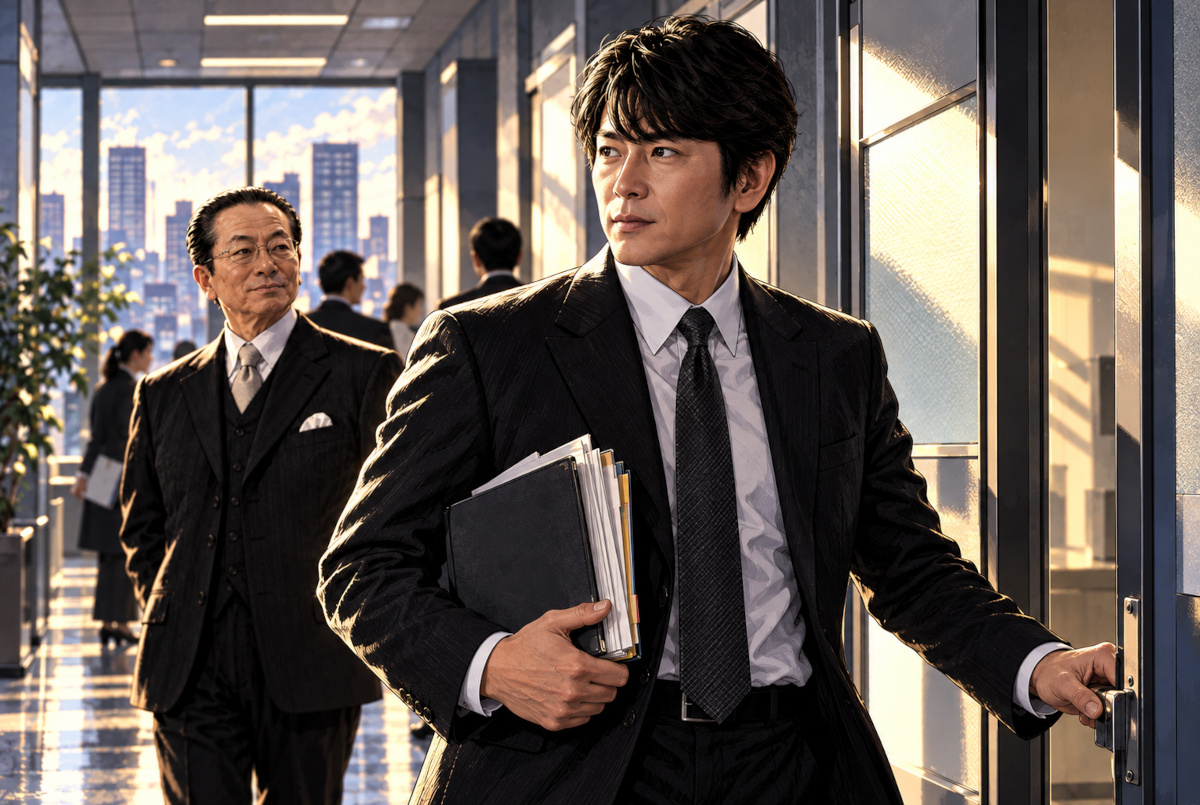
AI-generated illustration imagining Takeru Kanbe’s return in 2026. It does not depict an actual unaired scene from AIBOU Season 25 or reproduce the real Special Task Unit set.
At 74, Is Mizutani Really Approaching AIBOU’s Finale?
Yutaka Mizutani was born on July 14, 1952, making him 74 years old in October 2026.
Age makes the question of an eventual ending understandable. Few television actors spend a quarter of a century returning to the same leading character.
But it would be a mistake to turn an actor’s age into an announced retirement date.
In an official TV Asahi interview published on August 28, 2026, Mizutani reflected on the series having reached 465 episodes by the end of the previous season.
He credited the show’s longevity to its cast, staff and viewers, and suggested that older episodes still felt relevant because AIBOU had consistently portrayed the concerns of the moment in which each story was made.
He also made an intriguing observation about Sugishita.
The detective’s fundamental commitment to justice had remained consistent, but there might still be unexplored possibilities in his emotional life and personal identity beyond his role as a police officer.
That does not sound like a formal announcement of retirement. It sounds like an actor discussing aspects of his character that the series has not yet fully explored.
Of course, every long-running drama eventually reaches its final episode. AIBOU will be no exception.
What remains unestablished is when that episode will arrive.
The evidence does not require us to conclude that an ending planned around Kameyama was cancelled. A more defensible reading is that Mizutani once imagined Kameyama returning as the end approached, but the series continued for four more years and is now moving into another partnership.
As of October 19, 2026, viewers still did not know how Sugishita would welcome Kanbe back, why Kameyama would leave, or whether any of these developments would eventually lead toward a final season.
Those answers belonged to episodes that had not yet aired.
For now, the larger irony is hard to miss. A show that began with Kameyama, brought him back after fourteen years, and seemed perfectly positioned for a sentimental farewell is instead repeating its original transition to Kanbe.
After 26 years, AIBOU has reached the point where its own history has become an unusually rich source of new plots.
Editor’s Note
When Kameyama returned in 2022, I assumed we were watching the beginning of the end.
Come on. The original partner was back after fourteen years. What better way could a long-running detective drama possibly find to finish its story than putting Sugishita and Kameyama together one last time?
I had practically written the ending in my head.
Then I went back to Mizutani’s interview and noticed something I’d overlooked. Yes, he had thought about bringing Kameyama back when the series began approaching its conclusion. But he also admitted that he couldn’t see where that conclusion was.
Four years later, along comes Kanbe again.
My first reaction was something like: Wait, you’re still going? And with the second partner, of all people?
Then came the rather inconvenient realization that I actually wanted to see what would happen next.
The ratings aren’t what they were in the days when AIBOU could average more than 20% of households in the Kanto region. Mizutani is 74. Nobody can pretend time has stood still.
But if the sole intention were to wind everything down neatly, going to the trouble of bringing back Kanbe would be a peculiar way to do it.
What still fascinates me is Sugishita himself. Partners come and go, disappear for years and return in circumstances nobody expected. Yet his stubborn sense of justice remains the constant around which everything else turns.
Most television dramas would eventually make the hero’s retirement the great final spectacle.
AIBOU seems determined to suggest there might still be another story worth telling first.
So is the ending close? I don’t know. Neither the interviews nor the announcement supplies a date.
But after this many years, perhaps I should stop assuming that the ending that feels most obvious to the audience is necessarily the one the writers have in mind.
AIBOU: The Partner Switch $2014 Four-Part Series
Why is Takeru Kanbe returning after Kaoru Kameyama? Across four articles, we examine the 2008 departure, the rumors surrounding Kanbe's exit, and what the 2026 handover could mean for the long-running detective series.
- Part 1: AIBOU Is Going Back to 2009—Why Bring Back Takeru Kanbe?
- Part 2: Was AIBOU’s Original Partner Forced Out? The 2008 Exit Revisited
- Part 3: Was Mizutani Really Furious With Oikawa? Revisiting AIBOU’s 2012 Exit Rumors
- Final Part: Was AIBOU Supposed to End with Kameyama? What Mizutani Actually Said
References
- MANTANWEB, October 12, 2022 — Interview with Yutaka Mizutani and Yasufumi Terawaki (Japanese-language interview containing Mizutani’s comments about Kameyama’s return and his inability to foresee the series’ ending.)
- MANTANWEB, February 22, 2023 — AIBOU’s 400th-Broadcast Anniversary Interview (Mizutani revisits his long-standing wish to bring Kameyama back when thinking about the series’ eventual ending.)
- TV Asahi Post, March 8, 2023 — Mizutani Reflects on His Previous Partners (Primary interview in which he associates Kameyama with orange and Kanbe with blue and discusses their different personalities.)
- ORICON NEWS, March 10, 2011 — AIBOU Season 9 Achieves a 20.3% Average Household Rating (Contemporary Japanese report; the figure includes the New Year’s special and is a full-season average, not a premiere rating.)
- MANTANWEB, October 13, 2022 — Season 21 Opens with a 17.3% Household Rating (Kanto-region household television audience measurement.)
- MANTANWEB, October 16, 2025 — Season 24 Opens with a 10.4% Household Rating (Comparable Kanto-region household television audience measurement.)
- TV Asahi, August 28, 2026 — Official Season 25 Interview with Yutaka Mizutani and Yasufumi Terawaki (465-episode milestone, Mizutani’s reflections on the series, and the development of Sugishita’s character.)
- TV Asahi, October 13, 2026 — Official Season 25 Partner Handover Announcement (Primary source confirming Kanbe’s return, Kameyama’s planned departure, and comments from the three actors.)
- Nippon Columbia — Yutaka Mizutani Official Profile (Confirms Mizutani’s birth date of July 14, 1952.)
- TV Asahi International Program Guide — AIBOU: Tokyo Detective Duo (Official English series title, character names and background information for international readers.)