

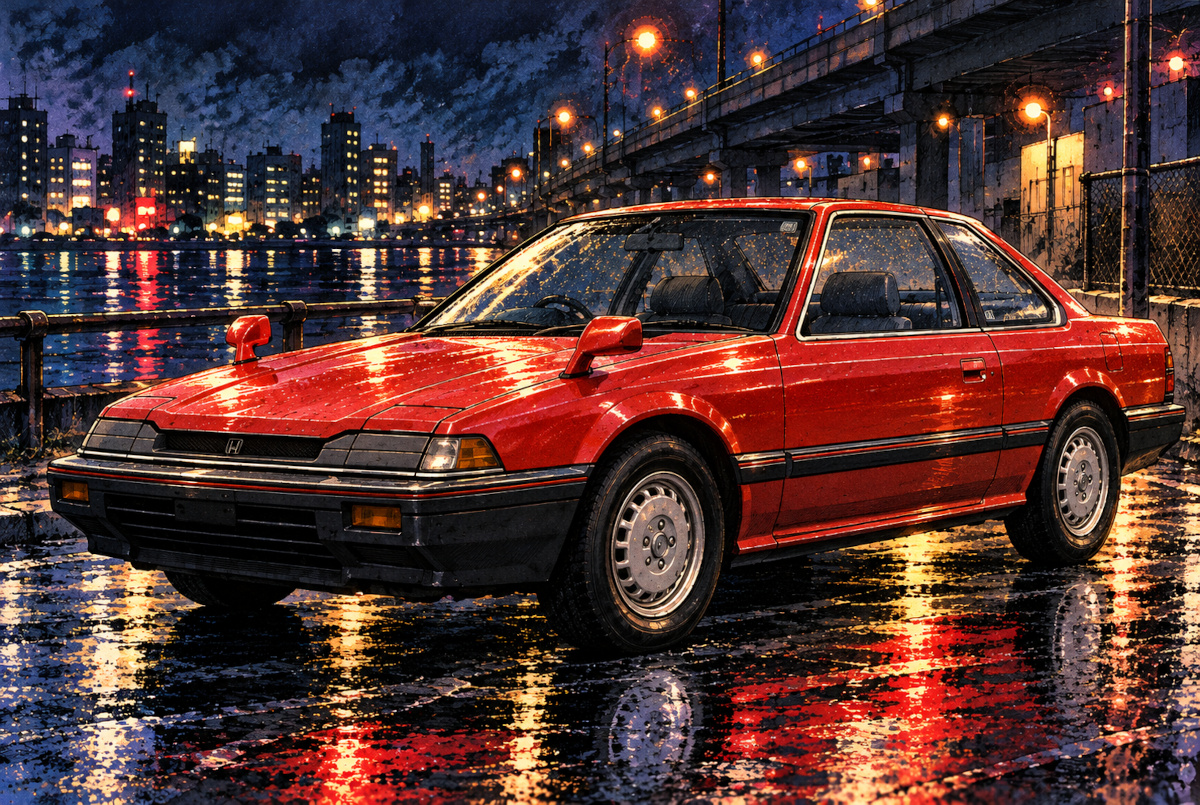
In November 1982, Honda introduced the second-generation Prelude, a sleek two-door coupe with an unusually low hood, pop-up headlights, and a profile that seemed designed to turn heads.
In Japan, the Prelude became one of the defining “date cars” of the 1980s. The term described a fashionable coupe that young drivers hoped would make an evening out a little more impressive.
But hidden inside this stylish Honda was a rather curious feature: a lever on the driver’s side of the front passenger seat, allowing the driver to operate the passenger-seat backrest without leaving their own seat.
Over time, this innocent-looking control acquired a suggestive reputation. Some enthusiasts even called it the sukebe lever, roughly the “naughty lever,” and linked it to the Prelude’s image as a car for dating and flirting.
Was Honda really designing equipment for that purpose? Or did a perfectly practical mechanism acquire a more colorful meaning after the car became famous?
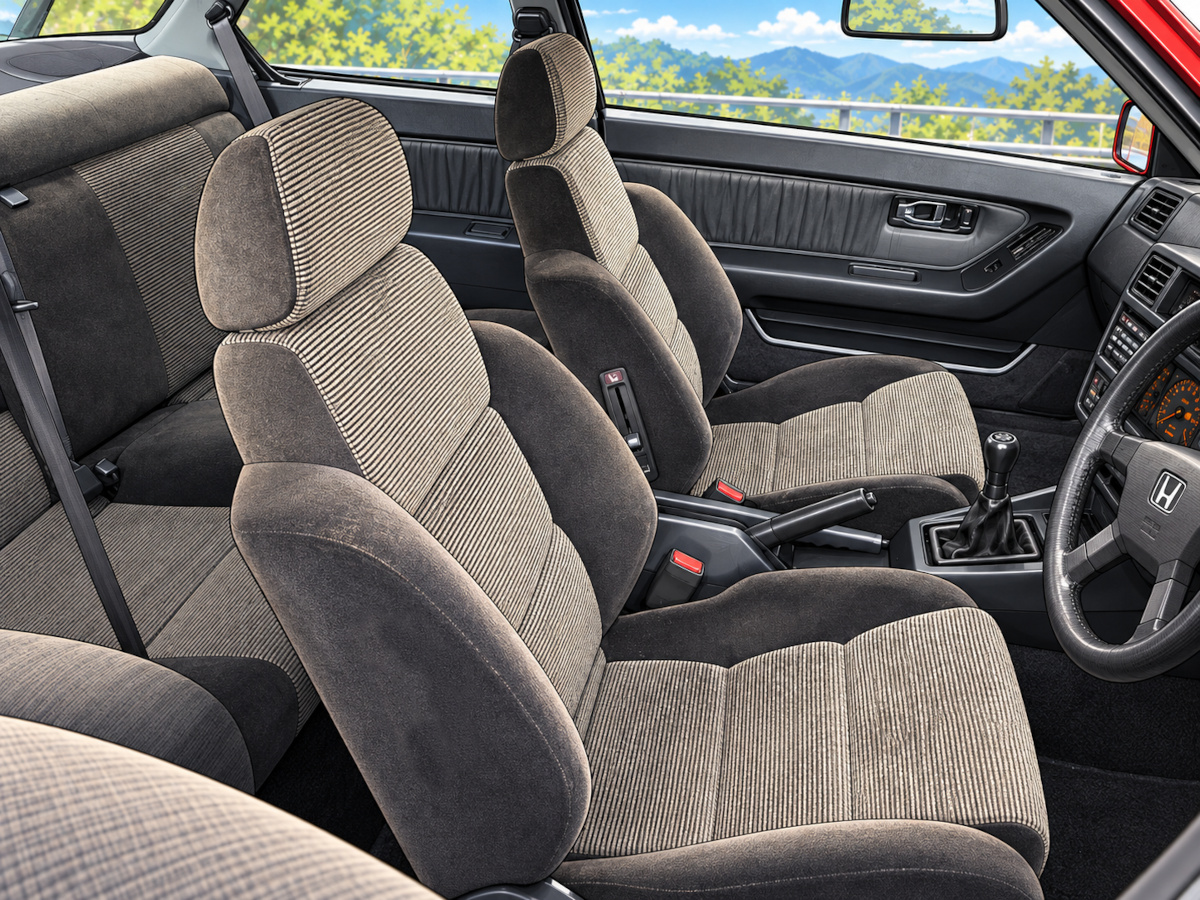
AI-generated illustration inspired by the second-generation Honda Prelude interior. The seating layout and upholstery draw on reference photographs, but some interior details, component positions, and lever features differ from the actual car.
The Lever Was Real. But What Was It Actually For?
First, the mechanism itself was no urban legend.
In February 2022, the Japanese automotive publication Motor-Fan photographed a remarkably well-preserved 1984 Honda Prelude XX. Among the details documented was a passenger-seat reclining lever that could be operated from the driver’s seat.
Its location was particularly unusual. Rather than being positioned on the passenger door side, the control was fitted to the side of the passenger seat facing the driver.
In a right-hand-drive Japanese Prelude, that meant the lever was located between the two front seats. The driver did not need to lean across the passenger seat and reach down beside the door.
The original arrangement can be seen in Motor-Fan’s photographic feature on the 1984 Prelude XX.
And this is where the story gets interesting.
A seat lever that could be operated by the driver certainly existed. But that does not prove Honda designed it to help anyone flirt.
Another Japanese classic-car publication, Nostalgic Hero, describes a practical function for the control. In a two-door coupe, getting into the rear seats can be awkward. Folding the front passenger backrest forward creates a passage for someone entering from the passenger side.
With the control positioned within the driver’s reach, the driver could assist a rear-seat passenger without getting out of the car.
It would also have made accessing items placed on the rear seats more convenient. That is a reasonable practical benefit, although Honda’s original product announcement does not establish it as the sole design objective.
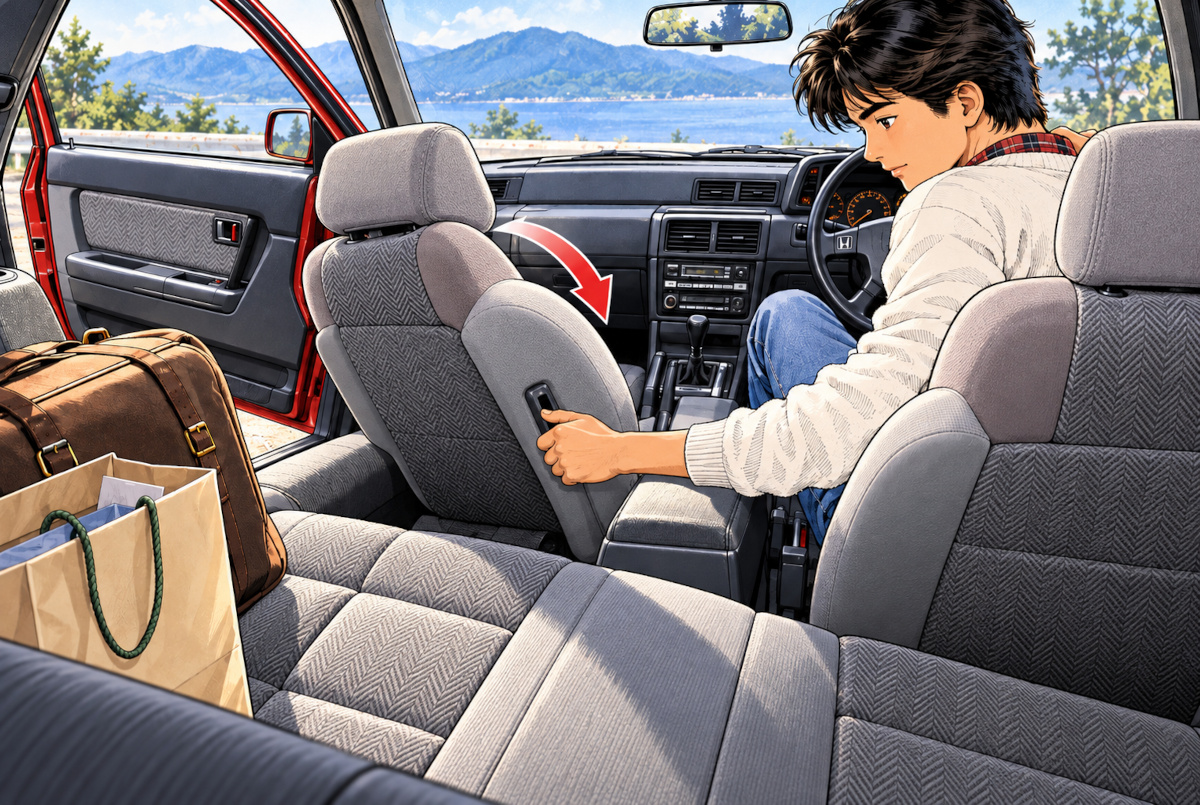
AI-generated illustration of a driver operating the passenger-seat backrest. The exact lever position, component shape, seat movement, and interior details are not mechanically accurate reproductions of the original vehicle.
Fold Forward or Recline Backward? Two Very Different Actions
The descriptions become less consistent when we examine exactly what the lever was supposed to do.
Some accounts emphasize folding the passenger backrest forward to help someone enter the rear seat. Others discuss reclining the seat backward, which fits rather neatly with the Prelude’s romantic reputation.
Those are two different operations, and they should not be treated as interchangeable.
Folding a backrest forward improves access to the rear compartment. Reclining it backward changes the seating position of someone already occupying the front seat.
The historical material confirms that the passenger-seat backrest could be operated from the driver’s side. However, the documents examined for this article do not establish the complete range of backward adjustment available through that same control on every version of the 1982-generation Prelude.
There is another useful piece of evidence, although it comes with an important limitation.
In June 2025, a Japanese Honda enthusiast examined an owner’s manual and parts documentation relating to a similar convenience lever. The manual described lifting the lever to fold the seatback forward for rear-seat access, while the parts listing identified the component as a “walk-in knob.”
That sounds considerably less scandalous than “naughty lever.”
However, the reported part number cannot simply be assigned to every second-generation Prelude built from 1982 onward. Similar equipment appeared across different Honda models and generations, and identical-looking controls do not necessarily share identical mechanisms.
Nor does Honda’s November 1982 launch announcement identify flirting or dating as the reason for developing the control.
That does not reveal everything that may have been discussed inside Honda during development. It means only that the sources examined here do not support such a claim.
The documented feature is a driver-accessible passenger-seat control. The idea that it was deliberately engineered as a dating accessory remains unproven.
Why a Prelude Instead of a Toyota Soarer or Nissan Leopard?
The lever may be the most entertaining detail, but it leads to a larger question.
Japan already had prestigious personal coupes such as the Toyota Soarer and Nissan Leopard. Both offered a sense of luxury and sophistication. So what made the smaller, front-wheel-drive Prelude so appealing to younger buyers?
Rather than relying on nostalgia alone, I compared the dimensions of three representative Japanese-market models using manufacturers’ published specifications.
| Model and specification | Length | Height | Drivetrain |
|---|---|---|---|
| Honda Prelude XX (1982) | 4,295 mm | 1,295 mm | FF |
| Toyota Soarer 2000VX (1981) | 4,655 mm | 1,360 mm | FR |
| Nissan Leopard Turbo SGX (1982) | 4,630 mm | 1,345 mm | FR |
Sources: Honda’s 1982 launch specifications, Toyota’s corporate vehicle archive, and the Nissan Heritage Collection. These are representative models from different model years and equipment grades. FF denotes a front-engine, front-wheel-drive layout; FR denotes a front-engine, rear-wheel-drive layout.
The Prelude was 360 mm shorter and 65 mm lower than the Soarer. Compared with the Leopard, it was 335 mm shorter and 50 mm lower.
That is not a trivial difference in the character of a car. The Soarer and Leopard emphasized the presence and refinement of larger, more prestigious coupes. The Prelude offered a compact, low-slung alternative.
But dimensions alone cannot explain the attraction. Price makes the comparison even more revealing.
A ¥550,000 Gap—and an Important Exception
According to Honda’s original November 1982 price list, the Prelude XX cost ¥1,718,000 in Tokyo with a five-speed manual transmission.
Toyota’s original 1981 Soarer price list gives ¥2,268,000 for the 2000VX with a five-speed manual.
The calculation is straightforward:
¥2,268,000 − ¥1,718,000 = ¥550,000.
Measured against the Soarer 2000VX price, the Prelude XX was approximately 24.3% less expensive.
That difference helps explain why the Prelude could seem like a more attainable dream. Its styling offered plenty of visual drama without necessarily requiring the budget of a more luxurious six-cylinder coupe.
But here is the detail that prevents this from becoming a simplistic “Honda was cheaper than Toyota” story.
The original Soarer range also included the entry-level 2000VI, priced at ¥1,662,000 with a five-speed manual.
That was actually ¥56,000 less than the Prelude XX.
In other words, not every Soarer was more expensive than the Prelude. The comparison depends on the particular models and equipment levels selected.
There is also a difference in launch dates: the Soarer prices come from 1981, while the Prelude figures date from 1982. These are historical Japanese-market list prices, not inflation-adjusted equivalents or a comparison of identical equipment packages.
Even with those qualifications, the figures reveal something useful. The Prelude was not merely a budget substitute for a Soarer. Honda was offering a different formula: a compact four-cylinder FF coupe built around styling, agility, and contemporary technology.
That Low Hood Took Serious Engineering
At just 1,295 mm tall, the second-generation Prelude was exceptionally low for its class.
Its proportions were not achieved simply by drawing a flatter roofline. Honda’s own historical account explains that the development team set itself the ambitious goal of making the front hood exceptionally low—even by sports-car standards.
That was a difficult task for a front-engine, front-wheel-drive car.
The engine, transmission, and steering-related components all had to fit within the front of the vehicle. Honda also insisted on a double-wishbone front suspension because of the handling characteristics the engineers wanted.
The suspension initially presented a packaging problem. Its components could not easily fit beneath the proposed low hood.
Honda eventually developed a compact arrangement involving a wide-span layout and specially shaped upper suspension arms. Combined with the engine packaging, this helped make the unusually low front end possible.
The retractable headlights then emphasized the resulting wedge-like appearance.
Underneath the fashionable body was a 1.8-liter CVCC dual-carburetor, 12-valve four-cylinder engine. The same model also introduced advanced chassis and braking technology for its era.
So while the Prelude became famous as a fashionable companion for a night out, its shape was backed by some decidedly serious engineering.
Young Buyers Were Purchasing More Than Horsepower
The second-generation Prelude arrived before Japan’s widely recognized late-1980s asset-price bubble. Honda’s original domestic sales target was 2,000 cars per month.
By April 1987, the third-generation Prelude had arrived with a further evolution of the low, elegant styling. It also offered Honda’s innovative four-wheel steering system, or 4WS, on selected versions.
The new domestic sales target was 4,000 vehicles per month—twice the target announced for the second generation. These were sales plans rather than actual sales results, but the increase illustrates Honda’s greater ambitions for the model.
The Soarer projected luxury. The Leopard projected sophistication. The Prelude suggested something slightly different: a stylish, technically advanced coupe that a younger buyer might realistically aspire to own.
That distinction matters more than any supposed magical power hidden in its passenger-seat lever.
The control became memorable because it belonged to a car that already carried an unusually strong romantic image in Japanese popular culture.
And perhaps that is the real explanation for the legend. An ordinary convenience feature became part of the folklore surrounding one of Japan’s most recognizable 1980s coupes.
Editor’s Note
There is something wonderfully absurd about the whole business.
Honda’s engineers spent years squeezing sophisticated suspension components beneath an impossibly low hood. They developed a 12-valve engine, worked on the chassis, and packed the car with technology.
Yet decades later, one of the details people still remember is a little lever on the passenger seat.
And the funniest part? There is a perfectly sensible explanation involving access to the rear seats.
I am not convinced that buying a Prelude automatically made anyone more attractive. A Toyota Soarer did not guarantee romantic success either. Neither did a Nissan Leopard. You will not find that particular performance figure in a manufacturer’s brochure.
But I can understand what the Prelude represented.
For a young driver looking across that impossibly low hood, perhaps the passenger seat was more than an empty place in the cabin. It represented the hope that the right car might make an ordinary evening—and an ordinary version of yourself—feel just a little more special.
That is not something Honda could measure in horsepower.
Next in this series, I will return to 1982 and examine why the second-generation Prelude made such an impact, tracing the differences from its predecessor through original specifications, prices, equipment, and sales records.
Honda Prelude: Japan's 1980s Date-Car Legend $2014 Four-Part Series
From the passenger-seat lever and the second-generation Prelude's appeal to third-generation 4WS and comparisons with the Soarer and Leopard, this four-part series examines what made the Prelude distinctive.
- Part 1: Did the Honda Prelude Really Have a “Naughty Lever”? The Passenger-Seat Mystery [Part 1]
- Part 2: The ¥1.36 Million Honda Prelude Was Built to Order—So Why Did Sales Quadruple? [Part 2] Coming soon
- Part 3: English edition Coming soon
- Final Part: English edition Coming soon
References
- Honda — November 25, 1982: Official launch announcement for the second-generation Prelude (Japanese). Original prices, specifications, engineering features, and domestic monthly sales target.
- Honda — April 9, 1987: Official launch announcement for the third-generation Prelude (Japanese). Four-wheel steering availability, specifications, and sales target.
- Honda — The History of the Prelude, a Pioneering Specialty Coupe (Japanese). Honda’s retrospective account of the second-generation model’s low-hood development and suspension engineering.
- Toyota Motor Corporation — 75 Years of Toyota: First-Generation Soarer (Japanese). Original vehicle dimensions, engines, and model specifications.
- Toyota Motor Corporation — Original 1981 Soarer Launch Materials (PDF) (Japanese). Period price list used to verify the 2000VX and 2000VI prices.
- Nissan Heritage Collection — Leopard Two-Door Hardtop Turbo SGX (Japanese). Specifications of the preserved 1982 model, including length, height, and engine configuration.
- Motor-Fan — The Second-Generation Honda Prelude, the Original Japanese Date Car (Japanese, February 3, 2022). Photographic examination of a preserved 1984 Prelude XX, including the passenger-seat control lever.
- Nostalgic Hero — The Second-Generation Prelude: Styling, Seats, and Japan’s Date-Car Culture (Japanese, September 17, 2025). Historical discussion of the passenger-seat lever and rear-seat access.
- HiRO(LT), Minkara — Investigation of Honda’s Passenger-Seat “Walk-In Knob” (Japanese, June 26, 2025). Owner research using a manual and parts listings. The cited part number has not been established as identical to the component fitted to every second-generation Prelude.