

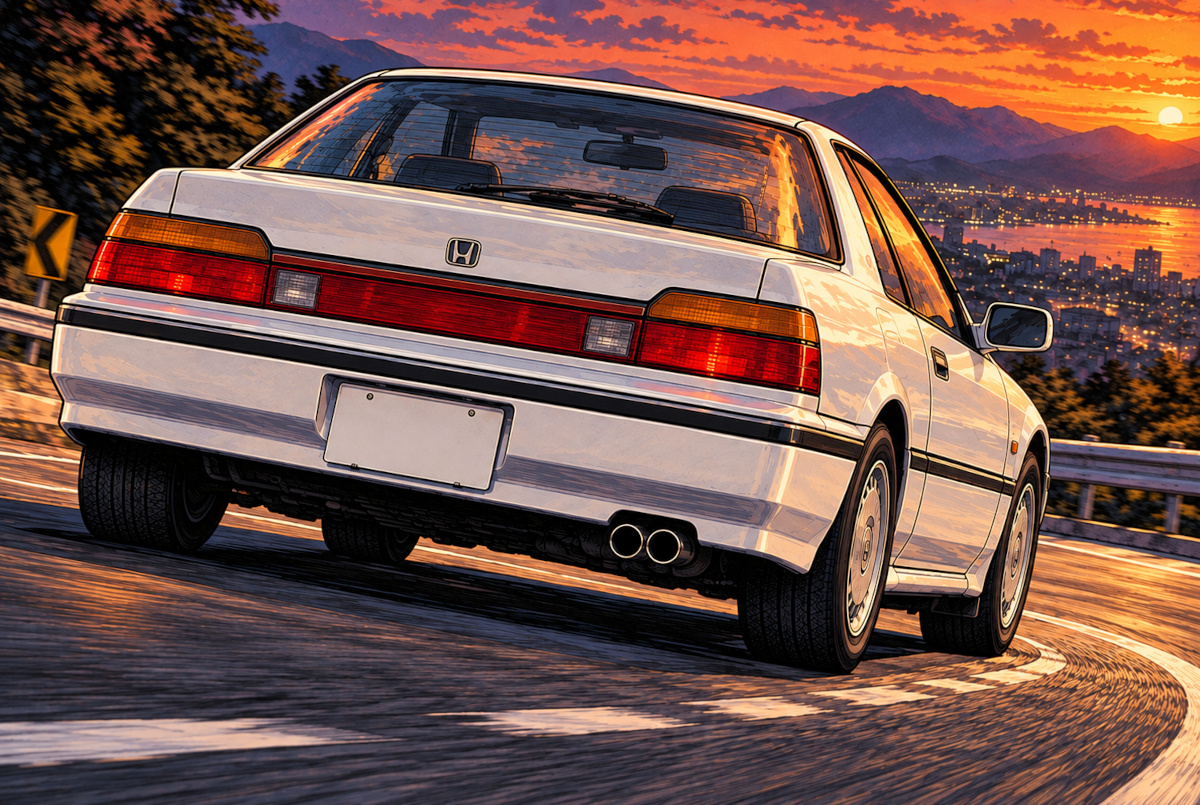
On April 10, 1987, Honda launched the third-generation Prelude in Japan. With its exceptionally low hood, elegant two-door profile, and an available 2.0-liter DOHC engine, it looked like the natural evolution of one of Japan’s most fashionable coupes.
The Prelude had already earned a reputation as a “date car” — a stylish personal coupe associated with the social and dating culture of 1980s Japan.
But the most remarkable feature of the new Prelude wasn’t its passenger seat, sunroof, or even its engine.
It was a steering system that could turn the rear wheels as well as the front ones: four-wheel steering, or 4WS.
Even more surprising, Honda didn’t use a computer to decide when the rear wheels should change direction. Instead, it developed a mechanical system built around gears and a connecting shaft.
Why would Honda put such an elaborate system into a fashionable dating coupe? The answer leads back to 1977, when the company began investigating four-wheel steering as a way to improve accident avoidance.
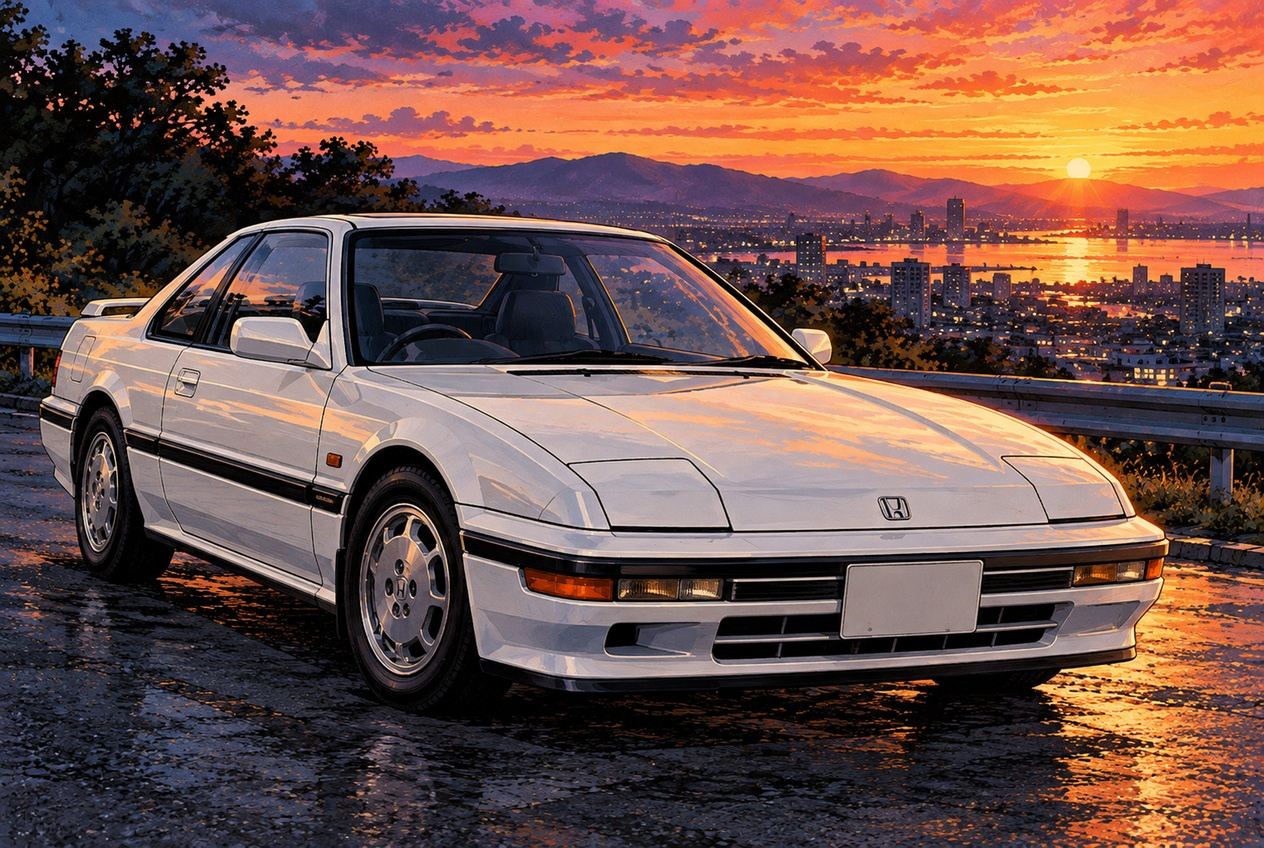
AI-generated illustration inspired by the 1987 third-generation Honda Prelude. Some exterior details, including the bumper and wheels, differ from the production vehicle.
Honda’s Original 4WS Wasn’t Simply Speed-Controlled
Four-wheel steering means exactly what it sounds like: the rear wheels can change direction in addition to the front wheels.
When the rear wheels turn in the same direction as the front wheels, the arrangement is called same-phase steering. When they turn in the opposite direction, it is called opposite-phase steering.
Four-wheel-steering systems are often explained with a simple rule: same-phase steering at high speeds, opposite-phase steering at low speeds.
That describes the intended driving behavior, but it doesn’t explain how the 1987 Honda Prelude actually worked.
According to Honda’s technical history, the mechanical 4WS system responded to how far the steering wheel was turned, not directly to the vehicle’s speed.
Small steering inputs moved the rear wheels in the same direction as the front wheels. Larger inputs eventually made them turn in the opposite direction.
The reasoning was straightforward. Drivers generally make small steering corrections when changing lanes at higher speeds, while parking and U-turns require much larger steering inputs.
Honda used that difference in typical driving behavior to achieve two different steering effects without an electronic system that selected the rear-wheel direction according to vehicle speed.
But exactly how far did the driver have to turn the steering wheel?
Honda’s technical explanation, published in 2023, gives us the numbers. We reorganized them into the following comparison.
| Steering-wheel rotation | Rear-wheel response |
|---|---|
| Approximately 120° | Maximum same-phase steering of about 1.5° |
| Approximately 230° | Rear wheels return to the straight-ahead position |
| 450° | Maximum opposite-phase steering of about 5.3° |
Note: These are steering-wheel rotation angles measured from the centered position toward one side, not the actual angles of the front or rear wheels. Figures are reorganized from Honda’s published technical explanation.
At approximately 120 degrees of steering-wheel rotation, the rear wheels reach about 1.5 degrees of same-phase steering. As the driver continues turning, they gradually return toward the center.
At around 230 degrees, the rear steering angle becomes zero. Beyond that point, the rear wheels begin steering in the opposite direction, reaching about 5.3 degrees at full steering-wheel lock.
The same car could therefore change the direction of its rear-wheel steering simply because the driver turned the steering wheel farther.
This wasn’t just a trick for making parking easier. It was an attempt to combine more responsive lane changes with better maneuverability in tight spaces.
No Electronic Rear-Steering Controller: Gears and a Shaft Did the Work
The mechanism is where the Prelude becomes genuinely fascinating.
Honda’s mechanical 4WS consisted of a front steering gearbox and a rear steering gearbox, linked by a center shaft running beneath the car.
The front used a rack-and-pinion arrangement. Steering input was transmitted through the mechanical connection to the rear gearbox, where a more unusual arrangement took over.
The rear mechanism used an eccentric shaft, planetary gearing, an internal gear, a slider, and a double-crank arrangement. Together, these components converted rotary motion into the sideways movement required to steer the rear wheels.
By carefully designing the geometry and gear relationships, Honda made the rear steering pass through its neutral position and reverse direction as the driver increased the steering angle.
No vehicle-speed sensor and electronic controller were required to decide whether the rear wheels should steer in the same or opposite direction.
The steering behavior was effectively built into the geometry of the mechanical system itself.
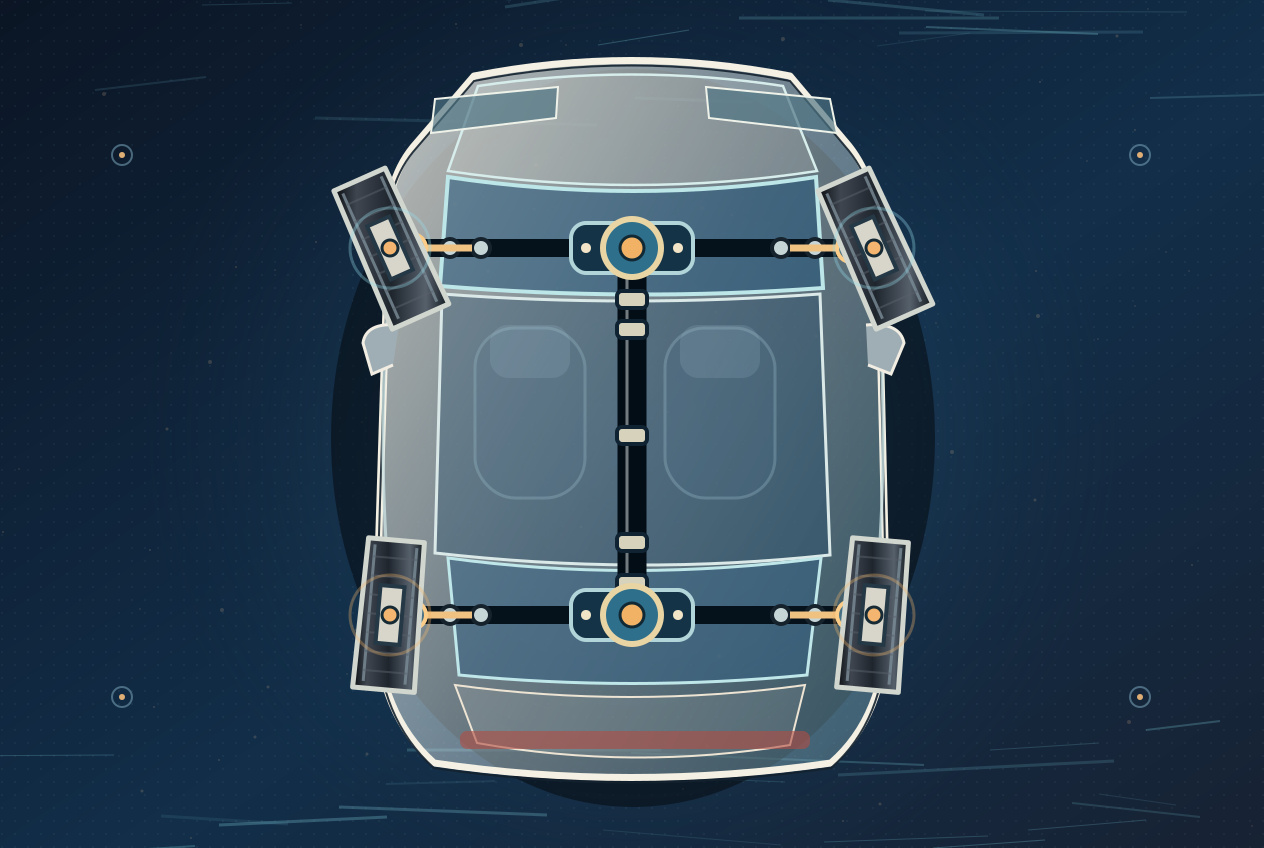
Simplified conceptual illustration of mechanical four-wheel steering. The gearbox shapes, vehicle structure, and individual wheel angles are not an exact reproduction of Honda’s production system.
For the actual steering gear layout and rear-wheel steering characteristics, see Honda’s detailed technical explanation of its original 4WS system (in Japanese).
And what did all this engineering achieve?
According to Honda’s specifications, the conventional two-wheel-steering Prelude had a minimum turning radius of 5.3 meters. The 4WS model reduced that figure to 4.8 meters.
That’s a reduction of 0.5 meters, or approximately 9.4%.
The calculation is simple:
(5.3 – 4.8) / 5.3 × 100 = approximately 9.43%.
Expressed as a turning diameter, the difference becomes more noticeable: from 10.6 meters down to 9.6 meters, a full meter less.
Of course, the actual space needed to park or maneuver also depends on body overhangs and driving conditions. The turning-circle calculation alone doesn’t describe every real-world parking situation.
Still, Honda had achieved a measurable improvement with a fully mechanical rear-steering system.
A Remarkable Technology for Just ¥80,000 Extra
Now for a detail that might be even more surprising than the gears themselves: the price.
Honda’s April 9, 1987, launch announcement listed 4WS as an additional-cost option for the 2.0XX and 2.0Si versions. It wasn’t standard across the entire Prelude range.
The extra charge was ¥80,000.
To put that into perspective, Honda’s Tokyo-area prices for five-speed manual models were as follows.
| 1987 Japanese-market model | Standard price | With 4WS |
|---|---|---|
| Prelude 2.0XX (5MT) | ¥1,820,000 | ¥1,900,000 |
| Prelude 2.0Si (5MT) | ¥2,145,000 | ¥2,225,000 |
Source: Honda’s original April 1987 Japanese launch price list. Prices are the Tokyo-area standard cash prices for five-speed manual cars, not inflation-adjusted figures.
For the 2.0XX, the 4WS surcharge represented:
¥80,000 / ¥1,820,000 × 100 = approximately 4.4% of the standard vehicle price.
That was hardly free, especially for buyers paying the full price of a new car. But it was a strikingly modest increment for an option that added a second steering gearbox, a mechanical connection running beneath the body, and the ability to steer the rear wheels.
There is one limitation to the story, however.
We could not verify a reliable sales breakdown showing how many Japanese buyers actually chose 4WS. Without an attachment-rate figure, it would be misleading to claim that four-wheel steering alone made the third-generation Prelude a sales success.
The Idea Started With Accident Avoidance, Not Dating Culture
Honda’s official development history takes the story back a full decade before the third-generation Prelude reached showrooms.
Research into four-wheel steering began in 1977, against the background of growing interest in automotive safety and programs such as the Experimental Safety Vehicle initiative promoted by the U.S. National Highway Traffic Safety Administration.
Honda’s engineers were interested in active safety: improving a car’s ability to respond quickly and predictably enough to avoid a collision in the first place.
One important problem was the delay between the driver’s steering input and the vehicle’s response. With conventional steering, the front tires begin generating the forces needed to change direction, while the rear of the vehicle follows.
If the rear wheels could also steer, Honda reasoned, the vehicle might respond more promptly and remain more stable during sudden changes of direction.
In 1978, Honda filed a fundamental patent application. In 1979, the research was presented at an international ESV conference.
Then came one of the wonderfully strange episodes in the project’s history.
In 1981, Honda tested an experimental four-wheel-steering vehicle created by joining the front sections of two first-generation Accords. The vehicle was driven at Suzuka Circuit to investigate the steering theory under actual driving conditions.
After further development, Honda announced its 4WS technology in October 1986. The production version arrived with the new Prelude in April 1987.
Roughly ten years had passed since the research began.
There is also an important distinction behind the famous “world first” claim. Honda was not claiming to have invented the entire concept of steering all four wheels.
Its achievement was bringing a steering-angle-sensing, same-phase/opposite-phase four-wheel-steering system into mass-production passenger-car use.
The fashionable coupe was therefore carrying the result of a long-running effort to improve vehicle response and collision-avoidance performance.
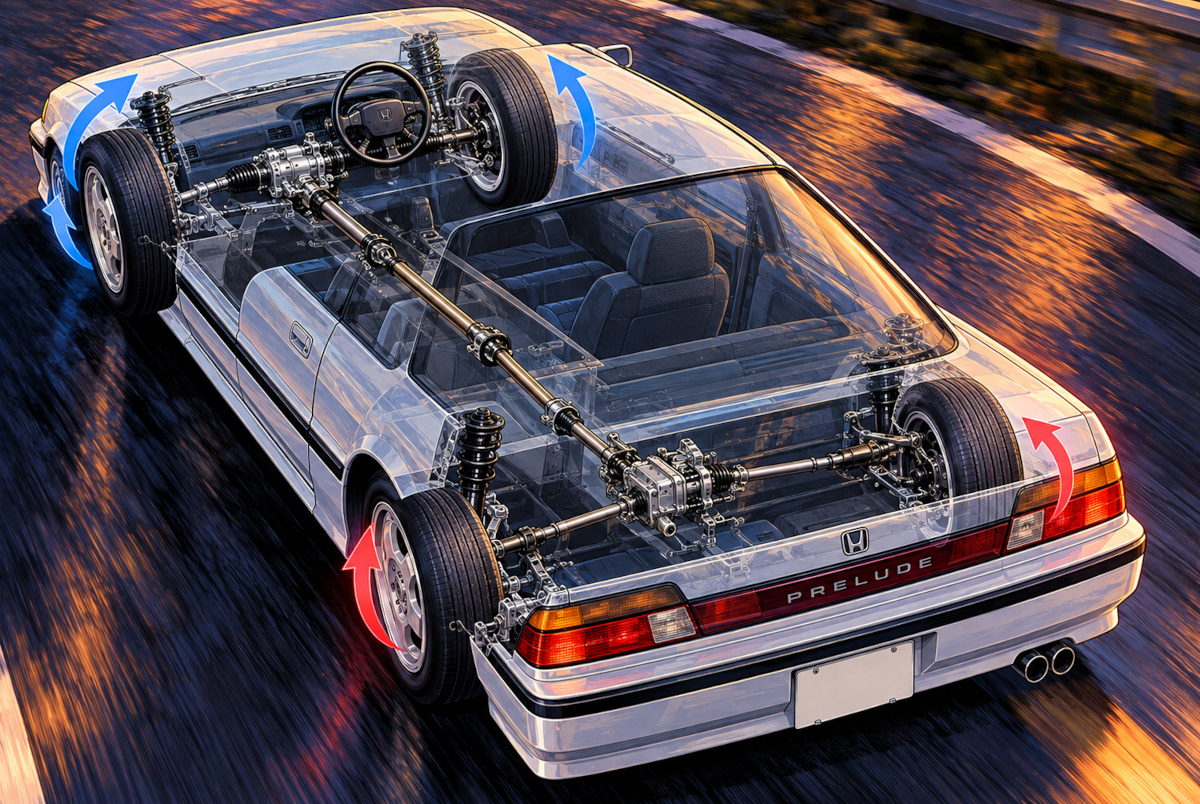
AI-generated artistic interpretation inspired by the third-generation Prelude’s mechanical 4WS. It illustrates the idea of mechanically linked front and rear steering, but the shaft routing, gearbox shapes, suspension layout, and wheel angles differ from the actual production mechanism. This is not an engineering drawing.
Lower Hood, 145 PS DOHC Power, and Double-Wishbone Suspension
Four-wheel steering wasn’t the only serious engineering hidden beneath the Prelude’s elegant bodywork.
Honda fitted every third-generation model with a 2.0-liter engine, but there were important differences between the versions.
The 2.0Si received a DOHC 16-valve engine with Honda’s PGM-FI electronic fuel injection, producing 145 PS on the Japanese net rating.
The 2.0XX, 2.0XR, and 2.0XL used a SOHC 12-valve engine producing 110 PS, also on a net basis.
So the third-generation Prelude wasn’t an all-DOHC lineup.
Nor was the DOHC engine a completely new idea for the Prelude. Honda had introduced a 2.0Si version of the second generation in June 1985, quoting 160 PS at the time.
That might seem to suggest the newer engine had lost 15 PS. But the 1987 figure was explicitly measured on a net basis, while the earlier published rating used a different measurement convention. Comparing the two numbers without accounting for the test standards would be misleading.
The third-generation engine layout also featured an 18-degree rearward tilt.
Honda used this arrangement to improve intake and exhaust efficiency while keeping the engine package compact. It also helped lower the center section of the hood by 30 mm compared with the previous generation.
The car’s overall height remained just 1,295 mm, while the aerodynamic drag coefficient was quoted as Cd 0.34.
Honda also equipped the third generation with double-wishbone suspension at both ends, a configuration that helped accommodate the rear-steering system while pursuing more precise handling.
It was a sophisticated combination: a low-slung grand-touring-style coupe with an unusually serious focus on steering response, suspension design, and engine packaging.
The Best-Selling Classic Prelude, but Only 5.2% Ahead of Its Predecessor
Now consider the sales figures.
In its October 2025 retrospective, Japanese automotive magazine CAR and DRIVER reported domestic cumulative sales of 166,904 for the second-generation Prelude and 175,634 for the third generation.
Among the original five generations, the third-generation model recorded the highest Japanese cumulative sales total.
But subtract the numbers and the margin becomes surprisingly small:
175,634 – 166,904 = 8,730 additional vehicles.
And as a percentage of second-generation sales:
8,730 / 166,904 × 100 = approximately 5.23%.
That is a very different story from the second generation, which sold roughly four times as many units in Japan as the first generation.
The third-generation Prelude didn’t create its popularity from nothing. It built on an already successful model and pushed the classic Japanese-market series to its cumulative sales peak.
These figures describe total domestic sales by generation, not the number of vehicles fitted with 4WS. They are not adjusted for differences in each generation’s production or sales period, either.
And the figures refer to the original first-through-fifth-generation series. Honda’s revived sixth-generation Prelude, introduced in 2025, belongs to a later chapter and is not part of that historical comparison.
We can’t say how many extra buyers were persuaded by the 4WS option. What we can say is that Honda gave an already fashionable nameplate a technological identity that went far beyond its dating-culture reputation.
Editor’s Note
The thing that caught my attention wasn’t just the fact that the rear wheels could turn. It was that Honda charged only ¥80,000 extra for the privilege.
Think about what had to be added: a shaft linking the front and rear steering systems, another steering gearbox, and a mechanism that could change the direction of rear-wheel steering as the wheel was turned farther.
All that engineering, sold as an optional extra. What on earth were Honda’s engineers thinking?
Then I looked at the development timeline. The work had started in 1977, long before this particular Prelude became a showroom attraction. Its roots lay in collision avoidance, not in the question of who might be sitting in the passenger seat.
That’s the part I like.
The public saw a fashionable coupe. Honda’s engineers had spent years working out how to make a car respond more faithfully to its driver, and then packed their invention beneath one of the sleekest bodies in the showroom.
To me, that contrast is what makes the Prelude special. It looked sophisticated, but its engineering could be gloriously obsessive.
Did four-wheel steering make anyone more attractive on a date? I seriously doubt there’s a meaningful statistic for that. And explaining rear-wheel steering angles over dinner probably wasn’t the most promising conversation starter.
Still, there was something wonderful about being able to drive through the city at night in a car fitted with such an unusual piece of technology.
Maybe that was the real luxury of Japan’s late-Showa-era specialty coupes: engineering that went well beyond what their owners strictly needed, simply because somebody believed it was worth doing.
In the final installment, we’ll follow what happened to the Prelude after its peak years, and examine how both the car and the culture surrounding the Japanese “date car” began to change.
Honda Prelude: Japan's 1980s Date-Car Legend $2014 Four-Part Series
From the passenger-seat lever and the second-generation Prelude's appeal to third-generation 4WS and comparisons with the Soarer and Leopard, this four-part series examines what made the Prelude distinctive.
- Part 1: Did the Honda Prelude Really Have a “Naughty Lever”? The Passenger-Seat Mystery [Part 1]
- Part 2: The ¥1.36 Million Honda Prelude Was Built to Order—So Why Did Sales Quadruple? [Part 2]
- Part 3: The Date Car That Steered All Four Wheels: Honda Prelude’s ¥80,000 4WS Secret (Part 3)
- Final Part: English edition Coming soon
References
- Honda (April 9, 1987), Japanese launch announcement for the third-generation Prelude and steering-angle-sensing 4WS — Primary source for the launch date, Tokyo-area prices, ¥80,000 4WS option, engine specifications, suspension layout, and body dimensions. In Japanese.
- Honda (September 27, 2023), “The Technology of Honda’s Four-Wheel Steering System (1987)” — Official technical history covering the mechanical 4WS layout, steering angles, turning radius, double-crank mechanism, and active-safety research. In Japanese.
- Honda Global, “Steering Angle Sensing Four-Wheel Steering System (4WS) / 1987” — Official English-language development history, including the early research, experimental Accord-based vehicle, and transition from speed-linked control to mechanical steering-angle control.
- Honda (June 20, 1985), launch announcement for the second-generation Prelude 2.0Si — Primary source for the earlier DOHC engine and its published 160 PS output. In Japanese.
- Honda, “PRELUDE: A Specialty Coupe Ahead of Its Time” — Official Japanese model history explaining the third generation’s design, low-hood engineering, and positioning of the 4WS system.
- CAR and DRIVER (October 5, 2025), retrospective comparison and drives of the Honda Prelude generations — Source of the original five generations’ Japanese domestic cumulative sales figures and contemporary retrospective assessments. In Japanese.