

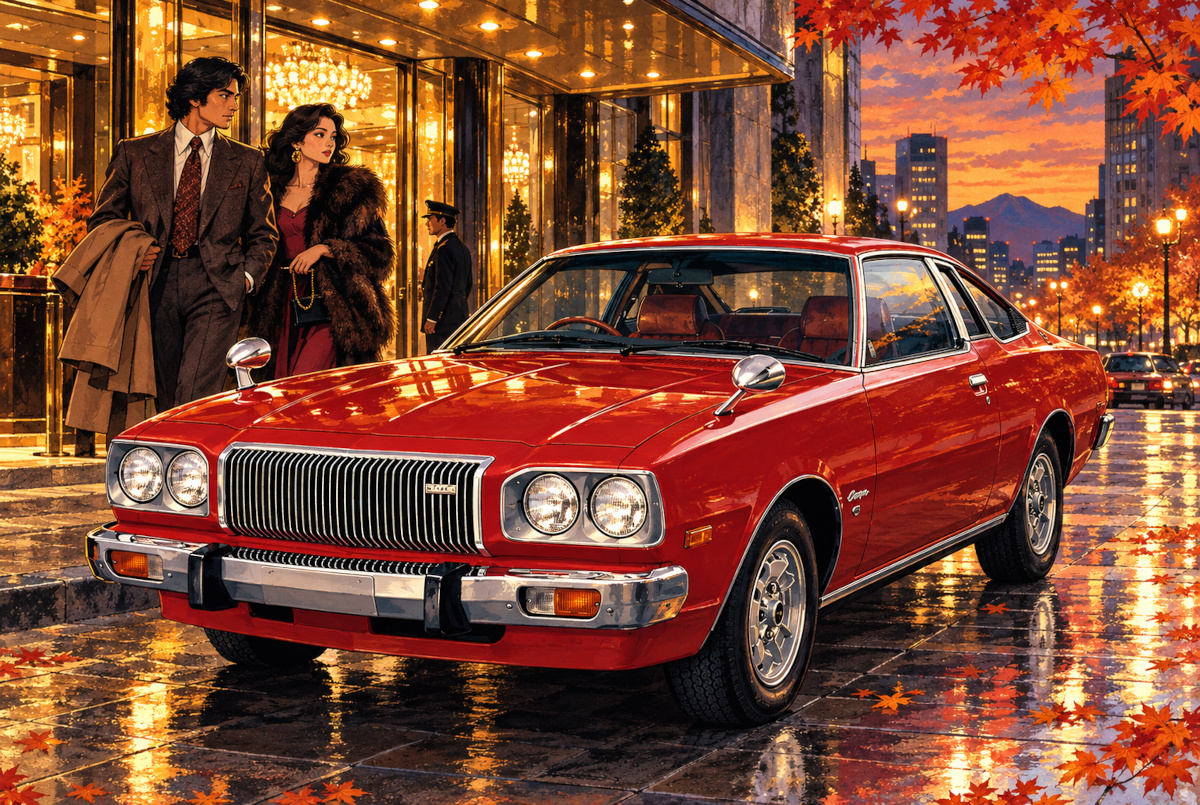
The original 1967 Mazda Cosmo Sport was a two-seat sports car that looked almost like a spacecraft. Only 1,176 were built.
Yet in 1975, the Cosmo name returned on a bright red luxury coupe. By 1981, Mazda had gone so far as to offer a four-door Cosmo. Then, in 1990, the Eunos Cosmo arrived with an extraordinary three-rotor engine producing 280 PS. Its most expensive version cost ¥5.3 million.
And that top-spec model offered something remarkable for the time: a GPS-based navigation system integrated with the car’s electronic controls.
How did a name born on an exotic rotary sports car end up attached to a luxury grand tourer? More importantly, when did the Cosmo actually become a luxury car?
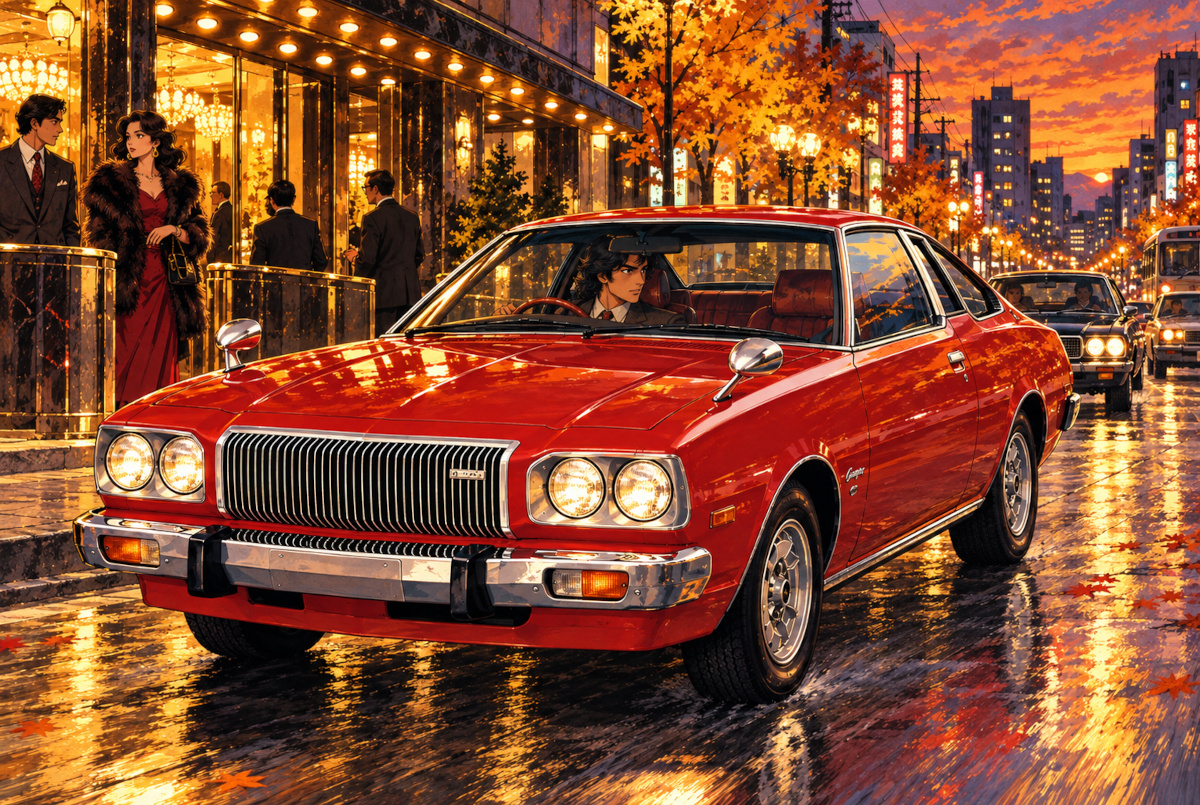
A period-inspired illustration of the Mazda Cosmo AP, introduced in 1975. The car’s overall appearance follows the early model, but some vehicle details, buildings, people, other cars and signs are artistic interpretations. AI-generated illustration.
The Answer Is 1975, Not 1990
The previous installment examined the oil crisis that pushed Mazda, then operating as Toyo Kogyo, into serious financial trouble. Right in the middle of that difficult period, Mazda introduced the Cosmo AP in October 1975.
Here’s the important part: Mazda’s own corporate history describes the Cosmo AP as a premium specialty car.
In other words, the Cosmo didn’t suddenly become a luxury model when the Eunos version appeared in 1990. That transformation had begun fifteen years earlier.
The Cosmo AP was a substantial two-door personal coupe with strong American styling influences. Its vertical-bar grille, distinctive center side window and long, elegant body were a considerable departure from the tiny, futuristic Cosmo Sport.
It was less about being a lightweight sports car and more about looking sophisticated while traveling in comfort.
A 1975 Cosmo AP Limited equipped with the 13B rotary engine produced 135 PS, accommodated five occupants and carried an original Japanese price of ¥1,795,000.
Despite its premium positioning, the Cosmo AP exceeded 20,000 cumulative sales in less than six months. That was an entirely different commercial scale from the original Cosmo Sport.
In 1977, Mazda went further with the Cosmo L, featuring a leather-covered landau-style roof designed to emphasize its upmarket character.
By this point, the Cosmo had changed from an exotic sports car built around the rotary engine into a luxury specialty coupe that could be ordered with a rotary engine.
And that last distinction matters. The Cosmo AP was also available with conventional reciprocating engines. It was not a rotary-only luxury model.
In 1981, Mazda Gave the Cosmo Four Doors
The next transformation was stranger still.
In 1981, Mazda introduced a new Cosmo family sharing its underlying architecture with the Luce, a model sold in some overseas markets under the Mazda 929 name.
The range eventually included a two-door hardtop, a four-door hardtop and a conventional four-door saloon.
Yes, the same name that once belonged to Mazda’s spaceship-like two-seater was now appearing on a four-door luxury car.
But a closer look at Mazda’s official launch chronology reveals an easily overlooked detail: the different body styles and engine versions did not all arrive at once.
| 1981 | Cosmo models introduced in Japan |
|---|---|
| September | Two-door hardtop with 2.0-liter piston engines |
| October | Four-door hardtop and four-door saloon |
| Late November | Versions equipped with the 12A rotary engine |
The new Cosmo was therefore not an all-rotary lineup from day one. The four-door hardtop initially appeared with conventional piston engines, while rotary-powered versions followed later.
The hardtop models also featured retractable four-lamp headlights, a low bonnet and a slim front grille, all intended to give the car an aerodynamically efficient shape.
Mazda published a drag coefficient, or Cd value, of 0.32 for the two-door hardtop.
That figure is often mentioned when discussing this generation of Cosmo, but it should not automatically be attributed to the four-door model. Mazda’s published figure specifically refers to the two-door body.
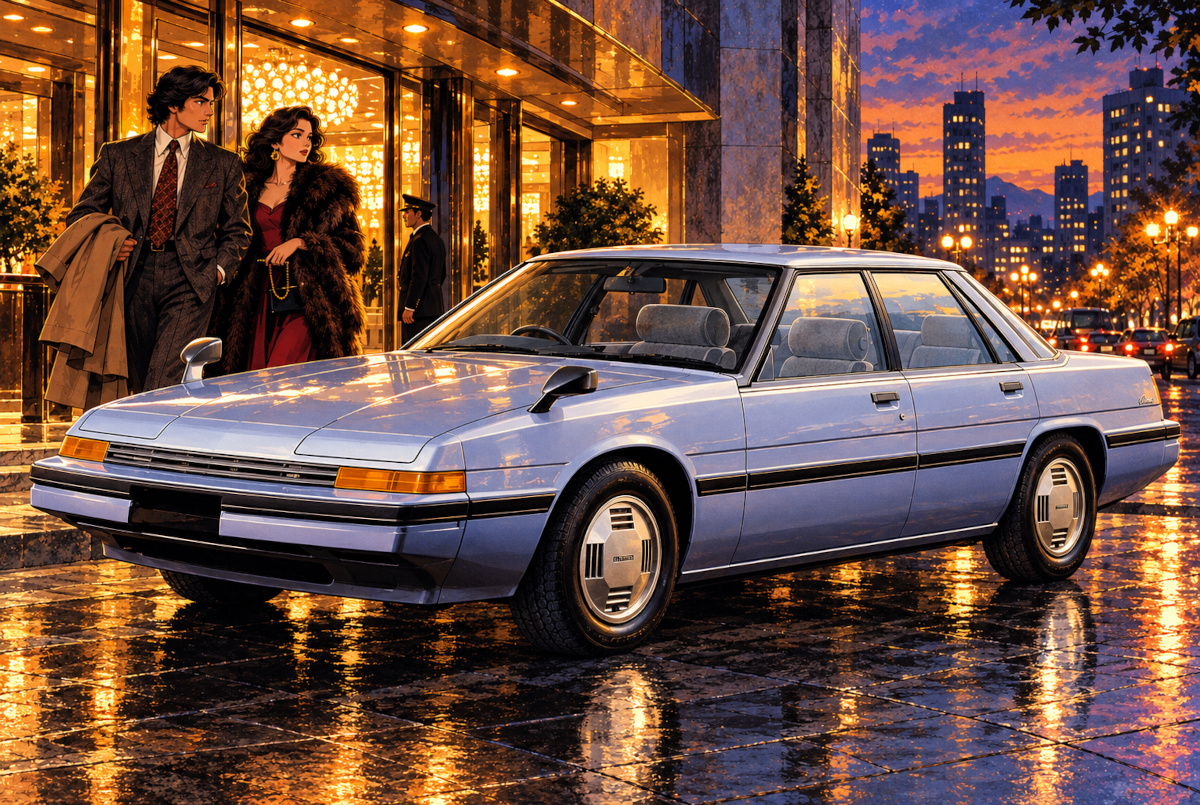
An artistic reconstruction of the Mazda Cosmo four-door hardtop introduced in 1981. The early HB-series body and retractable headlights are used as references. Smaller design details, equipment and the surroundings are not exact historical reproductions. AI-generated illustration.
In September 1982, Mazda added the world’s first production rotary turbo engine to the Cosmo range. The turbocharged 12A produced 160 PS.
So the Cosmo was still introducing serious rotary-engine technology, even as its body styles expanded into more conventional luxury-car territory.
Perhaps no other Cosmo generation stretched the meaning of the name quite as far as the 1981 model.
1990: The Cosmo Becomes a Two-Door Car Again
In April 1990, the Eunos Cosmo went on sale through Mazda’s Eunos dealership network in Japan.
The four-door experiment was over. This time, the Cosmo returned as an exclusive two-door personal luxury coupe.
Measuring 4,815 mm long, 1,795 mm wide and just 1,305 mm tall, it combined a long nose, a low roofline and a four-seat cabin with an unmistakably grand-touring character.
Two engines were offered: the twin-rotor 13B-REW and the extraordinary three-rotor 20B-REW.
Both used sequential twin turbochargers, and every Eunos Cosmo was equipped with a four-speed automatic transmission.
The 20B-REW was especially significant. Its three 654 cc rotor chambers gave it a nominal displacement of 1,962 cc, while maximum output reached 280 PS and torque peaked at 41.0 kgf·m.
It was the world’s first production three-rotor rotary-engine application, combining the unusual smoothness of a multi-rotor design with substantial turbocharged performance.
But how much did the third rotor actually buy the customer?
50% More Displacement, but Only 22% More Power?
To avoid comparing an entry-level model with a luxury flagship, let’s examine the original 1990 Type S versions of the 13B and 20B side by side.
| Specification | 13B Type S | 20B Type S |
|---|---|---|
| Number of rotors | 2 | 3 |
| Nominal displacement | 1,308 cc | 1,962 cc |
| Maximum power | 230 PS | 280 PS |
| Maximum torque | 30.0 kgf·m | 41.0 kgf·m |
| Curb weight | 1,490 kg | 1,590 kg |
| Japanese 10-mode fuel economy | 6.9 km/L | 6.1 km/L |
| Original 1990 Japanese price | ¥3,300,000 | ¥4,200,000 |
These are contemporary Japanese-market specifications. The fuel-economy figures come from Japan’s historical 10-mode test and should not be confused with modern EPA or WLTP ratings.
The most obvious difference is displacement. Moving from two rotors to three increases the nominal total by exactly 50%:
(1,962 − 1,308) ÷ 1,308 × 100 = 50.0%.
Yet maximum power rises from 230 PS to 280 PS, an increase of only about 21.7%.
Maximum torque rises from 30.0 to 41.0 kgf·m, or approximately 36.7%.
Meanwhile, the Type S price jumps by ¥900,000, an increase of roughly 27.3%.
Simply adding another rotor does not guarantee 50% more horsepower. The two engines had different operating characteristics and engineering calibrations, including their turbocharging arrangements. Rotor count alone cannot explain the performance difference.
Weight matters, too.
The 13B Type S weighed approximately 6.48 kg per PS, calculated by dividing 1,490 kg by 230 PS.
The 20B Type S improved that figure to roughly 5.68 kg per PS, despite being 100 kg heavier overall.
That is a meaningful improvement in power-to-weight ratio, although it is not a direct measurement of acceleration or lap-time performance.
But there is another side to the equation: fuel consumption.
Using the published Japanese 10-mode ratings, the 13B Type S would theoretically consume:
100 ÷ 6.9 = approximately 14.49 liters per 100 km.
The 20B Type S would consume:
100 ÷ 6.1 = approximately 16.39 liters per 100 km.
For the same distance, the 20B therefore uses approximately 13.1% more fuel under those published test conditions.
The three-rotor car offered more power, substantially more torque and a better power-to-weight ratio, but it also cost 27.3% more and consumed about 13.1% more fuel per kilometer in the official test comparison.
That is the trade-off hidden behind the simple statement that the Eunos Cosmo had a 280 PS three-rotor engine.
Why Did the Flagship Cost ¥650,000 More?
The Eunos Cosmo’s original price list reveals another curious difference.
In 1990, the 20B Type E cost ¥4,650,000. The flagship 20B Type E CCS was priced at ¥5,300,000.
That is a difference of ¥650,000, or approximately 14.0%.
What was the customer paying for?
CCS stood for Car Communication System. It brought together a GPS-based navigation function and electronic controls for systems including the audio equipment and climate control.
For 1990, this was remarkable technology. A navigation interface integrated into the car’s luxury electronics was far removed from the simple radio and heater controls found in most vehicles of the time.
But there is an important historical distinction.
The Eunos Cosmo was not the world’s first car with any form of navigation system. Honda had already introduced the Electro Gyrocator in 1981, using a gyroscopic sensor and distance measurements rather than GPS positioning.
Mazda’s pioneering achievement concerned GPS-based in-car navigation and its integration into an advanced vehicle communication system, not the invention of automotive navigation itself.
And the ¥650,000 price difference cannot automatically be called the price of the GPS unit.
It was the difference between two complete equipment grades. Without a separate contemporary option-price breakdown, attributing that entire amount to navigation would be misleading.
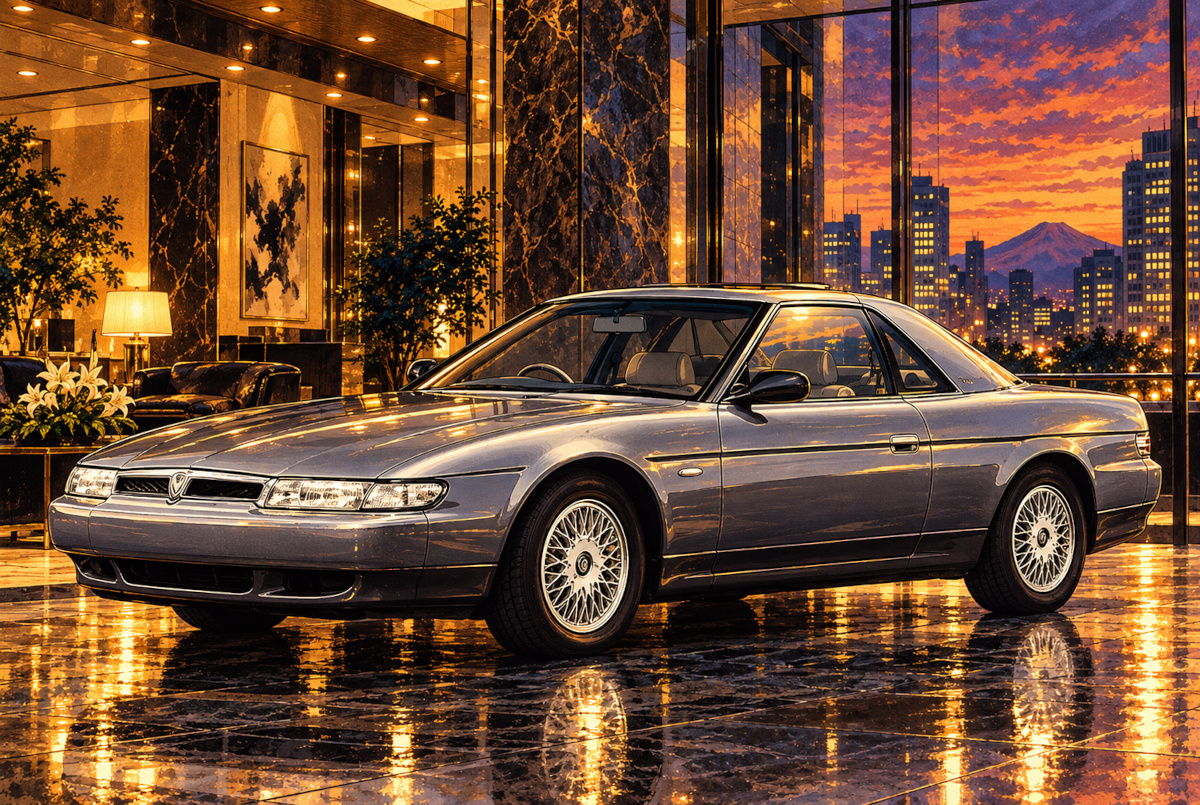
A historical-style illustration of the Eunos Cosmo introduced in 1990, inspired by the 20B Type E CCS. The exact grade cannot be established from the exterior alone. Some body details, equipment and showroom elements are artistic interpretations rather than exact reproductions. AI-generated illustration.
Inside, Mazda used premium materials including genuine leather and natural wood trim, aiming for an atmosphere that was as luxurious as the car’s powertrain was unconventional.
The result was not merely a fast coupe. It was an attempt to combine advanced rotary engineering, high performance and luxury into one very unusual grand tourer.
From ¥1,795,000 in 1975 to ¥5,300,000 in 1990
Now return to the red Cosmo AP that started this transformation.
The 1975 Cosmo AP Limited equipped with the 13B rotary engine cost ¥1,795,000 in Japan.
Fifteen years later, the top-spec 20B Type E CCS Eunos Cosmo had an original Japanese list price of ¥5,300,000.
Dividing the later price by the earlier one gives:
5,300,000 ÷ 1,795,000 = approximately 2.95.
So the advertised prices differ by almost a factor of three.
But this is a nominal-price comparison. It does not adjust for inflation between 1975 and 1990, differences in equipment, or the fact that the vehicles are not directly equivalent grades.
It would therefore be wrong to claim that the real cost of owning a Cosmo had simply tripled.
The more revealing change is what Mazda expected the name to represent.
In 1975, the Cosmo AP brought rotary performance into the world of premium personal coupes.
In 1981, the name expanded across two-door and four-door luxury body styles, including conventional piston-engine and diesel versions.
By 1990, Mazda had narrowed the concept again, creating a dedicated rotary-powered luxury coupe with a three-rotor engine and advanced onboard electronics.
The Cosmo’s move into the luxury market began in 1975. By 1990, the Eunos Cosmo had pushed that idea much further. This was not merely a car becoming more expensive; it was a name being given a succession of very different roles.
Whether the increasingly luxurious Cosmo models were financially successful is a separate question. Without reliable model-specific profitability data, their commercial return cannot be established from prices and specifications alone.
Editor’s Note
For me, the strangest part of this story isn’t the ¥5.3 million price tag on the Eunos Cosmo.
It’s the fact that Mazda turned the Cosmo into a four-door car in 1981.
Think about that. A name once attached to a tiny, spaceship-like rotary sports car ended up on a luxury four-door that could even be ordered with a conventional piston engine or a diesel.
That’s quite a stretch for a name with such exotic beginnings. You could almost accuse Mazda of having no idea what a Cosmo was supposed to be.
Then, in 1990, the company went back to two doors, installed a three-rotor engine producing 280 PS, and gave the whole thing an automatic transmission.
If outright sporting performance was the only goal, Mazda already had the RX-7. Yet here was the company building a grand tourer with leather upholstery, elaborate electronics and an engine that hardly screamed economy motoring.
Perhaps that’s what makes the Cosmo so entertaining. Mazda seems to have treated the name less as a fixed formula and more as a place to put whichever extraordinary car it wanted to build at the time.
Still, a three-rotor engine, 280 PS, a 6.1 km/L official fuel-economy rating and a ¥5.3 million flagship price? Even by the standards of Japan’s bubble-era luxury-car market, that was a wonderfully extravagant combination.
Next time, we’ll turn to the RX-7. While the Cosmo pursued luxury, the RX-7 took Mazda’s rotary technology in a very different direction: the dedicated sports car.
Terms That May Need a Quick Explanation
- Drag Coefficient (Cd)
- A dimensionless number describing how aerodynamically streamlined a vehicle’s shape is. A lower Cd generally indicates less drag for the same frontal area, but actual aerodynamic resistance also depends on vehicle size and speed.
- Car Communication System (CCS)
- An advanced onboard system offered in the Eunos Cosmo. It integrated GPS-based navigation with electronic controls for functions such as audio and climate control.
Mazda Rotary: A Seven-Part Series
From the pioneering Cosmo Sport to the RX-7 and RX-8, we trace Mazda's rotary-engine ambitions, engineering breakthroughs, commercial challenges, and the technology's eventual revival. Seven articles examine the history through original comparisons, calculations, and historical records.
- Part 1: Only 1,176 Mazda Cosmo Sports: What Was Mazda Really Building? (Part 1)
- Part 2: Did Mazda’s Rotary Engine Nearly Sink the Company? The 40% MPG Mystery (Part 2)
- Part 3: When Did the Mazda Cosmo Become a Luxury Car? From the Red AP to a ¥5.3 Million Three-Rotor GT (Part 3)
- Part 4: English edition Coming soon
- Part 5: English edition Coming soon
- Final Part: English edition Coming soon
- Special Edition: English edition Coming soon
References
- Mazda Official History — Cosmo (1975 Onward) (Japanese). Primary source for the Cosmo AP’s premium positioning, the 1981 model’s aerodynamic design, and the Eunos Cosmo’s three-rotor engine and GPS technology. Official English edition.
- Mazda Official Corporate History, 1980–1989 (Japanese). Launch dates for the 1981 two-door hardtop, four-door hardtop and four-door saloon, plus the subsequent rotary models and 1982 rotary turbo. Official English edition.
- Mazda Official Corporate History, 1990–1999 (Japanese). Confirms the April 1990 launch of the Eunos Cosmo, its powertrain and advanced navigation technology. Official English edition.
- Mazda 100th Anniversary — Eunos Cosmo (Japanese). Mazda’s account of the production three-rotor engine and the car’s premium personal-coupe design philosophy. Official English edition.
- Mazda 100th Anniversary Virtual Museum — Episode 8: Cars That Aimed for the Top During Japan’s Bubble Economy (Japanese). Describes Mazda’s upscale development ambitions, luxury interior materials and advanced electronics. Official English edition.
- Toyota GAZOO — Eunos Cosmo Historical Model Catalog (Japanese). Original Japanese-market Type S and Type E prices, engine outputs, 10-mode fuel-economy figures and equipment-grade comparisons. GAZOO organizes the earliest models under March 1990; Mazda’s official corporate history records the market launch in April.
- Nostalgic Hero — 1975 Mazda Cosmo AP Limited, Part 1 (Japanese). Specialist historical coverage of the early 13B-powered Cosmo AP, including its specifications, equipment and original ¥1,795,000 price.
- Honda Official Technology Archive — Honda Electro Gyrocator (Japanese). Documents Honda’s 1981 navigation system, which used gyroscopic and distance-sensing technology rather than GPS.